

Milestone of Internet Healthcare and a City: Why 17 Internet Hospitals Clustered in Yinchuan, Ningxia?

On December 10, 2016, Haodf.com’s Yinchuan Smart Internet Hospital officially opened.
On March 12, 2017, the Ningxia Internet Hospital, jointly established by WeDoctor and the General Hospital of Ningxia Medical University, officially opened.
On March 19, 2017, the Yinchuan Municipal Government of Ningxia launched the “Yinchuan Internet Healthcare Industry Project Signing Ceremony,” with 15 internet hospitals formally entering Yinchuan as the second batch of internet healthcare enterprises.
Thus, including Haodf Online, WeDoctor, DXY, Peking University Medical Information Technology, Chunyu Doctor, Jinglian Technology, Taoyibao, Qilekang, Giant Network Medical Division, Daxiang Doctor, Anxin Doctor, Medlinker, VYI, Haorensheng, Miaoshou Doctor, Sider Dental Hospital, and Shenghe Mobile Intelligence, thisSeventeen internet healthcare companies have successively obtained “licenses” for internet hospitals issued by the Yinchuan Municipal Government. This milestone event has propelled Yinchuan, Ningxia, to become the largest cluster of internet hospital industry in China.
Broadly speaking, the phenomena of “difficulty in accessing medical care” and “high medical costs” have become prominent contradictions in the process of economic development, driven by the insufficient supply and uneven distribution of medical resources, as well as the realities of overtreatment and the reliance on drug sales to subsidize medical services. In recent years, the state has successively introduced a series of reform measures aimed at addressing these prominent issues in healthcare. In conjunction with the “Internet Plus” strategy, the Guiding Opinions of the State Council on Actively Promoting the “Internet Plus” Action also put forward specific development goals and requirements for the healthcare sector.
Located in northwest China, an underdeveloped region, Yinchuan proposed the construction of a smart city in 2013 and has taken a leading role. As one of the second batch of pilot cities for smart city development in China, Yinchuan has focused on creating the “Yinchuan Model” of smart city development. This model is supported by business models, management frameworks, technical architectures, professional regulation, legislative safeguards, and reform and innovation, with the goals of improving management efficiency, providing convenient and beneficial services to residents, and fostering the growth of smart industries.
The smart city maturity model, based on Yinchuan, was adopted by the White House as a benchmark for smart city assessment and promoted in five U.S. cities, including Atlanta. Alongside Guiyang’s big data initiatives and Wuzhen’s internet development, Yinchuan’s “Smart City” has become a “Chinese calling card” in the era of big data.
During the development of smart cities, Yinchuan has prioritized the layout of “Internet Plus” initiatives, leveraging the internet healthcare industry as a key driver to promote the clustered development of smart industrial sectors. By establishing a national base for internet hospitals and a National Health and Medical Big Data Center, Yinchuan aims to anchor itself in Northwest China while extending its influence nationwide, thereby advancing the comprehensive development of the healthcare and wellness sector.
According to Guo Baichun, Deputy Mayor of Yinchuan City, “Supply-side reform must not only address overcapacity in certain industries but also tackle insufficient supply in others. The difficulties and high costs associated with accessing medical care are manifestations of inadequate supply in the healthcare sector. The difficulty in seeing a doctor indicates a significant overall gap between the supply and demand of medical resources. Beyond monopoly pricing driven by scarcity, the high cost of medical care is also significantly influenced by non-medical expenses arising from the uneven distribution of medical resources. For patients from central and western regions who travel to major hospitals in Beijing, Shanghai, and Guangzhou for treatment, non-medical expenses such as food, accommodation, and transportation account for approximately 30–50% of their total costs.”
The emergence of internet hospitals has effectively alleviated the long-standing challenges of difficult and expensive access to medical care. Doctors in cities such as Beijing, Shanghai, and Guangzhou have joined internet hospitals to practice at multiple sites, effectively consolidating their fragmented time and doubling or tripling the available physician resources, thereby increasing the supply of healthcare services. Meanwhile, these high-quality medical resources are extended through information technology to the central and western regions of China, where healthcare resources are relatively scarce. This has facilitated access for local residents, eliminating the need for arduous travel and reducing non-medical expenses incurred during diagnosis and treatment. Since its launch, Yinchuan Smart Internet Hospital by Haodf Online has handled over 10,000 daily consultations and diagnoses, with 43% of these cases originating from the central and western regions.
Regarding the internet healthcare industry, Yinchuan City has actively formulated relevant policies and adopted a principle of pioneering trials to encourage the coordinated development of internet hospitals and offline physical hospitals. The city aims to build medical alliances and medical consortia, foster an industrial cluster of internet hospitals, and ultimately achieve cross-regional health insurance settlement, promote the decentralization of high-quality medical resources, increase the family doctor contract signing rate, facilitate tiered diagnosis and treatment, implement drug and disease control guided by rational medication and health management, and establish big data for health and medical care. These efforts are primarily driven through three key aspects.
1. What policy support is available?
In December 2016, Yinchuan City took the lead in China by issuing policy documents such as the “Yinchuan Internet Hospital Management System (Trial),” the “Yinchuan Internet Medical Institution Supervision and Management System (Trial),” and the “Yinchuan Internet Hospital Management Measures (Trial),” which played a pivotal role in the development of internet hospitals. It also became the first provincial capital city to replace the dual licensing requirements for the establishment and practice of conventional internet hospitals with a single filing system, further expanding the scope of medical services provided by internet hospitals and simplifying the application and processing procedures for physicians’ multi-site practice across provinces.
On March 19, 2017, Yinchuan City introduced three additional policies: the “Access and Grading System for Licensed Physicians in Internet Hospitals,” the “Detailed Implementation Rules for the Administrative Measures of Internet Hospitals in Yinchuan City (Trial),” and the “Administrative Measures for Personal Medical Insurance Accounts and Outpatient Pooling in Internet Hospitals in Yinchuan City (Trial).” These measures further refined regulations concerning physician professional titles and integration with medical insurance systems.
Yinchuan City has adopted a pioneering institutional approach, collaborating with internet hospitals to develop industrial growth models by introducing a series of supportive and safeguarding policies. These measures include ensuring the legal status of electronic prescriptions, designating internet hospitals as designated providers for basic medical insurance, and incorporating online consultation fees into insurance coverage. By granting internet hospitals policy treatment equivalent to that of physical hospitals, Yinchuan aims to promote the healthy development of the industry.
“Outpatient Major Diseases” reimbursement rates are skewed toward primary care institutions, which not only promotes tiered diagnosis and treatment but also provides policy incentives for internet hospitals to control costs by delivering primary healthcare services.
It is worth noting that Yinchuan City took the lead in China by proposing the establishment of a rating system for physicians practicing in internet hospitals, replacing traditional rating criteria with practicality-based indicators. When conditions are ripe, this system will be linked to the physician professional title evaluation framework, thereby creating an equitable environment for title assessment for both online and offline practitioners and laying the groundwork for the implementation of free medical practice.
As an extension of the industrial chain and with a view to streamlining operational models, it is proposed that regulations governing the application for and issuance of qualifications for online pharmaceutical transactions be improved as soon as possible. This will assist internet healthcare enterprises in smoothly completing the necessary procedures—including applications, approvals, and registrations—required to obtain authorization for providing pharmaceutical transaction services.
It can be said that Yinchuan City’s institutional innovations and pioneering initiatives have laid a crucial foundation for the development of the “Internet + Healthcare” industrial cluster. According to Zhang Guoqing, Deputy Director of the Yinchuan Municipal Legislative Affairs Office, Yinchuan City will introduce additional policies and measures in 2017 to build an internet hospital ecosystem and support supporting institutions such as medical examination centers, surgical treatment centers, and rehabilitation and healthcare centers.
2. How to regulate in the absence of industry standards?
As an emerging entity, internet hospitals lack industry regulatory regulations and standardized norms, creating a regulatory “vacuum” that is difficult to oversee. Wang Chuan, Director of the Yinchuan Big Data Bureau, provided insights on this issue.
According to Wang Chuan, “Regulation of physical hospitals has traditionally been achieved through regular inspections and random spot checks. But how should online hospitals be regulated? In fact, internet hospitals represent a business model under the ‘Internet Plus’ initiative. The most prominent feature of these new ‘Internet Plus’ business models is that they leave digital traces online; therefore, monitoring their data enables oversight of their conduct. Moreover, online regulation allows for continuous, end-to-end supervision, which is more scientific and effective than the fragmented, discontinuous oversight typical of offline regulation. Thus, agreements have been signed with these internet hospitals, stipulating that their servers must be hosted at the Yinchuan Big Data Center and that access ports must be provided to our Big Data Bureau to facilitate real-time regulatory oversight by the Health and Family Planning Commission.”
It is evident that Yinchuan City has adopted a flexible regulatory approach by hosting the servers of all internet hospitals at the Smart Yinchuan Big Data Center and opening access ports to regulatory authorities. All data generated throughout the service process—covering medical insurance, medical services, and pharmaceuticals—as well as patients’ health records, are stored exclusively in the Smart Yinchuan Big Data Center.
By collecting, mining, and analyzing data, regulatory authorities can achieve real-time, traceable, and dynamic supervision of internet hospitals. This approach addresses challenges such as the outflow of prescriptions issued via telemedicine, medication coverage under medical insurance payments, and the difficulty in regulating telemedicine diagnostic results, thereby significantly surpassing the limited scope of physical hospitals, which typically monitor only registration and hospitalization information.
Every medical activity conducted on internet hospitals—including health consultations, clinical visits, prescriptions, pharmaceutical e-commerce transactions, specialist consultations, and follow-up visits—leaves a digital trail, allowing regulatory authorities to conduct spot checks at any time.
3. How is data shared?
In the healthcare sector, data sharing has long been a significant challenge. Yinchuan City has adopted a multi-faceted approach to data collection: first, through electronic health systems, including online platforms such as electronic health record (EHR) systems, electronic medical record (EMR) systems, electronic prescription and online physician order entry systems, telemedicine systems, prescription review and medication delivery systems, and payment and settlement systems (including insurance); second, via personal data collection using wearable devices such as smart bands, which continuously capture vital signs and transmit them to medical centers in real time; and third, through internet hospitals that connect physical hospitals, physicians, and patients, thereby enabling the integration of information, services, and data.
To this end, we aim to promote the sharing of medical big data resources, achieve comprehensive situational awareness of healthcare service operations, provide support for optimized decision-making in healthcare reform, and lay the foundation for precise, personalized health management services.
1. Preferential Policies
Tax Incentives: Provide tax incentives to attract internet hospitals to settle in Yinchuan and foster the formation of an industrial cluster.
Evaluation System: Establish a physician diagnosis and treatment evaluation system for internet hospitals, delegate the authority of physician assessment to internet hospitals, evaluate physicians’ competence based on the volume and quality of online consultations, and form an assessment mechanism;
Multi-site Practice: Simplify the procedures for physicians to practice at multiple sites, and remove restrictions on the number of practice locations and geographic regions.
Prescription Authority: Clarify the compliance of electronic prescriptions in internet hospitals, while lifting restrictions on prescription circulation;
Medical Insurance Settlement: Granting internet hospitals equal treatment for medical insurance settlement, etc.
2. Adopt a five-tier medical system
The Internet Hospital plays a pivotal role in connecting the five-tier medical system of “Smart Yinchuan.” Residents can use home health examination devices (Tier 1) to monitor 21 vital sign indicators in real time. Family contract doctors at community health service stations (Tier 2) analyze this data and provide diagnostic and treatment services. When necessary, they leverage the auxiliary diagnosis and treatment functions of the Online Hospital (Tier 3) to coordinate with local tertiary Grade A hospitals (Tier 4). Experts from the Internet Hospital provide guidance to grassroots family doctors, while patients with complex or critical conditions can receive timely consultations from off-site specialists in Beijing, Shanghai, and Guangzhou (Tier 5), invited through the consultation center. This tiered approach, based on disease severity, urgency, treatment complexity, and regional medical resource allocation, aims to alleviate the difficulty of accessing medical care.
3. Provide a physician service platform
By connecting hospitals, physicians, patients, and data via the internet, this model grants physicians authorized, on-demand access to medical information, facilitating easy retrieval of patients’ basic disease information, diagnoses, symptoms, and more. This provides greater freedom for physicians transitioning from multi-site practice to independent practice. Meanwhile, patients can leverage the service platform to seek remote medical consultations online, consult with multiple physicians, and choose those who respond most promptly or provide the most detailed and patient care, thereby gaining greater autonomy in their healthcare decisions.
1. Decentralize Medical Resources to Promote Tiered Diagnosis and Treatment
The decentralization of medical resources helps address the current challenges of difficult access to care at the primary level and congestion in major cities. The excessive concentration of medical resources is a nationwide issue in China. Through physicians practicing at multiple sites on internet hospital platforms, high-quality medical resources across the country can break through geographical barriers, achieving downward distribution and sharing of premium resources, thereby providing more channels for the diagnosis and treatment of complex and rare diseases. Online consultations via internet hospitals reduce patients’ costs in seeking medical care and medication. Meanwhile, by integrating medical resources across different tiers through medical consortia and medical alliances, patients can be guided toward tiered diagnosis and treatment. By strengthening the training and mentorship of general practitioners, improving the service capacity of primary healthcare institutions, and increasing the enrollment rate in family doctor contract services, we can solidify the foundation of primary care and effectively implement the tiered diagnosis and treatment system.
2. Curb Over-Treatment and Promote the Separation of Prescribing from Dispensing
Internet hospitals collaborate with payers (including basic medical insurance and commercial health insurance) to jointly participate in cost-containment management. By leveraging health data sharing, proactive health management guided by family doctors, and rational medication guidance, they aim to reduce overall medical expenditures through a disease-control-oriented approach. Meanwhile, internet hospitals extend their industry chain by leveraging offline resources and supplying medications at the source, thereby achieving cost containment through lower drug supply prices.
Cost containment, particularly the control of drug prices, has provided the necessary support for promoting the separation of prescribing from dispensing. Meanwhile, granting legal status to electronic prescriptions and enabling their free circulation, along with the inclusion of consultation fees in medical insurance coverage, allows online physicians to generate income primarily through clinical services rather than pharmaceutical sales, thereby further facilitating the implementation of the separation of prescribing from dispensing.
3. Promoting the Development of the Big Health and Medical Industry
At the 2017 National Health and Family Planning Work Conference, it was explicitly proposed to vigorously develop the health industry, ushering in substantial growth for all sectors related to healthcare. As a hub for the internet healthcare industry cluster, Yinchuan City, supported and safeguarded by relevant supporting policies, facilitates the construction of medical alliances and medical consortia. By integrating regional medical institution resources with the high-quality national medical resources aggregated through internet hospitals, these entities can join forces to share outcomes and benefits, thereby forming a mutually supportive rather than competitive or substitutive medical ecosystem. This approach also plays a positive role in implementing tiered diagnosis and treatment and demonstrating cost-control effectiveness.
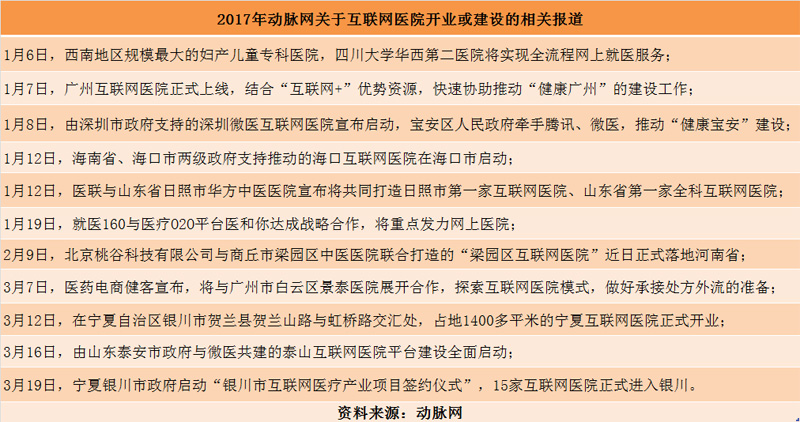
According to the “First White Paper on China’s Internet Hospitals (2016)” released by VCBeat Research, there were 36 internet hospitals in China in 2016, of which 25 had been established, and only a dozen or so were operating at scale. However, as of mid-March 2017, public searches indicated that the number of internet hospitals in China had reached approximately 60. Nearly half of these were still under construction, and the total was projected to exceed 100 by the end of the year. Following Yinchuan City’s simultaneous signing agreements with 15 internet hospitals, this figure has continued to rise substantially.
What does the future hold? There is no doubt that internet hospitals will proliferate widely; this is an indisputable fact. Since 2017, VCBeat (WeChat ID: vcbeat) has successively reported on more than ten cases of internet hospitals launching or being established. These publicly available reports represent only the tip of the iceberg of the rapid development underway in the internet hospital sector. Internet hospitals will become truly meaningful primarily in underserved and underdeveloped primary care settings. This aligns with VCBeat’s current focus on the primary healthcare sector and its ongoing preparations for the upcoming Primary Healthcare Conference. (See details:A RMB 500 billion primary healthcare industry awaits you!)
For Yinchuan, Ningxia—a city located in northwest China with a relatively underdeveloped economy and insufficient medical resources—the emergence of an internet hospital industry cluster can not only regenerate its medical resources but also optimize their allocation, thereby helping to address practical issues such as the difficulty of accessing primary healthcare services.
Beyond these immediate effects, the internet hospital industrial cluster holds immeasurable derivative value for Yinchuan. Although these internet hospitals are registered in Yinchuan, their operations serve the entire nation, generating nationwide data. Leveraging the technological foundation of Smart Yinchuan, the exponential value derived from this national-scale medical big data will be immeasurable. The mining of such medical data will directly benefit related industries, including healthcare, pharmaceuticals, wellness, elderly care, and exhibitions.
It is foreseeable that by positioning Yinchuan as a hub for the big health and medical industry cluster, leveraging the strong siphon effect of medical consortia and medical communities, and accompanied by the increasing maturity of cloud computing, big data, and artificial intelligence technologies, as well as innovations in business models, industries related to healthcare will gradually converge. This will drive the establishment and development of sectors such as health services, pharmaceutical e-commerce, rehabilitation and nursing care, healthy aging, medical informatics, sports and fitness, biotechnology, medical devices, and medical aesthetics in Yinchuan, thereby enhancing local health management standards.