Yinchuan Internet Hospital Policy Package: Essential Guide for Establishing Internet Hospitals and Multi-Point Online Practice
On March 19, Yinchuan City signed agreements with 15 internet hospitals in a single ceremony, marking a significant event in the digital healthcare sector. With the addition of previously contracted platforms such as Haodf Online and WeDoctor, the total number of internet hospitals in Yinchuan has reached 17. The influx of so many internet hospitals has established Yinchuan as China’s first dedicated hub for internet hospitals. Yinchuan’s ability to attract such a large number of internet hospital providers must stem from deeper, underlying factors.
Leveraging the policy advantages of “pilot initiatives” under the Ningxia Inland Open Economy Pilot Zone, Yinchuan has taken a national lead in smart city development. Supported by next-generation information technologies such as big data, the Internet of Things (IoT), and cloud computing, the city has built a brand-new “Smart Yinchuan.” In the recently released 2016–2017 Comprehensive Impact Assessment of China’s New-Type Smart City Construction and Development, Yinchuan was recognized as the Chinese Smart City with Best Management Practices. “Smart Healthcare” is also one of the key components of the “Smart Yinchuan” initiative.
Located in northwest China, Yinchuan is an underdeveloped region with relatively scarce medical resources. Against this backdrop, as one of the second batch of national pilot cities for healthcare reform, Yinchuan has embarked on an exploration of “Internet Plus Healthcare,” supported by big data and new Internet-based technologies, driven by policy innovation, and oriented toward improving public welfare. Through legislative safeguards and institutional reforms, it has pioneered the “Yinchuan Model” of internet-based healthcare.
Internet Hospitals Set Sail, with Policy Support as Safeguard
Previously, the operation of internet hospitals faced numerous hidden concerns, with compliance in diagnosis and treatment and the regulatory adherence of physicians’ multi-site practice being key areas of focus. As one of the first cities in China to pilot smart internet healthcare, the Yinchuan Municipal Government has introduced a series of policies to facilitate the implementation and development of internet hospitals.
In December 2016, Yinchuan City took the lead in China by issuing policy documents such as the “Yinchuan Internet Hospital Management Work System (Trial),” the “Yinchuan Internet Medical Institution Supervision and Management System (Trial),” and the “Yinchuan Internet Hospital Management Measures (Trial),” which played a pivotal role in the development of internet hospitals. Yinchuan also became the first provincial capital city to replace the dual licensing requirements for the establishment and practice of conventional internet hospitals with a single filing-based system. Furthermore, it expanded the scope of medical services provided by internet hospitals and streamlined the application and approval processes for physicians engaging in multi-site practice across provinces online. The breakthrough policies embodied in “one measure and two systems” in Yinchuan City filled the regulatory gap for internet hospitals in China.
On March 19, 2017, Yinchuan City introduced three additional policies: the “Access and Grading System for Licensed Physicians in Internet Hospitals,” the “Detailed Implementation Rules for the Administrative Measures of Internet Hospitals in Yinchuan City (Trial),” and the “Administrative Measures for Medical Insurance Personal Accounts and Outpatient Pooling in Internet Hospitals in Yinchuan City (Trial).” These measures further refined regulations concerning physician professional titles and integration with medical insurance systems.
Tian Yonghua, Director of the Yinchuan Municipal Health and Family Planning Commission, stated in an interview with VCBeat: “Internet hospitals can not only alleviate the difficulties and high costs associated with accessing medical care, but also promote the reform of China’s healthcare system. In recent years, various regions have been exploring the separation of prescribing from dispensing. Yinchuan has taken a leading role nationwide in piloting internet hospitals. In addition to the ‘two systems and one measure’ introduced last year, this year our Commission collaborated with the Big Data Bureau to strengthen the construction of an online regulatory system, enabling full-process supervision of internet hospitals. Moving forward, the Yinchuan Municipal Health and Family Planning Commission will coordinate with departments such as the Municipal Development and Reform Commission to introduce policies supporting the development of ancillary institutions, including third-party testing centers, treatment (surgical) centers, and rehabilitation and healthcare centers, thereby building a comprehensive ecosystem for internet hospitals.”
Yinchuan Policy Introduction
Basic Operational Systems for Internet Hospitals — "Yinchuan Internet Hospital Management Work System"
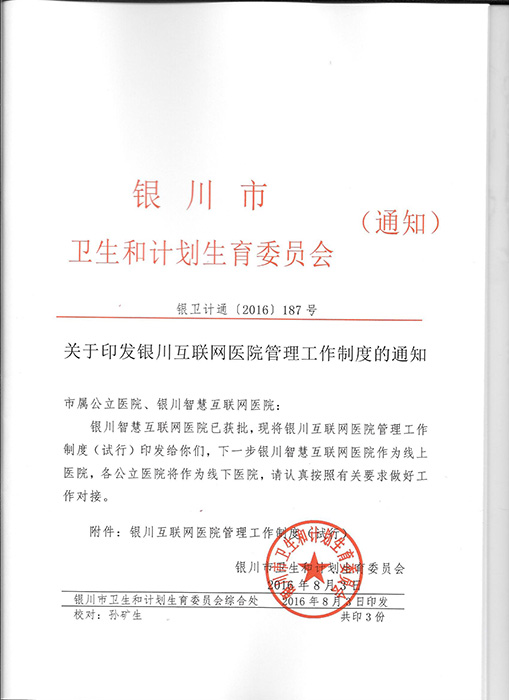
This is the Internet Hospital Management Work System formulated by Yinchuan City, representing the most critical document in internet hospital management. It stipulates the operational standards that must be adhered to during internet hospital operations, online physician consultations, and prescription issuance. The full text spans 73 pages and provides a detailed exposition of various rules and regulations governing internet hospital operations across five key areas: routine medical management, physician management, medical record management, pharmaceutical care management, and information security management.
This “Policy” first standardizes the pathways and processes for internet-based diagnosis and treatment. It sets forth regulations for various care-related activities, including patient–provider matching, online consultations, online appointment scheduling, online referrals, online laboratory testing, remote consultations, reporting of special cases, online coordination of hospital admissions, offline specialist care, issuance of electronic prescriptions, and antimicrobial drug management. While these clinical practices are already familiar to physicians in offline settings, the Policy provides detailed provisions on how hospitals and physicians should operate in the online environment, specifying the required workflows and applicable restrictions.
Secondly, this policy addresses the unique characteristics of online medical consultation models by standardizing requirements for both patients and healthcare providers regarding account management, evaluation systems, multi-site practice procedures, privacy protection, and medical record management.
Third, comprehensive management and emergency response procedures shall be established to address information security in internet hospitals. This section constitutes a substantial portion of the regulatory framework, spanning more than 30 pages.
Management Framework for Internet Hospitals—“Yinchuan Internet Hospital Management Measures”
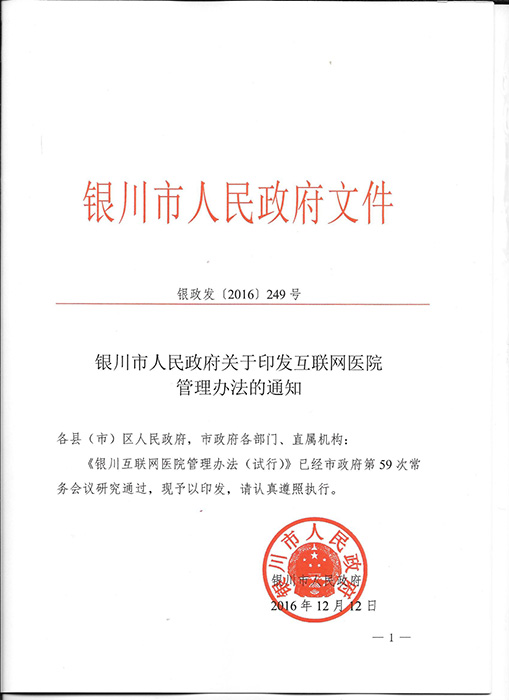
This nine-page document, the "Yinchuan Internet Hospital Management Measures," specifies the regulatory authorities for internet hospitals, the scope of medical services provided by medical institutions, and their corresponding liabilities. In other words, the "Measures" outline the permissible and mandatory responsibilities of internet hospitals and physicians practicing at multiple sites, thereby safeguarding the security of online diagnosis and treatment activities.
The Measures stipulate that the municipal health and family planning department is responsible for the primary regulation of internet hospitals; the municipal development and reform department is responsible for supervising and inspecting medical service prices and drug prices; the market supervision and administration department is responsible for the quality management of drugs in internet hospitals; the human resources and social security department is responsible for the alignment and administration of medical insurance policies for internet hospitals; and the Administrative Approval Service Bureau is responsible for the filing of internet hospitals and the registration of their physicians. The Measures also require internet hospitals to promptly transmit and back up relevant data to the Smart Yinchuan Big Data Center, and to accept routine supervision and management by the Health and Family Planning Commission and other relevant departments.
Supervision Methods for Internet Hospitals — "Yinchuan Supervision and Management System for Internet Medical Institutions"
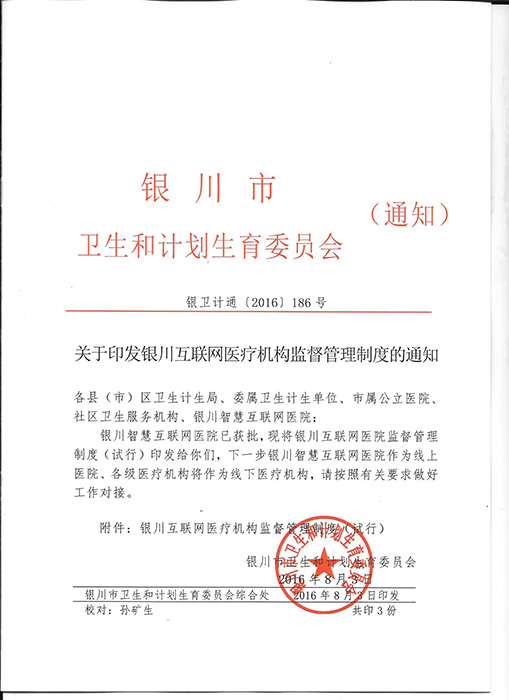
The “Regulations” stipulate that the Yinchuan Administrative Approval Bureau is the approving authority for internet medical institutions in Yinchuan City, responsible for approving such institutions within its administrative jurisdiction and reviewing the registration and qualifications of their personnel. This has been the issue of greatest concern to professionals in the internet healthcare sector in recent days. Given the inherent risks associated with internet-based diagnosis and treatment, the Yinchuan Municipal Health and Family Planning Commission has formulated detailed supervisory measures for internet hospitals.
Must-Read for Internet Hospital Applications: “Detailed Implementation Rules of the Yinchuan Internet Hospital Management Measures”
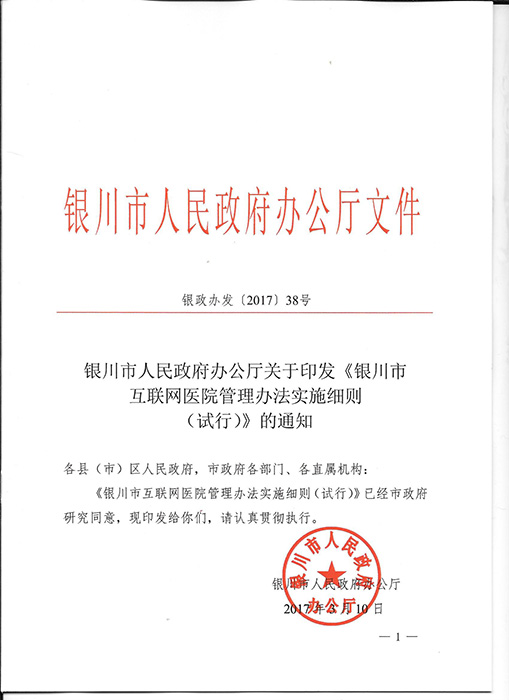
For enterprises seeking to apply for an internet hospital license in Yinchuan, the Detailed Rules contain a great deal of highly important information. The preceding three documents were issued in 2016, whereas these Detailed RulesAfter a period of operation at the Yinchuan Internet HospitalIt was issued, providing clarifications on certain issues arising during the approval process for new internet-based medical institutions. For instance, the Detailed Rules specify in detail the procedures and documentation required for enterprises applying to establish internet-based medical institutions, as well as the requisite formalities for physicians and pharmacists practicing online at internet hospitals registered in Yinchuan City.
The Detailed Rules propose two categories of internet hospitals: the “Internet + Medical Services” model and the “Medical Institution + Internet Technology” model. The first type operates without an offline physical medical institution; it primarily leverages internet technology platforms to deliver “Internet + Medical Services” and collaborates with various offline physical medical institutions. This model is exemplified by Haodf Online’s internet hospital and is adopted by the majority of internet hospitals involved in this signing. The second type, the “Medical Institution + Internet Technology” model, relies on offline public medical institutions to establish distinct single-entity physical medical institutions. It uses these newly established physical entities as a foundation to provide medical services through internet technology, as demonstrated by WeDoctor’s Ningxia Internet Hospital.
The Detailed Rules stipulate that all internet hospitals approved in Yinchuan must host their servers at the Smart Yinchuan Big Data Center to facilitate regulatory oversight. For internet hospitals established by offline physical hospitals, the number of beds in the affiliated physical hospital shall be no fewer than 20 and no more than 100. The Detailed Rules also incorporate certain provisions from the Access and Rating System for Licensed Physicians in Internet Hospitals, mandating assessment and management of physicians. Notably, one provision links the rating of internet hospitals to professional title evaluation and appointment, aiming to attract more outstanding physicians to practice in internet hospitals. When applying for senior professional titles (associate senior level and above), physicians may include their online diagnosis and treatment records and rating levels as part of their personal performance achievements submitted to the Municipal Health Series Senior Professional Title Review Committee. Physicians practicing in the internet healthcare sector who are rated as Expert-Level Physicians (Level 1) shall receive additional points during position appointment by their offline employing institutions, with priority given under equal conditions.
A Benefit for Yinchuan Residents—“Administrative Measures for the Use of Personal Medical Insurance Accounts and Outpatient Pooling Funds in Yinchuan Internet Hospitals”
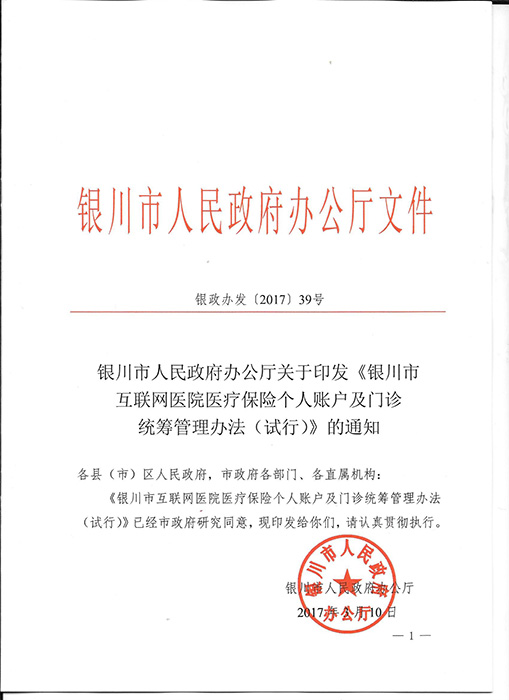
This is the most significant document released by the Yinchuan Municipal People's Government at this conference. Starting from March 19, residents of Yinchuan can have their medical expenses incurred at internet hospitals reimbursed through basic medical insurance. Patients can not only use the personal account of their medical insurance to pay for consultations but also have these expenses included in the outpatient pooling fund for proportional reimbursement. According to the Measures, insured individuals can directly use their medical insurance personal accounts to pay for online consultation fees. Furthermore, online consultation fees that fall within the scope of the "Three Directories" of basic medical insurance are eligible for reimbursement. This means that services such as text-and-image consultations, telephone consultations, disease counseling, remote consultations, and medication purchases provided by internet hospitals in Yinchuan are now covered by medical insurance in the same manner as visits to physical hospitals. The funds required for the online outpatient pooling will be drawn from the outpatient pooling funds of both employee basic medical insurance and urban and rural resident basic medical insurance. Previously, across China, the primary approach to managing medical insurance for internet hospitals was limited to payments via personal accounts; including them in the outpatient pooling fund sets a new precedent.
During the pilot phase, the Yinchuan Municipal Human Resources and Social Security Bureau imposed certain restrictions on the use of medical insurance in internet hospitals. First, geographic restrictions apply. The personal account portion of the employee medical insurance for all of Yinchuan City can be used for registration and consultations at internet hospitals, and to pay for medical expenses. However, the outpatient pooling fund is currently being piloted only among insured employees and residents in the three districts under municipal jurisdiction. Second, institutional restrictions apply. Currently, outpatient pooling benefits are available exclusively through the Haodaifu Yinchuan Smart Internet Hospital. Third, provider-level restrictions apply. Consulting physicians must hold the title of Associate Chief Physician or higher. Fourth, monetary caps apply. The annual payment limit from the urban and rural resident medical insurance pooling fund is RMB 50, while the annual payment limit from the employee medical insurance pooling fund is RMB 120.
Online Assessment of Licensed Physicians — "Access and Rating System for Licensed Physicians in Internet Hospitals"
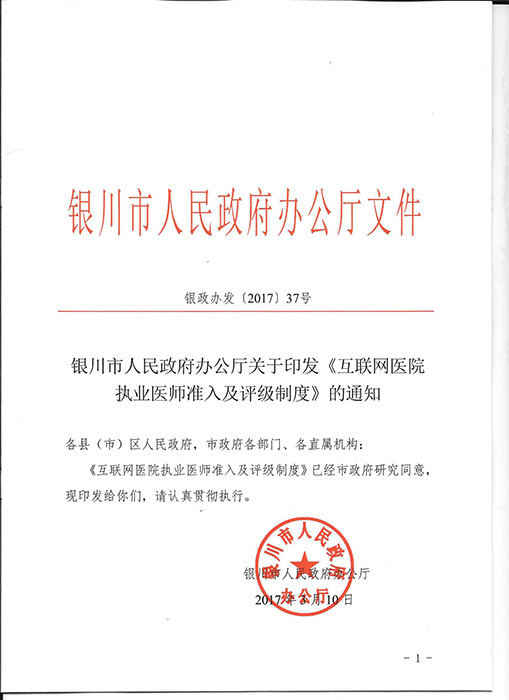
To enhance the quality of online diagnosis and treatment services provided by licensed physicians in internet hospitals, standardize their professional conduct, Yinchuan City has recently released the "Access and Grading System for Licensed Physicians in Internet Hospitals." The system clearly stipulates that licensed physicians certified to practice in internet hospitals must meet the following criteria: For online diagnosis and treatment, physicians must have obtained their physician qualification certificate, possess at least five years of offline clinical work experience, and hold an intermediate professional title; the medical services provided by physicians through internet hospital platforms must align with their registered scope of practice and technical expertise; they must obtain corresponding prescription privileges within the internet hospital; and they must demonstrate strong professional competence and ethical standards.
The Regulations stipulate the rating management system for licensed physicians practicing in internet hospitals. The primary rating indicators include eleven assessment criteria, such as the number of online consultations and treatments conducted, participation in online academic exchanges, provision of disciplinary training, and online patient satisfaction evaluations. Physicians who score below 70 points in the annual assessment will not be assigned a rating. Those scoring between 70 and 80 points with at least six months of registration are classified as Junior Physicians (Level 3); those scoring between 80 and 90 points with at least one year of registration are classified as Intermediate Physicians (Level 2); and those scoring above 90 points with at least two years of registration are classified as Expert Physicians (Level 1). The Regulations further stipulate that practicing physicians who receive scores below 60 points for two consecutive years and remain unrated shall be advised to withdraw from the internet hospital platform.
Click Here, download the complete set of Yinchuan Internet Hospital policies. Meanwhile, here is a preview: Wang Hang, pioneer of the Yinchuan Internet Hospital and Founder & CEO of Haodf Online, will conduct a group interview on VCBeat on March 23 to interpret issues and developments related to Internet Hospitals that concern you.