

Exclusive Interview with One of China's First Physicians Using IBM Watson: AI's Four Clinical Applications and Two Key Limitations
In another article by VCBeat (WeChat ID: vcbeat), titled “Practical Survey of Watson for Oncology: Serving Over 10,000 Patients, Partnering with Dozens of Hospitals, and Delivering Three Major Benefits,” we presented the implementation of artificial intelligence from a corporate perspective. To more accurately reflect the real-world deployment of AI,VCBeat interviewed Dr. Gu Xidong, an attending physician in the Breast Surgery Department of Zhejiang Provincial Hospital of Traditional Chinese Medicine and one of the first doctors in China to use Watson, to explore how artificial intelligence has transformed his work.。
Zhejiang Provincial Hospital of Traditional Chinese Medicine is a Grade III Class A hospital and the first in China to establish a Watson Joint Consultation Center. The hospital has currently set up corresponding outpatient hours for the cancer types supported by Watson for Oncology. Gu Xidong holds a Ph.D. in Clinical Surgery of Integrated Traditional Chinese and Western Medicine. He currently serves as an attending physician in the Department of Breast Surgery at Zhejiang Provincial Hospital of Traditional Chinese Medicine, Secretary of the Surgical Branch of the Zhejiang Association of Chinese Medicine, and Young Committee Member of the Oncology Branch of the Zhejiang Association of Chinese Medicine.
Gu Xidong told VCBeat that he was first exposed to artificial intelligence through the media. In recent years, there have been numerous media reports on AI. Coincidentally, in late 2016, the Zhejiang Provincial Hospital of Traditional Chinese Medicine planned to introduce Watson for Oncology and establish a Watson Multidisciplinary Consultation Center. As a result, Watson for Oncology was first implemented in the Breast Surgery Department of the Zhejiang Provincial Hospital of Traditional Chinese Medicine. Gu Xidong is among the first batch of doctors in China to use Watson.Since January of this year, we have served dozens of patients with the assistance of artificial intelligence and conducted multiple Watson multidisciplinary consultations.。
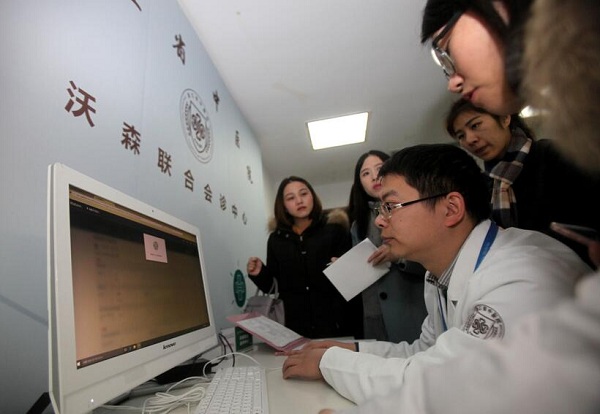
Dr. Gu Xidong Uses Watson to Analyze Patients' Conditions
# The Four Major Uses of Watson as Perceived by Physicians
Gu Xidong stated in an interview with VCBeat that cancer treatment emphasizes early diagnosis and early intervention. Therefore, Watson can play a significant role in managing patients diagnosed at an early stage and enhance the effectiveness of long-term cancer therapy. Below is a summary compiled by VCBeat of how Watson has assisted Dr. Gu Xidong in his clinical practice.
Watson’s first application: leveraging evidence-based research to select the optimal treatment plan. Taking breast cancer as an example, for patients with early-stage breast cancer, attending physicians can confidently identify appropriate treatment plans based on their experience; at this stage, Watson can provide relevant clinical evidence-based research to support the physicians’ treatment decisions.
However, for patients with complex conditions, such as those with advanced-stage breast cancer, a multidisciplinary team (MDT) consultation may be required. During the MDT discussion, specialists from different disciplines may have varying assessments of the same patient’s condition, leading to different treatment recommendations. This discrepancy does not indicate that any specialist’s judgment is incorrect; rather, it reflects differences in perspectives stemming from their respective areas of expertise.
In the past, people tended to trust authority in such situations. Now, with Watson’s multidisciplinary consultation, physicians from various specialties can discuss cases based on Watson’s recommendations. Each recommended treatment plan is supported by evidence, such as survival rates and the risk of severe adverse drug reactions. Physicians can evaluate this information through discussion to select the optimal treatment strategy.
Watson’s Second Application: Reducing Physicians’ Misdiagnoses. The precision of cancer treatment is paramount; an inaccurate diagnosis can not only adversely affect the subsequent progression of the disease but also lead to irreversible outcomes. Numerous objective factors contribute to misdiagnosis, which should not be attributed to a lack of diligence on the part of physicians. Nevertheless, it is undeniable that physician fatigue often plays a significant role. Typically, a specialist holds outpatient clinics for only half a day or one full day per week, during which they must consult with 20 to 30 patients. Furthermore, specialists at university-affiliated hospitals are also required to teach and supervise students at the academic institution. As human beings rather than machines, physicians cannot maintain peak mental alertness at all times.
Furthermore, tumor lesions themselves exhibit a wide variety of pathological types and sizes, making it difficult to establish uniform diagnostic criteria. Physicians often face dilemmas when making assessments, ultimately arriving at what they deem the most appropriate conclusion; however, this conclusion is not always entirely accurate.
In such cases, patient information is input into Watson. As an AI system, Watson does not suffer from fatigue and evaluates data from multiple perspectives. Therefore, its recommended treatment plans can serve as a reference for physicians, enhancing diagnostic accuracy, while its medication guidance helps prevent overmedicalization.
The third application is to provide doctors with new treatment plans as a reference.. Medical research literature and technologies are constantly and rapidly evolving, requiring physicians to engage in continuous learning and professional development to enhance their expertise. However, many doctors lack the opportunity, time, or channels to access the latest information. Watson is an artificial intelligence system with autonomous learning capabilities that stays abreast of the most recent global treatment protocols. When managing patient cases, it can propose novel therapeutic approaches unfamiliar even to physicians and make subtle adjustments to existing regimens, all of which serve as valuable references and learning resources for clinicians.
As the world’s most authoritative “oncology expert,” Watson can assist physicians in making diagnoses and alleviate patients’ concerns.
The fourth use is to assist in the training of young physicians., while every specialist physician is tasked with mentoring students, their heavy workload makes it impossible to provide timely answers to students' questions. By leveraging Watson, young physicians can readily access necessary information such as clinical consultations, drug dosages and rationales, and adverse drug reactions. This approach saves specialists' time and enhances the efficiency of physician training.
Challenges Facing Watson
Gu Xidong told VCBeat that the presence of Watson has indeed been helpful to us. Currently, Watson serves patients through a multidisciplinary consultation model, with fees adjusted according to those of the hospital’s multidisciplinary consultation center.In addition, Gu Xidong also stated that not all doctors are supportive of Watson; some remain cautious about the application of AI technology in medicine.
Regarding Watson's shortcomings, Gu Xidong statedFirst, Watson itself is positioned as a tool to assist physicians and cannot be adjusted to address the real-life circumstances of patients.Recommendations can only be made based on objective pathological indicators, but the situation of tumor treatment is very complex.The optimal treatment regimen is not necessarily the one acceptable to patients., in many cases, physicians still need to adjust treatment plans based on the patient’s actual condition and persuade and reassure the patient, which Watson is incapable of doing.
Second,Watson is currently unable to integrate traditional Chinese medicine with Western medicine.. Gu Xidong stated that traditional Chinese medicine (TCM) is gradually gaining recognition, and some Chinese doctors incorporate TCM principles to varying degrees when managing patients. Currently, Watson does not possess such capabilities; while localized adaptations cannot be ruled out in the future, at present, physicians can integrate their own experience and judgment with Watson’s recommendations to provide patients with the most reliable and reasonable treatment plans and conditioning regimens.