

Orbita Files for IPO: Smart Voice Startup in Digital Health Prioritizes Business Logic Over Technology
Many internet healthcare entrepreneurs in China ultimately aim to dominate both upstream and downstream segments, forcibly transforming their companies from internet IT firms into medical service operators, thereby turning their target customers into competitors. In contrast, Orbita aspires to be a connector.
Orbita is a U.S. startup that has introduced smart voice technology into the digital health sector. The company made appearances at both CES in January 2017 and HIMSS17 in March 2017. Its platform is available on Amazon Echo smart speakers and supports smart voice systems from Google, Apple, and Microsoft. Founded in February 2015, Orbita secured $1.7 million in seed funding at its inception. After more than a year of development and preparation, the company officially launched its product in December 2016, meaning the product has been on the market for only about three months.
Drawing on the experience accumulated by current entrepreneurs in the digital health sector, healthcare services involve the interconnection and mutual influence of multiple stakeholders, including consumers, healthcare providers, payers, and traffic channels. Orbita appeared more mature than previous startup teams from its inception, demonstrating an adeptness at addressing the interests of various stakeholders. Currently, companies leveraging intelligent voice technology in the digital health space remain scarce. Orbita aims to seize this first-mover advantage, designing its products and services from the outset with a business ecosystem mindset. Let us jointly analyze Orbita’s strategic approach.
"User Incentives as the Core Value"
The founding team members of Orbita primarily have backgrounds in software products focused on customer experience management. They believe that intelligent voice assistants, chatbots, and other conversational customer interaction interfaces are transforming this field. Notably, intelligent voice assistants and chatbots optimize the human-computer interaction interface by leveraging conversation as a key modality to enhance the efficiency and effectiveness of user communication, ultimately achieving better user engagement. This model is currently referred to as “conversational commerce.” According to Gartner’s predictions, 30% of web or mobile browsing sessions would be conducted via voice by 2020, and Gartner listed conversational systems as one of the top ten strategic technology trends for 2017. Orbita aims to provide solutions tailored to the new changes in digital strategy for various stakeholders in the healthcare vertical, including establishing enterprise-level solutions that further strengthen digital engagement, and building next-generation management platforms capable of developing and managing intelligent voice modalities.
How can AI-powered conversational systems effectively enhance user engagement? This question is clearly of significant importance. Orbita provides a sample human–computer dialogue script, using patient medication reminders as an example, as shown below.
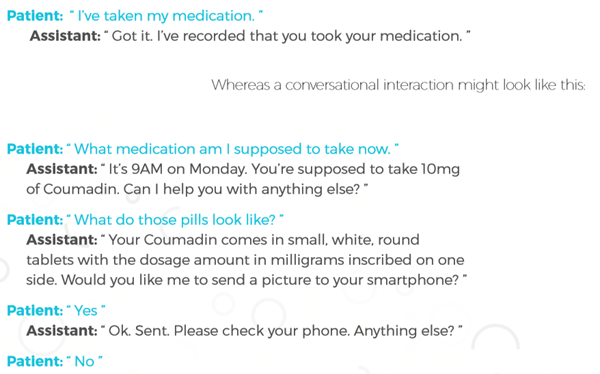
Medication Management via Intelligent Voice
From the above script, we can see that human-computer interaction under the new model can at least possess the following new capabilities:
Instant Query.By integrating multiple factors such as time, location, and individual circumstances, the chatbot provides more relevant and efficient instant query capabilities. In this example, the bot automatically confirms the time without requiring explicit input from the user, immediately returns the medication type, and also provides dosage instructions. Furthermore, when the patient could not recall the specific medication, the bot described the physical characteristics of the pill.
Proactive Inquiry.Unlike traditional human-computer interaction, chatbots can also proactively follow up with users by asking further questions when appropriate. In this example, the bot actively asks the user whether they would like to send an image for comparison. This is a feature that has been difficult to achieve in previous human-computer interaction interfaces.
Automatic recording.Many health apps in the past required users to meticulously log details such as diet, exercise, and medication. The traditional text-based input method was cumbersome and difficult to sustain on a daily basis. In contrast, the bot model eliminates the need for manual entry; users simply convey information through conversation, and the bot handles data recording in the background. In this example, when the user informs the bot that they have taken their medication, the bot automatically logs the data in the background.
Although it is a very niche application area, looking back at our past experiences with apps, seemingly simple human-computer interaction operations can become significant barriers to maintaining user stickiness. In the medical field, patient medication adherence and patient education are also key areas for user engagement. Orbita aims to use artificial intelligence technology to design a new human-computer interaction experience, truly improving outcomes.
In addition, special groups such as the elderly, children, and individuals with disabilities face greater barriers to using human-computer interaction systems that have historically required users to accommodate machine limitations; therefore, they are in greater need of human-centered interactive interfaces.
In February 2017, Orbita launched Orbita Engage™, a SaaS solution for user engagement.
Positioning Connectors
Many domestic internet healthcare entrepreneurs ultimately aim to dominate the entire value chain, forcibly transforming their companies from internet IT firms into medical service operations entities, thereby turning their target customers into competitors. In contrast, Orbita positions itself as a connector. It does not directly serve individual consumers (C-end) nor provide medical services directly; instead, it offers intelligent solutions to various stakeholders in the healthcare industry. These stakeholders include: healthcare providers, home care agencies, healthcare payers, corporate employers, pharmaceutical/biotechnology companies, and hardware device manufacturers. The figure below summarizes the target users of each solution category and their corresponding core functional values, based on information from Orbita’s official website.
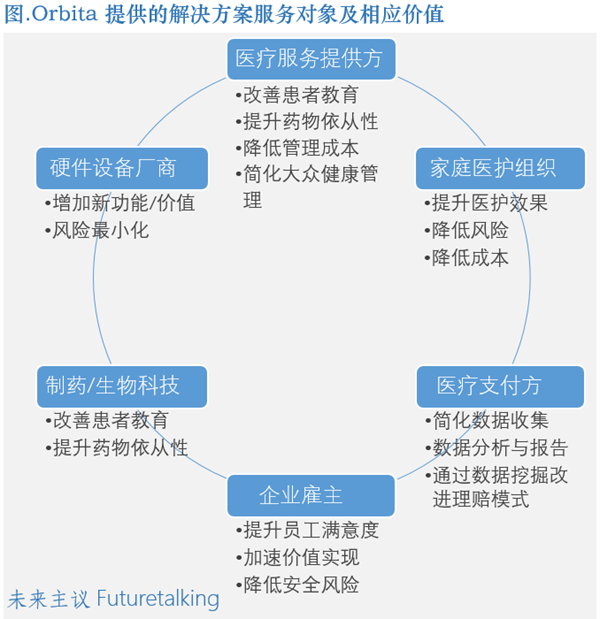
It is evident that Orbita has strategically positioned itself as a partner to all stakeholders within the existing commercial ecosystem, aiming to integrate its solutions throughout the healthcare services industry. On one hand, Orbita reaches consumers through solutions embedded in smart hardware terminals; on the other, it assists healthcare providers and home care organizations in connecting with and managing patients. By leveraging more effective data collection methods, Orbita provides payers, such as health insurance companies, with an additional tool for data collection, mining, and analysis. Meanwhile, it also addresses employee health management for corporate employers, who play a significant role as payers in the U.S. healthcare system. Furthermore, Orbita’s value proposition aligns with the focus of pharmaceutical and biotechnology companies on improving medication adherence and enhancing patient education outcomes.
For a startup whose product has been on the market for only three months, it is not yet possible to analyze its true value through in-depth application cases. What we can currently observe is the design philosophy behind its product architecture. The figure below shows the cloud-based enterprise service platform architecture provided by Orbita.
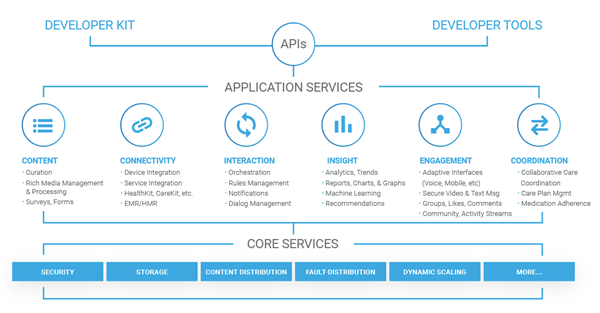
Orbita Health Cloud Platform Architecture
In China, there are already numerous companies offering intelligent voice technology solutions; however, none have yet emerged that focus exclusively on the healthcare vertical with comprehensive, in-depth specialization. I provided a brief analysis of China’s commercial ecosystem for intelligent voice technologies in my previous article, “A Preliminary Analysis of China’s Intelligent Voice Commercial Ecosystem.” In fact, vertical solution providers like Orbita do not need to possess their own speech recognition or other foundational artificial intelligence technologies. Instead, they concentrate their core competencies on clarifying the business logic of healthcare services, thoroughly dissecting and understanding business requirements and knowledge graphs, as well as integrating and leveraging related technologies such as intelligent voice systems, instant messaging tools, and natural language understanding.
Seizing the Smart Voice-Enabled Home Scenario
In December 2016, Orbita was first integrated into Amazon Echo smart speakers upon its official product launch. In addition to supporting Amazon Alexa, Orbita also supports Google Home, Apple Siri, and Microsoft Cortana. Subsequently, in February 2017, Orbita announced a partnership with Lenovo Health regarding smart speakers, with both parties preparing to jointly build voice-based home chronic disease management and post-diagnosis care services in the healthcare sector. In the context of smart voice-enabled home scenarios, smart speakers are arguably the most important hardware terminal; however, applications for accessing healthcare services through smart speakers remain largely undeveloped. Nevertheless, eager market participants have already begun taking action. For instance, in March, WebMD, known for its health information and data integration capabilities, launched an Amazon Alexa skill that allows consumers to query health information on WebMD via voice commands.
It is important to note that hardware terminals supporting intelligent voice capabilities are not limited to smart speakers; they can also include smartphones, wearable devices, home medical equipment, and other smart hardware. Furthermore, voice interaction is an optional rather than a mandatory mode. Apart from voice, Orbita can still utilize text-based chatbots for interaction.
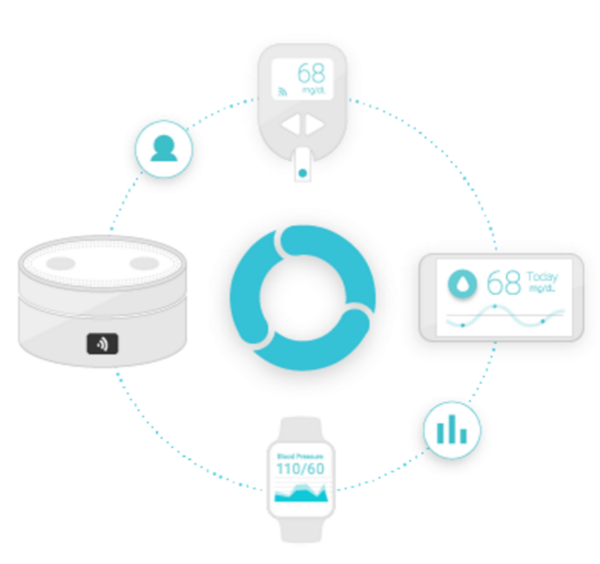
Orbita Aims to Connect Various Smart Terminals
Trials Starting from Appointment
Leveraging its smart voice integration interface, which is already on standby, healthcare providers can utilize Orbita’s solutions to create various patient engagement capabilities, such as scheduling medical appointments or sending medication reminders. Orbita is currently conducting a pilot program with the non-profit healthcare organization Commonwealth Care Alliance (CCA). CCA provides community-based health services to its members, including Personal Care Attendants (PCAs). However, coordinating between supply and demand has traditionally been complex, with cumbersome processes for hiring caregivers, scheduling, and tracking. The experimental project between CCA and Orbita aims to streamline the PCA appointment process through smart voice interactions. This initiative will cover at least 100 CCA members, ultimately analyzing whether the smart voice model effectively enhances user engagement and satisfaction in this application.
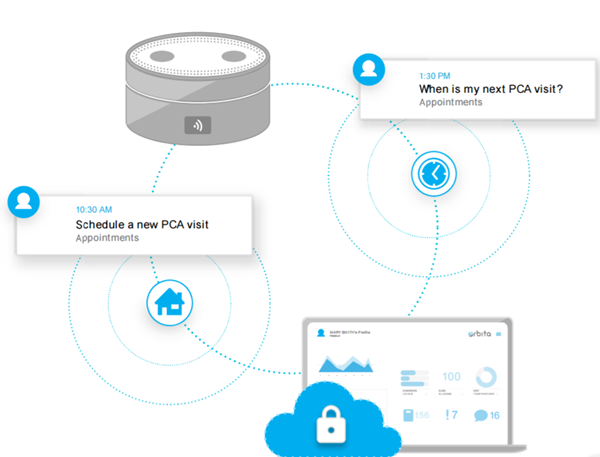
Orbita Partners with CCA to Improve Private Caregiver Scheduling
We all agree that the core components of healthcare delivery remain offline. Beyond enabling remote communication, data processing, and certain patient self-management activities, facilitating appointments for offline services constitutes a crucial aspect of digital health’s online offerings. Such appointment scheduling requires matching provider capabilities with patient demands while adhering to constraints such as time, location, and payment coverage. Many mobile health platforms we are familiar with essentially focus on efficiently matching supply and demand to optimize the allocation of medical resources. Therefore, appointment scheduling is evidently a key element of the online service experience. It is thus understandable that Orbita initiated testing of its personal care appointment functionality at the early stage of its product launch. Ultimately, Orbita aims to become a strategic partner for healthcare providers, facilitating a more efficient connection between the supply and demand sides of medical resources than ever before, thereby easing the burden on providers and enhancing satisfaction among patients.
An increasing number of innovative companies are attempting to integrate artificial intelligence (AI) technology into the digital health sector. Currently, both the technology and the ecosystem can be described as immature, and their true value remains to be verified. However, when the dust finally settles and the truth is revealed, will there still be a role for us? Last August, I published an article titled “Are Chatbots Interesting in the Medical and Health Sector? And in What Way?” which provided the first analysis combining chatbots with innovation in the medical field. Following its publication, aspiring entrepreneurs asked: “By entering the mobile health sector with chatbot-based products, can newcomers surpass established players like Chunyu Doctor?” This question cannot be answered with a simple yes or no. However, one thing is clear: internet entrepreneurs in the medical and health sector and AI technology entrepreneurs are seeking opportunities for synergistic collaboration. As for how to create stronger sparks from this collision, we need both greater courage and more patience. Analyzing pioneers like Orbita is an excellent approach that offers significant insights. The healthcare industry has its unique characteristics, with entrenched traditional forces. Orbita’s choice to act as an enabler within the existing ecosystem, rather than a disruptor, is undoubtedly worth considering for medical entrepreneurs.
By Gu Beini, Co-founder of VCBeat; personal WeChat official account: Future Talking (futuretalking)
For more articles by this author, please seeGu BeiniColumn
Further Reading:
“Will Intelligent Virtual Assistants Change the Fate of Chronic Disease Management Apps?”
“Are Chatbots Making Waves in Healthcare and Wellness, and What Exactly Does That Mean?”
“A Brief Analysis of China’s Intelligent Voice Business Ecosystem” (Please view this article on the WeChat official account “futuretalking”)