

Why Are We Growing More Anxious After Three Years in Digital Health Entrepreneurship?
About ten years ago, I shared a dormitory room at the Computer News office with Li Datao, founder of VCBeat, and co-founder Lao Bi (Bi Yuanfeng) for nearly two years.
In Lao Bi’s words, “That age is the best time to make close friends.” Later, Da Tao went to Beijing, and we would meet every year to drink, chat, and discuss our aspirations in life.
The outcome of our conversations always ends up being: “Let’s do something together.”
For instance, we once considered using our pens to document the lives of ordinary people, creating a modern-day ukiyo-e. Deeply influenced by traditional literati, we have always harbored the desire to change the world through writing. Therefore, before adopting the name “VCBeat,” we initially intended to call it “Pencil Stub.” To this day, the master folder on my computer for VCBeat-related files is still named “Pencil Stub.” Later, a media outlet named “Pencil Road” emerged; they were diligent in their work, and we greatly admired them.
In 2014, Datao and I finally settled on the direction of “Internet + Healthcare.” Subsequently, we brought in Benny (the story of how the three of us first met is detailed in another article), a close friend we had known for over ten years. In 2015, Old Bi joined, marking the official completion of VCBeat’s founding team.
Then we officially fell into the “super pit” of healthcare.
Our Intellectual Roots
Many people may not realize that Chongqing is an anomaly in the media industry. In hubs like Beijing, Shanghai, and Guangzhou, where star media outlets frequently emerge, few are aware that Chongqing is home to several media organizations ranked number one nationwide. Leading the pack is Computer World News (Diannao Bao). Its founder, Chen Zongzhou, began popularizing computer knowledge in the early 1990s, when most people across China had never even seen a computer. He built a vast media empire whose peak performance rivaled that of China’s top-tier media outlets such as Caijing.
Chen Zongzhou embodies a defining characteristic of Western media: pragmatism, accessibility, and specialized expertise in vertical domains. Much of the professionalism and diligent, grounded approach advocated by VCBeat originates from this foundation.
Another defining characteristic is that, although based in western China, its vision is fixed on the global forefront. After launching Computer News, a remarkably forward-looking media outlet, Chen Zongzhou went on to publish the Chinese edition of Scientific American, titled Global Science—a premier popular science magazine with a history spanning over 170 years and three centuries. Most inspiring is the fact that Chen Zongzhou continued to embark on new ventures even after turning 70. On the very second day after Tencent officially released its Mini Programs, he called me to discuss their application scenarios and compare their advantages and disadvantages with native apps. We talked for nearly an hour.
In addition to Computer News, Chongqing is also home to media outlets such as Micro Computer, which was the top-ranked magazine during the IT era. Liu Dong, a content partner at VCBeat, and Liu Zongyu, a senior editor, both hail from this publication. Liu Dong and Liu Zongyu often say that producing subpar articles feels worse than swallowing flies. Their rigorous approach to content is intimidating.
Chongqing is also home to Business Review, a business magazine that currently boasts the highest circulation in China. It is arguably the media outlet with the richest resources of high-quality small and medium-sized enterprises (SMEs) in the country, as well as the most adept at telling compelling business stories. Luo Mei, a senior journalist at VCBeat, began her career there.
Actually, Chongqing is home to several media outlets that rank first nationwide—or even far ahead of the competition—in their respective vertical sectors. I’ll just keep those to myself.
VCBeat ultimately chose to base its content team in Chongqing. This decision is tied to our understanding of the essence of healthcare (though I will not admit it has anything to do with housing prices), and it also explains the sense of apprehension we have mentioned. The healthcare industry is highly specialized; given the high turnover rate in Beijing, where staff often change annually, it is difficult to cultivate a truly professional team. This is precisely where western China-based media outlets hold an advantage. (If you don’t mind, let me take this opportunity to promote VCBeat: We welcome professionals from Beijing, Shanghai, and Guangzhou to join us in Chongqing. Here, you’ll enjoy clean air, a positive work atmosphere, affordable housing, and good-looking colleagues.)
We Have a Very Cosmopolitan Worldview
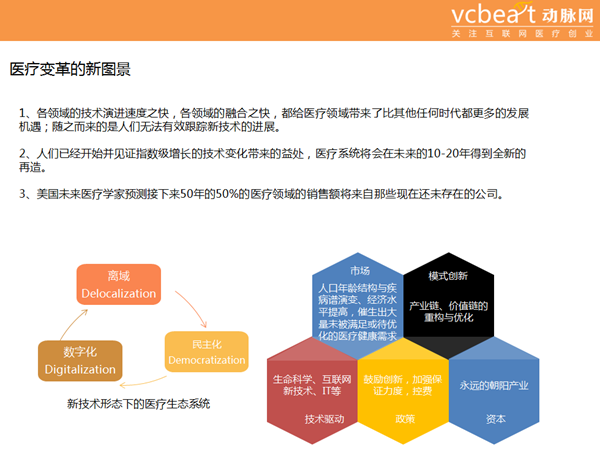
Our Worldview: How We See the Future of Healthcare.
Although we describe ourselves as a low-budget version of the “Chinese Partners” and arguably fit the stereotype of the “Three Treasures of the Underdog,” we still employ a rather sophisticated methodology. This primarily stems from our founder, Da Tao. Our philosophical framing of healthcare is entirely derived from Da Tao’s insights:
The emergence of every revolutionary foundational technology triggers a reallocation of factor resources and reshapes social institutions. Throughout each grand historical evolution, a cohort of great recorders and thinkers arises. The IT era has generated unprecedented wealth, freedom, and the popularization of knowledge. IT media outlets such as Wired and Computer News crafted grand narratives heralding the advent of a new civilization, influencing generations while also delivering substantial returns to their institutional investors.
From a medical perspective, the practice of diagnosing and treating patients was initially associated with “shamanism,” imbued with the primordial ignorance of early civilization and regarded as a sacred activity. It was not until the 19th century, with the establishment of the modern medical system, that medicine truly entered a phase of rapid development. Clearly, the healthcare industry is closely intertwined with advancements in technology and evolving cognitive frameworks, and it has never experienced decline.
Of course, uncertainty remains the norm in healthcare, and a complete understanding of the essence of life is still immeasurably distant. The current relatively closed landscape calls for new technologies, concepts, and disruptors to break through traditional barriers and establish a new order.
Identifying these pivotal forces reshaping the healthcare landscape, providing support, and growing together—this is VCBeat’s worldview and its founding mission. Since its establishment in 2014, this core principle has remained unchanged.
Building upon this worldview, we have further developed our own: we firmly believe that our value stems from serving the industry and facilitating its growth.Practices such as writing defamatory PR articles, attacking competitors, and charging for negative coverage are not services we endorse. We take this opportunity to reiterate this core value and urge certain individuals to cease attempting to induce or challenge our principles with improper incentives.
As entrepreneurs, we deeply understand the challenges inherent in corporate growth and hold profound respect for the value that entrepreneurs create. Behind every great enterprise lies a story of hardship; Steve Jobs was once ousted from his own company by its board, Jack Ma faced repeated setbacks in Beijing, and Pony Ma considered selling his company on multiple occasions. The trajectory of corporate growth is, in itself, a tale of struggle and resilience. Therefore, we are committed to viewing the ups and downs of a company’s development through a forward-looking lens and with an eye toward the future, offering whatever support we can provide.
We have a rigorous methodology.
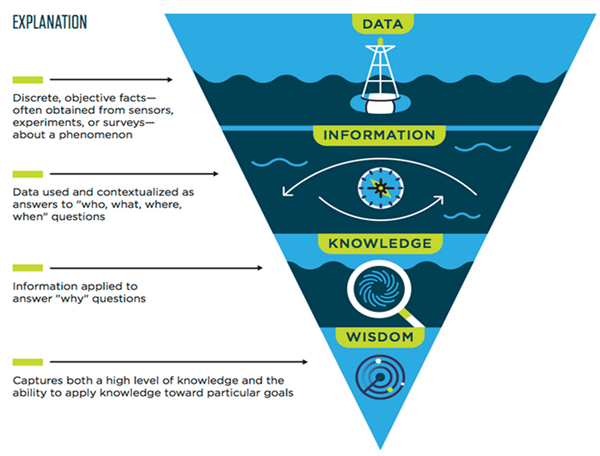
Our Methodology: The World Through the Eyes of Editors
Many readers and friends describe VCBeat as “professional.” This is both a source of pride and a cause for deep apprehension. The notion of professionalism, after all, depends largely on its scope and stage of applicability.
For instance, during the early boom of internet healthcare, many professors from Tsinghua University, Peking University, and Cheung Kong Graduate School of Business cited data and reports from VCBeat. This does not imply that VCBeat is more professional than these esteemed academics; rather, it highlights that VCBeat addressed areas that had previously gone unnoticed. Here, I wish to discuss VCBeat’s methodology.
Our core methodology for content creation is derived from the Pyramid Model proposed by Harvard Business School, with Data at the base, followed by Information, then Knowledge, and topped by Wisdom. From a single news event, we can uncover the business logic and strategic judgments behind a company’s actions; through big data analysis, we gain a comprehensive view of specific sectors; and by leveraging historical insights alongside an understanding of current events, we develop the ability to forecast future trends. In an era of information overload, where the line between truth and falsehood is increasingly blurred, VCBeat serves as a screener and filter for information.
In reflecting on ourselves, we recognize that we are currently still largely at the Information stage, occasionally reaching the Knowledge stage, with the goal of advancing to the Wisdom stage. This aligns with the concerns I mentioned earlier: we feel our professional expertise is still relatively weak and requires further strengthening. Such enhancement demands experience and time. We aim to transform VCBeat’s journalists and analysts into experts, which necessitates the accumulation of many years of experience.
At this level, we also need more experts and true professionals to provide guidance. Fortunately, we do have many such good friends around us who are silently helping VCBeat learn and grow.
We Hold Unfashionable Values: Putting in the Hard, Grunt Work
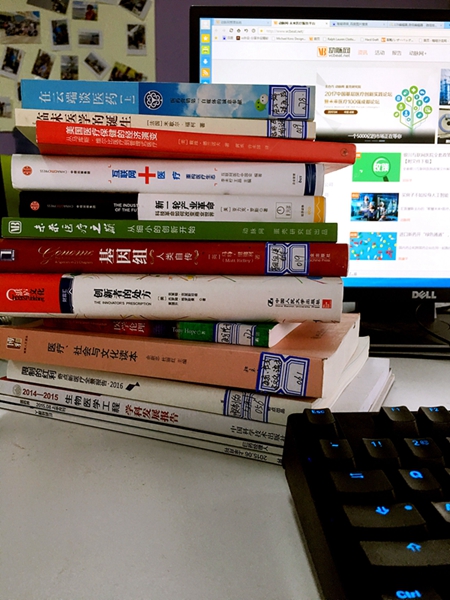
Before writing an article, it is necessary to consult a considerable amount of reference material.
Industry insiders observed that the distinctive qualities presented by VCBeat began with its report, “Deconstructing Chunyu Yisheng.” The project involved over 20,000 physicians, each assessed across 15 dimensions, yielding approximately 300,000 data points. Nine team members spent one month manually entering, cleaning, and tabulating the data before completing the writing. In just two months, this willingness to invest “labor-intensive effort” resulted in a nearly 100-page report.
What I wish to share are the stories behind these reports.
In December 2014, the first report on internet healthcare enterprises, “Deconstructing Chunyu Yisheng,” was released. This report took nearly two months to complete. There were several moments when I considered giving up or simplifying the work, but I ultimately pushed myself to finish it.
In July 2015, the first industry-specific report, the special report on “Medical Imaging,” was released. At that time, nearly the entire team at VCBeat, though still small, was mobilized for the project. They conducted interviews with dozens of domestic and international companies, gathering primarily first-hand data unavailable elsewhere in the market. Beini holed up in a hotel for several days to write the report, avoiding going out for fear of being disturbed.
In March 2016, the first trend report in the cardiovascular field, “Analysis Report on Intelligent Cardiovascular Hardware in China and Abroad,” was released. The preparation of this report spanned nearly six months, involved three team members, and required the collection of extensive materials before the final manuscript was completed.
In April 2016, the inaugural comprehensive report, “VBInsight Quarterly Report on Future Healthcare Venture Capital,” was released. The entire VCBeat team dedicated three months to its production, compiling an exceptionally vast volume of data that pushed the researchers to their limits.
In September 2016, the first report on AI + Healthcare, titled “2016 Report on Innovation Trends in Artificial Intelligence for Healthcare,” conducted timely interviews with AI companies both domestically and internationally. At that time, there were relatively few domestic enterprises, and the primary application scenarios originated from abroad. Due to the scarcity of available data, an edited version was released to facilitate better understanding of the report.
In November 2016, VCBeat’s VBInsight and Tencent Research Institute jointly released the “White Paper on China’s Internet Hospitals 2016,” which for the first time clearly defined the standards and models for internet hospitals, becoming a reference model for many researchers studying internet hospital models.
However, this intensive effort has not ceased. In the first quarter of 2017, VCBeat will also complete in-depth reports on primary healthcare, chain clinics, and internet hospitals. To date, VCBeat has covered more than 14 specialized medical sectors; published over 40 industry trend reports; and reported on more than 1,500 healthcare startups, with an exclusive first-report rate exceeding 60%.
"So impressive, why still feel apprehensive?"

The specialized nature of medicine fills us with trepidation.
The healthcare sector is incredibly complex! The more we delve into this field, the more apprehensive we become, as we constantly encounter an ever-growing array of unknowns:
First, insufficient professional knowledge: The field of medicine is vast and profound, with a long-standing academic heritage. Upon entering the healthcare sector, one finds that even a master’s degree is often inadequate; after joining this industry, we have come to know more individuals with doctoral degrees than those with master’s degrees we knew previously.
Second, insufficient industry knowledge: The healthcare industry chain is extremely complex and cannot be simply explained by TMT or O2O models. It spans from medical practice to pharmaceuticals, insurance, policy, and social ethics, and cannot be wholly addressed by the internet alone.
Third, we still do not have enough partners. The healthcare industry is a long-term endeavor. All models focused on quick profits, fabricated transaction volumes, or achieving valuations of hundreds of billions within a few years are difficult to realize in this sector. It requires patience, composure, the courage to persevere, and the wisdom to endure. This necessitates friends, resources, and mutual growth.
Although VCBeat has amassed a follower base of over 300,000 in the industry, covering the largest communities of healthcare entrepreneurs, investors, and supply chain professionals, our relationships remain insufficiently close, our engagement is not strong enough, and our knowledge and resource sharing have yet to be maximized.
The solution we envision to address these anxieties is to transform our followers into members and friends, fostering closer engagement between VCBeat and the healthcare industry community. This will enable VCBeat to better facilitate mutual recognition and collaboration within this vast network.
This was our most important initiative in 2017: establishing the VCBeat Member Circle. The primary functions to be supported by the Member Circle include:
1. Knowledge Sharing: Internally share the expertise held by VCBeat and its network of friends among our members, making our members an integral part of knowledge production. Your experience and knowledge are highly valued, while VCBeat serves as a platform for aggregation and dissemination.
2. Resource Sharing: We foster strong relationships between enterprises and among individuals, much like our past collaborations with companies such as Pfizer, Ping An, and Taikang, thereby establishing broad industry partnerships while providing members with opportunities to build deeper interpersonal connections.
3. Professional Sharing: VCBeat is building a comprehensive ecosystem of professional services, uniting high-quality partners across consulting, legal affairs, financial advisory (FA), and investment to provide startup support for new enterprises and offer transformation and resource matchmaking services for traditional companies.
We have prepared extensively for this endeavor and made significant efforts, yielding both recognition and areas for improvement. There is still much work to be done.
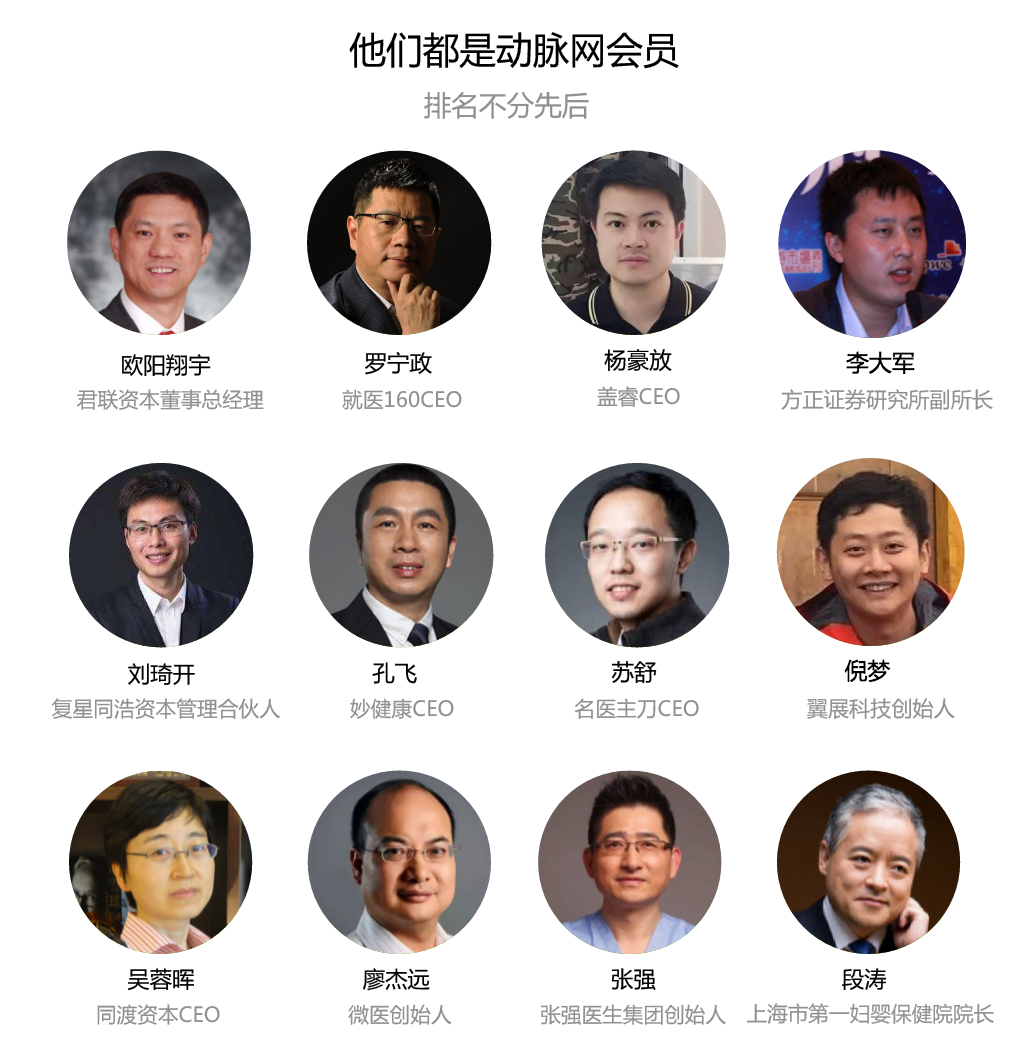
This marks a new beginning. Welcome, everyone! Let’s join hands with VCBeat to offer mutual assistance and support, building a stronger community for healthcare entrepreneurs and shaping a better future in medical innovation!