

Beijing Announces Major Healthcare Reform: Registration and Consultation Fees to Be Replaced by Medical Service Fees
On March 22, the Beijing Municipal Information Office, in conjunction with the Beijing Municipal Health and Family Planning Commission and other member units of the Beijing Working Group on the Comprehensive Reform of Separating Medical Services from Drug Sales, held a press conference to announce the reform plan. All public medical institutions in Beijing will abolish registration and consultation fees, eliminate drug markups, and introduce a medical service fee. Meanwhile, prices for 435 medical services will be standardized and adjusted. The reform is scheduled to take effect on April 8.
The healthcare reform comprises three core components: abolishing drug markups, registration fees, and consultation fees while introducing medical service fees; implementing transparent drug procurement to lower purchase prices; and standardizing basic medical services with a structured adjustment mechanism involving both price increases and decreases.
Abolish drug markups and introduce medical service fees
This healthcare reform completely eliminates the 15% drug markup (excluding traditional Chinese medicine decoction pieces), with all drugs sold at zero markup. Meanwhile, registration and consultation fees are abolished, and a medical service fee is established, facilitating the transition from a model where drugs subsidize medical services to one where medical services support pharmaceutical provision.
Medical Service Fee is a newly established item in this reform. In essence, the Medical Service Fee serves as compensation for medical institutions’ operational costs and for the medical teams providing diagnostic and treatment services to patients, following the elimination of drug markups, registration fees, and consultation fees. The goal of the reform to separate prescribing from dispensing is to sever the compensation model whereby hospitals and physicians generate revenue by “prescribing medications,” thereby guiding medical institutions and healthcare professionals to obtain reasonable compensation by delivering more and higher-quality diagnostic and treatment services.
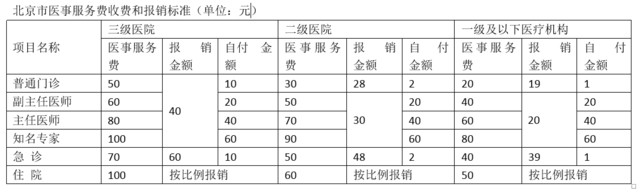
Beijing’s medical insurance fund has incorporated medical service fees in their entirety into the reimbursement coverage of the Basic Medical Insurance for Urban Employees, the Basic Medical Insurance for Urban and Rural Residents, Maternity Insurance, and Work-Related Injury Insurance. Outpatient medical service fees are reimbursed according to fixed quotas, and medical service fees incurred by insured individuals are reimbursed in accordance with relevant regulations.
Medical service fees and reimbursement amounts vary by hospital tier and physician level, with specific standards as follows:
New Mechanism: Transparent Drug Procurement
Beijing has leveraged market mechanisms to integrate nearly 4,000 medical institutions of all levels and types across the city into the Sunshine Procurement Platform. Drug varieties and prices are determined through competitive negotiations, with procurement conducted based on actual needs. This means that all drug procurement by medical institutions is carried out on the government-established online centralized drug procurement platform, where prices are dynamically linked to the lowest prices from provincial-level centralized procurement nationwide and remain open and transparent.
Meanwhile, a classified procurement system is implemented for pharmaceuticals. For low-priced drugs in short supply, the national minimum reference price is no longer set, ensuring clinical drug availability through market pricing mechanisms. As part of this reform to separate medical services from pharmaceutical sales, the drug procurement platforms formerly used by primary healthcare institutions and those used by secondary and tertiary hospitals have been merged into a single platform, enabling community health centers to procure all medications available at large hospitals.
It was revealed that after the implementation of transparent procurement, the average price of drug procurement decreased by 8%, enabling public medical institutions across the city to save approximately RMB 2.8 billion in annual drug procurement costs. During the transparent procurement process, the Municipal Health and Family Planning Commission prioritized drug quality as the primary criterion for evaluation. A "one-vote veto" policy was applied, directly placing entities on a negative record list, if they met any of the following conditions: causing serious adverse social impact due to severe drug-related harm incidents; repeatedly publishing seriously non-compliant advertisements in the Beijing area; being verified as engaging in serious commercial bribery; or having product varieties found with significant quality issues during sampling inspections at the production stage.
Standardize Medical Service Pricing
This reform will standardize and adjust the prices of 435 medical service items.These items specifically include:
Comprehensive medical services (beds, nursing care, etc.): 125 items, accounting for 28.7%;
Imaging diagnostics (CT, MRI, etc.): 185 items, accounting for 42.5%;
TCM medical services (including acupuncture, tuina, etc.), 96 items, accounting for 22.1%;
Clinical surgical procedures (e.g., appendectomy): 26 items + Clinical physical therapy procedures (e.g., radiotherapy): 3 items, accounting for 6.7%.
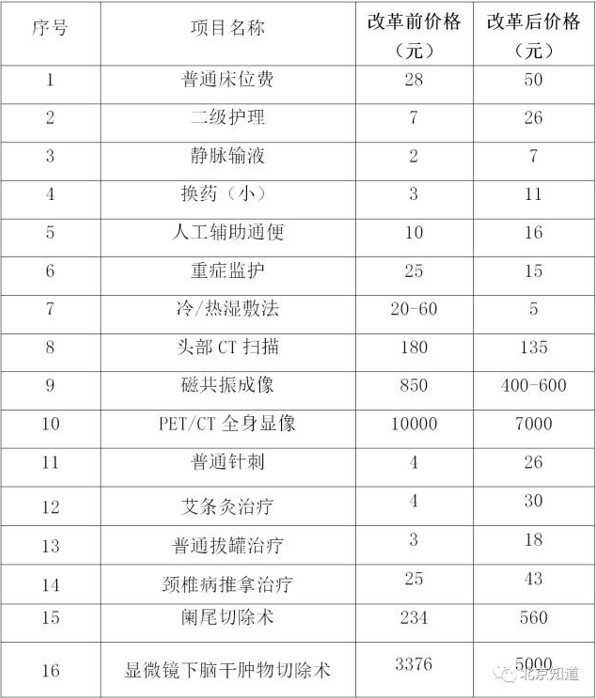
This round of healthcare reform in Beijing maintains overall balance in total medical expenditures, with a pricing structure characterized by “one increase and two decreases.” Price adjustments include increases for items that reflect the technical and labor value of medical personnel, such as bed charges, nursing care, general treatments, surgeries, and traditional Chinese medicine (TCM) services. For instance, the fee for a standard hospital bed has been adjusted from RMB 28 to RMB 50; Level II nursing care from RMB 7 to RMB 26; appendectomy from RMB 234 to RMB 560; and acupuncture from RMB 4 to RMB 26. Meanwhile, prices for major diagnostic equipment examinations, such as CT scans and MRI, have been reduced. Specifically, the cost of a head CT scan has decreased from RMB 180 to RMB 135; MRI scans from RMB 850 to RMB 400–600; and PET/CT scans from RMB 10,000 to RMB 7,000. Additionally, drug prices have been lowered through the concurrent elimination of drug markups and the implementation of transparent drug procurement, achieving an average price reduction of approximately 20%.
Based on calculations, the overall financial burden on patients has not increased following the adjustments. However, for individual patients, the impact may vary due to differences in diagnosed conditions, treatment regimens, and treatment durations.
For instance, patients whose treatment primarily involves pharmacotherapy or requires extensive CT and MRI scans will generally see a reduction in medical costs; conversely, if the diagnostic and treatment process is dominated by technical and labor-intensive services, patients’ medical expenses will increase to some extent.
Healthcare Insurance Measures for Public Benefit
In terms of healthcare insurance measures benefiting the public, to support the reform separating medical services from pharmaceutical sales, and particularly to further facilitate access to diagnosis and medication for common diseases, chronic conditions, and geriatric patients within their local communities—thereby eliminating the hassle of traveling to and queuing at large hospitals solely for prescription refills—the Beijing Municipal Health and Family Planning Commission has also introduced a series of supporting measures.
First, the number of designated community medical institutions has been continuously increased, with over 1,400 such facilities currently in operation, thereby enabling residents to access medical care conveniently in their vicinity.
Second, unify the reimbursement scope of medical insurance drugs between community health centers and large hospitals; any drug reimbursable at large hospitals shall also be reimbursable at community health centers.
Third, patients with four types of chronic diseases—hypertension, diabetes, coronary heart disease, and cerebrovascular disease—are eligible for the convenience of reimbursement for long-term prescriptions covering up to two months.
Fourth, community health institutions are encouraged to provide home-based medical services and establish home hospital beds; the resulting medical expenses shall be reimbursed by medical insurance in accordance with relevant regulations.
Fifth, regardless of whether it is outpatient or inpatient care, insured individuals can be smoothly referred to other specialists or hospitals based on medical necessity. Sixth, a “differentiated” reimbursement policy for medical service fees is implemented for community health centers and large hospitals, ensuring that patients’ financial burden when seeking care at the community level is significantly lower than at large hospitals, thereby promoting tiered diagnosis and treatment.