

Point-In Bio Leverages AI to Enable 3-Minute Lung Cancer Early Screening; Files for IPO
On average, one lung cancer patient dies every minute in China. According to 2016 data from the National Cancer Center, lung cancer ranks first in both incidence and mortality rates, with these figures continuing to rise. There are over 650,000 new cases and 500,000 deaths annually in China. Factors such as smoking, secondhand smoke, dust exposure, environmental pollution, and population aging may all contribute to the development of lung cancer.
Medical experts point out that early detection and early treatment are key to reducing lung cancer mortality. However, in China, 75% of lung cancer patients are diagnosed at an advanced stage, and only 16% have a survival period exceeding five years; yet, if detected through early screening, patient survival rates can be significantly improved.
Nowadays, a new type of lung cancer screening product has emerged on the market, which uses artificial intelligence engines for screening to identify high-risk populations, thereby enabling early prevention and opening up treatment windows for advanced-stage patients at an earlier stage.
Ge Liang, founder of Diannei Biology, told VCBeat that if early screening for lung cancer were widely adopted, China’s current professional medical standards would be fully capable of approaching and achieving the five-year survival rate for lung cancer seen in the United States.
>>>>
Early Screening Can Control the Incidence of Lung Cancer
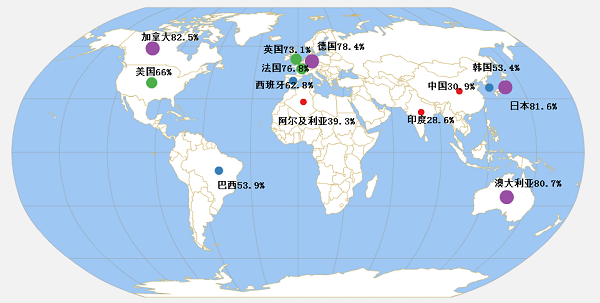
Five-Year Cancer Survival Rates by Country Data Source: The Lancet
According to a survey on five-year cancer survival rates across countries published in The Lancet, the five-year survival rate for cancer patients in China is 30.9%, only half that of the United States.
The lung cancer incidence data in China is even more alarming: 75% of lung cancer patients are diagnosed at an advanced stage, and only 16% achieve five-year survival. However, if potential cases can be detected through early screening, the likelihood of cure increases significantly. Data shows, in the United States, early screening has reduced the incidence of lung cancer by 25%, and the 5-year survival rate for early-stage lung cancer approaches 90%.
The underlying reason is that the United States has achieved early detection and early treatment in lung cancer prevention and control.In the United States, the Centers for Disease Control and Prevention recommends that all individuals aged 20 and older undergo regular comprehensive examinations of the oral cavity, skin, lymph nodes, testes, and other areas.Smokers require more frequent screenings, with a comprehensive examination every two years, to facilitate early detection, prevention, and treatment of cancer.
In the United States, women who are 21 years of age or older and sexually active should begin undergoing cervical cytology (Pap smear) screening. After age 30, screening is recommended every three years. Additionally, individuals aged 50 and older should undergo colorectal cancer screening every five years. These regular screenings are routinely facilitated and monitored by primary care physicians.
Based on the above facts, Ge Liang, founder of Diannei Biotech, co-founded “Diannei Bioinformatics Co., Ltd.” with his team. His team members come from renowned pharmaceutical and healthcare companies such as GE, Roche, and Solvay Pharmaceuticals, and possess many years of experience in the medical industry.Jointly developed an AI-powered product for early lung cancer screening—"LungCare".
>>>>
Accurately Assess Lung Cancer Risk in Just 3 Minutes
According to the introduction, "Dian Nei Fei Chang Hao" is a highly effective method for early lung cancer screening that is simple to operate. To use it, open WeChat on your mobile phone, follow the "Dian Nei Fei Chang Hao" official account, and enter data such as your age, height, weight, smoking history, family history, medical history, presence of nodules, and imaging characteristics of any nodules, as prompted by the form.By comparing with a global ultra-large database of over one million cases, an early screening risk assessment will be generated within three minutes., providing you with practical information such as your lung cancer risk score, underlying causes, and health recommendations; offering professional guidance for future prevention and treatment; and providing access to further specialized medical consultation services.
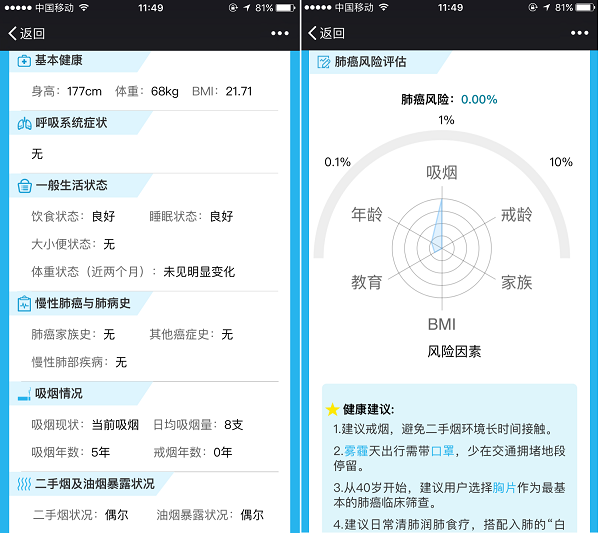
Given the report’s brevity and rapid turnaround, can it be trusted? To address this, Ge Liang reveals the underlying principles behind the product’s design and development.
He stated that the authoritative U.S. National Comprehensive Cancer Network (NCCN) has clearly defined risk factors for high-risk populations, including age, smoking history, pulmonary history, and family history. Early-stage lung cancer mostly presents as small nodules within the lung lobes; the imaging characteristics of these nodules constitute a critical basis for evaluating lung cancer. Scientists have long sought to predict and assess the risk of lung cancer based on these features.
After years of dedicated efforts by scientists, world-leading hospitals such as Mayo Clinic, MD Anderson Cancer Center, and others have launched their respective lung cancer risk prediction models. Building on this foundation, “Fei Chang Hao” integrates the currently mainstream international lung cancer risk prediction models and combines them with artificial intelligence and machine learning technologies. Validated against 20,000 lung cancer cases in China, it has been optimized to create “Fei Chang Hao,” an intelligent lung cancer screening engine tailored for the Chinese population.
“Typically, people often use accuracy to measure the quality of an artificial intelligence system. A highly effective application is early screening for lung cancer, which integrates various risk factors to quantify individual lung cancer risk, provides solutions for pulmonary nodules for physicians’ reference in assessing nodule characteristics, and generates predictions that inform users of their personal risk levels. If the risk is high, users are advised to seek medical attention and follow the clinician’s clinical pathway.”
“Furthermore, Diannei Bio can provide professional consultation on next-step prevention and treatment, and can also connect patients with the best specialized medical institutions both domestically and internationally for precise follow-up treatments, such as targeted therapy. If the risk of lung cancer is relatively low, appropriate preventive measures are sufficient,” stated Ge Liang. “In short, regular annual health check-ups can help prevent diseases before they occur.”
>>>>
Agreements have been signed with government agencies, and free screening services have been launched in communities.
The “Fei Chang Hao” app has signed an agreement with the government of a district in Shanghai and entered communities to provide early lung cancer screening services for residents. Typically, district-level governments are proactive in investing in community healthcare, as initiatives that benefit the public and promote healthy living concepts receive positive feedback from residents. For example, colorectal cancer screening has long been effectively implemented within community health services.
Although users can access free early lung cancer screening via WeChat, Fei Chang Hao primarily charges B-end clients, such as those involved in medical insurance cost containment and drug R&D. To improve treatment outcomes and control medical insurance expenditures, governments and insurance companies require early cancer screening. Previously, they relied on traditional paper-based methods, which were inefficient and labor-intensive. Today, leveraging artificial intelligence and internet big data not only enhances efficiency but also facilitates data organization and secondary applications.
“These data are owned by the government and retain significant scientific research value even after de-identification,” said Ge Liang. Currently, Fei Chang Hao has signed an agreement with a district government in Shanghai for early lung cancer screening. The program is government-led, with the enterprise primarily responsible for implementing the screenings, and the government providing corresponding subsidies.。
>>>>
Profit Drivers of Diannei Bio’s “Fei Chang Hao”
When discussing future development, Ge Liang, founder of Diannei, told VCBeat,Early StageIt will acquire more user health data and provide community users with more health advice, helping them gain personal insights from early lung cancer screening. Government endorsement is also crucial.
Mid-termObjective: To leverage data acquired in the early stages to train our artificial intelligence models using machine learning, enabling automatic optimization and delivering personalized, precision medical services for patients’ next steps. This approach will generate subsequent commercial value through data monetization.
Currently, the product "Dian Nei Fei Chang Hao" has officially entered public beta testing and is simultaneously accepting angel-round financing to support activities such as seed user acquisition and iterative updates of its artificial intelligence algorithms.