

Pang Chenglin of 39 Internet Hospital: 'Building 100 Internet Hospitals Is Not Too Many!'
On March 24, 2017, at 9:32 a.m. during the morning trading session, the share price of Longmaster Information & Technology Co., Ltd. (Stock Code: 300288) surged by 5.06%, reaching a two-month high. The latest annual report revealed that as of December 31, 2016, Longmaster Information reported operating revenue of RMB 398 million, net profit of RMB 85.15 million, earnings per share (EPS) of RMB 0.25, and a price-to-earnings (P/E) ratio of 109.40. Medical services appeared for the first time in the annual report as a new revenue product category.
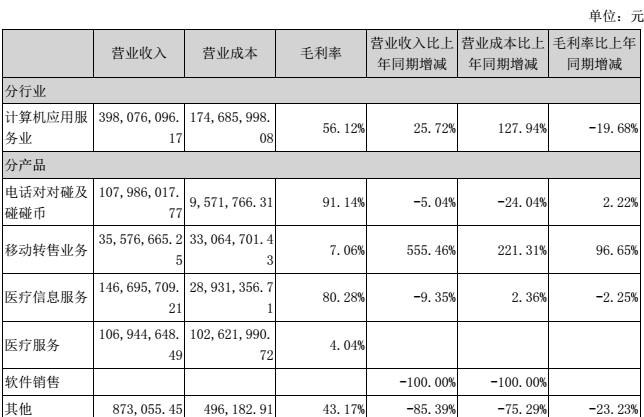
Langma Information's 2016 Revenue Performance Data Source: 《Langma Information 2016 Annual Report》
Looking back at 2016, the term “Internet Hospital” became virtually the core theme for Langma Information. The 39 Internet Hospital and the Guizhou Internet Hospital acted like two oars, propelling Langma Information into the vast ocean of healthcare.
In 2015, through the restructuring and capital increase of Guiyang No. 6 People's Hospital, Longmaster Information completed a crucial step in internet healthcare. Leveraging physical hospitals and medical resources, it established grassroots-oriented medical services for Guizhou Internet Hospital and provided remote consultation services for complex and critical cases through the 39 Internet Hospital.
In January last year, Pang Chenglin, the current Executive Dean and General Manager of 39 Internet Hospital, joined Longma Information. In February, after being reviewed and approved by the 17th meeting of the second board of directors of Longma Information and the 2015 annual shareholders' meeting, 39 Internet Hospital was officially established.In June 2016, the 39 Internet Hospital, a teleconsultation platform designed for patients with complex and critical conditions, was officially launched.As of now,39 Internet Hospital's monthly consultation volume has exceeded 500 cases。

Pang Chenglin, Executive Dean and General Manager of 39 Internet Hospital
China's First "Physician-to-Physician Consultation"
On his first day at Langma Information, Pang Chenglin established a six-character corporate credo: “Standardized, High-Quality, Safe.”
39 Internet Hospital is the first platform in China to introduce the “doctor-to-doctor consultation” model. Patients can directly book remote consultations with renowned specialists from top-tier (Grade 3A) hospitals in Beijing, Shanghai, Guangzhou, and other major cities. This enables multi-party video consultations involving the patient, the primary care physician at the local level, and leading medical experts, thereby facilitating the allocation of high-quality medical resources to grassroots healthcare institutions.
Since the launch of 39 Internet Hospital, it has signed contracts with over one hundred primary healthcare institutions, leveraging a remote consultation model,AssistancePrimary Healthcare Institutions. Currently, 39 Internet Hospital has contracted with over 1,000 expert-level physicians from more than 50 renowned hospitals, including Peking Union Medical College Hospital, Peking University-affiliated hospitals, and the Chinese PLA General Hospital (301 Hospital). The hospital has provided remote consultations for thousands of patients with complex and critical conditions across 28 medical specialties, serving individuals from 23 provinces, municipalities, and autonomous regions throughout China.。
To enable patients’ experience during consultations to approximate the “on-site” feel of medical care as closely as possible, 39 Internet Hospital has evolved from the traditional teleconsultation model into the most advanced contemporary framework: an internet hospital system encompassing multiple service models, including remote ward rounds, remote joint specialist outpatient clinics, imaging consultation, pathology consultation, remote technical guidance for diagnosis and treatment, precision triage and appointment scheduling, two-way referral, remote teaching using classic cases, and precision-based, routine telemedicine for poverty alleviation.
Pang Chenglin told VCBeat, “From the diagnosis and treatment of patient diseases to the improvement of professional competence among primary care physicians, 39 Internet Hospital has connected hospitals, doctors, and patients through remote services.”
Differences from Other Internet Hospitals
According to Pang Chenglin, the most significant difference between 39 Internet Hospital and other internet hospitals lies in its positioning: 39 Internet Hospital is one of the few pioneers to obtain a Medical Institution Practice License, and it was the first internet hospital to focus on consultations for complex and critical cases.
Next is the six-character credo of 39 Internet Hospital—Standardized, High-Quality, SafeBy connecting and amplifying high-quality, standardized, and safe medical care, we facilitate interoperability between renowned specialists and primary-care hospitals, enabling precise triage, appointment scheduling, and patient referral. Furthermore, through the organization, linkage, and structuring of medical data, we aim to build a systematic, routine, and multi-dimensional medical-grade remote diagnosis and treatment platform.
Standardization refers to providing standardized medical care to both physicians and patients. At present, the level of standardization in disease treatment in China is relatively low, particularly at the primary care level.
In terms of high-quality medical care, 39 Internet Hospital boasts an expert system led by Professor Huo Yong (Professor, Chief Physician, and Doctoral Supervisor at Peking University First Hospital; Fellow of the American College of Cardiology).As a core component of Longma Information’s internet healthcare strategy, 39 Internet Hospital naturally inherits numerous high-quality resources from its parent company, including technology, physicians, and telecom operators.
Furthermore, Pang Chenglin placed particular emphasis on patient and physician satisfaction, which he considers the top priority. In last year’s internal survey, 39 Internet Hospital achieved a patient satisfaction rate of over 90%, a truly remarkable result.
At present, doctor-patient disputes are frequent in China. How to resolve this issue through 39 Internet Hospital is a question that Pang Chenglin has been contemplating.“To cure sometimes, to relieve often, to comfort always.”39 Internet Hospital has always adhered to Dr. Trudeau’s epitaph.
Among the thousands of cases diagnosed and treated by 39 Internet Hospital last year,Dozens“Patients who can be treated at the primary care level are kept in local hospitals, while those requiring referral to major hospitals in Beijing receive timely care, truly achieving a two-way referral system among patients, primary care physicians, and top medical experts,” said Pang Chenglin.
Returning to the Essence of Healthcare: Since its inception, 39 Internet Hospital has adhered to this principle. As Pang Chenglin stated, the healthcare value chain encompasses numerous segments, ranging from pharmaceuticals and online consultations to caregiving and elderly care. However, the fundamental need for both physicians and patients remains effective diagnosis and treatment. Merely operating on the periphery will never address the core issues at their root.
Internet Hospitals: 100 or 200 Are Not Many
The revenue of 39 Internet Hospital primarily stems from three sources: out-of-pocket payments by patients; hospital payments, which encompass both hospital funds and medical insurance reimbursements; and payments related to medical devices used in medical education and training.
In June and November 2016, 39 Internet Hospital completed its angel round and angel-plus round of financing, respectively, raising a total of RMB 70 million. Investors included Guiyang Venture Capital, funds under IDG, and Langma Information, among others, with the company’s valuation reaching RMB 570 million.
Pang Chenglin told VCBeat that after two rounds of financing, the expenditures of 39 Internet Hospital mainly consist of three parts:First, the costs associated with R&D personnel and telemedicine staff; second, education for physicians and hospitals; third, the purchase of consultation devices, such as iPads.etc.
Throughout 2016, Pang Chenglin led the team at 39 Internet Hospital to fully establish a closed-loop model for internet-based healthcare, covering the entire patient journey from initial engagement to physician consultation and follow-up. More importantly, they successfully tapped into the willingness of both consumers (C-end) and businesses (B-end) to pay, thereby achieving genuine revenue generation.
Earlier last year, Pang Chenglin was asked, “With so many internet hospitals, how do you compete?” Pang Chenglin told him:“This is not competition at all, but rather each party leveraging its respective strengths.”. In his view, the 100 to 200 internet hospitals currently operating in China are not numerous. This is because the healthcare sector differs from consumer markets; the latter typically have low barriers to entry, and internet-driven consolidation can easily lead to industry oligopolies.
In the fields of healthcare, pharmaceuticals, and hospitals, no single company or hospital has achieved a dominant position to date. Why? A simple example illustrates this: while Peking Union Medical College Hospital is widely regarded as the best hospital in China, patients seeking neurosurgical care still turn to Beijing Tiantan Hospital and Xuanwu Hospital, whereas those with cardiovascular conditions prefer Fuwai Hospital, Beijing Anzhen Hospital, Peking University First Hospital, and others. The same principle applies to internet hospitals.
Before leaving Lanma Information, Pang Chenglin skillfully took an iPad out of his backpack and invited the reporter to observe a remote consultation in progress. From the device, the reporter inadvertently noticed a page of information, which displayed densely packed entries in chronological order.Pang Chenglin told the reporter, “That was“By reviewing the long-term observation data from this iPad, I’ve identified areas for improvement in every consultation. My goal is to uncover as many of these issues as possible so that we can perform better next time.”
Note: All data related to this company in the article were provided and confirmed by the interviewee.