

Zhejiang University Files Prospectus to Build "Chinese Power" in Medical AI with 100 Million Yuan Donation
From the nascent stages of technology in the 1950s to its formal integration into medical diagnosis in the 1970s, artificial intelligence (AI) in medicine has nearly become synonymous with advancements in healthcare technology. Continuous progress in artificial neural networks and deep learning, coupled with a burgeoning wave of entrepreneurship in the healthcare sector, is exerting a significant impact on the development of modern medicine.
In recent years, the field of artificial intelligence has witnessed a continuous stream of major developments. IBM began developing Watson in 2006,In 2014, Google acquired DeepMind. In 2016, major events such as AlphaGo’s match against Lee Sedol and the announcement by Google, Facebook, Amazon, IBM, and Microsoft to establish the Partnership on AI had profound implications for the development of artificial intelligence, spurring successive waves of entrepreneurship in the field.
According to a CBI report, 550 AI startups collectively secured $5 billion in investment in 2016. Tracy Tsai, Vice President at Gartner, further predicted that artificial intelligence would generate $300 billion in business value by 2020. The number of entrepreneurial ventures combining AI with healthcare has been increasing year by year. Several noteworthy startups have emerged in China, and even prestigious universities have entered this field.
Top Universities Build China’s First Open Medical AI Platform
On March 25, 2017, Zhejiang University, a prestigious Chinese institution, announced the establishment of the Ruiyi Artificial Intelligence Research Center. Professor Wu Zhaohui, President of Zhejiang University and a leading figure in China’s artificial intelligence science, spearheaded the formation of an expert committee. The center was simultaneously unveiled at Zhejiang University and the Hangzhou Bay Information Harbor. It announced plans to build China’s first open medical artificial intelligence platform through an integrated “industry-academia-research” model.
Zhejiang University possesses substantial strength in medical artificial intelligence, with its Institute of Artificial Intelligence under the College of Computer Science being one of the earliest AI research institutions in China. In the 2016 National Science and Technology Awards, Zhejiang University secured nine awards, ranking first among all universities nationwide. The university demonstrates domestic leadership in fields such as medicine, engineering, and information science, while its affiliated hospitals under the School of Medicine are at the forefront of clinical medicine in China.
According to VCBeat (WeChat ID: vcbeat), the Ruiyi Artificial Intelligence Research Center will leverage the scientific research strengths of relevant departments at Zhejiang University—including the College of Computer Science and Technology, the College of Information Science and Electronic Engineering, the School of Medicine, the College of Pharmaceutical Sciences, and the College of Biomedical Engineering and Instrument Science—as well as its affiliated hospitals, to enhance the overall level of artificial intelligence in the healthcare sector.
Focus on researching key common technologies in medical artificial intelligence (AI) based on clinical big data, imaging, and genomics; prioritize the development of a medical AI service platform; foster the medical AI industrial ecosystem and third-party medical AI service enterprises; establish multi-disciplinary and multi-institutional collaborative innovation mechanisms; formulate industry norms and standards; and build a higher education system for medical AI.
To support the development of the Ruiyi Artificial Intelligence Research Center, Zhejiang University President Wu Zhaohui established an Expert Committee; Professor Wu Jian from the College of Computer Science and Technology was appointed as the center’s director to lead the core R&D team. Corresponding operational and management support staff were also assigned, and a designated number of doctoral and master’s graduate admissions quotas were allocated to the center to advance talent cultivation in the field of medical artificial intelligence.
Meanwhile, the Ruiyi AI Research Center functions as both a scientific research platform and an industrialization platform. It serves not only as a medical AI research hub but also opens its doors to technical and application-based collaborations with affiliated hospitals of Zhejiang University, healthcare institutions across China, and leading discipline experts. By integrating clinical experience, academic research, and clinical data from healthcare institutions, the center seeks to translate scientific achievements into industrial outcomes, while leveraging industrial development to support further research, thereby achieving synergy among industry, academia, and research.
“We will leverage Zhejiang University’s foundational strengths, collaborate with major medical institutions and discipline leaders with an open mindset, integrate data sources, and establish a multi-disciplinary, multi-institutional collaborative mechanism, striving to achieve breakthroughs in key technologies of medical artificial intelligence at the earliest possible date,” said President Wu Zhaohui.
Optimizing the Healthcare Service System: Broad Application Scenarios
Artificial intelligence is becoming a technological high ground in global competition and was included in the Government Work Report of China’s Two Sessions for the first time in 2017. The large-scale application of artificial intelligence in the medical field began in 2011, and currently covers areas such as virtual assistants, medical imaging, drug discovery, nutrition, biotechnology, emergency room/hospital management, health management, and mental health.
It is evident that medical artificial intelligence holds immense prospects for development. University-affiliated institutions modeled after the Ruiyi AI Research Center deliver tangible value in accelerating the application of AI technologies in healthcare, expediting breakthroughs in the prevention and control of major diseases, securing leadership in emerging strategic industries related to biomedicine, safeguarding the security of health data, and optimizing the healthcare service system.
The application of medical artificial intelligence will help improve the current situation faced by the healthcare service system, such as the uneven distribution of high-quality medical resources, insufficient service capabilities of primary healthcare institutions and physicians, and the "passive medical care" model centered on disease treatment, thereby optimizing the healthcare service system.
Micro Medical Group Donated 100 Million Yuan, and the Reason Is...
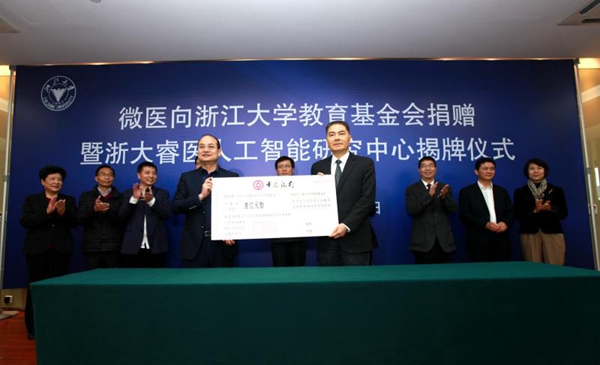
At the launch event of the Ruiyi Artificial Intelligence Research Center, we once again saw a familiar face—WeDoctor. WeDoctor donated RMB 100 million to Zhejiang University to support the development of the Ruiyi Artificial Intelligence Research Center.
Why Did WeDoctor Donate to Zhejiang University to Support the Establishment of the Ruiyi AI Research Center? Liao Jieyuan, Chairman and CEO of WeDoctor, Revealed the Reasons Behind It to VCBeat.
Liao Jieyuan believes that many people’s understanding of medical artificial intelligence is fragmented. The core of medical AI comprises three key elements: data sources, technological capabilities, and application scenarios. While many medical AI companies start with technology, both the technologies and algorithmic models are generic; the critical factor lies in post-development “training.”
First, is there a large-scale data source to continuously train it, making it increasingly intelligent? Starting from a single disease type, disease course, and disease point, it evolves into a physician’s assistant. This is not an isolated action but necessarily a system. The backend of this system relies on data sources located in hospitals, within various electronic medical records;
Secondly, the medical capabilities developed by medical artificial intelligence must encompass competencies across all medical disciplines, thereby establishing a genuine service system;
Finally, there must be diverse application scenarios. Hospitals, physicians, and patients each represent distinct use cases; only by integrating these three stakeholders can a true medical artificial intelligence platform be realized.
It would be quite challenging for such a platform to rely solely on a single enterprise or institution. Zhejiang University, however, possesses unique advantages, with robust capabilities in medicine, engineering, and information technology. The university began artificial intelligence research as early as 1981, boasting profound expertise and heritage. Moreover, its president, Professor Wu Zhaohui, is a renowned expert in the field of artificial intelligence.In 1991, he pursued advanced studies for two years at the German Research Center for Artificial Intelligence.Has been engaged in research in related fields.
Therefore, in terms of conditions, Zhejiang University can take the lead in establishing an Artificial Intelligence Research Center. However, since every expenditure by universities is earmarked for specific purposes, Zhejiang University needs to concentrate substantial efforts on medical artificial intelligence, which also requires significant support in terms of manpower and funding. The RMB 100 million donated by WeDoctor has precisely provided the financial impetus for the development of the Ruiyi Artificial Intelligence Research Center.
Of course, the funds donated by WeDoctor alone are insufficient; corresponding government support is also required, along with the participation of more institutions, to generate sufficient momentum to drive this initiative forward.
Forging the “Chinese Power” in Medical AI
In China, where there is a scarcity of top-tier medical experts and physicians, coupled with weak primary healthcare resources, the significant strides made in medical artificial intelligence (AI) offer a promising future. The emergence of the Ruiyi AI Center at this juncture is both necessary and inevitable. As envisioned by Wu Zhaohui, President of Zhejiang University, we also expect university-affiliated research institutions like the Ruiyi AI Center to develop core capabilities in medical AI with independent intellectual property rights. By doing so, they can create a Chinese-owned medical AI engine and collaborate with major healthcare institutions, multidisciplinary experts, and industry partners to forge a “Chinese force” in medical AI.