

Episode 14 of 'Dialogues on Health' Season 2 Features Professor Yiping Shen from Harvard Medical School
Source: GenePPT
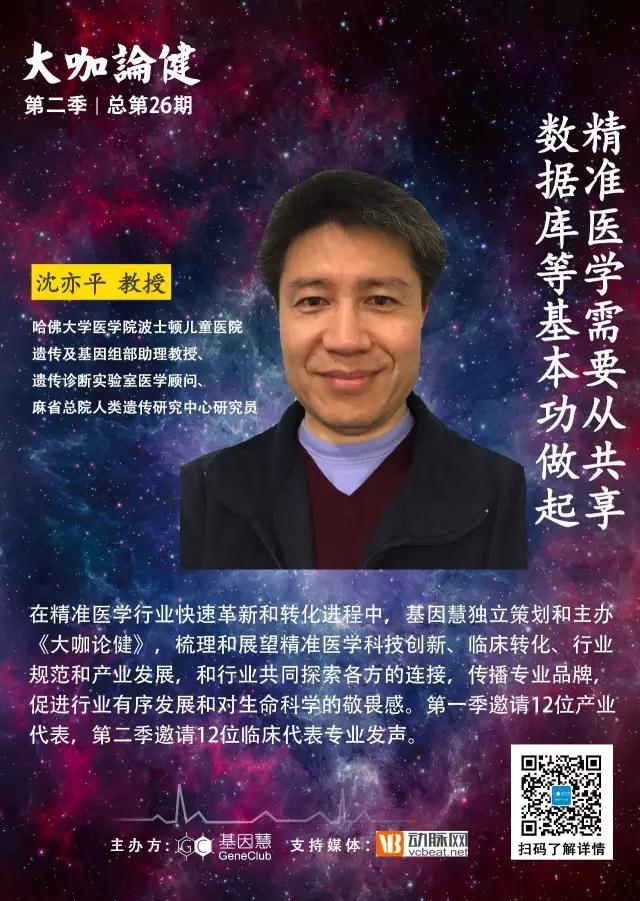
Welcome representatives from research, clinical practice, industry, and investment to participate in "Leading Experts Discuss Health" (info@genonet.cn).
[Previous Reviews]
Season 2, Episode 01: Professor Huang Shangzhi
Season 2, Episode 02: Dr. Gu Weihong
Season 2, Episode 03: Professor Yao Hong
Season 2, Episode 04: Professor Zhao Haitao
Season 2, Episode 5: Vice President Wang Yi
Season 2, Episode 6: Professor Qi Ming
Season 2, Episode 07: Dr. Wang Wei
Season 2, Episode 08: Professor Ding Jie
Season 2, Episode 9: Dr. Dai Junbiao
Season 2, Episode 10: Dr. Shen Yue
Season 2, Episode 11: Professor Huang Taosheng
Author: Professor Shen Yiping
Assistant Professor, Department of Pathology, Harvard Medical School
Medical Advisor, Laboratory for Molecular Medicine, Boston Children's Hospital
Researcher, Human Genetics Research Center, Masheng General Hospital
Editor: GeneWell
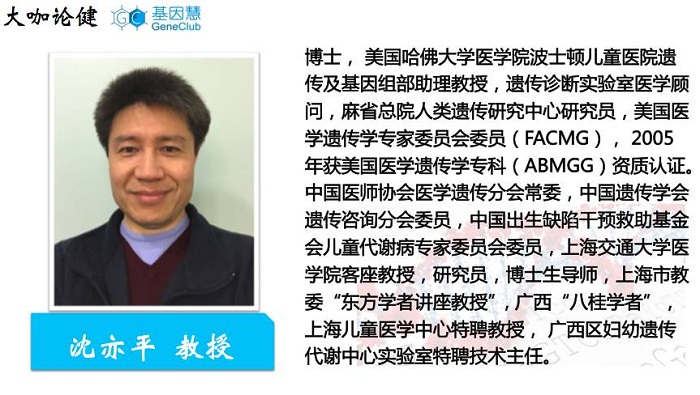
It has been a great honor for me to transition from choosing biology out of personal interest to entering the field of clinical medicine through specialized training in medical genetics in the United States. I am deeply grateful to many mentors for their guidance and leadership, particularly Professor Yu Jingwei from the former Wuhan Tongji Medical University. He introduced me to the American College of Medical Genetics and Genomics (ACMG) at an early stage; thus, shortly after pursuing advanced studies in the U.S. on his recommendation, I focused my career path in this direction. After completing my Ph.D. and postdoctoral research, and with the generous permission and active support of my mentor, James Gusella, I entered Harvard Medical School in 2003 to undergo specialized training in medical genetics.
Figure 1: ACMG, from the official ACMG website. The American College of Medical Genetics and Genomics (ACMG) is an organization composed of professionals dedicated to the practice of medical genetics. Established in 1991, it aims to develop clinical practice guidelines, laboratory service catalogs, databases, and screening guidelines, as well as to establish unified laboratory standards, quality assurance, and proficiency testing. It was renamed ACMGG in 2011 [1].
Medical Genetics is the youngest among the 24 medical specialties in the United States.As an independent discipline, it has been only a little over two decades. This specialty demonstrated great foresight by incorporating PhDs as committee members from its inception. It is the only medical subspecialty that includes PhD participation. From today’s perspective, this decision was exceedingly correct, wise, and important. More than ten years ago, this specialty had not yet received widespread recognition. I was very fortunate to join the training program at Harvard Medical School immediately after applying, and two years later, I successfully passed the Board certification examination, becoming a specialist in molecular genetics.
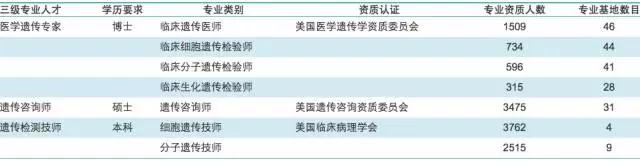
Figure 2: Qualification composition and workforce size of the specialized system for medical genetics in the United States. Source: Chinese Journal of Medical Genetics, 2016, 36(03): 396-401[2]
For over a decade, I have been working on the front lines of medical genetics with a focus on molecular diagnostics, while placing particular emphasis on close collaboration with clinicians and genetic counselors, as well as direct engagement with outpatients. Thus, over these past ten-plus years, I have personally witnessed the remarkable transformation of this field from a peripheral discipline to a central one. We know thatThe completion of the Human Genome Project, advances in gene sequencing technologies, the sharing of databases and knowledge bases, and the widespread emergence of concepts such as personalized medicine and precision medicine have made medical genetics an indispensable central discipline required by all medical specialties.
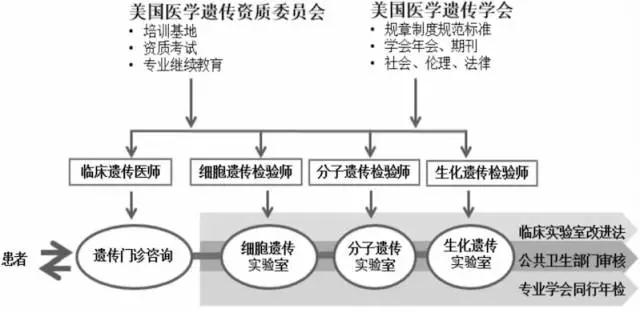
Figure 3. The specialty system of medical genetics in the United States. Source: Chinese Journal of Medical Genetics, 2016, 36(03): 396-401[2]
Therefore, from a historical perspective, I consider myself extremely fortunate. I have experienced and actively participated in the evolution of medical genetics from a relatively niche field to one of great prominence. I am fully aware of my mission and responsibilities, particularly given that this domain in China lags several decades behind its development in the United States. Although we are still some distance away from establishing a comprehensive system, butIn recent years, thanks to the concerted efforts of many senior experts and peers, significant progress has been made in establishing this system. For instance, medical genetics is now recognized as a secondary discipline, and we have launched standardized training programs for clinical specialist physicians and genetic counselors. These developments are highly encouraging.This is the result of the collective efforts of many like-minded peers, which is something I feel very fortunate about.
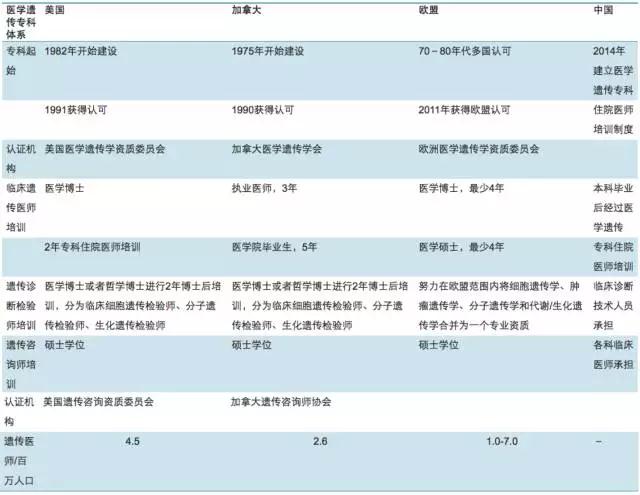
Figure 4: Training systems for medical genetics specialists and genetic counselors in North America, European countries, and China. Source: Chinese Journal of Medical Genetics, 2016, 36(03): 396-401[2]
Having worked in medical genetics in the United States for over a decade, I have maintained a strong interest and commitment to research and development (R&D) alongside providing clinical molecular diagnostic services. Consequently, I have devoted significant efforts to establishing laboratory technical systems, as well as developing and validating new test assays. More than ten years ago,As one of the few laboratories in the United States to pioneer the application of chromosomal microarray technology in routine clinical diagnostics, we have led the development of this field., authored the standard operating procedures (SOPs) for chromosomal microarray analysis in this field, and the accumulated evidence regarding the clinical utility of chromosomal microarray in conditions such as autism spectrum disorder has provided a critical basis for professional associations, including the American College of Medical Genetics and Genomics (ACMG), to develop clinical practice guidelines for microarray testing.
Over the past decade, our research and development on the clinical applications of microarray technology has further expanded its scope to include other clinical phenotypes such as short stature and childhood obesity. We have identified a series of pathogenic loci associated with new clinical manifestations and accumulated substantial experience in the clinical analysis of copy number variations (CNVs). In the last five years, we have also made significant innovations and investments in applying next-generation sequencing (NGS) for the diagnosis of genetic diseases, with the aim of ensuring these technologies are utilized more effectively and accurately in China.
Therefore, over the years, I have made efforts to advance the training of specialized professionals in China—including clinical geneticists, genetic counselors, and laboratory directors—as well as to strengthen the development of laboratory systems, knowledge frameworks, and clinical shared databases. I hope that more peers will join us in this endeavor.
Moreover, I consider myself extremely fortunate to have grown up in the premier sanctuary of biomedical science in the United States—Harvard Medical School—from my training through my professional career. Boston Children’s Hospital, recognized as the leading children’s hospital in the U.S., has also provided an invaluable environment for this development.The most prominent feature here is a highly open knowledge environment.. Here, high-quality lectures and forward-looking discussions are held every week, providing us with an indispensable opportunity to recharge and gain inspiration.
"My colleagues in the United States are highly dedicated and research-oriented, while also placing great emphasis on collaboration.", so many of my achievements are the result of collaborations with colleagues at Harvard. I also place great emphasis on collaboration with clinicians. Over the past few decades, I have conducted extensive research on autism with physicians in the field of developmental and behavioral pediatrics, and investigated the genetic etiologies of short stature with endocrinologists. Furthermore, I have participated in numerous large-scale international collaborative projects, from which I have gained substantial insights.
At Boston Children's Hospital, Harvard Medical School, I perceive another significant advantage: the electronic sharing system for patients' clinical information and extensive collaboration.Here, we have accumulated years of experience and gained widespread recognition for the concept of shared benefits and win-win outcomes, which are essential lessons for us to learn. We are in a critical era where big data only becomes truly meaningful when it is organically integrated and shared. Without achieving this, no matter how many patients we have, we will not be able to gain deeper insights into their diseases.
Precision medicine demands comprehensive sharing of clinical, genomic, and therapeutic information; this is our only opportunity to achieve a leapfrog advantage., I believe this is something we must clearly recognize.
When it comes to precision medicine, I believe it fundamentally represents a conceptual and practical leap from “treating the disease” to “targeting the specific mechanism.”. We currently have a solid conceptual framework, but what is needed most is action; precision medicine remains an ideal goal that requires continuous effort to approach. While we can achieve relatively satisfactory outcomes in certain areas, in the vast majority of cases, our limited understanding of the correlation between genotypes and phenotypes means we are still far from achieving true precision.We must pay particular attention to precision in the fields of medical genetics and genetic counseling, starting with foundational infrastructure such as the accumulation of knowledge bases and the development of shared databases.. This requires the participation of many of our colleagues in China, as well as national investment and attention in this area. We have such an opportunity, and we need to turn it into reality.
References:
1. https://www.acmg.net/
2. Shu Wei, Zhou Qinghua, Zhang Hui, et al. Development of medical genetics specialty and related allied health professional systems in the United States and Europe and their impact on healthcare [J]. Chinese Journal of Medical Genetics, 2016, 36(3): 396-401. DOI: 10.3760/cma.j.issn.1003-9406.2016.03.027
3. https://hms.harvard.edu/
4. http://www.childrenshospital.org/