

BaYi Smart Tech Secures Exclusive Three-Year Distribution Rights for IBM Watson for Oncology in China
2On March 28, 2017, Baiyang Pharmaceutical Group and IBM signed a strategic cooperation agreement in Beijing., its subsidiary Baiyang Intelligent Technology will become the strategic partner of Watson Health in China,Secured the exclusive three-year master distribution rights for Watson for Oncology in the Chinese market, along with priority negotiation rights for select future new products and collaborative R&D rights for newly launched products in China.
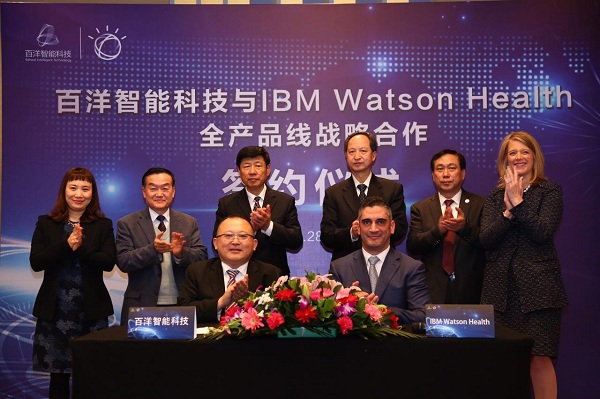
Through this collaboration, a wide range of cognitive intelligence solutions under Watson Health are expected to fully enter the Chinese market. Various medical institutions in China, including hospitals and clinics, will gain access to the world’s most mature cognitive intelligence technologies and solutions. Physicians will significantly enhance diagnostic and treatment precision through intelligent decision-support systems based on massive big data, while patients will benefit from first-class “cognitive healthcare” services aligned with international standards. This marks the formal entry of smart healthcare in China into the phase of substantive application.
“The Cognitive Intelligence” Health Ecosystem Begins to Take Shape
Under the agreement, Baiyang Smart Technology will vigorously promote Watson Health’s full product portfolio in the Chinese market. Currently, the focus is primarily on oncology treatment decision support, while these products will also undergo customized adaptations tailored to China-specific characteristics to better meet the demands of the Chinese market.
According to public data obtained by VCBeat, China sees 4.3 million new cancer diagnoses annually, with 2.8 million patients dying from cancer-related causes. Chinese cancer patients account for one-quarter of the global total, while cancer-related deaths in China represent one-fifth of all deaths in the country.
Fu Gang, Chairman of Baiyang Pharmaceutical Group, stated that the trend of cancer development in China is not optimistic. Baiyang has evaluated many artificial intelligence technologies, and Watson technology is undoubtedly the most promising for application. It can understand 12 languages and has strong learning capabilities, making it an effective tool to assist human decision-making.
IBM’s artificial intelligence technologies have been deployed globally across multiple sectors, including healthcare, enterprise operations, government, and consumer services. While its various products have achieved multi-sector adoption in the United States, their enterprise-level and healthcare applications in China are still in their early stages.
Watson is a prominent representative in the field of cognitive computing, signaling to some extent the advent of a new era of technological revolution. It encompasses extensive technological innovations in information analytics, natural language processing, and self-learning, leveraging cloud computing to analyze vast amounts of data, interpret complex problems, and provide evidence-based decision-making recommendations and answers.
Watson possesses powerful comprehension capabilities through natural language understanding technology and its exceptional ability to process both structured and unstructured data.Meanwhile, it possesses powerful intelligent logical reasoning capabilities, enabling it to perform inference, analysis, comparison, induction, summarization, and argumentation to gain deep insights and evidence for decision-making. Furthermore, its evidence-based learning ability allows it to rapidly extract key information from big data, exhibiting excellent learning and cognitive abilities akin to humans, while continuously improving by learning from interactions to optimize its models.
In fact, healthcare was the first domain IBM’s cognitive intelligence division ventured into, with its research team having been developing Watson technology for medical and health applications since the 1990s. Leveraging nearly three decades of extensive research experience and deep learning capabilities, Watson Health has become the most mature product in the Watson family. In 2012, Watson Health even passed an examination equivalent to the U.S. Medical Licensing Examination.
Within the established Watson Health product portfolio, Watson for Oncology has emerged as the leading artificial intelligence product in the global healthcare sector. The American Cancer Society is also leveraging Watson technology to mine relevant data, with the aim of providing personalized treatment for cancer patients.
Watson for Oncology possesses powerful learning capabilities. It has currently stored and learned from a vast array of oncology cases from Memorial Sloan Kettering Cancer Center (MSKCC) and dozens of other medical institutions in the United States, over 300 peer-reviewed medical journals, more than 200 oncology monographs, and over 15 million research papers. It also incorporates cancer treatment guidelines based on the National Comprehensive Cancer Network (NCCN) and MSKCC’s century-long practical experience in clinical cancer care in the United States.
Leveraging its robust database and extensive experience, Watson for Oncology serves oncologists providing cancer treatment by performing semantic and contextual analysis on both structured and unstructured data from various sources, including handwritten documents. Compared with treatment plans recommended by top expert panels, Watson for Oncology’s recommendations have achieved a concordance rate of over 90%, gradually becoming an essential intelligent assistant for oncology specialists.
It is reported that since Watson for Oncology was launched commercially in July 2015, it has covered the treatment of lung cancer, breast cancer, rectal cancer, colon cancer, gastric cancer, and cervical cancer, and is expected to expand to 8–12 cancer types by 2017.
“Cognitive Commerce” Consensus-Driven Alliance
After extensive evaluation and careful consideration, IBM Watson Health has selected Baiyang Smart Technology as its strategic partner for the China region. As medical cognitive intelligence enters the deep learning phase, IBM aims to introduce its Watson Health products to the Chinese market and requires collaboration with a professional company capable of integrating advantageous resources within the healthcare industry.
According to VCBeat, Baiyang’s years of deep engagement in the healthcare industry have enabled it to cover more than 12,000 hospitals and 200,000 pharmacies, establishing itself as a leading brand marketing enterprise in the healthcare sector. Fu Gang noted that the healthcare industry possesses unique characteristics; unlike the internet or gaming sectors, it cannot pursue rapid growth alone but must instead demonstrate strong social responsibility. Baiyang has established long-term collaborations with the four most authoritative industry associations in China’s healthcare field.
Baiyang’s internet DNA is sufficient to propel Watson into the Chinese market. An experienced IT team of nearly 600 members operates Yi Fuzhen, a post-consultation patient management tool contracted with over 60,000 physicians; Zhangshang Yixun, the mobile health app with the longest usage duration among Chinese doctors; and Baiyang Mall, the online pharmacy offering the best consumer experience. The combination of superior operational capabilities with Watson Health’s technological prowess will significantly shorten the market adoption time for cognitive intelligence application-level products and help Watson Health acquire more learning data.
In fact, shared platform DNA also facilitated the collaboration between IBM and Baiyang. Baiyang has strategically deployed and established a series of service-oriented platforms, including the Puti Medical Cloud Platform, the Health Products and Services Trading Platform, and the Cross-Border Medical Service Platform. Baiyang’s big data capabilities will enhance learning abilities in the field of AI-driven healthcare. Emphasizing big data analytics, Baiyang has established a Medical Big Data Center built upon three core elements: integration, security, and precision. This aligns perfectly with IBM’s big data strategy, as effective data control, isolation, and maximization of value are key to enhancing enterprise cognitive capabilities.
As early as 2016, Baiyang Pharmaceutical Group and IBM reached a cooperation agreement, under which Baiyang’s invested entity, Puti Medical, selected IBM’s LinuxONE to build the “Puti Medical Cloud Platform,” regarded as the most powerful brain in the healthcare sector. This platform supports the construction of the “IoT Cloud Hospital” at Qingdao Municipal Hospital (Group). In 2017, this hospital successfully obtained official certification from the Qingdao Municipal Health and Family Planning Commission, becoming an internet hospital within the medical consortium. In the future, the integration of Watson Health’s cognitive intelligence technology will help upgrade the hospital across multiple areas, including oncology treatment, chronic disease management, and medical imaging and laboratory services.
Xuan Shiying, President of Qingdao Municipal Hospital (Group), stated, “We are highly anticipated and honored to introduce Watson, the world’s most advanced cognitive computing solution for healthcare. This not only provides our patients with more precise and diversified treatment options but also significantly broadens the global perspective of clinicians, facilitating the rapid professional development of young physicians.”
Furthermore, the Smart Doctor Initiative launched by Baiyang Pharmaceutical Group in collaboration with the Chinese Medical Doctor Association will be integrated into Watson Health’s suite of solutions, extending physicians’ cognitive capabilities and empowering them to become truly intelligent doctors for the new era.
In the pharmaceutical retail sector, the trend toward clinic-integrated pharmacies is becoming increasingly pronounced, with minute clinics emerging as a global phenomenon. Baiyang boasts nearly 10,000 partner pharmacies and is poised to follow the model of CVS Health in the United States by granting Watson access to extensive datasets, including patient behavior information, clinical data, prescription purchase records, and insurance data.
By analyzing users’ medical health records, pharmacy data, and other information, Watson can predict individuals’ disease risks and provide them with information on nurse practitioners, physicians, and relevant health insurance plans, thereby formulating optimal solutions for their health concerns. Pharmacies can also upgrade into service centers for community-based health management and chronic disease management by integrating Watson Health’s cognitive computing technologies, thereby unlocking greater service value.
"The Transformation Brought by 'Cognitive Healthcare'"

Fu Gang believes that while China’s healthcare sector still faces numerous challenges, it is also presented with significant opportunities. The government is continuously refining policies, hospitals are undergoing sustained transformation and upgrading, physicians are engaged in ongoing learning, and patients’ demand for personalized medical care is steadily rising. “We believe that the development of artificial intelligence technology in the healthcare field has matured and entered a phase of deep learning. We are highly optimistic about the market prospects of Watson Health.”
The Chinese government has placed significant emphasis on the development of artificial intelligence (AI). The term “artificial intelligence” was mentioned for the first time in Premier Li Keqiang’s Government Work Report in 2017, which stressed the need to accelerate the research, development, and translation of AI technologies, thereby promoting the practical implementation of AI as a national strategic priority. In February, the National Health and Family Planning Commission also issued four regulatory standards for AI applications in the medical field, encouraging the development of AI in areas such as assisted diagnosis and treatment technologies at the national level, while providing foundational support for the large-scale adoption of AI in healthcare.
Fu Gang stated that IBM’s cognitive healthcare solutions analyze patient conditions based on medical data and professional expertise to provide personalized treatment plans. Its advent will foster a large cohort of hospitals and physicians proficient in leveraging intelligent medical tools, bringing about transformative changes to precision patient care, the enhancement of clinicians’ diagnostic and therapeutic capabilities, and the entire healthcare industry.
First and foremost, patients are the group that will benefit most directly. Currently, artificial intelligence is accelerating its development in the healthcare sector, enabling risk identification for patients, providing personalized care plans and self-management mechanisms, and optimizing medical processes, among other applications. Disease diagnosis is a complex process that requires comprehensive judgment based on information such as patients’ individual behaviors, habits, and psychological factors. For patients, particularly those with cancer, early detection of lesions is of paramount importance.
Artificial intelligence can also generate deeper insights based on an individual’s genetic information. By analyzing vast amounts of data, it can provide better recommendations for modifying personal lifestyle habits, thereby becoming a true health steward for humans.
For physicians, cognitive intelligence serves as an intuitive "superhuman brain" capable of acquiring knowledge—such as clinical experience, medical literature, case studies, and medical imaging data—that would be impossible for ordinary doctors to master in a lifetime. It can rapidly extract this information, identify the most precise treatment plans based on evidence, and convey all the insights physicians seek in natural language.
“Therefore, we can say that physicians have transitioned from the era of cold weapons to that of hot weapons. AI-powered tools will serve as an extension of physicians’ intellectual capabilities, enabling every doctor to leverage ‘cheat codes’ by combining rich clinical experience with rational judgment. This will significantly enhance diagnostic and therapeutic capabilities and accelerate their development into the general practitioners and intelligent physicians needed in the new era. Through this, Chinese physicians will fully enter the era of intelligent healthcare characterized by ‘human-machine integration,’” said Fu Gang.
For the entire healthcare industry, artificial intelligence is reshaping the landscape of the sector. In the future, new types of smart clinics, new drug development, construction of medical institutions, and physician training will all see extensive application. Taking new drug development as an example, advances in artificial intelligence have significantly reduced the time required for R&D. AI enables computers to predict necessary trials based on past successful cases and data, analyze the chemical composition of drugs, and thereby accelerate the development process.
Differences from Hangzhou Cognitive Care
When discussing the differences between Baiyang and Hangzhou Cognitive Care, another partner of IBM, Fu Gang told VCBeat that Baiyang would distribute the full product line of Watson Health, covering all products related to Watson Health, including those not yet launched. Baiyang has priority negotiation rights, representing a collaboration of a different scope.