

From the Establishment of Modern Corporate Governance to the Departure of Fosun's CEO: A Long and Arduous Path for Chinese Private Enterprises
"Iron-clad barracks, flowing soldiers; even shareholders should step down when appropriate."
According to VCBeat (WeChat ID: vcbeat), beyond Liang Xinjun’s resignation, Fosun Group’s establishment of a modern corporate governance system and its globalization strategy may warrant even greater attention.
"Modern" Over "Inheritance"
The Chinese seem to harbor an inexplicable fondness for “heritage,” placing great emphasis on the concept of “century-old establishments.” Even when revitalizing an old brand, companies feel compelled to invite descendants of the founder—often several generations removed—to provide endorsements, thereby demonstrating their authentic lineage and impeccable pedigree. Europeans share this tendency; beyond the Rothschild family, depicted in Currency Wars as wielding overwhelming power over British finance, luxury brands like Louis Vuitton also highlight their ancestral ties, such as having once packed luggage for royalty. Americans, by contrast, do not adhere to this tradition. Today, JPMorgan Chase and Citibank have expanded globally, successfully “seizing the jugular vein of global finance.”
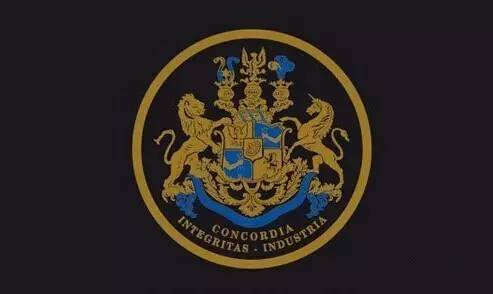
The Rothschild Family Coat of Arms
The underlying reason may lie in the longer histories of Europe and China. Chinese history, vast and majestic, spans over 5,000 years from the era of the Three Sovereigns and Five Emperors to the present. European history is somewhat shorter, yet it also boasts glorious periods marked by the emergence of great sages, such as the Greek and Roman eras. European nobility has long emphasized lineage, with many families tracing their heritage back at least to the same “Charles V.”
In an era defined by capital systems, or more precisely, before the concept of the “corporate legal person” had emerged, the endorsement of prominent families served to guarantee the continuity of credibility and quality. This fostered a virtuous cycle linking family control, business development, and familial expansion, ensuring that the means of production remained firmly in the hands of a select few. Even when dynastic power shifted to new rulers, or when unworthy descendants failed to sustain the legacy, one could still boast, “My ancestors were far more affluent than yours.”
From a Darwinian perspective, the essence of “inheritance” is selfishness. Controlling more means of production equates to securing greater opportunities for genetic propagation; families further solidify and prolong such monopolies through intermarriage—“I have an ancestral chromosome to offer you.”
However, the cannonade of the French Revolution shattered the dream of family monopoly. It proclaimed that “all men are born equal,” a principle further enshrined in the U.S. Declaration of Independence with the slogan “all men are created equal,” affirming everyone’s right to pursue happiness. Yet where does happiness come from? The control over means of production and wealth remains the sole path.
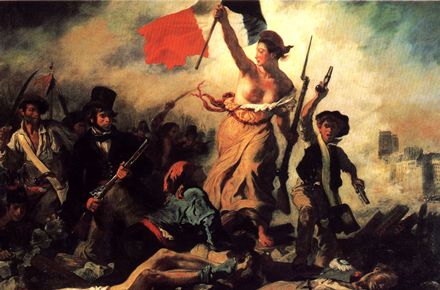
Oil Painting of the French Revolution
Thus, the modern corporate system was born, enabling individuals to register companies, operate capital, and leverage their intellect and ingenuity to collectively realize the great “American Dream.” Although women, African Americans, and other minority groups did not yet possess such rights at the time, a handful of dispossessed white Europeans, inspired by this vision, propagated it to all humanity in the name of Uncle Sam.
Modern interactions between China and the United States can be traced back to the era of foreign compradors and the collective memory of the Eight-Nation Alliance, followed by a hiatus of several decades due to regime change. Formal diplomatic relations between China and the United States were established in 1972. Alongside the U.S. liaison office that arrived with Henry Kissinger, various Sino-U.S. joint ventures and cross-border investments emerged. In addition to bringing in U.S. dollars, these developments also introduced elements of the modern American corporate system to China.
The connections among the French Revolution, the Declaration of the Rights of Man and of the Citizen, the modern U.S. corporate governance system, and the resignation of Fosun’s CEO are not “tenuous”; rather, they represent a subtle reflection of economic globalization and China’s modern enterprise management system.
Apple does not prioritize “legacy.” Thus, after the failure of the Macintosh launch, Steve Jobs was ousted from the company by an executive he had personally recruited from Pepsi, even though he remained one of Apple’s largest individual shareholders at the time. Microsoft likewise does not prioritize “legacy.” As a result, its CEOs have changed like flowing water—from Steve Ballmer to Satya Nadella, the latter being an Indian national. It is precisely because of this Indian executive that Bill Gates has had the time to manage his foundation, helping children in Asia, Africa, Latin America, and other economically underdeveloped regions gain access to healthcare and education.
China has been committed to playing a more significant role in the global economy. Chinese enterprises have actively pursued international expansion through mergers and acquisitions, investments, and collaborations. More importantly, they have been continuously adopting modern corporate governance systems, including the professional manager model and partnership structures.
The resignation of Liang Xinjun, CEO of Fosun Group, serves as a telling microcosm. While external observers were still focused on Fosun’s equity and governance structures, the group had already advanced its globalization strategy through listings on the Hong Kong stock exchange, overseas investments, the introduction of international partners, and strategic capital alliances.
The Big Three of Fosun
In the spring of 1992, a pivotal moment for many, Deng Xiaoping, despite his frail health, embarked on his Southern Tour. His speeches on “invigorating the economy” ensured the deepening of reform and opening-up, which had previously been met with wait-and-see and conservative attitudes among the senior leadership.
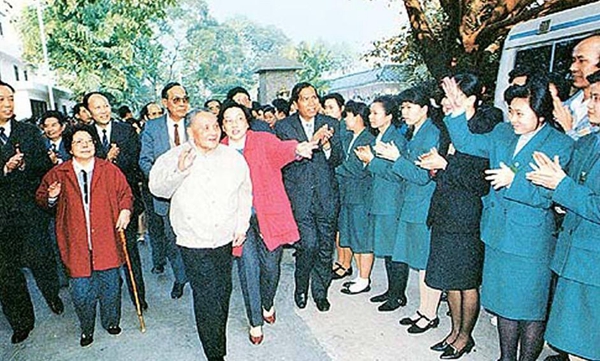
Deng Xiaoping’s Southern Tour Speech Brought a Springtime to China’s Economy and Ignited the Passion of Entrepreneurs
Beyond the economic environment, what was also stirred up were the restless hearts of several young people. That summer, Guo Guangchang, Liang Xinjun, and Wang Qunbin founded a small enterprise called “Guangxin,” with “Guang” derived from Guo Guangchang’s name and “Xin” from Liang Xinjun’s.
Later, a large group of like-minded individuals joined the venture, prompting “Guangxin” to change its name to “Fosun.” The three founders were all alumni of Fudan University, sharing a deep affection for their alma mater; “Fosun” also conveys the idea of gathering talent—“when united, we burn as one flame; when dispersed, we shine as stars across the sky.” Furthermore, “Fosun” is homophonic with “rejuvenation” in Chinese. Embracing a sense of duty toward family and country, Fosun’s people aspire to contribute to the great rejuvenation of the Chinese nation.
Guo Guangchang stated that since then, “cultivating oneself, regulating the family, establishing a career, and contributing to the world” has become the original aspiration of Fosun employees. With unwavering commitment, they have journeyed together to the present day, still holding fast to this founding mission.
On the evening of March 28, Liang Xinjun issued an open letter to Fosun Group employees, announcing his resignation. In the letter, Liang stated, “While fighting side by side with you, I never knew fear, never worried about getting hurt, and always knew that ‘our hearts were always together.’” He added, “I am grateful that you allowed me to step down and take time off to recuperate at a critical juncture when Fosun was striving for deeper growth and expansion.”
In addition to understanding, Guo Guangchang also expressed some self-criticism. He said, “I still remember that during an interview with the media, Xinjun once commented on me: ‘Once Guangchang reaches a certain height, he will inevitably set an even higher goal.’ Now I am also reflecting on myself. Is it like mountain climbing? Sometimes, without considering whether everyone is exhausted, I keep my eyes fixed on higher peaks, always thinking about moving forward together with the team. But in reality, there may already be companions in our team who need to catch their breath and take a rest.”
Guo Guangchang recalled that more than a month ago, he had dinner with Liang Xinjun, and they talked for over three hours. On that day, Xinjun proposed to him that due to health reasons, he wanted to take a temporary break. "I was very shocked. It was only after Xinjun carefully reconsidered and insisted that we arrived at today's joint decision."
“I still remember when Xinjun and I first started our venture together; he was quite slim back then. Later, due to work-related stress, I watched him gradually gain weight. Still later, he bet with Liu Chuanzhi and lost the weight again. Through twenty-five years of ups and downs, of gaining and losing weight, our brotherhood has only grown deeper and more substantial.”
Within the company, I have generally been courteous toward others; however, with Xinjun, I have never held back for the past twenty-plus years—speaking my mind and offering criticism whenever necessary. At the time, I was convinced that I was in the right; yet in retrospect, this may not have been entirely accurate. As a second-in-command, Xinjun must have exercised considerable tolerance and undergone significant, difficult adjustments to accept and face such public criticism. Had I been in his position, I certainly would not have demonstrated such forbearance. I feel deeply apologetic; it has truly been an extraordinary challenge for him.
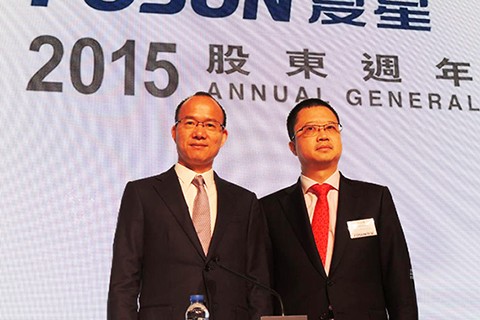
Guo Guangchang and Liang Xinjun
Drawing an analogy with characters from the Three Kingdoms period, Guo Guangchang is akin to Liu Bei, whose goal was the “restoration of the Han Dynasty”; Liang Xinjun resembles Guan Yu, personally charging into battle to capture cities and repel enemies. Indeed, this characterization holds true: media assessments describe Guo Guangchang as possessing a comprehensive strategic vision, focusing on technology and trends, and contemplating how to build Fosun into an international conglomerate comparable to JPMorgan Chase or Citigroup. In contrast, Liang Xinjun is regarded as adept at navigating the capital markets, characterized by his eloquence and astute thinking.
Today, Liang Xinjun has stepped down, and his successor is Wang Qunbin. With a technical background, Wang once led the development of Fosun’s first diagnostic reagent and has many years of experience in managing marketing and investment operations, which may enable him to seamlessly take over from Liang Xinjun.
Modern Enterprise System and Fosun's Internationalization
Fosun has stated that it learns value investment principles from Buffett, talent development and cultural construction from GE, globalized management from Li Ka-shing, asset management from Carlyle, and corporate risk control from Prudential. Through this learning process, Fosun has distilled a modern corporate system that guides its thinking and operations.
In this personnel restructuring, Executive Directors Chen Qiyu and Xu Xiaoliang have concurrently assumed the roles of Co-Presidents, while Wang Can, Kang Lan, and Gong Ping have been appointed as Executive Directors and Senior Vice Presidents. Guo Guangchang described the former group as long-time colleagues who grew with Fosun, maintaining an entrepreneurial spirit and continuously pushing their own boundaries. The latter group is younger and has already spent considerable time at Fosun, enabling them to quickly understand and implement Fosun’s strategy; starting from specific business units, they have all achieved outstanding results in their respective fields.
At this point, Fosun Group’s team of professional managers had largely taken shape. Together with its three foreign partners—Jorge, Henri, and Franz—Fosun had assembled a management team that was not only well-versed in each business sector but also capable of close collaboration. In Guo Guangchang’s own words, the company boasted “a cloud of battle-tested generals”: young, professional, globally minded, and entrepreneurial.
Where there are generals, there are battlefields. Fosun’s battlefields span the pharmaceuticals, real estate, steel, insurance, and media industries, as well as its global investment reach.
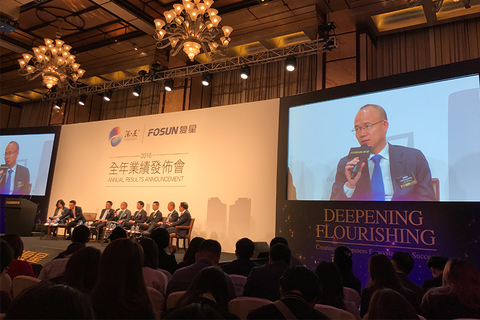
Fosun International Results Presentation
Fosun International held its earnings press conference in Hong Kong on the morning of the 29th, with the new generation of Fosun’s management team making a collective appearance.
2017 marked the 25th anniversary of Fosun’s establishment. The performance report released by Fosun showed that, as of December 31, 2016, Fosun Group’s total assets reached RMB 486.78 billion, with a five-year compound annual growth rate (CAGR) of net assets amounting to 23.7%.
Internationalization is a core strategic pillar for Fosun. In recent years, Fosun has acquired or established deeply localized subsidiaries in countries such as Japan, the United Kingdom, Russia, Brazil, and India. These entities bring extensive experience and resources in their respective local markets, which, when combined with Fosun’s global capabilities, have proven to be a powerful catalyst for growth.
Teams such as Japan’s IDERA, which has been part of Fosun for over two years, have completed multiple projects and jointly established J-REITs with Mitsui & Co., achieving a successful IPO in Tokyo and forming a closed-loop system encompassing investment, financing, management, and exit. The UK-based Resolution team, after completing the acquisition of the Thomas More Square project in London’s financial district, recently finalized the purchase of Estrella, a Grade-A commercial office building in Frankfurt. Eurasia Capital in Russia has also achieved remarkable results. This portfolio approach will become one of Fosun’s most important business development models in the future.
Some have compared Fosun’s development model to that of Berkshire Hathaway in the United States. This super “investment empire,” with a total market capitalization of RMB 435.3 billion, holds stakes in well-known companies such as American Express, Coca-Cola, Gillette, The Washington Post, and Wells Fargo, serving as an invisible helmsman behind these major corporations.
Fosun Group is no less impressive, holding stakes in multiple listed companies such as Minsheng Bank, Sina, JOYY Inc., Intime Retail, and Ping An Insurance. Under its umbrella are two publicly traded entities: Fosun International and Fosun Pharma, listed on the Hong Kong Stock Exchange and the Shanghai Stock Exchange, respectively.
Looking to the long term, Fosun may seize the opportunity presented by adjustments to its human resources and governance structure, leverage industrial extension, and rely on sectoral synergy to grow into a global investment group.