

Alibaba Cloud ET Medical Brain Launches to Tackle Cancer with Artificial Intelligence
Amidst the vast ocean of DNA sequences, it aligns and identifies mutated gene loci; inheriting the “discerning eye” of hundreds or even thousands of imaging experts, it captures millimeter-scale lesions in dark cross-sectional images of organs/tissues from CT, MRI, ultrasound, or X-ray scans, reducing the analysis time to under one minute...
None of this is science fiction; rather, it is the “superpower” endowed to ET Medical Brain by multiple scientific teams leveraging big data from clinical cases, continuously innovating and refining complex computational methods, and the open “Tianchi Crowdsourcing Intelligence” platform provided by Alibaba Cloud.
Among these, the imaging diagnostic system developed for thyroid nodules has been deployed for “clinical trials” at medical institutions such as The First Affiliated Hospital of Zhejiang University School of Medicine, where it assists ultrasound radiologists in interpreting images, detecting thyroid nodules, and generating diagnostic reports.
To date, several months of preliminary clinical practice have demonstrated that ET Medical Brain, developed on Alibaba Cloud, can assist physicians in interpreting thyroid ultrasound images within tens of seconds or even less. It delineates nodule regions and provides an assessment of whether they are benign or malignant. Previously, experienced sonographers required at least 20 minutes to review the images and prepare a diagnostic report.
On March 29, at the Apsara Conference·Shenzhen Summit, ET MedicalLiao Brain is officially launched.
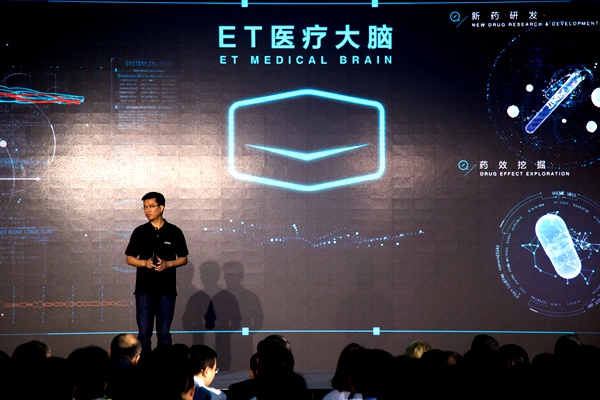
In Alibaba Cloud’s empowerment roadmap for its ET artificial intelligence system, beyond the widely publicized capabilities such as “mind-reading,” magic performance, air-and-ground traffic command hubs, and cybersecurity offense and defense, its medical capabilities—particularly in risk prediction, prevention and control, diagnosis, and treatment of high-prevalence diseases in modern society, such as thyroid disorders and lung cancer—appear even more critical, urgent, and inspiring.
“In tests involving big data analytics across multiple diseases, we realized that machines are capable of deep learning and mastering the ability to observe medical images and identify differences with the human eye, performing as well as human doctors!” said Min Wanli, an AI scientist at Alibaba Cloud. He noted that in certain disease areas where medical imaging serves as the primary basis for diagnosis—such as thyroid nodules and pulmonary nodules—AI-powered robotic systems can “fully serve as assistants to physicians,” significantly improving diagnostic and treatment efficiency at a low cost and with greater speed.
In addition to training in medical imaging diagnosis using CT, MRI, and ultrasound, Alibaba Cloud has partnered with top enterprises and startups from the computer science and biomedical fields, such as Intel and BGI Genomics, to integrate big data from genetic testing. Together, they are researching the strong correlation between diseases like lung cancer and genetic mutations. By leveraging ET’s deep learning capabilities, they aim to precisely locate the mutated gene sites (targets) that cause disease, ultimately assisting physicians in providing personalized treatment plans and guiding precision medication.
Within Alibaba Cloud’s artificial intelligence strategic layout, ET will be equipped with a range of medical capabilities, serving as a “doctor’s assistant” across multiple domains, including disease risk prediction, medical imaging diagnosis, precision treatment planning, drug efficacy mining, new drug development, disease surveillance, and health management.
Among the technologies initially integrated into Alibaba Cloud’s ET Medical Brain, the intelligent diagnostic algorithm for ultrasound imaging developed by Professor Kong Dexing’s team at Zhejiang University stands out as a leading solution.
Deep Learning on 10,000 Medical Records: "Machine Eye" Achieves Higher Accuracy Than "Human Eye"25%
“Big data is the foundation of intelligent diagnosis,” Professor Kong explained. Before its development, this technology underwent deep learning on more than 10,000 thyroid ultrasound images from various medical institutions, with nodule locations accurately annotated (localized) by experienced physicians.
Building on a vast reservoir of “memory,” the research team incorporated modern mathematical concepts such as rotational invariance into the computational system and adjusted the convolutional network architecture, thereby making the “machine eye” for detecting nodules more sensitive and the “machine brain” for determining whether nodules are benign or malignant more “intelligent.”
In 2016, starting from the Department of Ultrasound Imaging at the First Affiliated Hospital of Zhejiang University School of Medicine, this technology was subsequently deployed at the PLA Rocket Force General Hospital, the Liuxia Street Community Health Service Center in Hangzhou, and several online consultation platforms, initiating clinical validation of its detection rate and accuracy for thyroid nodules.
For many years, ultrasound has been the primary diagnostic method for thyroid nodules. Among various medical imaging modalities, ultrasound offers low cost, flexibility in location and timing, and real-time image acquisition. However, the collection and interpretation of ultrasound images are heavily dependent on physicians’ experience and technical skills, making them more challenging to process than other imaging techniques such as CT and MRI.
Clinical sampling surveys from tertiary hospitals in China indicate that the average diagnostic accuracy for thyroid nodules is only 60%. In many cases, a definitive diagnosis of whether a nodule is benign or malignant requires surgical resection followed by biopsy (pathological examination). "Without a biopsy, different physicians often reach different conclusions," frankly stated Zhao Qiyu, Deputy Director of the Department of Ultrasound at The First Affiliated Hospital, Zhejiang University School of Medicine. He noted that the benign or malignant nature of nodules is not always clear-cut on ultrasound images; some benign nodules may exhibit malignant features, while some malignant nodules may present with benign characteristics.
However, in the preliminary “clinical trials,” the machine achieved a detection rate of over 90% for thyroid nodules in approximately 2,000 ultrasound images, with an accuracy rate exceeding 85% in distinguishing between benign and malignant cases.
“Improvements in detection and accuracy rates have significantly reduced the burden of repetitive, mechanical tasks for physicians and shortened patients’ waiting times for examination reports. In particular, this has alleviated the longstanding dilemma where primary-care hospitals could perform ultrasound scans but lacked diagnostic capabilities,” Kong Dexing revealed. Currently, multiple community health service centers, including those in Xixi Subdistrict of Xihu District in Hangzhou, are eager to introduce ultrasound robots to serve as clinical “assistants” for physicians.
Intelligent ultrasound diagnosis operates in parallel with the physician’s performance of a B-scan ultrasonography examination. The intelligent diagnostic system automatically captures images, precisely “locates” nodules, and, within seconds, evaluates whether a nodule is benign or malignant by comparing it against a series of indicators derived from deep learning models, while simultaneously generating a report for the physician. To indicate the reliability of these computational results, the system assigns a probability score, providing a reference to support the physician’s final diagnosis.
Based on the deep learning capabilities of artificial intelligence to identify subtle differences in human eye recognition images and make judgments,On the Alibaba Cloud platformIt not only enables the study of thyroid nodules but also gives rise to an intelligent diagnostic system for lung nodules, which are a fundamental characteristic of lung adenocarcinoma.
Xing Xiang, an algorithm engineer at Alibaba Cloud, explained that the principle of AI-assisted diagnosis involves designing algorithms and recognition models to equip machines with deep learning capabilities. Meanwhile, large volumes of medical imaging data with accurately annotated lesion locations are collected to train the machine’s abilities in memory-based comparison and pattern recognition. Ultimately, this enables the system to interpret medical images—such as CT scans, MRI scans, X-rays, and ultrasounds—in place of physicians, thereby assisting doctors in making diagnoses.
“Theoretically, various imaging studies of all systemic organs and other massive medical datasets can be deeply mined,” said Xing Xiang.
Through a Prize-Based Competition, Alibaba Cloud ET Aims to Harness the Collective Strengths of Leading Medical AI Innovators
“Collective intelligence is the best.” Drawing on its accumulated experience in comparative research through competitive talent recruitment across multiple sectors—including e-commerce, logistics, transportation, finance, and information security—Alibaba Cloud has launched the “Tianchi” platform, aiming to create an open, application-oriented artificial intelligence “incubation” platform.
Regarding the development and refinement of the ET Medical Brain, given the high professional barriers in the healthcare sector, Alibaba Cloud places greater hope in the power of “collective intelligence.”
Gu Fei, a young postdoctoral researcher at Harvard Medical School, joined Alibaba Cloud to begin research on “tracking” gene mutations in lung adenocarcinoma.
From Gu Fei’s perspective, although there are numerous domestic institutions engaged in genetic testing, particularly cancer gene sequencing, their approaches to interpreting and analyzing DNA sequence fragments tend to rely heavily on statistical methods. In contrast, leading international internet technology companies such as Google and IBM have leveraged big data computational power and the deep learning capabilities of artificial intelligence, combined with large-scale genetic testing samples, to investigate and predict the relationship between diseases and genetic mutations.
“By leveraging deep learning on big data, machines can identify which gene mutation sites are strongly correlated with disease onset. The application prospects of this research include predicting disease risk, diagnosing diseases through targeted biomarkers, and providing precise, personalized medication guidance.” Before returning to China, Gu Fei studied the landscape of medical artificial intelligence in the country. Ultimately, considering computational power and platform inclusiveness (specifically, big data storage capacity and efficiency), he chose to join Alibaba Cloud’s ET Medical Brain to conduct in-depth research on the prevention and treatment of lung adenocarcinoma.
Over the past 18 months, BGI Online, a precision medicine project jointly established by Alibaba Cloud, Intel, and BGI Genomics, has also been exploring this area.
Previously, BGI Genomics, Alibaba Cloud, and Anhui Medical University jointly announced that they had completed the analysis of whole-exome sequencing data for 1,000 human samples within 21 hours, 47 minutes, and 12 seconds. Forty years ago, it would have taken 1,000 years to perform whole-genome sequencing on Escherichia coli.
“From a system architecture perspective, we have designed the ET Medical Brain as an open artificial intelligence system. Although Alibaba Cloud has dedicated a large number of medical and AI scientists to research and development, we are more eager to incorporate high-quality external algorithms and medical expertise. Only in this way can ET leverage the collective strengths of diverse sources,” said Min Wanli.
On the same day as the official launch of the ET Medical Brain, Alibaba Cloud announced a partnership with Intel and LinkDoc (a startup dedicated to big data research in oncology) to launch the Tianchi Medical AI Series Competition, a three-year crowdsourced competition for medical AI algorithms. The first season focuses on lung cancer, the most prevalent malignant tumor worldwide.
Wang Yiting, head of the Tianchi Platform—Alibaba Cloud’s big data incubator—introduced that, under the guidance of the National Health and Family Planning Commission, Tianchi has formed strategic alliances for medical research with more than 20 large cancer hospitals across China. For this season’s Crowdsourcing Competition, Tianchi will provide massive volumes of de-identified, high-resolution chest CT scan data.
As designed for the competition, participants/teams are required to integrate raw CT imaging data and train model algorithms to summarize and extract nodule features, ultimately achieving the capability to rapidly read and analyze CT images, intelligently detect pulmonary nodules, and determine their benign/malignant nature.
“Through such crowdsourcing competitions, we aim to identify outstanding engineers and R&D teams with strong computational capabilities and innovative models in the field of medical AI, enabling them to join Alibaba Cloud’s ET Medical Brain and jointly tackle diseases such as lung cancer, whose incidence rates are continuously rising and pose an increasing threat to human health,” said Wang Yiting. For participants and teams that stand out in the crowdsourcing competition, the Tianchi Platform will not only offer substantial cash prizes but also provide a range of software and hardware “incubation” services.
Regarding the development of the ET Medical Brain, Min Wanli explained that scientists and developers on the Alibaba Cloud platform do not need to manually summarize disease diagnosis and treatment patterns (i.e., encode problem-solving methods). Instead, they use massive amounts of de-identified medical record data as examples to train machines to perform specific deep learning tasks, allowing the systems to independently “discover” problem-solving approaches. The role of scientists is to optimize algorithms and provide substantial volumes of training data.
Last year, Huashan Hospital in Shanghai announced that, leveraging Alibaba Cloud’s capabilities, it would use digital models to replace certain clinical trials and simulate in vivo experiments on mice, thereby accelerating the development of breakthrough drugs.
Zuobula hopes to leverage the AI in Medicine Algorithm Crowdsourcing Competition as an opportunity to attract greater attention from medical institutions, physicians, and healthcare policymakers toward AI-driven diagnosis and treatment, thereby jointly driving industry transformation.
Gu Fei’s vision is to collaborate with AI scientists and biomedical experts from around the world to design and build, on Alibaba Cloud, a knowledge-learning model for predicting major diseases, enabling subsequent precise diagnosis and treatment, and providing personalized medication guidance.
“This model is more accurate than the major algorithms in the world,” said Gu Fei.