

Why the Second Wave of Internet Healthcare Crashed on Haodf Online: Business Model Evolution and Strategic Pivot to Internet Hospitals
By Liu Huiguang, Liu Dong, Liu Zongyu, and Hao Xueyang

At the beginning of 2017, Haodf Online set a goal for itself to break even. Wang Hang frequently traveled between Beijing and Yinchuan. After the $200 million led by Tencent was received, Wang Hang could finally breathe a sigh of relief.
Wang Hang’s 180 Days of Radical Transformation
Prior to 2016, Wang Hang, the founder of Haodf Online, was perceived as gentle and refined, consistently maintaining a low profile with limited public exposure. Although he occasionally granted media interviews, it was almost always out of courtesy rather than willingness. In conversations with VCBeat, Wang Hang frequently remarked, “I believe we should focus on doing things well first, without placing too much emphasis on promotion.”
After the news of Haodf Online securing Tencent’s Series D investment was revealed, Wang Hang’s first response to us was, “I’m still working hard, but Liu Qian helped me close the deal first.” This marks the first officially confirmed financing announcement in the 11 years since Haodf Online was founded.
Over the past year, Haodf Online has gradually become a favorite among major media outlets. Wang Hang’s frequent public appearances have made his transformation clearly evident. Taking March 2017 as an example, Haodf Online was featured in more than five exclusive reports on VCBeat, a figure only slightly higher than the total number of such reports throughout the entire year of 2016.
Wang Hang began to frequently voice his opinions in media outlets, including VCBeat, describing to the industry his company’s prospects, the future of internet healthcare, and explorations into the internet hospital model.
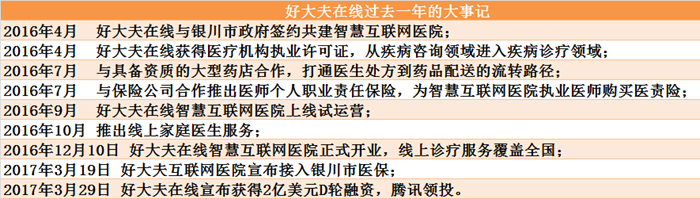
The origins of all this can be traced back to April 2016, when Haodf Online signed an agreement with the Yinchuan Municipal Government to jointly establish a smart internet hospital. From that moment on, Haodf Online obtained a Medical Institution Practice License, officially transforming into an internet hospital and formally expanding from the field of disease consultation into the realm of disease diagnosis and treatment.
In October 2016, rumors about Haodf Online began circulating online, leading to operational difficulties for the company and triggering large-scale layoffs. In response, Haodf Online issued a statement debunking the rumors, clarifying that the company was preparing for the launch of its Smart Internet Hospital and conducting routine adjustments to its organizational structure and staffing. Subsequently, Wang Hang shared Haodf Online’s recruitment information on his WeChat Moments, offering a low-key response.
In the wake of layoff rumors, Wang Hang decided to address the negative sentiment through media channels, shedding light on what Haodf Online is truly doing. Since then, we have seen a different side of Wang Hang.
Over the subsequent 180 days, Wang Hang made multiple appearances on VCBeat, sharing his thoughts and perspectives with the industry, as well as detailing the evolution of Haodf Online. Below are selected excerpts from Wang Hang’s viewpoints, all originally published on VCBeat.
“There has long been a prevailing view in the internet healthcare sector that physician-finding and consultation services, with appointment registration and medical consultations as their core business models, are unable to achieve profitability. For Haodaifu Online in the past, achieving profitability was indeed a challenge. However, since profitability is an essential goal for any enterprise, this has led to the significant strategic moves undertaken this year.”
“After two to three years of rapid development, this industry has already seen some bubble formation. Therefore, as it reaches its current stage, it will inevitably undergo a period of consolidation to address several key issues. First, the business model: how should it be structured? Second, what is the growth model, and how can the business model be effectively implemented?”
“Haodf Online’s Yinchuan Smart Internet Hospital operates much like Didi Chuxing: it does not build offline hospitals, purchase medical equipment, or hire physicians. Instead, it allocates patients’ diagnostic and treatment needs—such as laboratory tests, examinations, and prescription services—through a ‘dispatch’ model, thereby revitalizing underutilized medical resources.”
“In principle, every company should strive to pursue its commercial value. However, when capital flows in and places high demands on a company’s ability to expand its market presence, greater emphasis is often placed on user base, traffic, and foundational data, while attention to business operational metrics tends to decline. Although we have always maintained that the healthcare industry experiences no winter, the internet healthcare and mobile health sectors have nonetheless faced significant challenges during this year’s capital market winter.”
“The purpose of Haodf.com’s business transformation is to achieve commercialization and attain financial self-sufficiency. Only by establishing a virtuous commercial cycle can the platform continue to explore future opportunities. Without profitability, it is impossible to sustain such a commercial cycle. Consequently, physicians would be unable to earn income on the platform, and patients would not receive committed, commercially viable services, making it difficult for the platform to remain operational. Therefore, the ultimate goal of this transformation is to realize commercialization, achieve financial self-sufficiency, and build a larger-scale platform.”
“Internet hospitals can better guide patients to seek medical care locally, promote tiered diagnosis and treatment, and alleviate the financial burdens on families and the medical insurance system caused by seeking care in other regions, thereby making healthcare more time-efficient and convenient for Yinchuan residents. Therefore, Yinchuan’s recent medical insurance innovation is a highly significant public welfare initiative.”
“Haodaifu Online’s next goal is to develop commercial medical insurance products based on high-quality healthcare services, driving comprehensive innovation in service professionalism, accessibility, coverage levels, and cost-control capabilities to create a virtuous cycle and provide the public with trustworthy medical security services.”
How Does Haodaifu Internet Hospital Generate Revenue?
During the three months of operation, the Internet Hospital has registered 11,500 physicians for multi-site practice, covering all regions across China and serving 985,000 patients. Furthermore, as of March 2017, Haodf Online had listed 490,000 physicians from 7,500 accredited hospitals nationwide, among whom 145,000 had completed real-name registration, thereby accumulating substantial medical resources.
Wang Hang has been exploring the profit model of Haodf Online and has discussed this topic on multiple occasions. So, what are the actual revenue streams for Haodf Online? To address this, VCBeat conducted a business analysis of Haodf Internet Hospital, which primarily offers five types of products:
I. Information Inquiry Services: Similar to Baidu Zhidao, searching for terms such as “cold” will display categorized content including physician articles, classic consultations, introductions, symptoms, diagnostics, etiologies, and treatments related to colds and associated conditions, allowing patients to obtain detailed information according to their needs;
II. Expert Consultation Services: This includes online consultations (text-and-image, telephone, and video consultations) as well as family doctor services. Pricing for online consultations increases progressively based on the mode of consultation, ranging from a few yuan to over one thousand yuan. On Haodafu, patients can express their satisfaction with physicians through a “like” feature and by sending virtual gifts such as flower baskets and fruit baskets.
Family Doctor Membership Services Include: 1. Unlimited text and image consultations; 2. Unlimited callback calls; 3. Two calls per month to the doctor’s private phone number (in emergencies); 4. For complex cases, the family doctor will invite specialists to provide free telephone consultations. Fees range from hundreds to thousands of yuan, depending on the contract duration.
3. Consultation-focused medical services: Free referral and overseas referral services are available. The free referral service directs patients who require offline laboratory tests or surgeries to high-quality hospitals with underutilized medical resources.
Overseas Medical Services include remote consultations with international medical experts and treatment at authoritative institutions abroad. The overseas remote consultation service covers medical record collection and organization, medical translation, selection and scheduling of U.S.-based specialists, translation and interpretation of consultation reports, and appointment scheduling with leading domestic medical experts. Service fees start from RMB 42,000.
The overseas authoritative treatment services include medical record collection and organization, medical translation, coordination of multidisciplinary consultations, and appointment with domestic authoritative medical experts after returning to China. The service fee starts from RMB 78,000.
IV. Corporate Membership Services: Providing high-quality medical experts to support the physical and mental well-being of management teams and their families;
V. Patient Education Services: Assisting pharmaceutical companies with patient education initiatives.
Leveraging the business structure of smart internet hospitals, Haodf Online has also partnered with licensed online pharmacies such as Haoyaoshi and Jianke. After physicians issue prescriptions, qualified online pharmaceutical suppliers deliver medications directly to patients’ doors, thereby addressing the issues of incomplete drug assortments and lack of new medications in remote areas. Moving forward, Haodf Online plans to collaborate with insurance companies to launch next-generation health insurance products, working alongside physicians to help patients reasonably control medical expenses.
Has Internet Healthcare Found a Path to Monetization?
For Wang Hang and Haodf Online, these were 180 days of life-and-death urgency. For the entire internet healthcare industry, however, it was a two-year period marked by both pain and joy.
From 2014 to the first half of 2015, internet healthcare was undoubtedly the darling of both the market and investors. However, after the second half of 2015, the trend took a sharp downturn.
Prior to Haodf Online’s successful fundraising round, the sector had seen virtually no new financing for nearly two years. Among other internet healthcare platforms, only a few companies, such as WeDoctor and JiuYi 160, secured new funding; most other platforms have been unable to close financing rounds since 2015. Many smaller internet healthcare companies have accepted lower valuations to some extent in order to secure much-needed capital inflows.
Why? For one reason only: monetization. The mobile health model of lightweight consultations, represented by Chunyu Doctor, initially offered the market immense potential. However, in the face of a lack of core medical capabilities and pressure to generate revenue, this promise has turned into skepticism.
The entire market is searching for direction. Let us examine the market trajectory of internet healthcare. Haodf Online is arguably the earliest pioneer, having established its online consultation model as early as 2006. This model primarily generated revenue through voluntary tips from patients, a approach that garnered strong reputation but failed to achieve genuine commercial monetization. Another benefit of this model was that it cultivated a large number of physicians who were early adopters and innovators; Dr. Zhang Qiang, for instance, was one of the prominent key opinion leaders (KOLs) on Haodf Online in its early days.
Subsequently, mobile healthcare platforms represented by Chunyu Yisheng (Spring Rain Doctor) emerged. Their most distinguishing feature is the establishment of standardized doctor-patient services and fee structures via smartphones, thereby achieving a high degree of standardization and efficiency in internet-based healthcare and playing a pivotal role in market penetration. However, the most significant limitation of this model is that, due to current policies and other factors, physicians are unable to address patients’ core medical issues, necessitating secondary conversion for further care.
Subsequently, WeDoctor pioneered and led the internet hospital model, rapidly integrating a vast array of resources from hospitals, physicians, and local governments with unprecedented speed. Its momentum was unmatched, truly establishing it as a unicorn in the digital healthcare sector.
During this process, another major player, DXY, also experimented with the general practice clinic model, shifting its focus to offline operations. Of course, Chunyu Doctors has also made attempts in the clinic space, and WeDoctor is currently expanding into clinic channels.
In the exploration of payers, all parties have converged on similar paths: beyond end users, key partnerships are being forged with pharmaceutical companies and insurers, though these efforts remain in the trial phase.
In 2016, Haodf Online, a pioneer in online medical consultations, also chose to go all-in on the internet hospital model, concentrating its efforts in Yinchuan. This move attracted widespread attention and even achieved breakthroughs in medical insurance policies.
We believe that internet hospitals represent the core initiative of the Internet Healthcare 2.0 era, aiming to integrate internet platforms into the core of healthcare services—namely, consultation, prescription, and medical insurance reimbursement—thereby achieving monetization.
Medical Innovation Is Particularly Challenging! Teladoc, the first online consultation company in the United States, was founded in 2002. On March 3, it released its financial report for the fourth quarter of 2016. Teladoc’s membership surged to 17.5 million, a year-on-year increase of 43%. Total revenue amounted to $37.4 million, with a net loss of $14.3 million; revenue grew by 65% compared to the same period last year. Meanwhile, full-year revenue increased by 59%, reaching $123 million for the entire year of 2016.
Over the past decade-plus, Teladoc has undergone multiple business model adjustments and operational upgrades, evolving from a pure B2C model to a combined B2B and B2C approach, and finally achieved explosive revenue growth in 2016.
The successful securing of substantial financing by Haodaifu at this stage clearly demonstrates that the internet hospital model has gained market recognition, and the monetization pathways for internet healthcare are becoming increasingly clear.
Why Haodf Online?
What Exactly Does Tencent See in Haodf? Let’s First Take a Look at the Internet Healthcare Unicorns Previously Invested in by Tencent.
Dingxiang Yuan's advantage lies in its physician community.Not only does its online consultation platform host more than 10,000 attending physicians and above from Grade 3A hospitals, but it also boasts a professional medical and nursing team of thousands. Most critically, DXY commands a vast pool of professional medical resources, accounting for over 70% of China’s total physician population. Additionally, DXY’s WeChat official account has tens of millions of followers, and its B2C business has consistently remained profitable.
When Tencent invested in WeDoctor in 2014, the company was still known as Guahao.com. At that time, Guahao.com’s competitive advantage lay in the derivative value generated from its patient services. Tencent subsequently participated in WeDoctor’s Series C financing round, when WeDoctor aimed to build a nationwide internet-based tiered diagnosis and treatment platform. However, this plan ultimately led to the establishment of Wuzhen Internet Hospital, WeDoctor’s first online hospital. This initiative gained significant momentum thereafter; it has now been deployed across 18 provinces and municipalities in China, integrated with the information systems of over 2,400 hospitals, amassed more than 150 million real-name registered users, engaged 260,000 expert physicians, and provided cumulative services to over 850 million patient visits.WeDoctor has established a closed-loop ecosystem integrating healthcare services, pharmaceuticals, and insurance, boasting extensive resources in patients, medical experts, hospitals, and government partnerships.
In the physician segment, in addition to DXY, Tencent has also invested in Medlinker. Medlinker now boasts 430,000 real-name verified physicians, with 130,000 monthly active physicians.On January 12, 2017, Medlinker and Rizhao Huafang Traditional Chinese Medicine Hospital in Shandong Province launched Medlinker’s first general practice internet hospital, providing patients with services such as online consultations, offline referrals, in-person visits, surgical appointment scheduling, and online prescription delivery. Founder Wang Shirui boldly stated that this was merely the beginning, with plans to establish internet hospitals in Sichuan, Chongqing, Hebei, Liaoning, and other provinces and municipalities in 2017. The operations of the internet hospital enable Medlinker to maximize the utilization of its physician resources.
So, what does Haodf.com offer?Haodf Online has always held firmly onto its position as one of China’s leading platforms for top-tier doctors and patient resources.According to data provided by Haodf.com, by the end of 2016, the platform had served a total of 32.74 million patients, with 142,000 doctors providing services on the platform. By March 2017, it had included 490,000 doctors from 7,500 accredited hospitals across China, among whom 145,000 had completed real-name registration.
Wang Hang once said, “The Yinchuan Smart Internet Hospital established by Haodf Online operates much like Didi Chuxing: it does not build offline hospitals, purchase medical equipment, or hire doctors. Instead, it allocates patients’ diagnostic and treatment needs—such as laboratory tests, examinations, and prescription services—through a ‘dispatch’ model, thereby revitalizing underutilized medical resources.”
From fierce rivals to strategic partners, Kuaidi and Didi not only gave birth to Didi Chuxing, China’s largest ride-hailing company, but also enabled Tencent and Alibaba to deliver a dimensionality-reducing strike through cash flow superiority, leaving competitors other than Didi to taste the fate of cannon fodder in the aftermath of the titanic clash.
Currently, Haodaifu Online, WeDoctor, DXY, and Medlinker are all developing internet hospitals. Meanwhile, we have noticed a striking coincidence: all of them have established operations in Yinchuan. This has sparked much speculation. However, for WeDoctor, DXY, Medlinker, and Haodaifu Online—all of which are backed by Tencent—the fierce competition between Kuaidi and Didi bears little resemblance to the dynamics among these four players.
Their behavior can be understood as follows: Internet healthcare companies initially started with diverse focal points. However, whether it was appointment scheduling, online consultations, physician services, or doctor-focused tools, these were essentially peripheral businesses centered around the core of diagnosis and treatment, making it difficult to achieve widespread profitability. As the path to monetization became increasingly clear, it emerged that there was effectively only one viable route. Consequently, industry players have begun to flock into the internet hospital sector.
Moreover, it is implausible for Tencent to invest in several companies with entirely identical business models. If their resources were largely overlapping, Tencent’s investment returns would inevitably fail to be maximized. In reality, these unicorn companies each possess distinct strengths. By integrating hospitals, physicians, patients, pharmacies, insurance providers, and various derivative resources, Tencent has secured the most powerful leverage in the internet healthcare sector.
Thus, we cannot help but ask: Will internet hospitals become a monopoly for Tencent’s portfolio companies? Judging solely by numbers, such a conclusion seems premature. Even if we combine the number of internet hospitals operated by WeDoctor, DXY, Medlinker, and Haodf Online, the total amounts to only slightly more than 20. In contrast, according to the database of VCBeat Eggshell Research Institute, we have collected data on 79 internet hospitals that are either under construction or already operational.
However, Tencent’s move signals its heavy bet on internet hospitals, highlighting their monetization potential. The second wave of internet healthcare, driven by Tencent, is poised to take off.