

The Most Overlooked Among Tencent's Five $500M+ Healthcare Investments Submits IPO Filing
On March 29, VCBeat reported the news that Haodaifu raised $200 million in its Series D financing round, led by Tencent, which sparked widespread discussion on WeChat Moments.
Another key focus of this financing round is Tencent’s healthcare strategy. A review by VCBeat of Tencent’s major investments in internet healthcare reveals:
In 2014, Tencent led WeDoctor’s Series B round with an investment of $104 million; in 2015, Hillhouse Capital and Goldman Sachs co-led the Series C round, with Tencent participating as a follow-on investor, raising a total of $394 million.
On September 2, 2014, Tencent invested $70 million in DXY.cn;
In January 2015, Tencent invested RMB 150 million in Zhuojian;
On September 7, 2015, Medlinker secured $40 million in Series B financing, led by Tencent and followed by Yunfeng Capital.
On March 29, 2017, Tencent led Haodf Online’s $200 million Series D financing round;
As healthcare reform advances, Tencent’s investments in medical enterprises have been remarkably swift—akin to the one-inch punch in Wing Chun: fast, fierce, and precise.
Since 2014, Tencent has primarily invested in five internet healthcare companies—WeDoctor (Guahao.com), DXY, Zhuojian, Medlinker, and Haodf—with cumulative investments exceeding $500 million.Capital is the most powerful catalyst for corporate growth. What is the current status of these five companies invested in by Tencent? And what underpins Tencent’s investment logic?
Tencent’s investment logic has never been disclosed to the outside world, remaining as enigmatic as a riddle. Tencent has invested in numerous healthcare and medical enterprises, along with a substantial number of strategic investments related to government and urban development. Here, we review the five investments most closely tied to internet healthcare: DXY, Zhuojian, Guahao.com, Medlinker, and Haodf Online. By examining these portfolio companies, we hope to gain some insights into Tencent’s strategy.
An Overview of BAT’s Involvement in the Healthcare Industry: Only Tencent Has Deeply Penetrated the Core of Healthcare. On March 3, Baidu Doctor was shut down and taken over by Haodf Online. Since Alibaba Health’s drug regulatory code was revoked, Alibaba Health has still been seeking opportunities to enter the core of hospital operations.
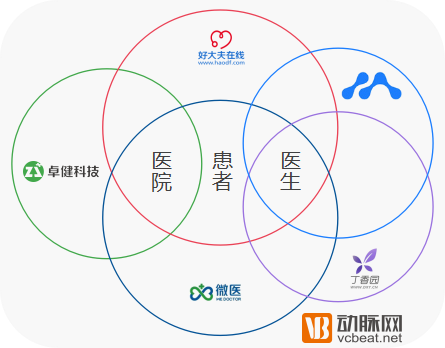
Throughout, Pony Ma has made “connecting everything” the core of his strategy, and internet healthcare is no exception. Among these five companies, two target consumer-facing (C-end) users—WeDoctor and Haodafu; two cater to the physician side—Medlinker and DXY; and only one focuses on the hospital side—Zhuojian. In terms of the volume of medical resources, hospitals still account for the vast majority of the share.
These five companies embody Tencent’s two core investment logics in healthcare: first, comprehensive coverage of all key stakeholders in medical services, including patients (WeDoctor), physicians (Dingxiang Yuan), hospitals (Zhuojian Technology), and private healthcare providers (Medlinker); second, end-to-end coverage of the entire patient journey, encompassing pre-consultation, treatment, post-consultation, rehabilitation, and even emergency care.
The healthcare industry involves numerous stakeholders, including patients, physicians, hospitals, pharmaceuticals, and the government. Tencent’s portfolio companies cover nearly all of the first four segments. Since the key barriers to entry in this industry are controlled by physicians and hospitals, it is evident that Tencent has accumulated sufficient leverage to command a significant voice in the sector.
So, how are these five healthcare companies currently developing? What are their respective characteristics and roles?
The first investment was in DXY, a service platform for physicians. The deal took place in early September 2014, with an investment amount of $70 million. At the time, Tencent’s own tech media outlet, Tencent Technology, commented on the move as follows: “This marks Tencent’s formal entry into the healthcare and medical sector. It is reported that following the completion of the investment, DXY will engage in a series of collaborations across Tencent’s various platforms, including exploring integration with the WeChat ecosystem.”
Also targeting the physician side, Medlinker secured $40 million in funding led by Tencent in early September 2015. As one of the most successful startups in building physician social networks, Tencent’s investment in Medlinker signals its intent to make a strategic deep dive into the physician community sector.
Medlinker now boasts 430,000 real-name verified physicians, with 130,000 active doctors each month. On January 12, 2017, Medlinker partnered with Huafang Traditional Chinese Medicine Hospital in Rizhao, Shandong Province, to launch its first general practice internet hospital, providing patients with services such as online consultations, offline referrals and transfers, in-person visits, surgical appointment scheduling, and online prescription fulfillment with delivery. Founder Wang Shirui declared that this was merely the beginning, announcing plans to establish internet hospitals in Sichuan, Chongqing, Hebei, Liaoning, and other provinces and municipalities throughout 2017. The operations of internet hospitals enable Medlinker to maximize the utilization of its physician resources.
On the consumer side, Tencent has invested in two internet healthcare companies: WeDoctor and Haodf Online.
WeDoctor’s (Guahao.com) financing round took place in September 2014, led by Tencent, with a total investment amount of $106.5 million. Following the investment, interfaces were provided to hospitals and physicians, enabling them to connect seamlessly and offer convenient healthcare services to hundreds of millions of users across Guahao.com, WeChat, and QQ. Additionally, WeDoctor boasts substantial government resources.
Next came Haodf Online, which has recently dominated social media feeds. Apart from Wang Hang’s disclosure that the company will focus on developing commercial insurance products based on high-quality medical services, its future trajectory remains to be seen.
The only enterprise targeting the H-side (hospitals) was Zhuojian. This occurred in January 2015, a time when the fervor around “Internet + Healthcare” was gradually cooling down, with an increasing number of people advocating for “Healthcare + Internet.” Zhuojian was a company built on serving hospitals.
According to insiders at Tencent, everyone is rushing to build internet hospitals and directly target consumers (C-end), thereby going head-to-head with traditional hospitals. In contrast, Zhuojian has chosen to stand alongside traditional hospitals, empowering them through upgrades—a strategic counterpoint that reflects a broader vision.
Why Is Zhuojian the Most Overlooked? Because Zhuojian specializes in hospital-side operations. The internet industry finds it difficult to comprehend due to its deep integration, while the healthcare industry only has a superficial understanding because of its internet-driven approach. As a result, Zhuojian has been moving forward quietly under the national "Internet + Healthcare" policy, unaware to many that it has already established a profound presence.
Thus, Tencent’s overall landscape is gradually taking shape. Guahao.com represents the scenario of online medical consultations; DXY represents the scenario of academic exchange among physicians; Medlinker represents the scenario of physician social networking; Zhuojian Health represents the scenario of hospital digitalization; and Haodafu Online will focus on the health insurance sector.
The industry requires an ecosystem, exploration demands companionship, and both are even more dependent on policy. For example, the liberalization of multi-site practice for physicians has spurred the emergence, financing, and growth of a large number of online consultation companies.
On March 28, the National Conference on Healthcare Reform was held in Beijing. Vice Premier Liu Yandong specifically pointed out that by 2017, all tertiary public hospitals must fully participate in leading the establishment of medical consortia, break regional restrictions, achieve vertical integration, facilitate the downward flow of resources, and form communities of shared management, responsibility, and development linked by common interests.
It is evident that the construction of medical consortia in Grade 3A hospitals will witness explosive growth this year. Prior to this market surge, Zhuojian has established numerous benchmark medical consortium projects, such as the one with Henan Provincial People’s Hospital.
Under the guidance of the top-level design by the Henan Provincial Government, Henan Provincial People’s Hospital spent one year building an Internet-enabled, smart tiered diagnosis and treatment platform. Through steady, step-by-step progress—from initial product development and framework structuring to network deployment, pilot construction, and project implementation—the hospital has realized a tiered care pathway characterized by “initial consultation at the primary care level, treatment of serious conditions at hospitals, and rehabilitation back in the community,” thereby establishing itself as an industry benchmark.
As of now, the Internet-based Smart Tiered Diagnosis and Treatment Platform of Henan Provincial People’s Hospital has established collaborative relationships with 17 municipal-level hospitals across 18 prefecture-level cities in Henan Province, as well as 111 county-level hospitals in 108 counties and districts. In 2016, the platform conducted 3,210 remote consultations, facilitated 1,739 upward and downward patient referrals, performed 11,430 remote ECG diagnoses, completed 7,364 remote pathology diagnoses, provided on-site free clinic services to 30,650 patient visits, carried out 27,225 ward rounds, demonstrated 1,068 surgical procedures, held consultations for 7,570 cases of difficult and complex diseases, organized 1,848 teaching and training sessions, and conducted follow-up visits for 128 patients in different locations.
Perhaps 2017 was a year of rapid development for Zhuojian.