

BGI Genomics Lists on A-Share Market After 18-Year Journey from Human Genome Project to Commercial Sequencing Leader
The above plot is purely fictional. Any resemblance to actual persons or events is purely coincidental.
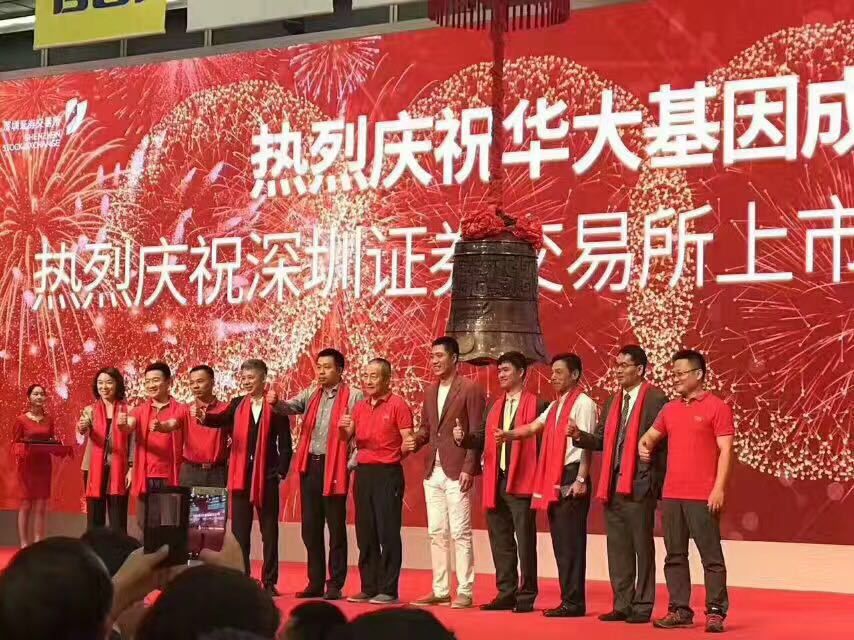
On July 14, 2017, BGI Genomics, the world’s largest sequencing institution, finally went public after 18 years since its establishment.
From the initial filing of its prospectus in 2015, to the unexpected suspension of regulatory review in 2016, and finally to its official listing on the A-share market this year, news regarding BGI Genomics’ IPO has never ceased.
“Or listed in 2016,” “earliest listing in March”—such headlines are abundant online. Now, with the bell-ringing ceremony on the A-share market, BGI Genomics (300676) has officially been listed and issued, bringing all speculation to a close.
For the entire NGS industry in China, this is a day worth commemorating.
Overcoming All Obstacles to Participate in the Human Genome Project
In the 1990s, Wang Jian and his colleagues conducted genomics research at the University of Washington in Seattle. Directly across from them was the leading laboratory among the scientific teams participating in the Human Genome Project at that time. Even then, they were discussing: “Should we bring this technology back to China?”
In 1990, the Human Genome Project, hailed as one of the three major scientific undertakings of humanity, was officially launched. The United States, the United Kingdom, France, and Japan all committed their top-tier scientific research resources to the initiative. At that time, however, Chinese institutions did not demonstrate particular enthusiasm. Nevertheless, Wang Jian remained steadfast in his conviction: “China must participate.”
In April 1999, a U.S. Congressional hearing called for accelerating the Human Genome Project. Wang Jian realized that this was his last chance. The debate over whether or not to participate had been ongoing in China for ten years. “There was no time left for hesitation!”
That night, he stayed up all night drafting a report to the relevant authorities. Regrettably, he received no response for a long time. Wang Jian felt both frustrated and anxious—only six months remained. “If I fail to act, I will become a sinner against history,” he said, his voice choking with emotion. He took a sip of water from the table, turned his head, and drew a deep breath before making a decision: “I will do it, even if it costs me my entire fortune.”
Wang Jian once candidly admitted that when BGI was initially established, it had no commercial objectives whatsoever; the sole mission was “to complete that 1% of the task.” At the time, however, BGI was merely a newly founded small company. As a developing country, China did not have the ample resources to participate in the Human Genome Project. With no funding, no instruments, and no reagents, how could it be done? Wang Jian considered selling the company.
After securing capital, the company was valued at 40 million yuan. “Just give me half of that amount,” he said. But when it came time to deliver the 20 million yuan, Wang Jian was informed that the other party could only provide 10 million yuan, with just 5 million yuan counted as investment. The remaining 5 million would need to be treated as a personal loan. “Fine,” Wang Jian gritted his teeth and agreed. However, the other party once again stalled, claiming that board approval was required before proceeding.
“The daylilies are about to go cold.” If you wait any longer, the opportunity will be gone. “I’ll mortgage everything I have to you; can you at least let me purchase the instruments and reagents first?” This was his final concession. But the other party’s reply remained the same two words: “No.”
“Money talks.” This phrase has become an eternal pain in Wang Jian’s heart.
On September 1, 1999, the Fifth International Strategy Meeting of the Human Genome Project was held in London. Yang Huanming took the stage and announced that China was willing to undertake 1% of the project. In fact, he had not been authorized by the Chinese government.

The Human Genome Project, the Apollo Moon Landing Program, and the Manhattan Project are collectively known as the three major projects in life sciences.
On November 11, an emergency meeting was convened in Beijing’s Yizhuang district, where the Genomics Project was officially incorporated into the national strategic action plan. BGI also secured partial funding from the Ministry of Science and Technology.
As a result, the 1% task became a joint responsibility of the Southern Research Center, the Northern Research Center, and the Institute of Genetics of the Chinese Academy of Sciences. BGI embedded itself within this framework, becoming an invisible “coolie laborer.”
In the early days of genomic research, the various research approaches adopted by different institutions remained a contentious issue. For BGI, however, the greater pressure stemmed from funding constraints. When asked after the completion of its task why it had only undertaken 1% of the project, Wang Jian gave a witty yet realistic reply: “The pot is only so big, and the iron can only fetch so much money.”
At that time, BGI was jokingly referred to as a “trouble maker.” Genomics research is a capital-intensive endeavor, often exhausting its funding shortly after disbursement. The Ministry of Science and Technology described BGI in these terms: “infuriating.”
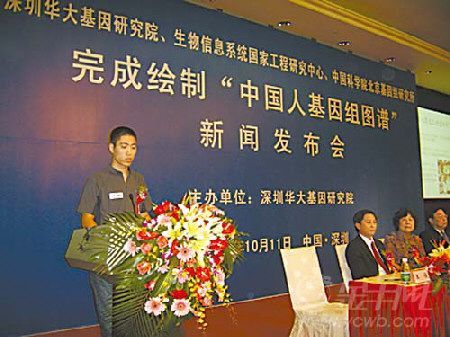
Despite the pressure of time and funding, BGI ultimately completed its 1% contribution to the Human Genome Project. In June 2000, President Clinton announced the completion of the “working draft” of the human genome, a collaborative effort undertaken by 16 centers across six countries: the United States, the United Kingdom, Germany, Japan, France, and China. China was the only developing country to participate in this initiative.
BGI Research: China's Voice in Global Genomics
In 2001, Hangzhou BGI was established with the aim of completing the Rice Genome Project. Rumor has it that Wang Jian even misled everyone by claiming that Japan would complete the sequencing of the rice genome on “September 18,” thereby motivating the team to accelerate their research progress.
In October of that year, the Chinese Academy of Sciences, the State Development Planning Commission, and the Ministry of Science and Technology jointly announced that China had taken the lead worldwide in completing the “working draft” map and database of the rice (indica rice) genome.
The rice genome project is said to have cost over 200 million yuan, leaving BGI heavily in debt. However, Wang Jian believes that the project was completed independently by BGI and brought the institute “international influence,” making it a worthwhile investment!

On April 5, 2002, the U.S. journal Science published an academic paper on the working draft of the Chinese rice (indica) genome as its cover article, which has also become the most frequently cited life sciences paper in China since the founding of the People's Republic of China.
During the SARS outbreak, BGI was the first in China to decode the complete genome sequences of four strains of the SARS virus and the first globally to release a SARS diagnostic kit. In 2004, a magnitude-9 earthquake struck the Indian Ocean seabed, triggering a devastating tsunami across Southeast Asia that claimed more than 292,000 lives.
China dispatched substantial relief supplies to the disaster-stricken areas, and BGI Genomics actively deployed a DNA identification rescue team for tsunami victims to Thailand’s tsunami-affected regions to participate in relief efforts. On July 1, 2005, the DNA test results for tsunami victims, completed by BGI Forensics, were handed over to Thai Prime Minister Thaksin by Chinese Premier Wen Jiabao and President of the Chinese Academy of Sciences Lu Yongxiang, representing the Chinese government.
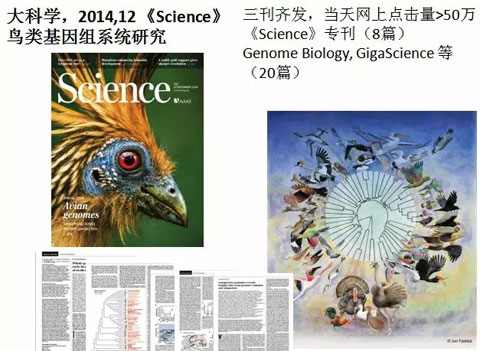
It is evident that BGI during this period was a research-oriented institution. Its work was predominantly scientific and public-welfare in nature. Research achievements, including the Rice Genome Project, the International HapMap Project, and the genomes of the silkworm and chicken, were successively featured on the covers of Science and Nature. Notably, the paper on the Rice Genome Project became the most-cited life sciences publication in China since the founding of the People's Republic of China.
Cost Reduction Drives Commercialization Potential: BGI’s Rapid Expansion in the Era of Next-Generation Sequencing
In 2006, the next-generation sequencer was introduced. Zhou Daixing, then employed at Solexa in the United Kingdom, approached Wang Jian to market this sequencing instrument. Compared with the first-generation Sanger dideoxy termination method, second-generation sequencing offered superior advantages in terms of throughput, speed, and cost.
After seeing it, Wang Jian was thrilled. BGI had introduced China’s first—and Asia’s first—installed Solexa sequencer, which later became known as the Genome Analyzer (GA sequencer). Tian Geng, founder of Yuanma Gene, recalled in an article: “At that time, the machine BGI received bore the serial number 19, indicating it was the 19th Solexa sequencer worldwide.” That same year, Solexa was acquired by Illumina.
Costs were bound to come down. Wang Jian saw the commercial potential of gene sequencing and prepared to acquire five more units. However, deploying so many instruments at the Chinese Academy of Sciences (CAS) all at once might not have been realistic. In 2007, Wang Jian resigned from his position as Deputy Director of the Beijing Genomics Institute and led BGI south to Shenzhen—marking BGI Genomics’ return to private-sector status.
In addition to Illumina, BGI has also successively purchased several instruments from Roche and Life Technologies. Tian Geng wrote: “In a sequencing laboratory in Shenzhen, three once-popular representative NGS platforms—Roche’s 454 sequencer, Life’s SOLiD, and Illumina’s GA—were operating side by side, a scene rarely seen anywhere else in the world.”
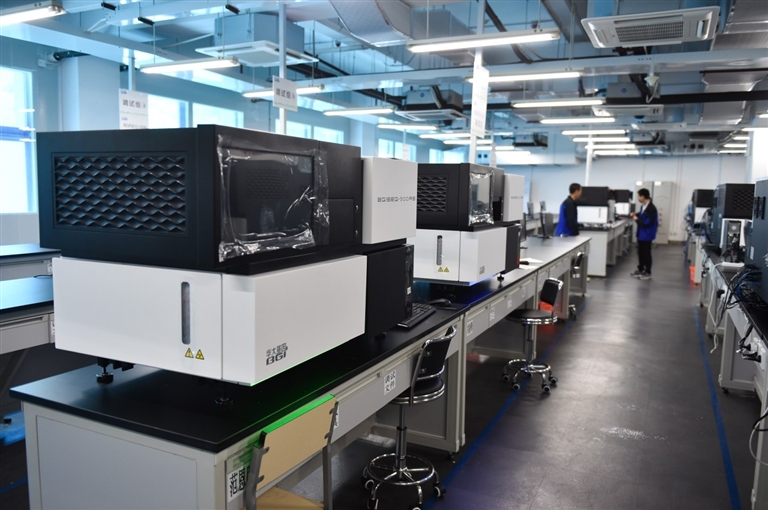
In 2010, BGI made a substantial investment to purchase 128 HiSeq 2000 sequencers from Illumina. This marked the largest order in BGI’s history and established it as the world’s largest sequencing center.
Questioning and Controversy: Scientists or Tech Laborers?
During those years, BGI Genomics experienced rapid growth in Shenzhen. Perhaps drawing inspiration from the Human Genome Project, Wang Jian consistently advocated for modularizing complex scientific research. By leveraging instruments, equipment, and reagents purchased from abroad, combined with low-cost domestic labor, the company gradually established a complete and efficient gene sequencing workflow.
However, this unique research model has also drawn significant controversy to BGI, with its labor-intensive approach and assembly-line workflows inevitably drawing comparisons to the manufacturing giant Foxconn.
Is BGI Genomics a research institution or a corporation? Are BGI employees scientists or “tech laborers”? Such debates have yet to cease.

In the face of skepticism, Wang Jian remained composed, stating, “Practice is the sole criterion for testing truth.” Since its establishment, BGI has published a total of 1,900 papers, including more than 200 in top-tier journals.
In addition to these research achievements, which have been published in scientific journals at an astonishing pace, this model has also enabled BGI Genomics to keep its average sequencing costs nearly ten times lower than those of its international peers.
Acquisition of CG: A Reverse Takeover Following Market Blockade
Perhaps BGI has grown too rapidly, or perhaps the sequencing market pie is expanding; upstream equipment manufacturers are no longer content with hardware sales alone and have begun to enter the midstream sequencing market.
In 2012, an upstream instrument supplier collaborating with BGI suddenly ceased selling instruments to them and stopped providing maintenance services for their existing equipment. The supplier demanded that BGI follow a development roadmap dictated by them, while also increasing the prices of reagents and consumables several fold.
“This was tantamount to strangling us to death.” Wang Jian described the situation at that time.
At that time, BGI had not even considered capturing the upstream market; all reagents and instruments were purchased from external suppliers. Upstream sanctions severely hindered BGI’s international expansion. “If they were to double the prices of our reagents, BGI would be doomed.” Feeling constrained on all fronts, BGI decided to pursue reverse acquisitions of its upstream suppliers.
The target company, CG, is a U.S. Nasdaq-listed company, ranking third in the upstream market with a valuation of nearly $180 million. BGI simply could not raise such a large sum, and as a last resort, it had to open up to capital markets once again.
By this time, BGI had already gained widespread renown, attracting a surge of capital. Sequoia Capital and Songhe Capital became its first batch of investors. Unlike the situation over a decade earlier, BGI was highly selective and assertive in its choice of investors this time, demanding high valuations while refusing valuation adjustment mechanisms (VAMs), making no commitments to an initial public offering (IPO), and rejecting any interference in corporate decision-making. Wang Jian no longer made concessions to capital; mutual trust and alignment of vision were his guiding principles.
“Money talks.” Even after many years, this phrase still felt like a fishbone stuck in Wang Jian’s throat, causing a lingering ache.
Although the funding issue was resolved, subsequent developments were far from smooth. In an interview, Wang Jian once remarked that while the acquisition itself was a minor matter, it constituted a significant strategic move.
During the more than six months of review, narratives of the “China threat,” “monopoly,” and “biosecurity risks” have continued to circulate in the United States. “BGI has grown too quickly, disrupting its upstream suppliers. Therefore, once it gains momentum, they will inevitably seek to suppress it.”
Ultimately, Bill Gates and the Children’s Hospital of Philadelphia stepped in to help BGI draft an open letter stating, “What BGI does is entirely for public welfare and does not pose a monopoly threat.” This ultimately led to the U.S. government approving the security review.
Filling the Upstream Gap: Forging Our Own “Gun”
The acquisition of CG filled BGI’s previous gap in the upstream industry, a move likened by outsiders to obtaining the secret formula of Coca-Cola.
In fact, CG was ranked third in the U.S. upstream market at the time and was considered obsolete by the industry. What BGI truly valued was CG’s patent protection. Following the acquisition, BGI injected an additional RMB 2 billion into CG, aiming to transform the company from a third-place player into the industry leader and “forge its own guns.”
Today, BGI’s latest sequencers have reduced sequencing costs to $600, representing a top-tier level in terms of cost-effectiveness. Looking at China’s genomics industry, “foreign instruments” have captured the entire market. For BGI, this is both a challenge and an opportunity.
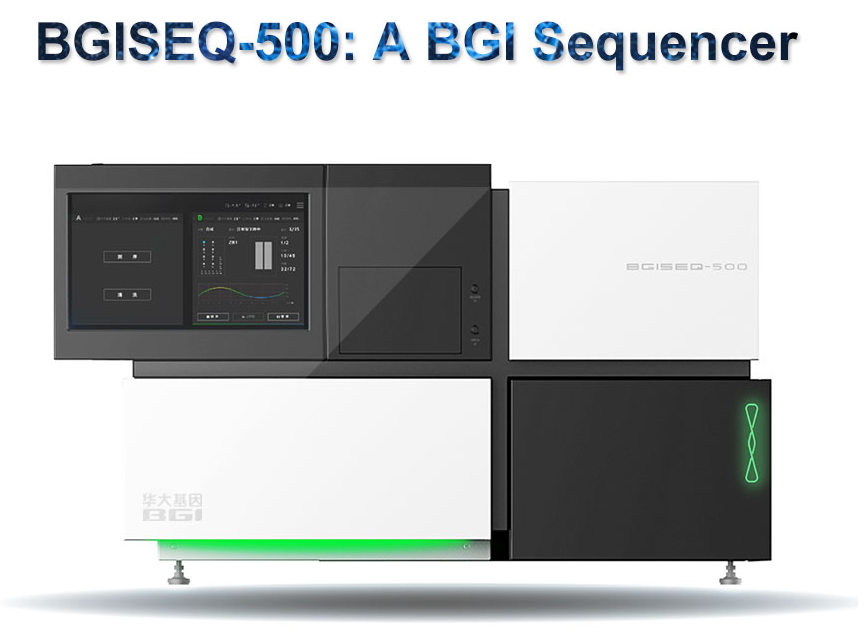
In 2015, BGI had already invested RMB 2 billion in the upstream market. With its proprietary technologies now available, it is difficult to predict how the market landscape will evolve.
In 2016, BGI signed a province-wide collaborative project with Henan Province. Wang Jian hoped that research departments in all provinces and municipalities across the country would recognize the strategic importance of their own core capabilities. He believed that genomics research requires the accumulation of data, the digitization of species, and the globalization of national gene banks—objectives that cannot be achieved through commercial efforts alone.
China's Sequencing Industry "Whampoa Military Academy"
Under Wang Jian’s leadership, BGI has long been permeated by an atmosphere that reveres youthful heroes.
From Wang Jun, a founding member who joined BGI at the age of 23, to Li Yingrui, a top student who dropped out of Peking University at 19, and then to Zhao Baiwen, who became the head of BGI’s research team at the age of 16 before even graduating from high school.
Wang Jian, known for his unconventional approach, has placed the focus of talent development on these young prodigies. He even proudly declared that they will become the core members of BGI’s executive leadership pipeline in the future.
Yet, the exodus of talent has continued unabated. Between 2014 and 2015, BGI experienced a wave of senior executive departures. These young professionals, once highly regarded by Wang Jian, left the company for reasons that remain unclear. Wang Jun and Li Yingrui departed BGI to establish iCarbonX, a big data health company, while Zhao Baiwen embarked on his own entrepreneurial venture in quantitative health.
Entrepreneurs from BGI include those born in the 1950s as well as those born in the 1990s. The companies they founded after leaving BGI are often jokingly referred to as “Hua Xiao” or “Hua Chuang.”
In 2016, Genetron Health conducted an inventory of these BGI-affiliated startups, numbering close to 40. It can be said that BGI and its “BGI-affiliated” ventures have propped up half of China’s sequencing industry. As a result, BGI has earned the reputation as the “Whampoa Military Academy” of the gene sequencing sector.
A Bumpy Road to IPO
When it comes to BGI’s journey toward going public, the term “tumultuous” truly aptly describes it. The earliest moves toward an initial public offering (IPO) can be traced back to 2014.
In December 2014, BGI initiated the restructuring of BGI Medicine and BGI Tech. BGI Holdings and BGI Agriculture collectively held 57.6226% of the shares in BGI Tech. During this period, BGI Medicine also increased its capital in BGI Medicine. Upon completion of the capital increase, BGI Tech became a controlling subsidiary of BGI Medicine, and BGI Holdings’ shareholding ratio in BGI Medicine consequently increased.
Almost simultaneously with this restructuring, Jinglin Jingqi exited BGI Medicine by transferring its 0.37% equity stake to Nanhai Chengzhang and Huahong Capital for RMB 47.3055 million.
In February 2015, BGI Medical launched a new round of financing, introducing a group of external investors including Shenzhen Hegao Yulin and China Life Insurance.
The investment institutions invested a total of RMB 2 billion, with RMB 1.5 billion used as a capital increase in BGI Medical and RMB 500 million used to acquire existing shares held by BGI Holdings. Following the capital increase and share transfer, He Gaoyulin collectively acquired a 10.9474% equity stake in BGI Medical.
In June, BGI Medicine was comprehensively restructured into a joint-stock company, renamed Shenzhen BGI Genomics Co., Ltd., and underwent further restructuring.
This restructuring consists of three parts:
1) Shanghai Zhenyou and Shenzhen Chenshi collectively contributed RMB 416.67 million to subscribe for additional capital in BGI Genomics, accounting for 2.1419% of the total share capital after the capital increase;
2) Sixteen shareholders of BGI Tech, including Yunfeng Capital, injected capital into BGI Genomics (formerly BGI Medical) by contributing their aggregate 25.7108% equity interest in BGI Tech, accounting for 7.27% of the total share capital after the capital increase;
3) Chengdu Guangkong Century Medical and Suzhou Panshi transferred their combined 7.5758% equity interest in BGI Tech to BGI Genomics, thereby completely exiting BGI Tech.
Due to policy restrictions, medical testing companies are prohibited from listing in the United States or Hong Kong, leaving BGI with only two options: a backdoor listing or an initial public offering (IPO).
Subsequently, rumors that BGI Group would go public via a reverse merger gained momentum, but the company ultimately proceeded with an initial public offering (IPO). Since 2014, there has been significant external speculation regarding the specific exchange on which BGI Genomics would list. Previously, Wang Jian, Chairman of BGI Group, stated in a speech at the Shenzhen Stock Exchange, “Once your team completes the review tomorrow, I will join the market [i.e., list] the day after.” It appears that Wang Jian had long made up his mind about where to list the company.
On August 15, 2015, BGI Genomics Co., Ltd. (hereinafter referred to as “BGI Genomics”) issued an announcement stating its intention to conduct an initial public offering (IPO) and list on China’s domestic securities market. The company is currently undergoing tutoring by CITIC Securities and has completed the filing registration for such tutoring with the Shenzhen Bureau of the China Securities Regulatory Commission (CSRC).
In December 2015, BGI submitted its prospectus for the first time, planning to launch an initial public offering (IPO) on the Shenzhen Stock Exchange. Although the failure of Bell Labs in the United States due to going public had left BGI’s management wary of listing, rapid development required substantial financial support, and financing institutions needed exit channels. Consequently, going public became an inevitable choice for BGI Genomics.
Subsequently, BGI entered a lengthy waiting period.
In November 2016, the statement “incomplete application documents prevented the review process from proceeding” sent shockwaves through the public sphere.
Why Was BGI’s IPO Review Suspended?
In response to this news, BGI Genomics stated: “Due to changes in the signatories of certain intermediary agencies, BGI Genomics Co., Ltd. was required to suspend the review process in accordance with relevant regulatory requirements for replacing signatories. The replacement of signatories has now been completed, and the company has received notification to resume the review. All listing-related activities are proceeding as normal. An announcement updating the status of the review is expected to be released in the near future.”
In December 2016, Berry Genomics, which had previously been under the radar, suddenly announced its plan to go public via a reverse merger. After such a long preparation period, could it be overtaken by Berry Genomics through this backdoor listing? One company was stuck in the IPO queue, subject to excessive human interference, while the other sought a reverse merger but saw its PE valuation plummet dramatically. Who would ultimately claim the title of the first NGS (Next-Generation Sequencing) stock became a hotly debated topic both within and outside the industry.
Shortly after the New Year in 2017, foreign media reported that BGI might list on the Shanghai Stock Exchange as early as March. BGI had previously submitted its prospectus to the Shenzhen Stock Exchange—was it now shifting to the Shanghai Stock Exchange? As VCBeat pondered this question, the China Securities Regulatory Commission (CSRC) released further information: BGI had once again submitted its prospectus to the stock exchange.
Subsequently, BGI seemed to have switched on its IPO turbocharger: it entered the “Feedback Received” stage on March 11 and advanced to the “Pre-disclosure” stage by March 14, completing both the “Meeting” and “Verification Inquiry” steps within just three days.
A barrage of corporate announcements and an accelerated IPO process are sending a clear message to China’s capital markets: “BGI is here!”
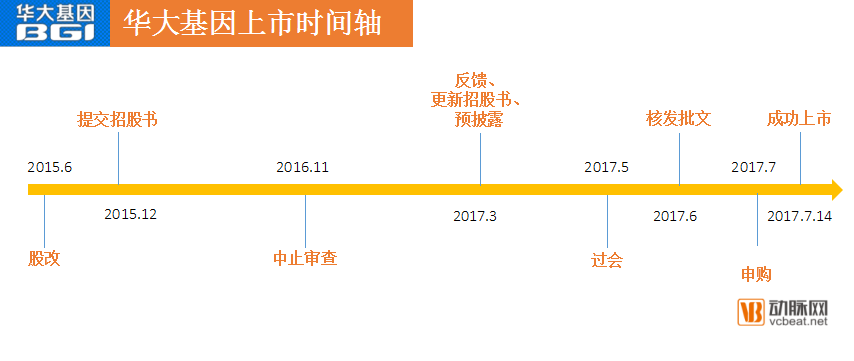
Having successfully passed the review in May and obtained approval from the China Securities Regulatory Commission (CSRC) in June, BGI’s path to going public has proceeded relatively smoothly this time.
On July 14, BGI Genomics’ stock was listed and issued as scheduled, marking the formal establishment of the NGS industry and encouraging hundreds of startups in China’s sequencing market to press forward.