

China's Medical AI Industry Landscape: Comprehensive Scan of 55 Medical Artificial Intelligence Enterprises
With the substantial decline in computing and storage costs, significant growth in computational power, and the gradual maturation of the artificial intelligence (AI) ecosystems established by IT giants, the barriers to entry for AI startups are lowering. Encouragingly, AI has attracted considerable investor interest in the past two years; in the first quarter of 2017 alone, more than 30 AI companies secured financing. Across specific industries, AI startups in the healthcare sector have performed particularly prominently, garnering the highest levels of attention and funding.
In medical fields such as virtual assistants, healthcare big data, and medical imaging, artificial intelligence is no longer merely a topic of discussion or research; most AI-driven products are already serving the general public. In light of this, VCBeat has conducted an overview of China’s healthcare AI companies to provide insight into their current development status.
VCBeat has compiled a list of 55 medical artificial intelligence companies, categorized into nine sectors: virtual assistants, medical big data, medical imaging, intelligent voice, fitness biotechnology, healthy lifestyle management, medical search, early cancer screening, and AI chips.
Among these, there are 5 listed companies and 24 companies that have secured financing. Excluding listed companies, medical AI startups raised a total of RMB 2.2355 billion (with amounts described as “tens of millions” or “millions” calculated as RMB 10 million and RMB 1 million, respectively). Financing details were not disclosed for 26 companies. A total of 59 institutions and enterprises participated in investments in medical AI. (Due to time constraints and the volume of information, we acknowledge that our data collection may not be comprehensive; any unlisted enterprises or institutions are welcome to contact us.)
>>>>
Scan of Companies in the Medical AI Sector
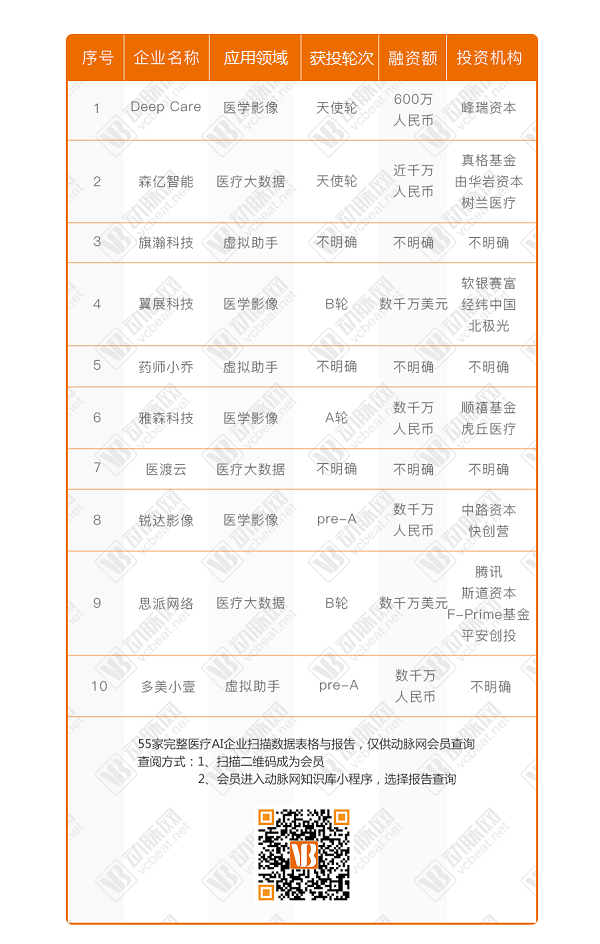
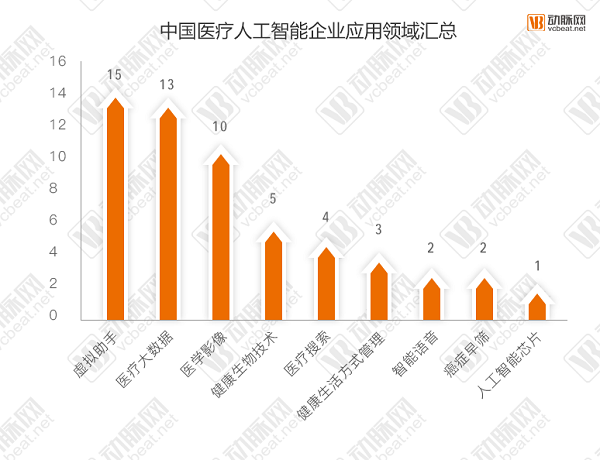
Data source: VCBeat, VCBeat database
Among the 55 companies compiled by VCBeat, the platform categorizes them into nine sectors. The most represented areas are virtual assistants, healthcare big data, and medical imaging. Virtual assistants include general-purpose physician aids such as ET Medical Brain, Baidu Medical Brain, and iFlytek, which serve as “physician assistants” across multiple domains, including disease risk prediction, medical image diagnosis, personalized treatment planning, drug efficacy mining, new drug development, disease monitoring, and health management. The category of virtual assistants also encompasses service and triage robots such as Ruoshui Doctor, Ban Ge Yi Sheng, and Duomei Xiaoyi.
Of course, there are more than just two companies engaged in intelligent voice technology—Unisound and Zhongke Huineng. iFlytek has also applied intelligent voice technology to healthcare. However, iFlytek operates three major business lines in the medical field, with goals extending beyond intelligent voice entry; therefore, it is categorized under virtual assistants.
It is worth mentioning Westwell Technology, the only company engaged in artificial intelligence chip research. The company has developed chips that simulate the working principles of human brain neurons. These chips possess both the learning capabilities of the human brain and powerful specialized computing power. A single chip, no larger than a postage stamp, can mimic the human brain’s ability to process massive amounts of sensory information in a short period of time.
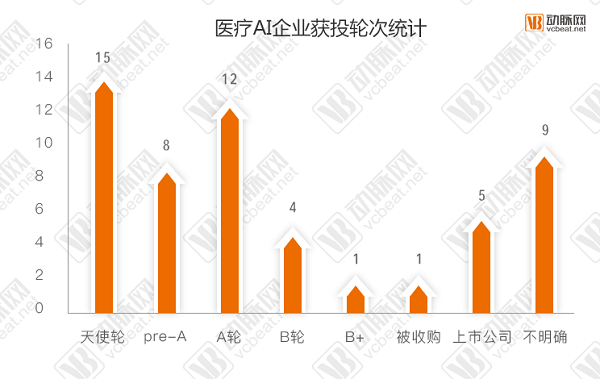
Data Source: VCBeat, VBInsight Database
In terms of financing rounds, most medical AI companies are still at the pre-Series A stage, with few advancing beyond Series B. The few publicly listed companies in this sector applied AI technology to healthcare rather than being founded primarily on AI technology. Among the 50 startups surveyed (excluding publicly listed companies), 24 have secured financing, accounting for nearly half. These medical AI startups have raised a total of RMB 2.2355 billion (with amounts described as “tens of millions” or “millions” calculated as RMB 10 million and RMB 1 million, respectively). The largest single round was CarbonCloud Intelligence’s Series A financing of RMB 1 billion.
The data collected by VCBeat is limited to publicly disclosed information. Many highly capable companies, such as Yidu Cloud and Qihan Technology, have not released their financing details. Despite their strong capabilities, the amounts raised remain undisclosed. When these “hidden giants” are taken into account, total capital investment in the medical AI sector would increase by an additional RMB 800 million to 1 billion.
>>>>
Virtual Assistant
As mentioned earlier, I categorize virtual assistants into two types: general-purpose virtual assistants and service- and triage-oriented virtual assistants. General-purpose virtual assistants are primarily positioned as assistants to physicians, with a broad scope of practice that encompasses nearly all applications of artificial intelligence in the healthcare sector.
For instance, within Alibaba Cloud’s artificial intelligence strategic layout, ET will be equipped with multiple medical capabilities, serving as a “doctor’s assistant” across various domains such as disease risk prediction, medical imaging diagnosis, precision treatment planning, drug efficacy mining, new drug development, disease monitoring, and health management.
For another example, consider iFlytek’s strategic layout in the healthcare sector. While our common perception may focus on intelligent voice technology, its offerings also include AI-assisted medical image diagnosis and clinical decision support systems. The company is committed to serving as an effective assistant to physicians.We should not be stereotyped.!
Another example is Wanwu Yulian. As a tool-oriented product, its physician-verified robot integrates core Internet 3.0 technologies, including artificial intelligence, cognitive IoT, big data, and cloud computing. Delivered in the form of a “robot,” it provides conversational interfaces, patient monitoring, and device-assisted solutions, helping physicians complete over 90% of highly repetitive and substitutable tasks in pre-hospital and post-discharge care.
>>>>
Medical Big Data
Companies operating in the medical big data sector engage in diverse activities. QiYunNuoDe has built a one-stop bioinformatics big data platform, comprising a genomic data engine, big data mining software, data visualization tools, and customized workflows, with the aim of making significant strides in the genomic data interpretation industry.
Yidu Cloud leverages healthcare big data solutions to enable hospitals to efficiently store, process, and analyze medical data across systems and business lines, structure unstructured data, and help hospitals and physicians improve clinical service quality, research translation rates, and management efficiency. This utilization and structuring of hospital data is an endeavor currently pursued by many companies.
Another type is application-oriented. For example, Kangantu, which we all know is a company specializing in cross-border healthcare, has built a global medical resource database. By deeply mining approximately 27 million scientific research papers and various materials, Kangantu is analyzing indicators such as new drug developments, medical costs, incidence rates, and insurance coverage across different countries to establish a comprehensive global medical information database. Additionally, it has developed an artificial intelligence platform to identify the most cost-effective cross-border healthcare consultation solutions for patients.
This is a tangible application of artificial intelligence. Perhaps Kangantu’s technology and algorithms are not the most advanced, but the use of AI has indeed facilitated the company’s growth.
Standardized healthcare big data serves as the foundation for artificial intelligence research and development. Many of these big data companies also collaborate with other AI firms, providing them with data services.
>>>>
Medical Imaging
The application of artificial intelligence in medical imaging is arguably the most familiar to us. We frequently encounter related information online, such as: the prospect of diagnosing skin cancer via smartphones with an accuracy rate exceeding 91%; the FDA’s first approval of an AI-based software for analyzing cardiac magnetic resonance imaging (MRI); and Google’s use of deep learning to assist pathologists in detecting cancer with an accuracy rate of 89%. These are all examples of artificial intelligence applications in medical imaging.
Among the 10 companies included in this funding analysis, nine secured financing. It should be noted that the landscape of medical imaging companies extends beyond these ten, encompassing listed enterprises such as Baidu, Alibaba Cloud, and iFlytek, which were not included in this calculation.
Applications of Artificial Intelligence in Medical ImagingThe application of artificial intelligence in medical imaging primarily serves to assist physicians in making diagnoses, ensuring that diagnostic decisions are evidence-based, thereby reducing the rates of misdiagnosis and missed diagnosis. According to a survey by VCBeat, physicians reported that the reduction of missed diagnoses is currently the most significant benefit AI provides them.
We compared the current state of medical imaging in China and the United States. In terms of the number of misdiagnoses related to imaging, the United States sees 12 million misdiagnoses annually, while China, due to its large population base, reaches a staggering 57 million per year. These misdiagnoses primarily occur in primary healthcare institutions.
Medical imaging in China is currently transitioning from traditional film to digital film, whereas traditional film has become a thing of the past in the United States. The widespread adoption of digital film has led to a substantial increase in medical imaging data, with an annual growth rate of 63.1% in the United States and 30% in China.
The annual growth rates of radiologists in the United States and China are merely 2.2% and 4.1%, respectively, far lagging behind the growth of imaging data, thereby creating a substantial gap. This has led to a significant increase in physicians’ workload and a decline in diagnostic accuracy. Leveraging artificial intelligence for image interpretation can effectively bridge this gap. Although this gap is slightly smaller in China than in the United States, the country’s unique circumstances have generated substantial market demand for cross-platform imaging cloud solutions.
>>>>
Health Biotechnology
In this field, iCarbonX stands out as the leader. We will use it as an example to discuss the application of artificial intelligence in biotechnology and health. In April 2016, when iCarbonX completed its Series A financing of nearly RMB 1 billion, its founder, Wang Jun, stated that the company would focus on four key areas: precision aesthetics, precision nutrition, precision health, and precision medicine. By leveraging multi-layered life data—including genomics, immunology, proteomics, metabolomics, microbiomics, clinical examinations, physical activity, diet, and environmental factors—iCarbonX aims to build a big-data ecosystem for life and health. Ultimately, the company intends to harness artificial intelligence technologies to enable precise health management for individuals.
Following its financing round, iCarbonX accelerated its global search for like-minded companies to establish the Digital Life Alliance: it strategically positioned itself in the upstream big data sector and opened up third-party collaborations in the downstream health experience sector, successively announcing the acquisition of and investment in China’s insurance big data firm Banruo Systems and the Israeli artificial intelligence company Imagu.
In the field of genomics, the primary approach involves leveraging intelligent technologies to build a gene data analysis platform, thereby achieving automated, high-throughput, and personalized genomic interpretation while enhancing the accuracy and speed of gene data analysis.
>>>>
Medical Search
After resigning, Feng Dahui cited three major reasons for his decision to pursue medical search:
First: The vertical healthcare search market is a quintessential blue ocean. With only a handful of current participants and the sector still in its exploratory phase, there is no established industry model yet; thus, any entrant has the opportunity to emerge as the dominant leader in this field.
Second: Even after the Wei Zexi-Baidu incident, Baidu remained the primary online healthcare entry point for the vast majority of patients. Although the Wei Zexi incident did not spark a revolution in search engines, it delivered a significant blow to traditional search giants. If vertical search engines can subsequently forge deeper collaborations with more high-quality internet healthcare content providers, this could hold greater significance for their position in the future healthcare industry.
Third: The key to medical search lies in reachability; the higher the search reach, the better the user experience. This encompasses two aspects: first, the relevance of search results, and second, the breadth and depth of resources in those results. From a technical perspective, there is a clear advantage in search relevance; however, from a content perspective, Feng Dahui has transitioned from a technical role to CTO, shifting his focus from technology to content. With his profound understanding of content operations and user needs—gained through his journey from Alipay to DXY—it is not impossible for him to catch up and even surpass competitors in terms of content accumulation.
>>>>
Healthy Lifestyle Management
Healthy Lifestyle Management leverages artificial intelligence and big data to digitize individuals’ lifestyle habits, enabling interventions based on these digital insights to improve users’ quality of life. YueTang 3.0 represents a new model of health management that utilizes machine learning to proactively understand user profiles, analyze behaviors and habits, predict health risks, and provide user-centric solutions. Furthermore, the proposed solutions accommodate user preferences, thereby enhancing adherence and increasing user engagement.
Bitoshi’s product, Tangxi, uses an app to analyze the sugar content of beverages and change user habits, while Yisuifang employs artificial intelligence to manage diabetes.
>>>>
Intelligent Voice
There are three companies in China engaged in intelligent medical voice entry: iFlytek, Unisound, and Zhongke Huineng. Among them, both iFlytek and Unisound apply intelligent voice technology to the healthcare sector, with their business operations also extending to other fields. In contrast, Zhongke Huineng’s product, “Yixuntong,” focuses primarily on medical voice entry.
Why Apply Technology to the Healthcare Sector? During interviews, VCBeat learned that this is primarily driven by three prominent pain points in hospitals: efficiency, safety, and data. Surveys indicate that 50% of resident physicians in China spend approximately four hours per day writing medical records. Radiologists have reported an extremely heavy daily workload for image interpretation and report generation. Due to the specialized nature of diagnostic and technical departments, clinicians must frequently switch between two screens—alternating between viewing images and documenting reports. Therefore, improving efficiency is an urgent need for physicians.
The voice input system does more than simply convert speech to text. To address the noisy hospital environment and accommodate surgeons, radiologists, and dentists who lack free hands for documentation during procedures or daily work, iFlytek has developed a specialized microphone for physicians. During interactions among doctors, nurses, and patients, the artificial intelligence system automatically filters out irrelevant information and converts essential medical data into text, enabling accurate record-keeping even while the physician is in motion.
Meanwhile, to further enhance physicians’ work efficiency and collect valuable medical data,Based on natural language processing technology, directly structure the converted text to generate structured electronic medical records., the case records include patients' examination history, medical history, various test results, and physical indicators. Doctors only need to make simple modifications and confirmations to the electronic medical record content, then print it for the patient and complete the electronic file storage. Currently, iFlytek's intelligent voice transcription system has an accuracy rate of 97%, and it is applicable to all departments in hospitals.
However, during VCBeat’s investigation, physicians indicated that the adoption of intelligent voice entry systems varies by department and individual practitioner. Some, particularly surgeons, find the technology highly convenient. In contrast, others have explicitly stated they will not use it, finding it peculiar and preferring to type instead. Thus, it will take time for artificial intelligence products to gain broader acceptance among physicians.
>>>>
Cancer Early Screening
We are all aware that the five-year cancer survival rate in the United States is significantly higher than that in China. Let us examine their approach: The U.S. Centers for Disease Control and Prevention (CDC) recommends that all individuals aged 20 and older undergo regular comprehensive examinations covering the oral cavity, skin, lymph nodes, testes, and other areas. Smokers require more frequent screenings, with a comprehensive examination every two years. Such check-ups facilitate early detection, prevention, and treatment of cancer.
In the United States, women who are 21 years of age or older and sexually active should begin undergoing cervical cytology (Pap smear) screening. After age 30, screening is recommended every three years. Additionally, individuals aged 50 and older should undergo colorectal cancer screening every five years. Family physicians typically provide regular reminders to ensure adherence to these scheduled screenings.
Early detection and early treatment are key to improving the five-year survival rate for cancer. This review identifies two companies engaged in early cancer screening. Diannei Biology focuses primarily on early screening for lung cancer, while Youqiu Yunzhen APP is an intelligent diagnostic platform that enables users to perform self-assessments of diseases and health conditions. Its most notable feature is that it eliminates the need for hospital visits; users can accurately identify the underlying cause of their symptoms and seek targeted medical care simply by uploading a few photos via the mobile app. The WeChat version has already been launched, offering screening for five major types of cancer—lung, liver, gastric, breast, and cervical cancer—as well as assessments of constitutional predisposition to tumors.
In fact, beyond the nine sectors covered in this review, artificial intelligence is also being applied in drug R&D, the discovery and control of emerging diseases, mental health, and emotion recognition. However, Chinese enterprises are still in the early stages of development in these areas, or their progress has yet to be widely recognized, underscoring the need for continued efforts by entrepreneurs and investors.
>>>>
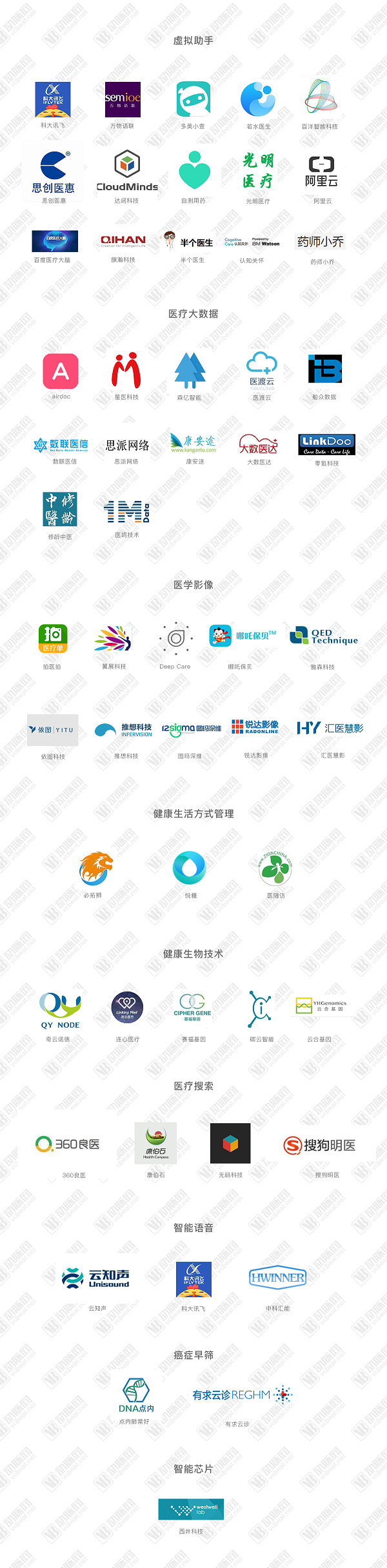
Industry Landscape
Copyright Statement
This report is produced by VCBeat. All text, images, and tables contained herein are protected by applicable trademark and copyright laws. Portions of the text and data have been sourced from publicly available information, with ownership retained by the original authors. No organization or individual may reproduce or distribute this report in any form without the prior written permission of our company. Any unauthorized commercial use of this report shall constitute a violation of the Copyright Law of the People's Republic of China, other relevant laws and regulations, and applicable international conventions.
Disclaimer
This research report is based on information that VCBeat considers reliable and currently publicly available. VCBeat strives to, but does not guarantee, the accuracy and completeness of such information. Due to limitations in research methodologies, sample sizes, and the scope of data collection, the data presented herein only reflects the basic conditions of the surveyed population during the survey period. It serves solely for the current research purposes and provides a basic reference for the market and clients. Furthermore, VCBeat does not guarantee that the views or statements contained herein will remain unchanged. At different times, VCBeat may issue reports with information, opinions, and projections inconsistent with those contained in this report.
VCBeat does not consider recipients of this report as its clients by virtue of their receipt thereof. This report is distributed only where permitted by applicable laws and regulations and solely for informational purposes; it shall not constitute any form of advertisement. Under no circumstances shall the information contained herein or the opinions expressed herein be construed as investment advice to any person. Where permitted by law, VCBeat and its affiliated entities may hold equity interests in the companies mentioned in this report and may provide or seek to provide fundraising, financial advisory, or other related services to such companies.