

Aier Times Files IPO Prospectus, Aiming to Become China's Largest Third-Party Offline Hearing Care Network
In the Aier Shidai Hearing Center, located in the New World Office Building on Chongwenmenwai Street in Dongcheng District, Beijing, several staff members were busy attending to customers who had come for hearing tests. From the moment of entry to consultation, everything was orderly and quiet within the 500-square-meter space, free from the hustle and bustle typically associated with hospitals.
Before founding Aier Times, Liang Qi worked at West China Hospital of Sichuan University for eight years, and then spent another eight years at Cochlear, the largest manufacturer of cochlear implants. In 2013, she resigned to “At that time, the original intention was to create an online education platform, as talent is extremely scarce in the audiology industry.”。
When Liang Qi applied to university, only two institutions in China offered programs in audiology: Capital Medical University and Zhejiang Chinese Medical University. The field was not only a minor subdiscipline under biomedical engineering but also available solely at the undergraduate level. After graduation,Liang Qi pursued advanced studies in Canada, where she earned a Master’s degree in Audiology, and later obtained a Doctor of Audiology (Au.D.) degree from Salus University in the United States.
Liang Qi told VCBeat that in China, approximately 120 million people require hearing healthcare services, including 27.8 million individuals with hearing disabilities and around 30,000 newborns diagnosed with hearing loss each year. A significant proportion of these cases fail to receive timely intervention due to a shortage of specialized physicians. The current state of hearing healthcare in China is characterized by insufficient resources to meet the high demand.
Liang Qi believes that if schools find it difficult to achieve this, online education can rapidly facilitate talent accumulation by breaking the constraints of time and space. With this vision, in February 2013, the first segment of Aier Shidai, China Hearing Online, was officially launched.

Liang Qi, Founder and CEO of iEar Era
Launch Parental Hearing Education Classes
Initially, all courses offered by Aier Shidai were paid. Although revenue was generated in the first month, it was not sustainable. To expand its reach, Liang Qi converted the paid courses into free ones. However, the downside was evident: the already strained revenue stream was completely cut off. How large is the market for professional hearing education? At that time, Liang Qi herself was uncertain. “Whether we could continue moving forward and survive was the fundamental issue.”
"When God closes a door, He will surely open a window."During the promotion of online educational courses by Ai'er Times, many parents of children with hearing impairments showed strong interest in the curriculum. Numerous parents asked Liang Qi whether personalized classes could be developed specifically for their children.YesLiang Qi, this is undoubtedlyAn Unexpected Discovery,BecauseMany parents have an urgent need for guidance on their children’s audiological evaluations, including how to interpret the test results and how to select appropriate intervention strategies.。
Children with hearing impairment are born with a hearing deficit. If left without intervention, these children willDerivativespresenting a variety of issues. The most typical is the inability to speak, as hearing impairment prevents the development of speech abilities. This group is commonly referred to as deaf-mute children.
136 Intervention is a commonly adopted approach. Newborn hearing screening is conducted starting from the first month of life. By three months of age, diagnostic evaluations are performed to determine the degree and type of hearing loss. At six months, hearing aids are introduced as an intervention; if this proves ineffective, cochlear implants may be considered at one year of age. In summary, through these various interventions, children with hearing impairments can re-enter the world of sound, enabling them to speak and communicate normally, just like their peers.
It is precisely due to the critical importance of early intervention that parents are so deeply engaged with hearing centers and auditory-verbal education. During their child’s intervention journey, the efforts they invest extend beyond financial resources to include their own continuous learning. Recognizing that need creates opportunity, iHear Era expanded its offerings by launching parent-focused mini-classes built upon its professional educational foundation, which quickly gained widespread popularity among parents.
In the era of hearing health awareness, iEar’s online education business operates at a very low cost, with virtually no expenditure on promotion or advertising. On one hand, Liang Qi has long been deeply engaged in the industry and has built connections with many individuals with hearing impairments; as she embarked on her entrepreneurial journey, many parents proactively helped promote her services through word-of-mouth. On the other hand,Since the hearing-impaired population often congregates in online communities, including QQ groups, forums, and WeChat groups, information can easily spread from a single point to a broad audience.。
In 2013, Wuhuan, the webmaster of “Deaf Children’s Network,” a hearing impairment forum with 100,000 registered users at the time, stumbled upon videos from China Hearing Online while browsing the internet. The professional and rigorous hearing education videos on the site caught his attention immediately. He realized that reposting these videos on Deaf Children’s Network would surely help many people in need. After several searches, Wuhuan found Liang Qi’s phone number. Upon learning about the situation, Liang Qi readily agreed to the request for reposting. Soon thereafter, the name “Ai’er Shidai” (Hearing Care Era) reached numerous parents through the channels of Deaf Children’s Network.
Investing in and Building Offline Hearing Centers
As online educational videos gained increasing popularity and attracted a growing audience, some parents began asking Liang Qi whether he could recommend offline professional hearing centers in addition to the training services, so they could conveniently access diagnostic services. However, at that time, it was nearly impossible to find a hearing center in China that met U.S. standards. Even in some Grade 3A hospitals, despite their professional expertise, the scarcity of resources made appointment scheduling difficult and the facilities overcrowded, resulting in a user experience that fell far short of that offered by hearing centers in the United States.
In Liang Qi’s view, the offline hearing healthcare industry faces several major pain points, with information asymmetry being the primary concern. It is not only difficult to secure appointments with specialists at tertiary hospitals, but consultation times are also extremely limited. Coupled with the scarcity of audiology experts, it is challenging to provide in-depth consultations to patients within such constrained timeframes. Post-operative follow-up care is even more of a luxury.
In many cases, it is the parents who decide whether their child should use hearing aids or cochlear implants, and which intervention approach to adopt. Armed with divergent test results from two or three hospitals, they rely on their own judgment to choose an intervention strategy. Yet, since what is at stake is their child’s future, they can hardly make such decisions lightly. To gain a comprehensive understanding of their child’s condition, they devote considerable time to gathering information; over time, in certain respects, they may even surpass experts in their knowledge.
“Where else can people go besides hospitals? How can they access professional hearing care services? The public remains unclear. The industry has long lacked a sufficiently authoritative and professional third-party hearing institution capable of providing in-depth, accurate consultative advice and diagnostic results.“said Liang Qi.”
It was precisely because of these pain points that, after careful consideration, Liang Qi made the firm decision to invest in and establish offline hearing centers. In September 2013, Aier Times invested RMB 1 million to set up two offline hearing centers in Beijing and Chengdu, respectively, and officially commenced trial operations in October.
Initially, the hearing centers of Aier Shidai were all located in office buildings, so the resulting expenses such as rent and renovation costs were not significant. Allocating funds where they would have the greatest impact, Liang Qi directed the majority of the invested capital toward purchasing diagnostic equipment and building a professional team.
To gain recognition for its professional expertise, Aier Times has partnered with renowned Grade 3A hospitals, such as Peking Union Medical College Hospital and Beijing Tongren Hospital. In the initial phase of these collaborations, Aier Times primarily handled pre- and post-hospital services. For instance, it conducted time-consuming pediatric behavioral audiometry tests. Each patient undergoing this test requires at least one hour from start to finish.Meanwhile, the collaboration of two audiologists is also required. This makes it nearly impossible to carry out such a project in tertiary hospitals where physician resources are scarce.
Furthermore, patients require an extended period of follow-up and management after cochlear implant surgery. This aspect is also beyond the capacity of hospitals; the intervention of Aier Shidai serves as an optimal complement to hospital-based care.
Hearing Centers in the Era of Ear Care provide one-stop, comprehensive hearing solutions, including professional services such as hearing assessments, counseling, hearing aid fitting, cochlear implant programming, and outcome evaluation. The hearing equipment used at these centers consists of top-ranked international products from the United States, Canada, Denmark, Switzerland, and other countries.
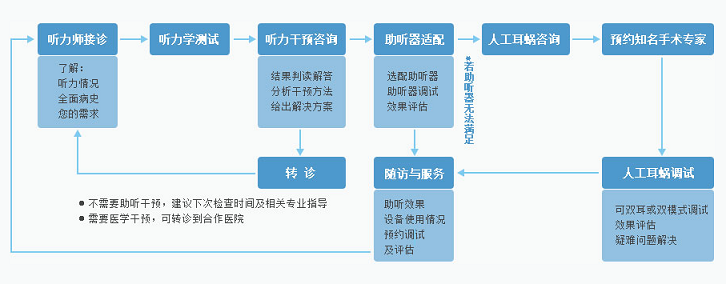
iEar Era Hearing Center Business Process
“We have never been in competition with hospitals. Hospitals simply cannot accommodate such a large number of patients, whereas Aier Times provides services outside the hospital setting for users who are willing to pay for premium care,” said Liang Qi.
From the very inception of the hearing center, Liang Qi had already been contemplating expansion. On one hand, given that hearing centers require substantial capital investment in fixed assets, sufficient funding was essential to sustain operations. In 2014 and 2015, Aier Times successfully secured two rounds of financing, each amounting to tens of millions of US dollars, from Guohai Innovation Capital and Legend Capital, respectively.
On the other hand, the shortage of talent is also a practical issue. Generally speaking, a hearing center needs to be equipped with at least one audiologist. In February 2017, the iHear Era Audiology Education Strategy Launch Event was held in Beijing, announcing that iHear Era would build a "Whampoa Military Academy" for audiology professionals and reached a strategic cooperation with HuLianWang, a well-known domestic nursing employment agency.
Aier Times engages nurses from the VCBeat Nurse Network in independently designed, paid audiology education programs. Meanwhile, Aier Times provides them with employment opportunities related to audiology. In terms of faculty, Aier Times collaborates with Salus University in the United States. The teaching staff includes renowned audiologists such as Professor James Hall from Salus University’s Audiology Department, Professor Jace Wolfe, Director of the Oklahoma City Hearing Center, Professor Li Xu from Ohio University, and Professor Jian Wang from Dalhousie University in Canada.well-known in the industryProfessor. After graduation, nurses can also obtain audiology certificates from American universities.
Liang Qi told VCBeat, “In April this year, Aier Shidai will train its first cohort of students. There will be two intensive audiologist training sessions each year, with the goal of cultivating 1,000 audiologists within three years. This will not only meet Aier Shidai’s needs for offline expansion but also supply more audiology professionals to the company and society.”
As of now,Including first- and second-tier cities such as Beijing, Shanghai, Guangzhou, Chengdu, and Xi’an, iHear Time has established approximately 20 hearing centers.There are two models: one is self-built flagship stores, and the other is hearing centers established in collaboration with local Grade 3A hospitals. In the latter model, the hospital provides the premises, while Aier Times provides technical support and training. Audiologists from many major hospitals, including Peking Union Medical College Hospital and Beijing Tongren Hospital, have participated in Aier Times’ training programs.


iEar Hearing Center
In addition, Aier Times plans to rapidly expand its hearing centers across China through a franchise model, providing franchisees with services including staff training, financial solutions, branded interior design, pre-launch marketing, and customer traffic redirection.
Liang Qi believes that although hearing centers have not received much public attention at the current stage, people will eventually accept this new model as it matures. Much like dental clinics, which were rarely seen near residential communities a decade ago but are now ubiquitous—with several on almost every street—public awareness regarding hearing centers is gradually shifting.
Transformation is a natural process.
The lengthy registration cycle for medical products in China is a key reason why foreign hearing-related medical devices generally lead their domestic counterparts by more than three generations. By the time a new product launched in Europe enters the Chinese market, three years may have already passed. Consequently, families with sufficient financial means are more inclined to seek optimal treatment abroad.
In July 2016, Aier Times officially launched its cross-border medical services, referring patients with more complex needs to the world’s leading auditory implant centers, including those in Hong Kong and Europe, for treatment.
From professional online education platforms to patient education and parent workshops, then to the establishment of offline hearing centers, and even cross-border medical services, Liang Qi’s “Ear-Caring Era” has evolved step by step. In the process of continuously identifying and meeting market demands, its development path has gradually become clear.Transformation requires a catalyst, yet it is also a natural progression.
“Looking back, the most difficult and testing aspect of our journey since founding the company has been choosing the right direction,” said Liang Qi.
Note: All data related to this company in the article were provided and confirmed by the interviewee.