

Sweat Sensing Emerges as the Next Frontier in Wearable Diagnostics: Non-Invasive, Continuous Monitoring Poised to Disrupt Healthcare
Sweat-sensing technology is gradually becoming a hot niche segment in the smart wearable device industry. Currently, there are multiple companies on the market leveraging sweat-sensing technology to track health. Previously, VCBeat published an article"Sweat Sensing May Become the Next Hotspot in Smart Health Wearables, as the U.S. Air Force Invests $4 Million"This article provides a comprehensive overview of the leading technology companies in the market. Dr. Sonia Sousa, CEO of Kenzen, shares her insights on the challenges currently addressed by sweat-sensing technology and its future development prospects. VCBeat has compiled and translated her comments.
VCBeat has learned that Kenzen is also a startup committed to developing next-generation wearable diagnostic technology based on sweat analysis. It produces a patch-type sweat sensor capable of connecting with smartphones.
Dr. Sousa, CEO and Co-Founder, is a serial entrepreneur who founded several companies prior to establishing Kenzen. He holds over 15 patents in the United States and worldwide, with additional applications pending, covering fields such as photonics, predictive modeling, lasers, and spectroscopy. He has been dedicated to advancing precision medicine by leveraging wearable diagnostic technologies for disease prevention. This diagnostic technology is clinically relevant, holding significant value for consumers and offering transformative potential for athletes.
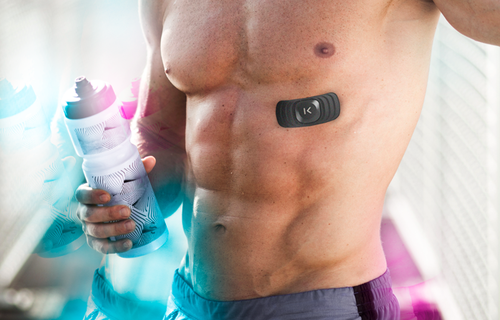
Sweat detection device using patch-type sensors manufactured by Kenzen
Dr. Sousa stated that reliable, fully non-invasive sweat analysis will revolutionize the way patients are diagnosed and monitored for health conditions, optimizing diagnostic and monitoring outcomes while saving billions of dollars in healthcare costs. However, most smart devices currently designed for sweat analysis have yet to achieve commercialization, with key challenges remaining in sensitivity, device size, integration with the human body, and practicality.
He also presented a vivid scenario and example: How would your favorite team perform if the players exerted their utmost effort and exceeded their usual performance levels? Could coaches substitute players before they experience muscle spasms or sustain sprains, thereby preventing costly injuries? Imagine if you could receive advance notifications of potential injury, illness, or worsening health conditions, enabling you to make proactive behavioral changes.
Biomarkers in sweat are nearly identical to those in blood
Recent research from Stanford University indicates that the scenario of preventing diseases through future wearable technology may soon become a reality. Furthermore, given the pivotal role sweat plays in driving significant transformations in health monitoring methods and cost structures, this realization may occur sooner than anticipated.
Discussions in medical journals regarding the value of sweat have persisted for nearly 50 years. Sweat is readily accessible and contains important biomarkers that reflect health status, offering diagnostic potential nearly equivalent to that of blood-based health examinations.
For instance, if you are concerned about the diagnosis of cystic fibrosis, sweat analysis is the “gold standard” for detecting this condition. Replacing costly medical consultations and painful laboratory blood tests with non-invasive sweat analysis would bring immense benefits to individual health. However, several challenges have continued to hinder the development of this technology.
First, it is necessary to identify a cost-effective and hygienic method for collecting sweat outside the laboratory. Second, technologies for real-time monitoring and analysis of sweat should be developed in conjunction with other critical parameters.The latter is crucial for truly transforming the way we track health, as well as for predicting avoidable health conditions based on real-time personalized data.
Encouragingly, these challenges have now been resolved. Sweat has officially emerged as the “new blood,” and 2017 will mark the inaugural year in which sweat-based technologies gain authoritative recognition in injury prevention, healthcare, and wearable diagnostics.
Driven by rising healthcare costs and an increase in lifestyle-related diseases, analysts predict that the global wearable patch market will grow by more than 88% between 2016 and 2020, surpassing a staggering $5 billion. The U.S. Army and Air Force have expressed interest in this technology. Professional sports teams such as the San Francisco 49ers and the Dallas Cowboys are already piloting sweat-analyzing biosensors designed to help prevent injuries in real time.
Using sweat, you can track the following data
1. Key biomarkers, such as sodium, can help predict and prevent non-contact injuries, including electrolyte imbalances, disorientation, fatigue, exhaustion, and even muscle strains. Before, during, and after games, we observe nearly every week how these issues affect the performance of NBA, NFL, and MLB players.
2. Heat-related issues, such as dehydration caused by fluid loss. This is also important for athletes and workers in extreme conditions (mines, factories, kitchens, and other high-temperature, high-altitude, or low-lying environments).
3. Continuous monitoring of potassium levels is of significant clinical importance. Cardiac function is critically dependent on potassium; indeed, it is not uncommon to observe marathon runners collapsing at the finish line due to hypokalemia.
4. Blood glucose levels are critically important for diabetes prevention and for individuals with diabetes. Blood glucose also reflects your overall energy status, aiding in the tracking of energy expenditure or metabolic rate.
Dr. Sousa has long been interested in sweat analysis. He previously collaborated with a company that uses salivary biomarkers for disease detection. Kenzen has extensive expertise in identifying valuable health data amenable to analysis, which can be extracted from sweat at lower difficulty and cost than from blood.
Facilitates continuous monitoring of the health index
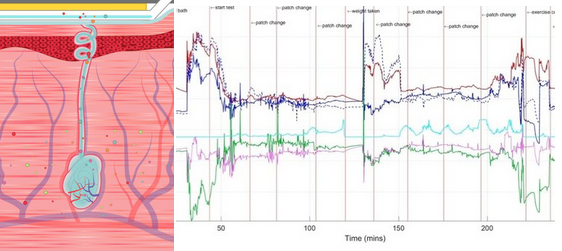
For decades, blood has been the gold standard in medical diagnostics. Consider this: a patient with diabetes must prick their finger four times a day to draw blood, amounting to 1,460 needle sticks per year. If you did not have a life-altering condition like diabetes, would you be willing to monitor your health through constant finger pricking? The answer is clearly “no,” but there is now a better alternative.
The Sports Performance Laboratory has conducted sweat analysis. An individual is weighed before and after exercise, and gauze is used to absorb sweat samples; chemical analysis of these samples may take several hours or even days. However, this laboratory-based sweat analysis differs from hospital blood tests in that it requires only a single measurement, without the need for continuous monitoring of changes in indicators.
These advanced technologies are available in hospitals, enabling a more in-depth understanding of our health status. However, we have too few opportunities to utilize these technologies, making them insufficient for predicting or preventing health issues. Recently, I asked a group of about 50 people, “How many of you undergo an annual physical examination?” Only five raised their hands.
We also recognize that individuals seeking continuous tracking of their health status need to purchase monitoring devices. However, they soon discover that the data provided by these devices is of limited value. Unless you can quantify your set goals (e.g., 10,000 steps), your device will ultimately end up abandoned in a corner of a drawer.
The equipment we require should provide us with comprehensive, laboratory-grade diagnostic data while being easy to wear and capable of continuously analyzing multiple measurement parameters over a period of time.
This enables individuals to truly understand their precise position on the spectrum from “health” to “disease.” A single measurement of indicators such as heart rate, blood pressure, hydration levels, core body temperature, cortisol, blood glucose, and lactate can facilitate disease prediction and prevention, and even allow for the comparison of the effects of different therapies.
We know that many teams are already using urine testing, a method athletes often consider too invasive. However, if you focus on biofluids that are easily accessible for analysis, such as tears and saliva, you will see how crucial the future development of wearable sensing devices is for precision medicine. Sweat currently holds significant appeal for wearable diagnostic technologies, as it eliminates the need for multiple blood samples, thereby reducing hospital costs.
Conditions such as hyponatremia (abnormally low sodium levels in the blood), which are difficult to detect through standard blood tests, can be continuously monitored via non-invasive sweat analysis. The good news is that wearable diagnostic technologies based on non-invasive sweat analysis will soon become widely accessible, offering a low-cost solution open to all.