

Aier Eye Hospital Group Reports 2016 Net Profit of RMB 560 Million, Up 30.24% Year-over-Year
VCBeat learned that on April 5, Aier Eye Hospital Group (300015) released its 2016 annual report. During the reporting period, the company’s outpatient visits reached 3,705,533, a year-on-year increase of 15.24%; surgical procedures totaled 377,245 cases, up 16.74% year on year; operating revenue amounted to RMB 4,000,401,700, representing a 26.37% increase from the same period last year; operating profit reached RMB 700,501,800, a 16.62% year-on-year increase; net profit stood at RMB 567,111,500, up 29.90% from the previous year; and net profit attributable to shareholders of the parent company was RMB 557,467,200, marking a 30.24% year-on-year growth.
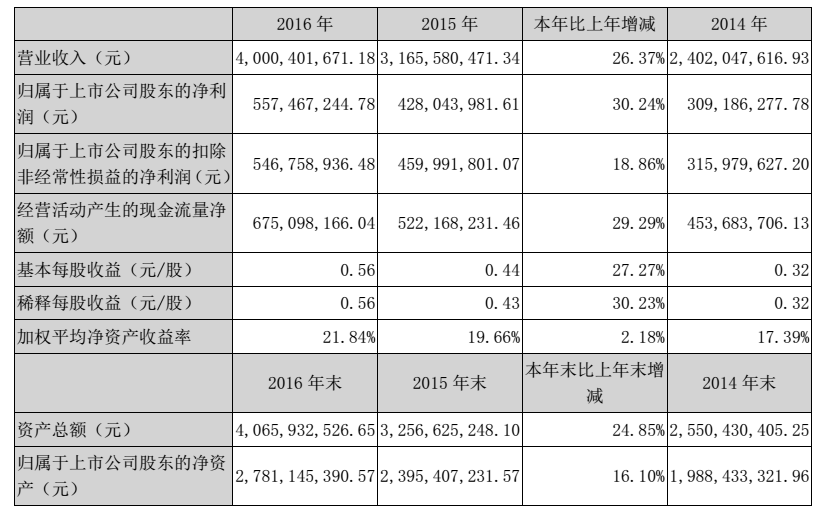
Key Accounting Data and Financial IndicatorsData Source: Aier Eye Hospital Group 2016 Annual Report
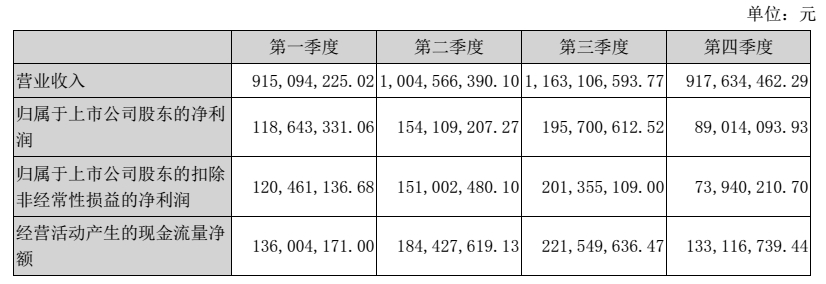
Key Financial Indicators by Quarter Data Source: "Aier Eye Hospital Group 2016 Annual Report"
Eye health is a crucial component of national health. Visual impairment, including blindness, severely affects the physical well-being and quality of life of the population. In October 2016, the National Health and Family Planning Commission issued the "13th Five-Year National Eye Health Plan (2016–2020)," which established ensuring universal access to basic ophthalmic medical services, gradually eliminating avoidable blindness and visual impairment, and improving the eye health of the population as the fundamental starting point and ultimate goal for eye disease prevention and control efforts.
Aier Eye Hospital, a nationwide chain of specialized ophthalmic medical institutions, is primarily engaged in the diagnosis and treatment of various ophthalmic diseases, surgical services, and medical optometry and glasses fitting. The company’s distinctive “tiered chain” business model is highly suited to China’s national conditions and market environment. By defining the functional roles of hospitals at different levels, it enhances the efficiency of resource sharing and expands the breadth and depth of its brand, gradually forming a development pattern with a nationwide presence and international connectivity.
In addition, the Company’s proprietary tiered chain model—“central city hospitals–provincial capital hospitals–prefecture-level hospitals–county-level hospitals”—aligns with China’s vigorously promoted tiered diagnosis and treatment policy. It has established strong core competitiveness in technology, services, brand, scale, talent, scientific research, and management, with multiple mature hospitals gradually capturing the largest local market share in terms of outpatient visits, surgical volumes, and operating revenue.
Meanwhile, with the continuous innovation of the Company’s development model and incentive mechanisms, the steady advancement of its internationalization strategy, the global layout of technological innovation, and the gradual implementation of mobile healthcare, the Company’s advantages in the ophthalmic industry chain will gradually take shape, further consolidating and enhancing its leading position in the industry and its international influence.
VCBeat has learned that Aier Eye Hospital’s primary competitors at this stage are the ophthalmology departments of one or two general hospitals, or specialized eye hospitals, located in the same cities as its chain facilities. In terms of institutional strength, a select few public hospitals—such as Beijing Tongren Hospital, the Zhongshan Ophthalmic Center of Sun Yat-sen University in Guangzhou, and the Eye & ENT Hospital of Fudan University in Shanghai—possess strong competitive capabilities in both clinical practice and scientific research.
During the reporting period, the Company’s core competitiveness was further enhanced, as primarily reflected in the following aspects:
Advantages of the Tiered Chain Model
In 2016, in response to the national policy vigorously promoting tiered diagnosis and treatment, the Company accelerated the improvement of its tiered chain model and advanced the construction of a medical network with a focus on prefectures, counties, and cities. Multiple provinces and regions gradually formed an integrated network structure, significantly enhancing resource sharing and enabling patients at the grassroots level to access high-quality ophthalmic medical services locally. Under the tiered chain model, superior hospitals provide technical support to subordinate hospitals, while complex cases from subordinate hospitals are referred upward, thereby optimizing resource allocation and facilitating patient access to care. As the network expansion accelerates, the advantages of the tiered chain model will become increasingly prominent.
Professional Brand Advantages
In 2016, the Company continuously enhanced brand credibility, strengthened visual brand recognition, and advanced the development of its brand essence. The concept of “Sharing Global Ophthalmic Expertise” became deeply ingrained, comprehensively elevating the Company’s professional and authoritative brand image. On one hand, the Company promoted the development of its ophthalmic medical service capabilities and improved healthcare quality by introducing internationally advanced equipment, recruiting high-end medical talent, and conducting academic and scientific research collaborations both domestically and internationally.
In 2016, the Company was honored as the “Global Healthcare Institution with the Highest Volume of SMILE Surgeries” and the “Global Healthcare Institution with the Highest Volume of ICL Surgeries,” further enhancing its international influence. Meanwhile, by optimizing service processes and raising service evaluation standards, the Company achieved both standardized and personalized patient services. Additionally, the Company has fully leveraged internet and mobile internet technologies to continuously improve patients’ medical experience, providing more convenient healthcare services that meet the multi-level needs of a broad patient base. This has enhanced patient satisfaction, effectively promoted word-of-mouth referrals, and steadily strengthened the brand effect of Aier Eye Hospital.
Advantages of the Clinical, Educational, and Research Platform
In 2016, the company further enhanced its integrated medical, educational, and research platform, with the Aier Eye Hospital Academy, the School of Optometry and Ophthalmology, the Institute of Ophthalmology, and the Institute of Optometry and Vision Science as its core components. The company collaborated with Jinan University and Academician Guohui Su from the University of Hong Kong to establish the “Changsha Academician Workstation,” marking the first interdisciplinary academician and expert workstation in ophthalmology in Hunan Province, which was hosted by Aier Eye Hospital. The company assembled a team of authoritative experts for the Eye Hospital Academy and research institutes, appointing Academician Guohui Su from Jinan University and the University of Hong Kong, and Professor Zhipeng Peng from the Chinese University of Hong Kong, as Honorary Directors of the Aier Eye Hospital Research Institute. Professor Heping Xu from Queen’s University Belfast, UK, was appointed as Deputy Director of the Aier Eye Hospital Research Institute. Additionally, the company invited Professor Ronald Yeoh, President of the Asia-Pacific Society of Cataract and Refractive Surgeons (APACRS), to serve as a Visiting Professor at the Academy.
Currently, Aier Eye Hospital Academy has appointed a total of 17 top ophthalmology authorities from China and abroad as honorary professors, adjunct professors, or visiting professors, including two academicians of the Chinese Academy of Sciences, Yang Xiongli and Su Guohui, and Professor Wang Ningli, Chairman of the Ophthalmology Branch of the Chinese Medical Association. The first cohort of graduate students at Aier Eye Hospital Academy has successfully graduated.
In 2016, leveraging its integrated platform for clinical practice, education, and research, the company undertook multiple projects funded by the National Natural Science Foundation of China and submitted applications for numerous other national-level research grants. The company hosted several influential international academic forums of high caliber, including the “International Forum on Refractive Surgery,” the “Juzhou International Optometry Forum,” and the “International Forum on Cataract and Refractive Surgery.” These events attracted authoritative experts from around the world, further enhancing the company’s industry influence and increasingly highlighting the advantages of its integrated model of medical care, education, and research.
Advantages of the Management System
In 2016, the Company continued to optimize its management model, effectively enhancing operational and managerial efficiency. At the headquarters level, it further refined the division of responsibilities among group functional departments, improved collaborative mechanisms with provincial regions, strengthened support and oversight for provincial operations, investments, and human resources, promoted the implementation of various work standards, and ensured the fulfillment of business plans. At the provincial level, the Company further detailed provincial management mechanisms and organizational structures, as well as profit distribution mechanisms, to promote the integration and sharing of regional resources within provinces, and to strengthen provincial functions in managing, training, guiding, and supervising regional chain hospitals.
At the hospital level, we will continue to uphold the effective integration of managerial and technical talent, fully implement a two-tier management system at both the hospital and departmental levels, and continuously enhance operational efficiency and professional standards. Through dynamic adjustments to management models, we will promote the integration and sharing of corporate resources, enable affiliated hospitals to better align with market demands, respond promptly and accurately to patient needs, and further strengthen the Group’s overall competitiveness.
Technological and Talent Advantages
In 2016, the company continued to recruit a cohort of authoritative ophthalmology experts from both domestic and international arenas, further strengthening its core expert team and establishing a well-structured hierarchy of physicians with comprehensive disciplinary coverage and extensive experience, thereby laying the foundation for enhanced clinical diagnosis and treatment. Meanwhile, the company persisted in tracking and introducing the latest international ophthalmic diagnostic and therapeutic technologies as well as advanced equipment. By leveraging various approaches—including remote consultations, cross-regional patient referrals, expert-led consultation and teaching, and multi-center research—the company enhanced its capacity for sharing technical resources, continuously improved its clinical and research capabilities, and provided patients with systematic technological solutions and multi-tiered services to meet their diverse needs.
In 2016, the Company implemented a total of 95 new technologies, including clinical applications of such innovations as 27-gauge pars plana vitrectomy, vitreolysis, Ahmed TM glaucoma drainage valve implantation, Contoura Vision topography-guided individualized surgery for normal corneas, corneal collagen cross-linking, and bifocal intraocular lens implantation. As the Company advances its internationalization strategy and global layout for technological innovation, its competitive advantages in technology and talent within the industry will become increasingly prominent.
Advantages of the Incentive Mechanism
Continuously attracting top talent from both domestic and international sources and fully stimulating their enthusiasm serve as crucial guarantees for building a century-old Aier and establishing a first-class hospital group. The Company has consistently leveraged its position as a publicly listed entity to implement diverse, multi-tiered incentive measures, including stock options, restricted stocks, and partnership programs. These initiatives have enabled an increasing number of core business professionals and managerial talents to form long-term communities of shared interests with the Company, allowing them to continuously share in its development achievements. This approach has significantly unleashed the work potential of key personnel, further enhanced the Company’s overall competitiveness, and better facilitated the achievement of its strategic objectives in the new era.
Currently, Aier Eye Hospital has established a virtuous cycle in talent development and recruitment, with an increasing number of renowned experts joining the organization. Its comprehensive medium- to long-term incentive mechanisms have played a crucial supporting role in the rapid chain replication and expansion of Aier Eye Hospital.
During the reporting period, driven by the expansion of the Company’s operational scale and brand influence, along with continuous upgrades in medical technology and services, the Company’s operating revenue maintained steady growth. Specifically, refractive surgery generated RMB 1,141.2866 million in revenue, a year-on-year increase of 35.94%; cataract surgery generated RMB 981.1396 million, a year-on-year increase of 22.36%; and optometry services generated RMB 872.1215 million, a year-on-year increase of 36.67%. Revenue from other business segments also experienced varying degrees of growth.
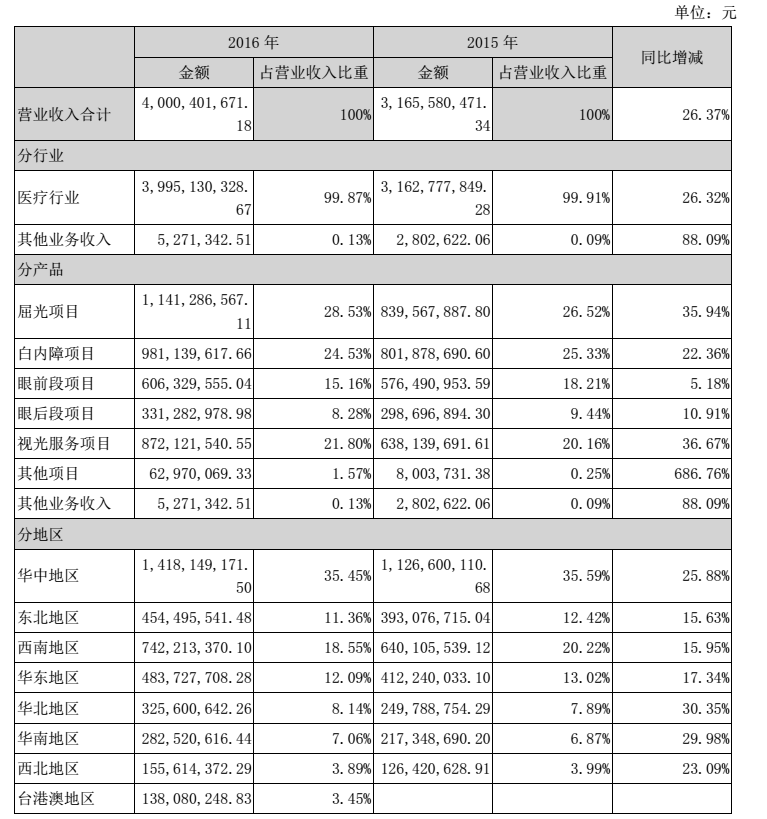
Composition of Operating Revenue Data Source: "Aier Eye Hospital Group 2016 Annual Report"
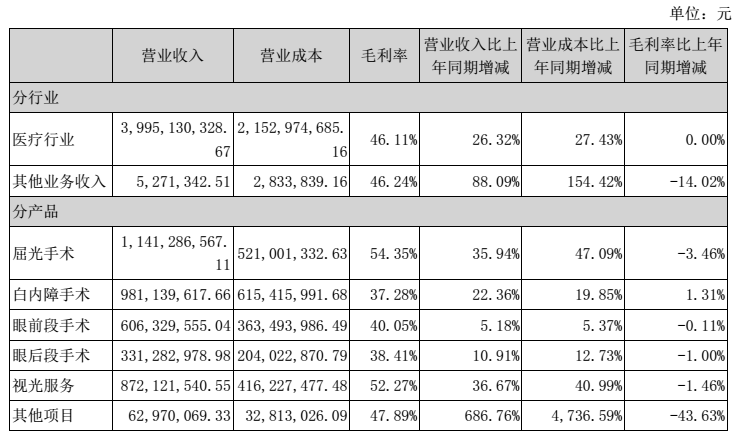
Industries, Products, or Regions Accounting for More Than 10% of the Company’s Operating Revenue or Operating ProfitData Source: “Aier Eye Hospital Group 2016 Annual Report”
During the reporting period, the company had three key initiatives that are particularly noteworthy:
Dual-Engine Drive Accelerates Network Expansion, with Vertical and Horizontal Extension of Market Coverage
During the reporting period, the Company actively aligned with the national healthcare reform direction of accelerating tiered diagnosis and treatment and promoting initial consultations at primary care facilities. Continuing to employ a dual-drive strategy of “Corporate Operations + Industrial M&A Funds,” the Company accelerated the vertical layout of its medical network across prefecture-level and county-level cities in various provinces, while simultaneously exploring horizontal expansion models for optometry services and community eye health services within urban areas. On one hand, the Company newly established Zhengzhou Aier Eye Hospital, Luzhou Aier Eye Hospital, and Ningxiang Aier Optometry Outpatient Department using its own funds. On the other hand, the Company accumulated a substantial pipeline of high-quality M&A targets through its industrial M&A funds, laying a solid foundation for sustainable and rapid growth.
During the reporting period, the Company and its wholly-owned subsidiaries respectively participated in the establishment of the Nanjing Aier Anxing Ophthalmic Medical Industry Investment Fund, the Ningbo Honghui Equity Investment M&A Fund, the Shenzhen Dachuang Chuangkun Equity Investment M&A Fund, the Tianjin Xinxinsheng Equity Investment Partnership, the Hunan Liangshi Bocom Investment Partnership, and the Huagai Xincheng Medical Health Investment Chengdu Partnership.
Among them, medical industry investment funds such as Nanjing Aier Anxing and Hunan Liangshi Jiaoyin focus on the mergers and acquisitions of ophthalmic hospitals and their related industrial projects, while other investment and M&A funds invest in high-quality projects in other related industries, taking into account the company’s strategic development layout, to achieve capital appreciation returns and enhance the company’s profitability. During the reporting period, the aforementioned funds have been established and are operational; the investment from the Beijing Huatai Ruilian M&A Fund has been recovered, achieving favorable investment returns.
Accelerate the implementation of mobile health and internationalization strategies, and establish a global platform for incubating technological innovation
During the reporting period, the Company released the “Aier Eye Hospital Mobile Healthcare Development Plan and Implementation Progress.” Leveraging the specific characteristics of the healthcare services industry, the unique advantages of its nationwide tiered chain hospital network, and the robust capabilities of its extensive medical team, the Company will integrate and utilize various social medical and technical resources to build an all-encompassing “Eye Health Assurance System.” This system will facilitate synergy across online and offline channels, between treatment and prevention, and within and outside hospital settings, thereby providing high-quality, lifelong eye health management for China’s 1.4 billion people. Furthermore, in terms of industrial development, the Company aims to pioneer a mobile healthcare system characterized by an advanced business model, clear profitability structure, and diversified service models, ensuring strategic success in future competition.
During the reporting period, Hunan Jishi Interconnection Technology Co., Ltd., in which the Company has invested, has established multiple Community Eye Care e-Stations in Changsha, Tianjin, Chengdu, and other locations. By leveraging the synergy between its online cloud service platform and offline Eye Care e-Stations, it has created a community eye health service model that integrates online and offline operations. The wearable device product “Cloud Clip,” launched by Hangzhou Jingzhijing Technology Co., Ltd., another company invested in by the Company, has been brought to market. Furthermore, through a capital increase in Taiwan’s Jin Hong Technology Co., Ltd., the Company is closely tracking new developments in the international telemedicine sector to seize early-mover advantages in the development of China’s telemedicine industry.
During the reporting period, the Company accelerated its internationalization process by establishing a wholly-owned subsidiary in the United States with US$50 million of its own funds. This subsidiary serves as the Company’s global resource integration platform, embodying the philosophy of sharing global ophthalmic expertise and promoting the global layout of the ophthalmic ecosystem. Meanwhile, the Company decided to initiate the establishment of the Aier Global Technology Innovation Investment and Incubation Fund, serving as an incubation platform to build an innovation and entrepreneurship ecosystem in fields related to ophthalmology and visual science.
The establishment of the fund will help comprehensively enhance Aier Eye Hospital’s medical technical standards and scientific research innovation capabilities, cultivate new business growth drivers, leverage technological innovation to improve quality and efficiency while providing strategic leadership, fully strengthen the company’s core competitiveness, and consolidate and reinforce its leading position in the ophthalmology industry.
Debut of the Company's Private Placement Plan to Facilitate Leapfrog Development
During the reporting period, the Company unveiled its initial private placement plan, which was reviewed and approved by the shareholders’ general meeting. The China Securities Regulatory Commission (CSRC) accepted the Company’s application for the private issuance of shares on January 22, 2017.
Through this capital raising, the Company will enhance and strengthen the functions of its headquarters command center and comprehensive support capabilities, building a world-class integrated platform for medical care, education, and research to efficiently support the rapid development of its chain hospitals at all levels. Secondly, the Company has acquired nine hospitals from an industrial M&A fund for the first time, further enhancing the listed company’s profitability and promoting sustainable development. Thirdly, two hospitals in Chongqing and Harbin are being relocated and expanded, significantly increasing patient reception capacity while simultaneously improving medical quality and service capabilities. Fourthly, the Company is accelerating investment in informatization by establishing an ophthalmology big data center and an IT cloud platform, thereby achieving a comprehensive upgrade of both service and management models.
In summary, by building a robust corporate headquarters and advancing its information technology infrastructure, the Company provides a more powerful management and support platform for its rapidly expanding chain of hospitals. This lays a solid foundation for launching mobile ophthalmic healthcare services, while also opening up avenues for multi-dimensional growth. In the future, the Company aims to establish an ophthalmic ecosystem and innovation incubator, creating new overall advantages across the industry chain and facilitating leapfrog development.
In 2017, as the industry landscape expanded and the company’s comprehensive strength rapidly strengthened, we focused on four key areas—further optimizing the operational management system, comprehensively enhancing overall medical capabilities, improving human resources planning, and continuously refining marketing models. Centered on organic growth, we tapped into endogenous growth potential through continuous innovation in management and mechanisms; meanwhile, we accelerated inorganic expansion and advanced strategic layout by innovating development models and platforms, thereby sustaining the company’s rapid and continuous growth.