

Rock Health Q1 2017 Digital Health Funding Report: 71 Deals Surpass $1 Billion Amid Regulatory Uncertainty
Rock Health released its Q1 2017 quarterly report, which VCBeat (WeChat ID: vcbeat) promptly monitored and translated.
In 2011, Rock Health began tracking healthcare transactions, with the newly enacted Affordable Care Act serving as the primary catalyst for market growth. Entrepreneurs eagerly seized the opportunity to embed their new ventures into the evolving healthcare landscape, aiming to serve the additional 30 million Americans gaining insurance coverage. As Rock Health tracked only digital health activities within the scope of the Affordable Care Act, it was genuinely taken aback when the new administration vowed to repeal this landmark healthcare reform.
Although it remains unclear when and how the National Healthcare Security Law will be amended, we have at least identified one external characteristic of the legislative process: due to policy uncertainty, healthcare providers and health plans are slowing down their spending.
As Sam Brasch, Senior Director at Kaiser Permanente Ventures, described: “The lack of clarity regarding the future of the Affordable Care Act and other healthcare policies has caused panic among at least a segment of hospital systems’ customers, leaving them paralyzed in their decision-making on whether to adopt new HIT solutions.”
Julie Papanek, a partner at Canaan, also stated, “We have learned from hospitals and employers operating under fee-for-service models that they seek to understand the regulatory framework before making substantial purchasing decisions.”
Nevertheless, the founder of this solution remains cautiously optimistic and has made all necessary preparations to address any regulatory adjustments. Leah Sparks, Founder and Executive Director of Wildflower Health, stated, “The most astute healthcare purchasers recognize that digital patient engagement is foundational to any care setting, whether fee-for-service or alternative payment models. Providers must maintain contact with patients and empower them to achieve successful care outcomes. Our platform facilitates deep engagement, and in fact, we are witnessing accelerating patient adoption of our services, contrary to the stagnation some had anticipated due to administrative uncertainty.”
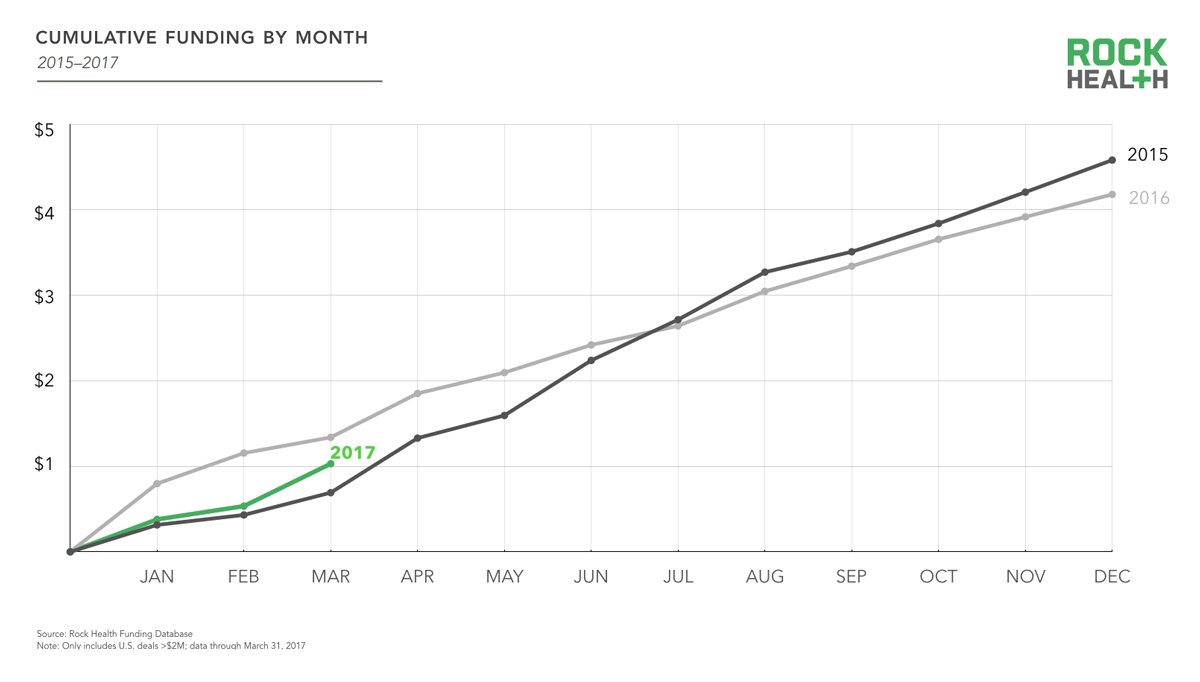
VCBeat has learned that startup activity this quarter also reflects this optimism.In the first quarter, we recorded 71 digital health transactions, with a total value exceeding $1 billion.Despite regulatory uncertainties, this business continues to fund digital health as always.
Data Source: Rock Health Funding Database
A reminder: The Rock Health report notes that digital health transactions in the United States alone reached or exceeded $2 million. Which organizations were excluded? These include health insurance service providers such as Forward and Oscar; biotechnology diagnostic and therapeutic companies such as Grail or Theranos; and software companies like Zenefits and Reputation.com, which are not solely focused on health insurance.
The Q1 report does not cover large international companies such as the German startup Clue, even if their users and investors are American. We also exclude medical giants, government-backed enterprises, non-dilutive crowdfunding campaigns, or ventures with risk transaction amounts below $2 million. Why? Because only by comprehensively tracking a clearly defined scope can our longitudinal data be more accurate and insightful.
Steve Kraus, a partner at Bessemer Venture Partners, stated, “I was surprised that the pace of investment did not slow down in the first quarter. Political shifts have led to policy instability. I had expected that all the turmoil in Washington, D.C., would result in a slowdown in investment activity.”
Maximum Transaction
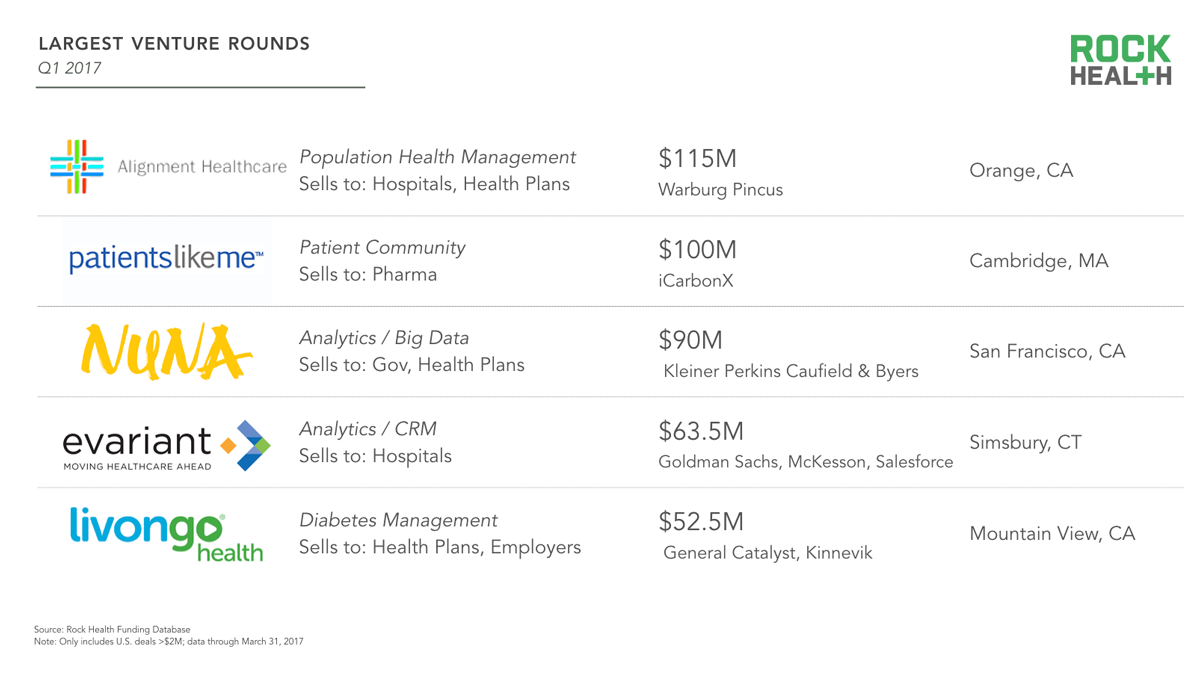
Q1 Report ReleasedFive Blockbuster Deals Exceeding $50 Million. These medical companies’ investors include KPCB, General Catalyst, McKesson Ventures, Salesforce Ventures, Warburg Pincus, and Goldman Sachs, all of which are well-established investment institutions.
The companies outside the top five transactions each serve different user bases, yet no single product dominates the entire healthcare consumer chain. PatientsLikeMe, the largest patient social network in the United States, is a peer community that generates revenue by selling de-identified patient data to partner companies. Livongo Health is a B2B2C diabetes management platform that sells its products exclusively to health plans and employers, rather than directly to end users.
Data Source: Rock Health Funding Database
The five companies span five sectors: Alignment Healthcare (population health management), PatientsLikeMe (patient community), NUNA (analytics/big data), evariant (analytics/customer relationship management), and Livongo Health (diabetes management).
Key Topics
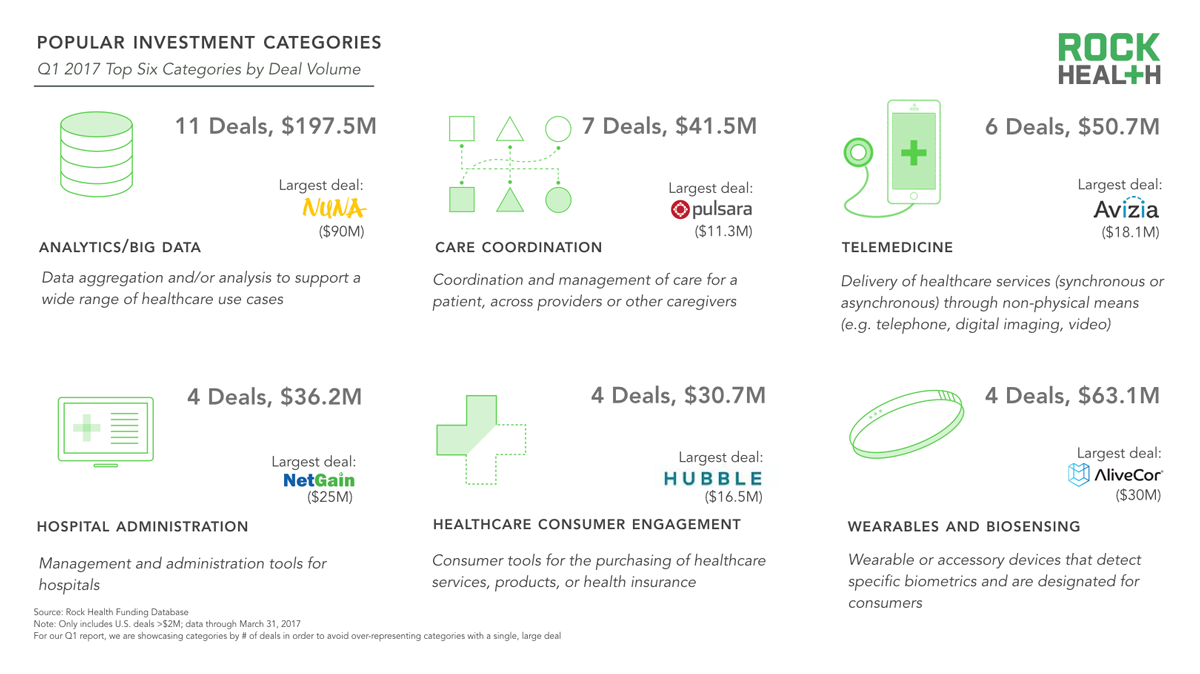
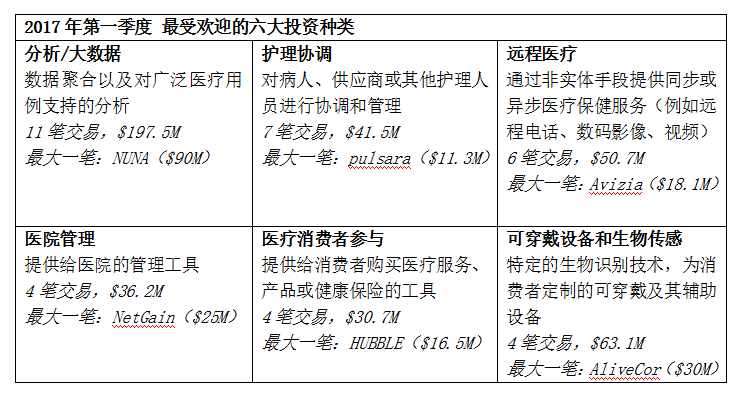
Nearly half of the transactions in the first quarter can be categorized into six major groups (see chart below). The “Analytics/Big Data” category, which saw the highest transaction volume and frequency, includes eleven startups—with Nuna Health accounting for 46% of the funding within this subsector.
Telemedicine completed six transactions in the first quarter, with a total transaction value of $50.7 million. Notably, its recent developments in legislation and reimbursement are worthy of recognition.Telemedicine reimbursement systems continue to evolve; according to a recent report, only 24 states had telemedicine coverage in 2005, whereas by 2017, all 50 states had “achieved telemedicine coverage to some extent.” Telemedicine legislation is developing differently across states, which will influence future investment trends in this field.
Note: In the first-quarter report, only transaction volumes are presented to avoid the lack of representativeness associated with reporting on individual, large-scale transactions.
Data Source: Rock Health Funding Database
M&A
In the first quarter, we tracked nearly 20 M&A transactions, including two notable acquisitions:
1/ CoverMyMeds was acquired by McKesson for up to $1.1 billion in cash, plus an additional $275 million contingent upon the achievement of CoverMyMeds’ financial performance targets (by the end of fiscal year 2019). This transaction, valued at approximately $1.4 billion, became the fourth-largest digital health M&A deal in history. The Ohio-based startup was founded nine years ago and received funding from Francisco Partners in 2014.
2/ Castlight Health is considering acquiring the employee health platform Jiff in an all-stock transaction valued at $135 million. Jiff had previously raised $68 million from investors including Venrock, Aberdare Ventures, GE Ventures, Aeris Capital, and Rosemark Capital Group. Venrock is also an early investor in Castlight Health.
Although the transaction values of the following four mergers and acquisitions were not disclosed, these four acquisitions are worth mentioning. The locations of these M&A deals are also noteworthy, as we have observed a growing number of transactions taking place outside California.
1/ Retail health kiosk provider Higi has acquired EveryMove, a health behavior rewards system headquartered in Seattle, Washington.
2/ Digital Pharmacist, a newly established company formed by the merger of RxWiki and TeleManager, completed its first acquisition this quarter by purchasing PocketRx, a mobile application for prescription services. PocketRx is headquartered in Shreveport, Louisiana, while Digital Pharmacist is based in Austin, Texas.
3/TreatMD, a self-started telemedicine company headquartered in Miami, Florida, was acquired by GlobalMed, a point-to-point telemedicine technology group based in Scottsdale, Arizona.
4/ Zen Planner, a membership management software company for gyms and sports clubs, was acquired by DAXKO (headquartered in Birmingham, Alabama). With 88 employees and 5,500 clients, the Colorado-based Zen Planner secured Series A funding from Mainsail Partners in 2013.
Open Market
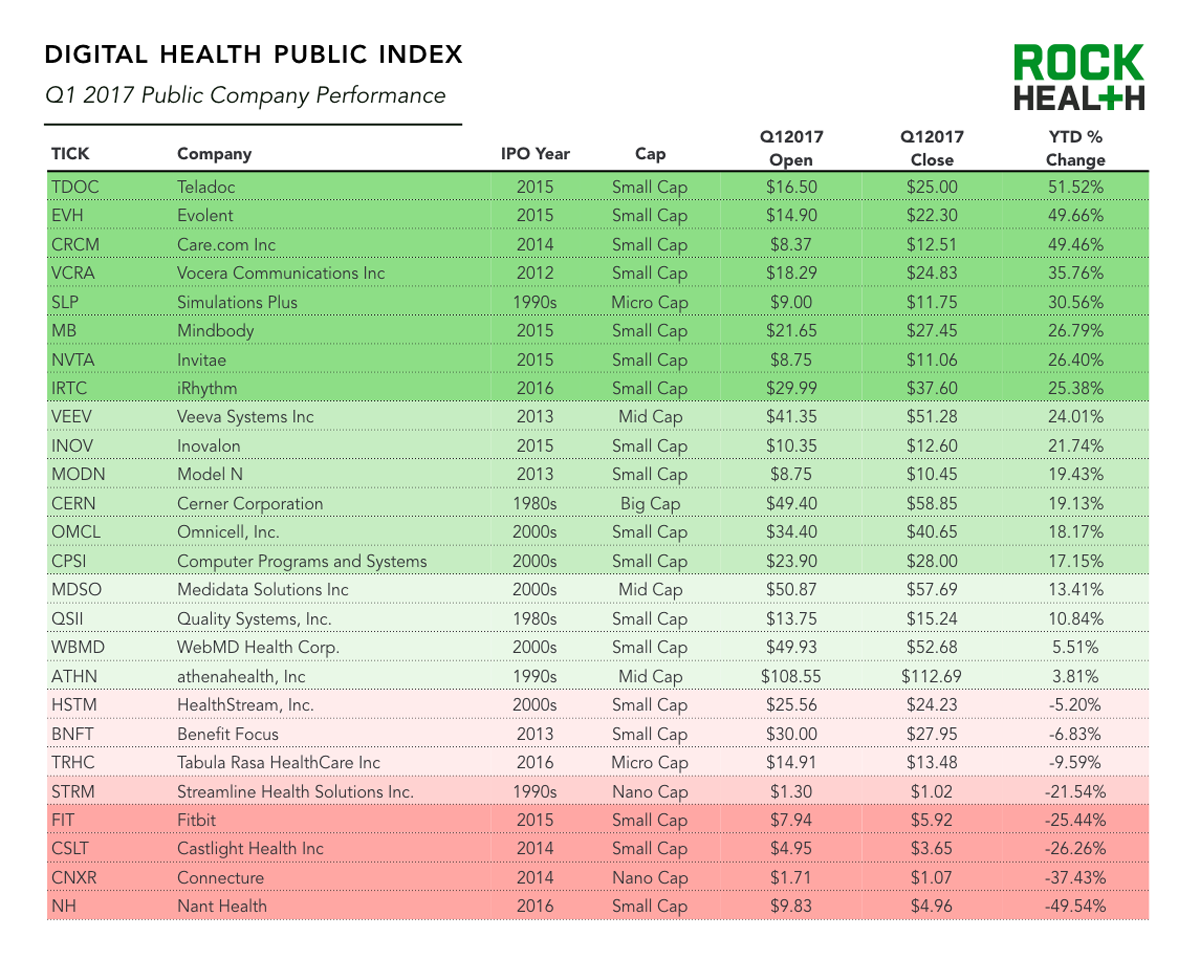
Overall, the public markets performed strongly this quarter, with the S&P 500 and Dow Jones Industrial Average rising by 5.77% and 4.89%, respectively. Since the beginning of this year, the Digital Public Health Index (unweighted) has increased by 13%, with the vast majority of companies posting positive returns this quarter. In the statistical data for the first quarter (Q1),Teladoc Posted the Largest Stock Gain Among Digital Health Companies. Currently, its trading volume has reached unprecedented highs, partly because its performance announcement on March 1 showed a year-on-year revenue increase of 65.5%.
Not all companies listed in the Digital Public Healthcare Index have benefited from the public markets. Even Fitbit, the darling of the wearable fitness device sector, with projected 2017 device sales of $1.5 billion, is currently trading 25% below its opening price in 2017 and 70% below its initial public offering (IPO) price in 2015.
However, none of these declines were as significant as the drop in NantHealth's stock price this quarter.. Since a STAT News article revealed that it might have used charitable donations to support NantHealth’s revenue growth, the company’s stock price has fallen by nearly 50% this quarter. The company was founded and is led by billionaire physician Dr. Patrick Soon-Shiong.
Since 2011, more than 20 digital health companies have raised over $100 million in funding, and we can predict that there will be greater room for returns in the near future.
 Data Source: Rock Health Funding Database
New Fund
In the first quarter, a series of new digital health–friendly funds were announced, expanding the capital pool for investors in the digital health sector and, ultimately, the funding available to startups. We identified at least six new funds with capital exceeding $1 billion:
1/Venrock (Palo Alto, California) raised $450 million for its eighth fund. It is one of the most profitable investors in digital health, with top-performing portfolio companies including Doctor on Demand, Stride Health, and Virta (all part of the Rock Health healthcare investment portfolio).
2. Lux Capital (New York, New York) raised $400 million for its fifth fund. The firm focuses on investing in emerging science and technology ventures. Its current digital health portfolio companies include Aptible, Kyruus, and Zipdrug.
3. Biomatics Capital (Seattle, Washington) Launches $150 Million Fund to Invest in Genomics and Data-Driven Healthcare Projects. The Firm Was Founded by Two Former Gates Foundation Executives.
4/Section 32 (San Diego, California) is reportedly a $100 million fund founded by Bill Maris, former CEO of Google Ventures, with a focus on healthcare investments.
5/ Spectrum Health (Grand Rapids, Michigan) Establishes $100 Million Corporate Venture Capital Arm to Invest in Technologies, Products, and Services That Improve Patient Health and Reduce Costs. Spectrum Health is a non-profit, integrated managed care organization.
6/Refactor Capital (San Francisco, California) is a new $50 million fund dedicated to addressing the “high-potential yet challenging” issues faced by healthcare startups.
Summary
Digital healthcare operations remain as usual.The year has only just begun, and it will be several months before various deals close (making this a lagging indicator). Nevertheless, we have not observed a slowdown in digital health funding to date, despite regulatory uncertainty. Funding for digital health in 2017 has already reached levels comparable to previous years (49% higher than in Q1 2015, but 23% lower than in Q1 2016). Amidst this uncertainty, vendors (providers) and health plans have deferred spending, yet founders remain cautiously optimistic about the outlook ahead and believe they are still in a favorable position.
Main Topics.Healthcare leaders have stated that they will focus on cost control, data analysis to improve data integration, increasing patient engagement, and the utilization of telemedicine. As expected, this outlook aligns with the top investment categories in the first quarter. Among the following six themes—Analytics and Big Data, Care Coordination, Telemedicine, Hospital Management, Consumer Health Engagement, and Wearable Health Devices and Biosensors—most deals in each category attracted nearly $500 million in digital health investments.
Maximum Transaction.The top five largest deals this quarter, accounting for a total of 41% of the overall funding, were Alignment Healthcare ($115 million), PatientsLikeMe ($100 million), Nuna Health ($90 million), Evariant ($64 million), and Livongo ($53 million).
Return Activities.This quarter saw nearly 20 mergers and acquisitions involving digital health companies. Two notable points stand out: CoverMyMeds and Jiff attracted attention due to the scale of their transactions; among publicly listed companies in the Digital Public Health Index, most are performing well operationally, and more than 20 private digital health companies have raised over $100 million in funding since 2011, suggesting that greater returns may still be on the horizon.
New Digital Health-Friendly Fund.At least six new digital health–friendly funds were established this quarter, accumulating over $1 billion in capital! Venrock announced the launch of its eighth fund, sized at $450 million, and Lux Capital launched its fifth fund, totaling $400 million. The first quarter saw significant entries in the healthcare sector, including Biomatics Capital’s $150 million fund, Section 32’s $100 million fund, Refactor Capital’s $50 million fund, and a new $100 million fund from Spectrum Health’s nonprofit corporate venture arm.