

FDA Gives Green Light to 23andMe’s First Direct-to-Consumer Genetic Health Risk Tests
Last night, 23andMe founder Anne Wojcicki announced good news on Twitter: 23andMe has received FDA approval to provide users with genetic risk reports for diseases.
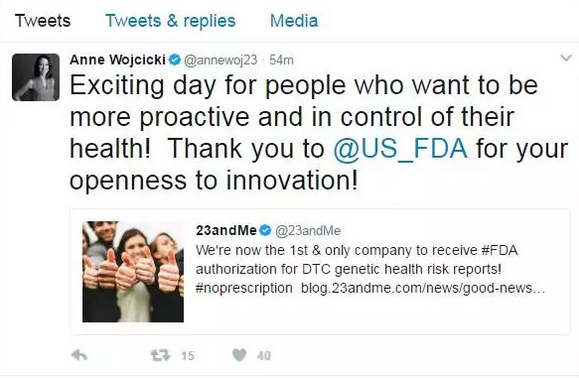
This is also the first direct-to-consumer genetic testing product approved by the FDA.
23andMe is undoubtedly a familiar name to many. From its founder, Anne Wojcicki, to its investors—including Google, Johnson & Johnson, and even the NIH—and its globally renowned $99 direct-to-consumer genetic testing product, the company carries an aura of prestige wherever it goes.
Eleven years ago, 23andMe pioneered direct-to-consumer genetic testing services. As is well known, the cost of the first human whole-genome sequencing reached $2.7 billion, whereas 23andMe’s initial price was set at just $999, undoubtedly reshaping public perceptions.
As sequencing costs continued to decline, the price of 23andMe’s products also dropped steadily. After securing more than $60 million in Series B and C funding rounds, the test price was further reduced to $299. In 2013, because the FDA had not yet established relevant regulatory standards, 23andMe was forced to suspend its health-related genetic testing services. Consequently, the company’s direct-to-consumer genetic testing offerings were limited to ancestry analysis, and the price of its tests hit a new low of $99.
Subsequently, the FDA approved the company’s tests for Parkinson’s disease and Alzheimer’s disease, which typically cost just $149 or $199. This marks a step toward 23andMe’s testing products emerging from the regulatory wilderness.
According to 23andMe’s official press release, the approval of the GHR test was based on data from peer-reviewed scientific literature demonstrating that specific genetic mutations are associated with the aforementioned ten diseases. The FDA also reviewed 23andMe’s studies showing that its GHR test can accurately and consistently identify variants associated with the following ten diseases from saliva samples:

Parkinson's Disease
Late-Onset Alzheimer's Disease
Celiac Disease
α-1 Antitrypsin Deficiency (α-1 Antitrypsin Deficiency)
Early-Onset Primary Dystonia
Factor XI Deficiency
Gaucher Disease Type 1
Glucose-6-Phosphate Dehydrogenase Deficiency (G6PD Deficiency)
Hereditary Hemochromatosis
Hereditary Thrombophilia
Such a generous green light seems to signal that the FDA is intentionally moving toward standardizing and regulating consumer genetic testing. However, external commentary on this development has been mixed.
Wojcicki himself believes that such a result is"The Voice of the People", consumers want to know their genetic data. She stated that 11 years ago, it was challenging for 23andMe to deliver its products, but the company has consistently strived to help customers accept and understand genetic information. Subsequently, as consumer awareness and acceptance of genetic testing gradually increased, the consumer genomics market ushered in a period of robust growth.“23andMe’s remarkable turnaround is because users have indeed felt the benefits brought by this data.”。
However, experts have reacted differently. George Demetri, Director of the Bone Oncology Center at Dana-Farber Cancer Institute, believes that the FDA’s decision appears somewhat hasty. Anirban Maitra, Director of the Pancreatic Cancer Center at the Ahmed Cancer Center, went further, stating directly, “The market is still plagued by unscrupulous practitioners and salespeople lacking professional ethics, which has led to results that inspire no confidence. What, then, is the point of such testing?”
“Things could be worse.” Hank Greely, Director of Life Sciences Law, remarked, “This may not necessarily be a bad thing, but I am not particularly enthusiastic about it. Perhaps it could improve the health status of Americans and benefit consumers; however, I remain skeptical at present.”
However, Eric Topol, Director of the Scripps Translational Science Institute, strongly supported the FDA. He stated, “Following the FDA’s ban, many genetic risk assessments were published in top-tier journals. Commercialization of common genetic disease risk testing is feasible. I believe that 23andMe and other companies have provided valuable information and market education, which is highly commendable.”
It is important to note that the approved project is limited to disease risk assessment, indicating the likelihood of developing a condition; it does not serve as a clinical diagnosis and cannot determine whether an individual currently has the disease.
Compared to the 254 tests previously offered, the 10 tests approved this time are but a drop in the bucket. However, the FDA appears to be giving 23andMe the green light to secure approval for additional tests.
These risk screening tests can assess consumers’ disease risk before onset, enabling early intervention. Other companies may also gradually obtain approval in the future. This approval will be published in the Federal Register, opening a 30-day public comment period.
Wojcicki believes that the core issue in approving consumer genetic testing is whether“Whether enabling consumers to understand their disease risks in advance can effectively help them”? She believes that this is the issue of greatest concern to patients.
Robert C. Green, Director of Genetics at Brigham and Women’s Hospital, Harvard, stated that in his professional experience, patients do not suffer serious harm or engage in reckless behavior upon receiving alarming results.
As part of the approval process, 23andMe conducted a trial involving 25,000 participants in the United Kingdom, a region with a high prevalence of Alzheimer’s and Parkinson’s diseases. The results showed that participants did not engage in self-harm or other serious adverse behaviors after learning they had a high risk of developing these conditions.
“We are striving to expand into the consumer market because we believe it is our mission to enable consumers to benefit from genetic testing,” said Wojcicki. “I believe that consumers have the right to know their health status, will proactively take responsibility for their own health, and will have more choices.”
In 2015, 23andMe had only 800,000 users, but that figure has now reached 2 million, according to Wojcicki. Selling testing kits is not their sole revenue stream. In fact, the data they collect holds the true value.
The company has its own internal drug development program. Currently, the new vision proposed by 23andMe is to transform the traditional drug development model by “engaging patients in drug development.” This approach leverages big genetic data, whereby major pharmaceutical companies develop treatment plans for patients, and patients provide the data required for research. Key clients in this initiative include Genentech and Pfizer.
Greely criticized this point, stating: “Compared to genetic testing, 23andMe’s business model is more about selling data. I wonder if consumers have truly thought this through.”
Wojcicki countered this argument, asserting that 23andMe’s user base serves as the best proof. Two million people have entered into agreements with 23andMe, each taking charge of their own health. “This is an opportunity for people to understand and maintain their health,” she stated. “It is precisely this reason that fuels my research.”
It has been four years since 23andMe was ordered to halt operations, and the FDA only granted approval after multiple reviews. Whether this was hasty is difficult to determine through discussion alone. VCBeat believes that,Practice is the sole criterion for testing truth.。