

Pakinson Cloud Hospital: Integrating 'Internet+' into Comprehensive Parkinson's Disease Care
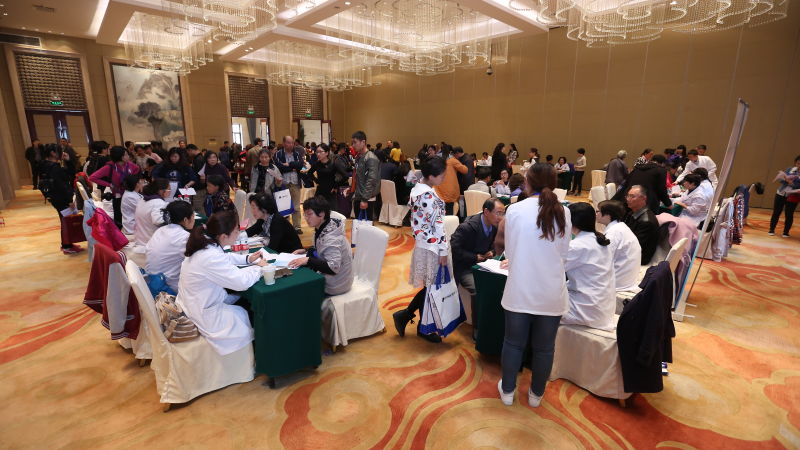
2April 9, 2017, more than 400 people gathered at the Hunan Building. In the venue, in addition to experts, scholars, and physicians, there were many elderly individuals exhibiting limb tremors and bradykinesia.
This isBeijing Parkinson's Disease Group、Dr. Pa Yun and Xuanwu Hospital of Capital Medical UniversityJointly Hosted Inaugural Conference of the Payun Doctor AllianceAtandBeijing2017 “World Parkinson’s Day” Large-Scale Commemorative Event。This group of quiet elderly individuals allowed VCBeat to truly grasp the reality of Parkinson’s disease for the first time.
4.11, “World Parkinson’s Day”
1817, UKA man named James· While observing pedestrians from the window, a physician specializing in Parkinson’s disease identified a peculiar group of patients: they exhibited tremors and rigidity in their limbs,Sluggish Reaction, the body leans forward, as if always expressionless.
He categorized this type of patientFor“Shaking Palsy.” Subsequent research has revealed that shaking palsy is highly prevalent among the elderly population, ranking as the second most common neurodegenerative disease after Alzheimer’s disease.
To commemorate Dr. Parkinson's outstanding contributions to the discovery of this disease,“Paralysis agitans” was renamed Parkinson’s disease; April 11, the birthday of Dr. Parkinson, has been designated by the World Health Organization as “World Parkinson’s Day.”
Parkinson’s Disease: An Inevitable Challenge in an Aging Society
Two hundred years later, with the deepening of population aging, Parkinson's disease has become a social issue that is difficult to avoid:withBased on the epidemiological survey results conducted in Beijing, Xi’an, and Shanghai from 1997 to 1998, which indicated a Parkinson’s disease prevalence of approximately 1.7% among the elderly population aged 55 years and older in China, it was calculated that 1.72 million people aged 55 years and older in China were affected by Parkinson’s disease in 1999.
According to the results of China's Sixth National Population Census, the elderly population in China has now exceededThe figure surpassed the 200 million mark, reaching 202 million, with the aging rate standing at 14.8%. Among the population aged 55 and above in China, there are 3.43 million Parkinson’s disease patients.
Professor Chen Biao, Xuanwu Hospital of Capital Medical UniversityIntroduction,Parkinson's disease is characterized by a large patient population, high disability rates, and long-term survival with the condition.Moreover, the progression of this disease occurs gradually.By the time patients become aware of their condition and seek medical attention, it is often already the tenth year since the onset of intrinsic pathological changes associated with Parkinson’s disease.
Since clinical diagnosis, the disease course in patients with late-onset Parkinson’s disease typically exceeds ten years, whereas in those with early-onset Parkinson’s disease among middle-aged and young adults, it can extend up to thirty years. Given that the primary clinical manifestations of Parkinson’s disease involve motor impairment, patients in the advanced stages often become unable to perform activities of daily living or even bedridden for prolonged periods due to balance disorders, falls, freezing of gait, dysphagia, and speech impairments. This imposes substantial physiological, psychological, and economic burdens on patients, their families, and society.。
Therefore, the identification and risk prediction of high-risk patients, along with the formulation of early individualized treatment plans, are of paramount importance.To achieve this goal, physicians need to provide screening, treatment, and guidance addressing the concerns of patients and their families at each stage, while patients and their families should provide timely feedback and maintain communication with their physicians.
Dr. Payun: Online + Offline, Providing End-to-End Services Centered on Patients
Chen Biao believes that, unlike other diseases, patients with Parkinson's disease exhibit higher adherence to healthcare providers.Physicians are required to provide screening, treatment, and guidance addressing the concerns of patients and their families at each stage, while patients and their families need to provide timely feedback and maintain communication with their physicians. Patients, family members, and physicians all play important roles in this process.
Dr. Pa Yun aims to leverage the Internet to establish effective channels for doctor-patient communication, integrating online and offline services.Achieve long-term, stable, and comprehensive patient management, providing genuine assistance to patients and their families.
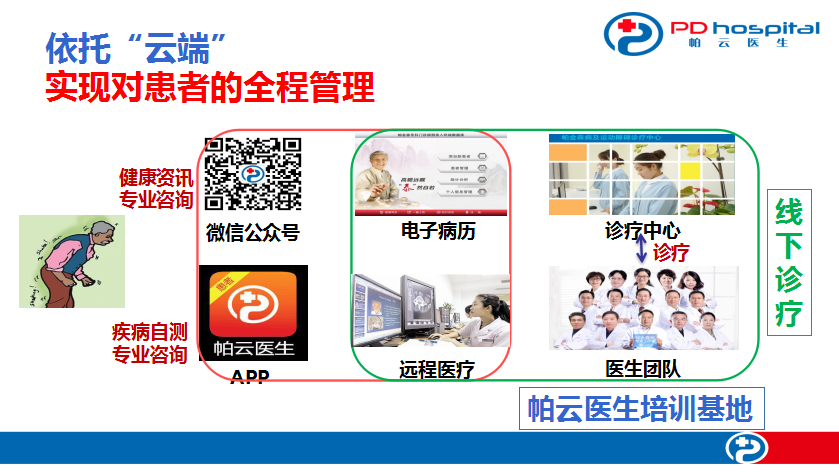
Via Payun DoctorThrough the app and WeChat interface, Payun Doctors can provide patients with preliminary self-assessment tools for diseases as well as further professional consultation services. Additionally, the online app facilitates direct communication between doctors and patients. By leveraging wearable motion-monitoring devices, doctors can remotely monitor patients’ symptoms and medication changes in real time, eliminating the need for face-to-face consultations.
Furthermore, traditional medical record handling presents numerous inconveniences when it comes to referrals between higher- and lower-level healthcare providers. Inspired by cloud technology, Payun Doctor connects physicians across different tiers of the healthcare system and facilitates referrals through a cloud-based electronic medical record (EMR) system, while also enabling diagnosis and consultations via a telemedicine platform.
In the offline sector, Dr. Payun has partnered with multiple physical hospitals through multi-site practice arrangements, aiming to expand service coverage and jointly establish a world-class specialized center for the diagnosis and treatment of Parkinson’s disease.
Professor Chen Haibo, Beijing Hospitalstated that Dr. Payun is, in fact, an exploration of a new healthcare model under the current circumstances—Breaking down hospital walls to ensure every patient receives the medical resources and attention they deserve. By collecting data in the cloud, establishing robust top-level design, and ensuring practical implementation, we can conduct comprehensive assessments for each patient. “This represents a completely new concept in disease treatment,” he stated.
Amplify Physician Resources and Streamline Doctor-Patient Communication Channels
Beyond conceptual innovation, perhaps of greater significance is the realization of physicians’ full participation in the entire process of disease prevention, control, and treatment for patients, thereby facilitating effective doctor-patient communication.
Zhou Bing, Editor-in-Chief of Health NewsIt was revealed that there are currently millions of Parkinson's disease patients in China.This figure continues to grow rapidly. However, the number of doctors and specialists is limited, their time is constrained, and they are unable to provide coverage across China.
It is extremely challenging to ensure that all Parkinson’s disease patients receive high-quality, precise treatment and management, and it is even more difficult to involve physicians in the comprehensive, end-to-end management of patients. This condition requires long-term management and ongoing communication between doctors and patients. Given the enormous population of Parkinson’s disease patients in China, the patient-to-physician ratio is highly imbalanced.
“Parkinson’s patients are unfortunate, yet also fortunate,” he stated. Their misfortune stems from the disease, while their good fortune lies in having come of age during the “Internet+"In this era, big data and artificial intelligence have filled many things with hope."
Compared with other“Internet+“With a different model, the protagonist of Payun Doctor is the physician, a group that plays a pivotal role in the doctor-patient relationship.”
“Only doctors have the deepest understanding of patients’ conditions, and only by scaling up physician resources can we serve a broader population.”“Zhou Bing concluded.”

On stage, Chen Biao and others pressed the launch button, officially establishing the Payun Doctor Alliance. Subsequently, accompanied by their family and friends, the elderly attendees in the audience proceeded in an orderly manner to the free clinic area. In addition toTwenty Parkinson's disease experts from the departments of neurology and functional neurosurgery at major hospitals in Beijing, along with Dr. Pa Yun, also invited gastroenterologists andNutrition specialists provide patients with care from the perspectives of digestive symptoms, such as constipation, and nutritional support.Provide preventive counseling.
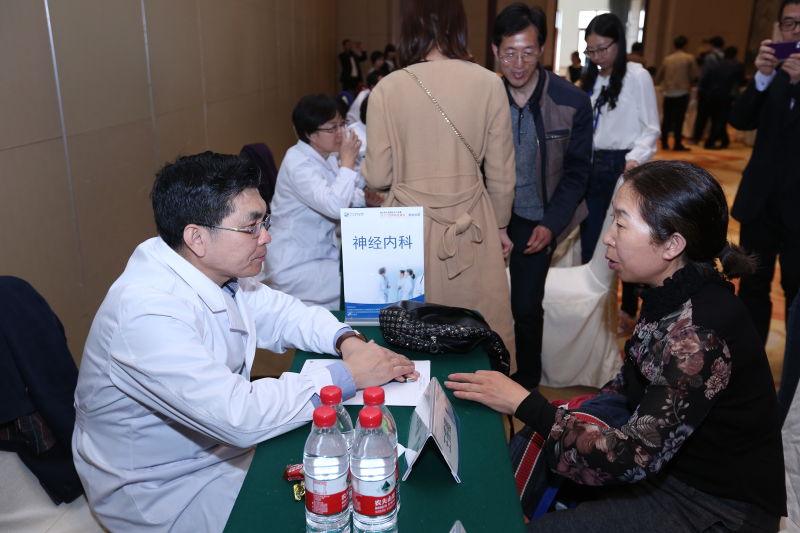
At the free clinic booth, a doctor was patiently discussing the patient’s condition with the patient and their family members, who were highly cooperative. This cooperation stemmed from the patient’s trust, which in turn was built on the doctor’s professionalism.“Often, the doctor-patient relationship is the key to resolving issues.” The words Chen Biao had just spoken came to mind for the reporter.
The terror of disease lies not only in its symptoms, but also in the isolation and helplessness patients feel due to their lack of understanding of their condition and confusion about treatment options. With compassion at the heart of medical practice, healthcare providers—who offer both emotional support and therapeutic reliance—may be exactly what patients need.