

Oubitang Secures RMB 3 Million Funding to Launch China's First Blockchain-Integrated Traditional Chinese Medicine Therapy Project
VCBeat (WeChat ID: vcbeat) has learned that a company operating a chain of traditional Chinese medicine (TCM) physiotherapy clinics recently secured RMB 3 million in financing. At first glance, this news may seem unremarkable; however, after an in-depth interview with Zhao Xinsheng, the company’s founder and CEO, we have come to realize that this is not merely a straightforward story of “chain-store financing for expansion.”
The company, named Obitang, appears to operate in a traditional sector—Traditional Chinese Medicine (TCM) spinal therapy and rehabilitation—yet it has chosen to pursue a rather trendy, even somewhat niche, path.Build the first truly implemented blockchain application project in China. This funding will soon be allocated to blockchain research, as well as to “on-chain” integration for products and personnel.
Why: “New” Blockchain + “Old” Chain Physiotherapy?
We were puzzled, as the seemingly mundane physiotherapy clinics appeared to have little in common with the “high-end” blockchain technology. The company’s CEO smiled and remarked that integrating chain-operated physiotherapy services with blockchain stemmed from the operational pain points previously experienced by Obitang.
Oubitang possesses proprietary patented technologies for spinal diagnosis and treatment, as well as its own pharmaceutical production lines. Both its physiotherapists and therapeutic medications are sourced internally. The company operates both directly-owned stores and franchised outlets, with cross-regional unauthorized distribution (parallel importing) posing a significant management challenge for the latter. “Some franchisees may engage in drug substitution, using products that are far less effective than Oubitang’s in-house manufactured medications, thereby harming our brand reputation and revenue.” Similar issues have arisen in the management of physiotherapy personnel; certain stores operate under the Oubitang banner while providing services through non-certified therapists, making effective oversight difficult.
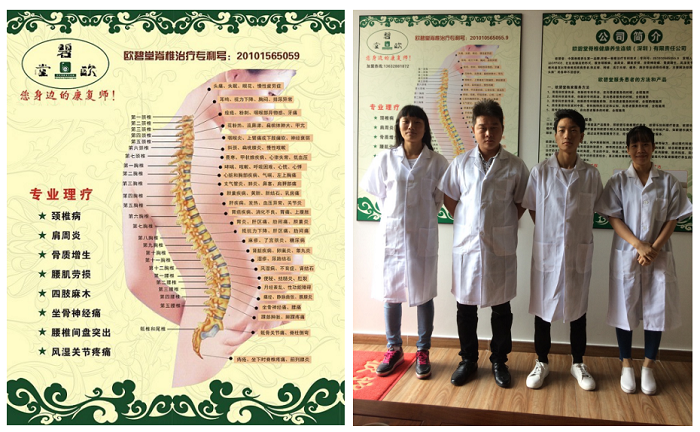
Oubitang’s Patented Spinal Therapy Technology and Professional Team
Just as the management team of Obitang was contemplating how to overcome operational pain points, a turning point quietly emerged. Zhao Xinsheng accidentally attended a high-level joint conference on FinTech, where he learned about the advantages of blockchain and artificial intelligence technologies from experts affiliated with IBM and Microsoft. He was immediately attracted by the potential these technologies demonstrated in anti-counterfeiting, confidentiality, finance, and data information management.
“The security and confidentiality of blockchain technology can meet our needs for brand anti-counterfeiting and talent management; furthermore, its close integration with finance can serve as the foundation for rigorous accounting oversight in chain stores.” Zhao Xinsheng also stated that the digitization and artificial intelligence-driven transformation of disease diagnosis and treatment is an inevitable trend. Putting words into action, the Oubitang team began upgrading and transforming its traditional chain brand with new technologies at the end of 2016.
How to Do It: Blockchain Benefits the Entire Business Process
For Obitang, the specific implementation methods of blockchain are as follows:
I.Anti-Counterfeiting and Traceability of Store MedicationsOubitang’s dedicated pharmaceutical manufacturing subsidiary will assign a unique network-wide ID to each drug product. During inbound and outbound warehouse operations, electronic tag information will be intelligently read after key-based verification, and the data will be uploaded and recorded on the blockchain to establish a unique network-wide mapping. Subsequently, when patients receive therapy at retail stores, they can directly scan the medication using a mobile app or digital wallet, making details such as the drug’s origin, distribution trail, production date, and formulation immediately visible.
II.Certification Management for Physical Therapists. Each physician’s academic credentials, practice qualifications, and professional training certifications are archived for patient verification.
III.Chain Store Financial Management. Digital currencies are distributed as tokens, with user payments and franchisee bookkeeping conducted in token form. Every consumption transaction is recorded on the blockchain in real time, while each franchise outlet serves as a node that mutually supervises accounting records, thereby fundamentally eliminating the possibility of fraudulent reporting by franchisees.
Oubitang also plans to integrate blockchain with electronic medical records to track patients’ treatment and recovery. By scanning a QR code or using fingerprint authentication, patients can establish a personal digital identity. Information such as their condition during each physical therapy session, services received, therapeutic efficacy, and progress will be synchronized onto the blockchain, creating a private health record for each member.
On the other hand, after accumulating a large volume of reliable and standardized clinical data on disease diagnosis and treatment through blockchain technology, Oubitang is poised to establish an inter-institutional shared database for spinal disorders. By leveraging healthcare big data secured via blockchain, it aims to collaborate with companies requiring medical AI training datasets, thereby improving disease treatment and pharmaceutical R&D, and exploring precise therapeutic approaches in Traditional Chinese Medicine (TCM).
Above,Brand Anti-Counterfeiting, Electronic Medical Records, Financial Management, and Data Accumulation Applications: A Full-Process Business Model“Put bluntly, this technology can help us expand more quickly and steadily.”
How It Works: New Technology Ushers in the Renaissance of Traditional Chinese Medicine Therapy
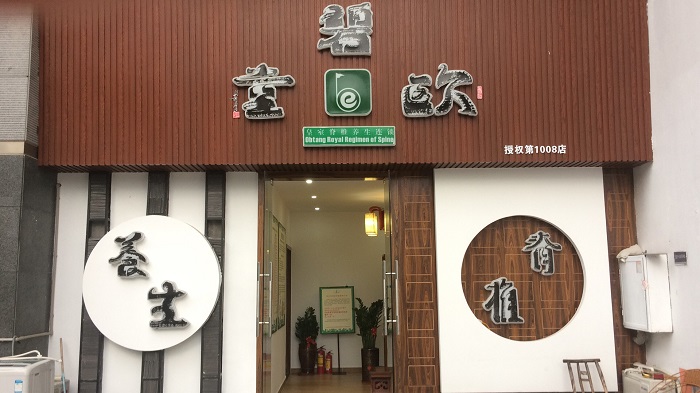
Oubitang Store
Summarizing Oubitang’s new explorations in managing its chain of Traditional Chinese Medicine (TCM) physiotherapy centers, we can conclude that they are leveraging blockchain technology to build industry barriers for their brand. However, having barriers alone is certainly not enough,The most critical factor lies in the unique value that the brand itself can create.. The founder of Obitang appears quite confident in its core values, namely the efficacy of its services and products.
“I used to work in the golf industry. In China, there was no awareness of preventing and recovering from sports injuries at that time. I frequently suffered from neck, leg, and waist sprains, and even traveled across the country without finding a cure.”
Zhao Xinsheng stated that after various Western medical treatments proved ineffective, he ultimately recovered from his injury using a traditional Chinese medicine (TCM) physiotherapy technique. Impressed by the remarkable efficacy of this method and eager to make it accessible to more people, Zhao joined forces with Huang Haibin, the patent holder of this spinal diagnosis and treatment technology, and Liu Xiaodong, a researcher in fields such as quantum computing, neural networks and machine learning, biotechnology, and gene technology, to further promote and advance this TCM physiotherapy technique.
“There are many TCM therapy clinics on the market, with varying quality and a mix of genuine and fraudulent practices; our aspiration is to”"Enabling the public to experience physiotherapy services that truly integrate the essence of Traditional Chinese Medicine.", building this reputation takes time, and it is also necessary to carefully safeguard it with the sophisticated technology of blockchain.”
The physiotherapy services promoted by Oubitang have also gained customer recognition. According to Zhao Xinsheng,The RMB 3 million financing round was sourced from one of their Hong Kong-based clients., having personally experienced the excellent therapeutic efficacy of Oubitang's Traditional Chinese Medicine (TCM) physiotherapy, this customer is also highly optimistic about its future transformation toward blockchain-based management.
Currently, Oubitang has its own blockchain technology R&D team. The company has also reached a cooperation intention with experts from Sun Yat-sen University—Sun Yat-sen University is recruiting a research team in health and wellness tourism and big data globally, which will serve as technical consultants for Oubitang's blockchain project and participate in project development.
The company already operates dozens of stores, andPlans to Launch the First Store with Blockchain-Based Management in Shenzhen, as first-tier cities like Shenzhen have a higher prevalence of "phubbers" and patients with chronic spinal disorders.
Regarding the advantages of using spinal therapy as a nexus for blockchain and big data integration, Zhao Xinsheng stated that spinal therapy encompasses both specialty and general practice, featuring broad data dimensions that facilitate expansion into other diagnostic and therapeutic fields.
Zhao Xinsheng expressed great passion for this endeavor: “Traditional Chinese Medicine (TCM) is profound and extensive. By integrating our 5,000-year-old traditional civilization with modern technology, we can certainly achieve its renaissance!” Oubitang aims to refine its blockchain technology into the key that unlocks the revival of TCM therapies. Here, VCBeat will continue to follow more enterprises that combine traditional diagnostic and therapeutic techniques with modern technology, focusing on their transformation, implementation, and growth.
At this stage, Oubitang is actively seeking industry collaborations, relevant technical talent, and its next round of financing.
All data related to the enterprise in this article were provided and confirmed by the interviewees.