

Six Healthcare IT Executives Share Insights on the Future of AI in Medicine Amid IPO Filing
According to data from CB Insights, in 2012, there were no more than 20 AI companies worldwide focused exclusively on healthcare; last year, the global total reached nearly 70. Clearly, artificial intelligence technology is making rapid strides in the healthcare industry.
Moreover, according to a report by the market research firm MarketsandMarkets, the healthcare sector will become one of the biggest drivers of artificial intelligence development over the next six years. From 2016 to 2022, the overall AI market is projected to achieve a compound annual growth rate (CAGR) of 62.9%, reaching a value of $16.2 billion.
Here, executives from six well-known healthcare IT companies shared their views on the prospects of medical artificial intelligence over the next 20 years. VCBeat (WeChat: vcbeat) compiled and organized these insights.
1. Mudit Garg, Co-founder and CEO of Qventus, a company that uses artificial intelligence to optimize entire hospital operating systems:
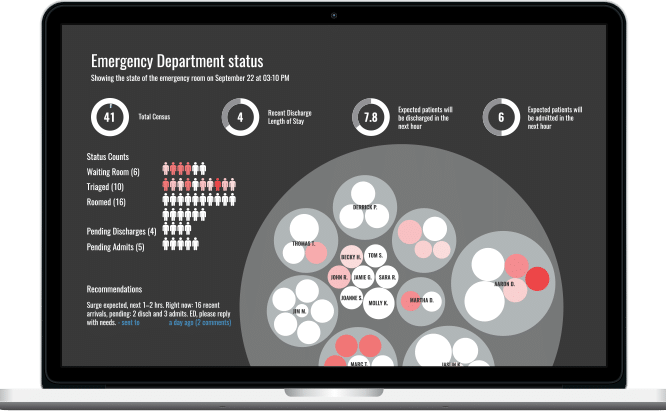
Qventus Uses AI to Optimize Hospital Processes
“Nowadays, many people like to imagine a scenario in which AI completely replaces doctors. In reality, however, the problem within the healthcare system does not lie in the inefficiency of healthcare providers, but rather in how to create an efficient working environment for outstanding physicians.”The Concept of Optimizing the Work Environment with Artificial Intelligence, appears dull and unsexy compared to the concept of “robotic surgeons,” but this alsoIt represents our greatest opportunity to enhance patient experience and reduce healthcare costs.。
There is no need to wait 20 years to witness the impact of artificial intelligence, as many hospitals are already benefiting from it. AI-driven task scheduling can enhance patient flow efficiency, reduce surgical delays and cancellations, and prevent patient falls. Last year, one hospital reduced patient waiting times by one million minutes through an AI-optimized system.
“The more widely AI is adopted, the lighter the burden on hospitals and physicians will become, thereby reducing the rate of professional burnout among healthcare workers. By enabling flexible workflow arrangements, AI allows them to focus on matters requiring critical attention, rather than dissipating their energy on every bit of data and every potential interaction and counteraction.”
2. CEO and Chairman of GE HealthCare, Charles Koontz, Chief Digital Officer of GE HealthCare:
“The digital transformation of healthcare is underway. Machine learning and artificial intelligence have demonstrated their potential to enhance the efficiency and quality of medical care, and their significance will continue to grow over the next two decades. For instance, GE Healthcare and the University of California, San Francisco, have partnered on a digital health initiative, establishing a library of deep learning algorithms that assist physicians in interpreting scan images more quickly and accurately, thereby facilitating patient diagnosis. One such algorithm can detect pneumothorax in medical images; upon identification, it alerts radiologists to expedite the patient’s care pathway, ensuring prompt treatment for affected individuals, which improves therapeutic outcomes and alleviates patient suffering.”
Over time, insights derived from these algorithms can be leveraged to develop next-generation algorithms capable of solving more complex problems with fewer images."As artificial intelligence becomes increasingly agile, traditional forms of diagnosis and treatment may undergo disruptive changes."”
3. Greg Kuhnen, Senior Director of Research at Advisory Board:
“To quote science fiction writer William Gibson: ‘The future is already here—it’s just not evenly distributed.’ Today, we already have emergency rooms capable of recording granular patient data, all under the surveillance of artificial intelligence, which sifts through these data to identify signs of missed diagnoses or disease outbreaks.”
Physicians are often overwhelmed by data, but AI can come to their rescue by extracting high-quality predictive insights from the ocean of raw data or flagging potential possibilities. These are our current expectations for AI—Assist in diagnosis; formulate medical instructions based on the patient's specific condition; and even take over all time-consuming and labor-intensive tasks of patient monitoring and data interpretation.。”
4. Fatima Paruk, Marketing Director of Allscripts Analytics, a provider of electronic health records and population health management solutions
“Artificial intelligence is the future of healthcare. In the retail and economic sectors, AI and predictive analytics have already achieved significant results, seamlessly integrating with many aspects of daily life. However, its application in the medical field remains insufficient, with its potential in precision medicine, preventive care, and disease management yet to be fully realized.”
Nevertheless,Over the next 2–3 years, artificial intelligence will begin to assume a significant role in the healthcare industry.. The area where intelligent systems are likely to have the most significant initial impact is chronic disease management, which is receiving increasing emphasis. This will be followed by the integration of patient-centered medical data with external factors (such as pollution, climate, and economic conditions) to tailor precision medicine solutions for each individual. In the near future, it will also become a reality to leverage genetic information, healthcare services, and precision medicine to identify optimal treatment plans.
Artificial intelligence will play a significant role in clinical decision support, early disease screening, and personalized medicine, thereby exerting a substantial impact on hospitals and physicians. For patients, it also serves an educational function by enhancing their understanding of pathogenesis and the varying outcomes associated with different treatment modalities.
5. Rajeev Ronaki, Life Sciences and Healthcare Leader at Deloitte Consulting:
“As healthcare gradually evolves toward outcome-based models, patients increasingly expect medical services to become as highly personalized as those in the retail and banking sectors. Currently, a top-tier hospital is operating the largest medical research project in the United States, leveraging machine learning algorithms to analyze tens of billions of genetic samples in its database.”
Three trends are driving the wave of artificial intelligence: first, exponentially growing data; second, faster distributed systems; and third, algorithms capable of processing data more agilely. Chief Information Officers can choose to unlock the value of AI from several perspectives, including:
VBInsight—Machine intelligence capable of assisting human decision-making.
User Service Value——Can handle relatively complex administrative tasks, such as arranging patient admissions, through voice commands and other inputs.
Value of Automation—Implantable devices and procedural workflows, among others, have enabled automated operations in specific fields to reduce manual labor, allowing physicians to focus on higher-value tasks.
According to IDC data, investment in the field of artificial intelligence will reach $31.3 billion by 2019. It is hoped that this technology will continue to grow as investment increases.”
6. Lisa Suennen, Managing Director of GE Ventures
“Artificial intelligence has the potential to undertake tedious data analysis for doctors and clinicians, freeing up more of their time and energy to focus on specialized tasks. We believe that AI empowers physicians to be more efficient and knowledgeable, thereby enabling them to provide better care for patients.”
Source: beckershospitalreview.com