

NHC and SATCM Launch 2017 Initiative to Enhance Primary Healthcare Service Capacity
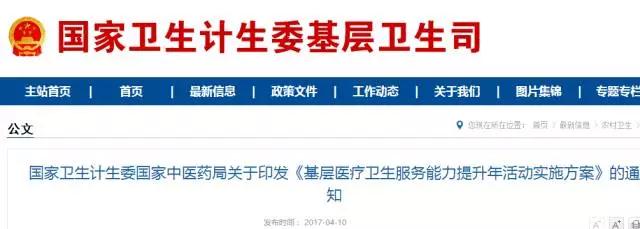
To advance the development of a tiered diagnosis and treatment system and promote family doctor contract services, the National Health and Family Planning Commission and the State Administration of Traditional Chinese Medicine jointly launched the “Year for Enhancing Primary Healthcare Service Capacity” initiative in 2017. Today, they released the “Implementation Plan for the Year for Enhancing Primary Healthcare Service Capacity” (hereinafter referred to as the “Plan”). Let’s take a look at the key tasks we will be undertaking this year in public health and family doctor contract services:
By implementing the “Year of Improvement” initiative, we aim to enhance the service functions, capabilities, distinctive features, and quality of care at primary healthcare institutions, ensure medical safety, and increase both the utilization rate and patient satisfaction with these facilities, thereby laying a stronger foundation for the establishment of a tiered diagnosis and treatment system. In 2017, on a provincial (autonomous region and municipality) level, primary healthcare institutions achieved a significant year-on-year increase in outpatient and emergency visits; the coverage rate of family doctor contract services reached over 30%, while the coverage rate for key populations exceeded 60%.
Under the organizational leadership of local governments at all levels and the administrative departments of health, family planning, and traditional Chinese medicine, community health service centers and township health centers are responsible for implementation, while community health service stations and village clinics shall carry out their work in accordance with relevant requirements.
Given the complexity of key initiatives, VCBeat has curated a list of “highlights” for your reference:
1. Vigorously Promote Family Doctor Contract Services
Assign responsibility for contracted services to individual physicians, strengthen team building based on physician-nurse partnerships, and improve the operational mechanisms and performance-based incentive systems for contracted service teams. In 2017, the coverage rate of family doctor contracted services exceeded 30%, with the coverage rate for key populations exceeding 60%.
2. Strengthen the development of general practice; establish "Departments of General Practice" in township hospitals
The Plan states that outpatient medical service capacity should be enhanced. Priority should be given to strengthening the development of general practice, with outpatient departments in community health service centers primarily organized around general practice, and township health centers required to establish general practice departments. Primary healthcare institutions with adequate resources are encouraged to develop specialized departments, fostering a complementary and differentiated development pattern relative to higher-level hospitals, thereby facilitating the appropriate diversion of patients from hospitals.
Going forward, community health service centers and township health centers should prioritize general practice. This necessitates that primary care hospitals proactively prepare for job-transition training and talent recruitment; otherwise, given the current shortage of general practitioners, it will be difficult for primary care institutions to meet policy expectations.
3. Inpatient care at the primary level is increasingly focused on community nursing and rehabilitation.
Regarding the improvement of inpatient care at the primary level, the Plan encourages primary healthcare institutions to establish joint wards with their affiliated higher-level hospitals, so as to enhance the capacity for inpatient diagnosis and treatment at the primary level, improve bed utilization efficiency, and facilitate medical access for residents.
It was also mentioned that, in accordance with the needs of tiered diagnosis and treatment, primary-level inpatient services should focus on community nursing and rehabilitation. Where conditions permit, palliative care and geriatric long-term care beds may be established to provide necessary diagnostic and therapeutic conditions for patients referred down from secondary hospitals and above.
4. Third parties establish regional centers for medical imaging, electrocardiography, clinical laboratory testing, and sterile supply services
To promote mutual recognition of test results among medical institutions within medical consortiums, reduce resource waste, and alleviate the financial burden on patients, the Plan reiterates the need to fully leverage existing medical resources and harness the role of third-party organizations. It calls for establishing regional centers for medical imaging, electrocardiography, clinical laboratory testing, and sterile supply services, while implementing an effective model of “primary-level examination with senior-level diagnosis.” These measures aim to improve the accessibility of high-quality medical resources and enhance the overall efficiency of healthcare services.
It also reiterates the encouragement of establishing regional centers for medical imaging, electrocardiography, clinical laboratory testing, and sterile supply services operated by non-public entities.
5. Encourage the provision of pharmaceutical care services
“The Plan” states that, in accordance with the needs of tiered diagnosis and treatment work and relevant regulations and requirements, necessary drug varieties shall be equipped to meet patients’ medication needs. It encourages the provision of pharmaceutical care services to offer patients guidance on rational drug use.
On April 8, Beijing implemented the policy of separating medical services from pharmaceutical sales, which introduced medical service fees. Does the phrase “encourage the provision of pharmaceutical care services” signal that large-scale pilot programs for pharmaceutical care will be launched in the future to demonstrate the value of pharmacists? Not only have multiple policies emphasized the need to provide pharmaceutical care services, but CCTV-12 has also recently been broadcasting the popular series *Tracing Medication Cases*, which uses cases of improper medication use to remind the public of the importance of standardized medication practices and greater recognition of pharmacists’ roles.
From the perspective of policy and mainstream media guidance, the implementation of pharmaceutical care services is not far off.
6. Strengthen Supervision of Intravenous Infusion at the Primary Care Level
To ensure the quality and safety of medical care, strengthen the clinical management of antimicrobial agents, hormones, intravenous infusions, and other medications. Control the irrational use of antimicrobial agents through measures such as negative prescription list management and prescription reviews, thereby reducing the utilization rates of antimicrobial agents and intravenous infusions. Implement quality management and control for single diseases that are common and frequently occurring. Strictly adhere to industry standards and technical specifications for traditional Chinese medicine (TCM), and enhance the management of TCM usage and quality. Implement the basic requirements for healthcare-associated infection management in primary healthcare institutions, and rigorously enforce the documentation and verification processes for disposable medical supplies, disinfectants, and sterilization equipment.
7. Launch a Publicity Month (Important)
This is a critical task that every primary healthcare institution must undertake in the near term!
To enhance the effectiveness of public health services, efforts will be intensified to promote the National Basic Public Health Services Program through a concentrated month-long publicity campaign aimed at raising societal awareness of these services. Comprehensive standardized training on the program will be vigorously implemented to improve healthcare professionals’ capacity to adhere to the specified service content, standards, and requirements.
Strengthen screening efforts for hypertension and diabetes to ensure timely identification of patients and their inclusion in health management programs, reinforce the integration of prevention and treatment, and conduct follow-up services as part of routine medical care. Enhance health management services for children, pregnant women, and the elderly, improve the ability to identify major health issues, and implement timely interventions for significant problems detected through screening.
Enhance community health diagnostic capabilities by analyzing major health issues among residents in the jurisdiction based on health records, physical examination results, and clinical diagnosis and treatment data, so as to implement targeted health interventions. Strengthen collaboration with village (neighborhood) committees and local entities to continuously diversify methods and formats of community health education, popularize knowledge and skills related to health and public self-rescue and mutual aid, and improve the health literacy of residents in the jurisdiction. Standardize vaccine management through unified procurement and full-process cold chain logistics to ensure the safety of preventive vaccination.
It is reported that some provinces have designated April as a publicity month to further increase public awareness of basic public health services and the family doctor contract service policy. Local medical institutions at all levels are required to carry out promotional activities for these services and submit the collected materials to the local grassroots health administration departments.