

China's State Council Unveils Major Reforms for Medical Consortium Pilots: Unrestricted Doctor Mobility and Primary Care Metrics Included in Performance Evaluations
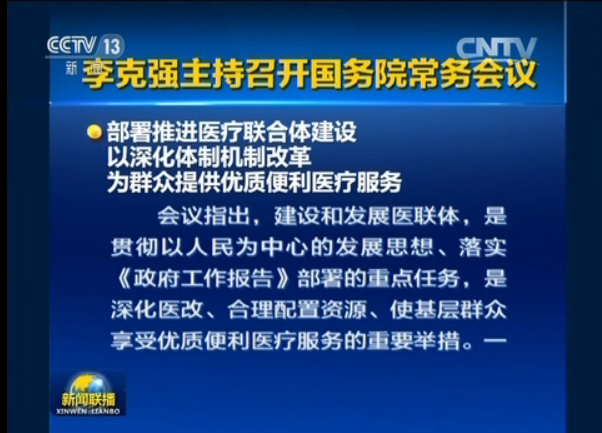
Yesterday, Premier Li Keqiang presided over an executive meeting of the State Council, which primarily deployed initiatives to advance the development of medical consortia, aiming to deepen institutional and mechanistic reforms and provide the public with high-quality, accessible medical services.
It was emphasized at the meeting that building and developing medical consortiums is a key task in implementing the people-centered development philosophy and carrying out the deployments of the Government Work Report. It is also an important measure to deepen the coordinated reforms of healthcare, health insurance, and pharmaceuticals, optimize resource allocation, and enable grassroots populations to access high-quality and convenient medical services.
What Is a Medical Consortium?
“Medical Consortium” refers to a collaborative alliance or medical group formed by public healthcare institutions of different types and levels within a specific region, establishing a community of shared interests and responsibilities. Within the consortium, patients can access convenient, high-quality diagnostic and treatment services, including two-way referrals between primary care hospitals and tertiary Grade A hospitals, mutual recognition of laboratory test results, specialist consultations in community settings, and remote consultations. The aim is to guide patients toward implementing tiered diagnosis and treatment, rather than overwhelmingly flocking to tertiary Grade A hospitals.
At this meeting, the State Council outlined four implementation plans for advancing the construction of medical consortiums, which VCBeat has interpreted individually.
First, break down restrictions such as administrative divisions.
Meeting Requirements:Break down barriers in administrative divisions, fiscal investment, health insurance payment, and personnel management; comprehensively launch pilot programs for the construction of medical consortia in various forms; explore, in light of local conditions, the establishment of medical consortia led by tertiary public hospitals or hospitals with strong clinical capabilities and county-level hospitals, featuring complementary advantages and division of labor among urban and rural medical institutions of different levels and types, as well as among specialties; and vigorously develop telemedicine collaboration networks oriented toward primary care settings and remote, impoverished areas.
VCBeat Analysis:During the development of medical consortia, two primary models are generally adopted: tightly integrated and loosely affiliated consortia. A tightly integrated medical consortium is characterized by administrative or asset management relationships between the core hospital and its member hospitals. In contrast, a loosely affiliated consortium lacks such constraints in these areas, functioning primarily as a form of medical cooperation linked by the complementarity of healthcare services.
Generally speaking, in China, tightly integrated medical consortia are better suited for unified administrative divisions or healthcare institutions with hierarchical affiliations, including the vast majority of county-level medical institutions. These entities feature shared benefits and shared responsibilities, functioning as a community with a shared future. In contrast, loosely affiliated medical consortia generally have no restrictive conditions; they can be cross-regional, cross-ownership, networked, or telemedicine-based. Loosely affiliated “medical consortia” do not enhance the service capabilities of primary care personnel, making it difficult to effectively promote tiered diagnosis and treatment or to implement initiatives in a substantial manner.
The meeting called for breaking down restrictions such as administrative divisions and launching pilot programs for the construction of medical consortia in various forms. The aim is to intensify the development of medical consortia under diverse models, including strengthening the interest alignment within previously loose-knit consortia, overcoming regional and health insurance constraints to achieve close collaboration, and ensuring that high-quality medical resources reach grassroots levels and remote, impoverished areas.
Second, mutual recognition of test results, prescription portability, and resource sharing
Meeting Requirements:Promote the sharing and decentralization of high-quality medical resources to the grassroots level, and enhance primary healthcare capabilities through measures such as dispatching experts, co-building specialized departments, and providing operational guidance.Achieve interconnectivity of health records and medical charts within the Medical Consortium, implement mutual recognition of test results, prescription portability, and medication sharing. Establish centers for medical imaging, laboratory tests, and other services to provide integrated care within the Medical Consortium.Collaboration among different medical alliances should also be strengthened.
VCBeat Analysis:The State Council has mandated that, in addition to dismantling administrative and managerial barriers among medical consortia, clinical care barriers must also be eliminated. This includes enabling the circulation and sharing of medical data such as prescriptions, medications, test results, and resources from imaging and laboratory centers.
Third, accelerate the signing of family doctor contracts
Meeting Requirements:Accelerate the implementation of the tiered diagnosis and treatment system. Strengthen family doctor contract services based on demand, ensuring that all impoverished populations are included within the service coverage by the end of the year. Encourage and guide residents to seek initial consultations at primary care institutions. Tertiary hospitals shall provide contracted patients with priority access to consultations, examinations, and hospitalization, while facilitating downward referrals for patients in postoperative recovery or with stabilized critical conditions. Encourage nursing homes and specialized rehabilitation institutions to join medical consortia.
VCBeat Analysis:In June last year, the “Guiding Opinions on Promoting Family Doctor Contract Services,” jointly issued by the State Council Office for Healthcare Reform, the National Health and Family Planning Commission, the National Development and Reform Commission, the Ministry of Civil Affairs, the Ministry of Finance, the Ministry of Human Resources and Social Security, and the State Administration of Traditional Chinese Medicine, explicitly designated the family doctor contract system as a key instrument in national healthcare reform. The targets set forth in the Guiding Opinions were to achieve a family doctor contract service coverage rate of over 30% and a coverage rate of over 60% among priority populations by 2017. Therefore, with time running short, the implementation of family doctor contracts must be expedited.
Fourth, there are no restrictions on physician mobility within medical consortia, and the volume of primary care consultations is included in performance evaluations.
Meeting Requirements:Strengthen policy support. Explore distribution and incentive mechanisms that facilitate the vertical integration of medical resources. Implement multiple payment methods, such as global budgeting for health insurance, for vertically integrated medical consortia.Incorporate indicators such as the proportion of primary care visits, the rate of two-way referrals, and improvements in resident health into performance evaluations. Medical personnel generally do not need to complete relevant procedures for practicing across institutions within a medical consortium.Better meet the public’s needs for disease prevention, convenient medical access, and nursing rehabilitation through reform and innovation.
VCBeat Analysis:Fourth and finally, a key focus of this conference is that indicators such as the proportion of diagnoses and treatments at primary care facilities, the rate of two-way referrals, and improvements in residents’ health will be incorporated into performance evaluations. Although medical consortia have been vigorously promoted across various regions, the actual referral practices within these consortia remain unsatisfactory. The Beijing Social Development Report (2015–2016), released last year by the Beijing Academy of Social Sciences, showed that between 2013 and 2015, only about 1/3,000 of the city’s total outpatient and emergency visits were conducted through referrals within medical consortia. By establishing assessment requirements for specific indicators reflecting the actual operational status of medical consortia—such as the rate of initial consultations at primary care facilities and referral rates—the effectiveness of medical consortium development will be evaluated.
Secondly, the meeting emphasized that medical personnel can practice across institutions within a Medical Consortium without the need to complete relevant administrative procedures, thereby achieving free mobility. Medical institutions at different levels are subject to distinct management systems; consequently, even within a Medical Consortium, the free movement of physicians faces numerous practical challenges. The State Council has underscored that medical personnel do not need to undergo such procedural formalities when practicing within a Medical Consortium. This reform and innovation aim to better meet public needs for tiered diagnosis and treatment, including disease prevention, convenient access to medical care, and nursing rehabilitation.