

Douting Technology Files IPO Prospectus to Become China's First Professional Hearing Health Companion for Over 20 Million People with Hearing Disabilities
Ma Ji’s multi-performer crosstalk piece “The Five Sense Organs Vying for Credit” is widely regarded as a canonical masterpiece, celebrated both for its witty punchlines and its profound thematic depth. Liu Wei’s portrayal of the “Ear” was particularly memorable; through humorous dialogue, he highlighted the ear’s vital role as an “information-processing organ,” while also capturing the awkward predicament of being diligent and uncomplaining yet frequently overlooked.
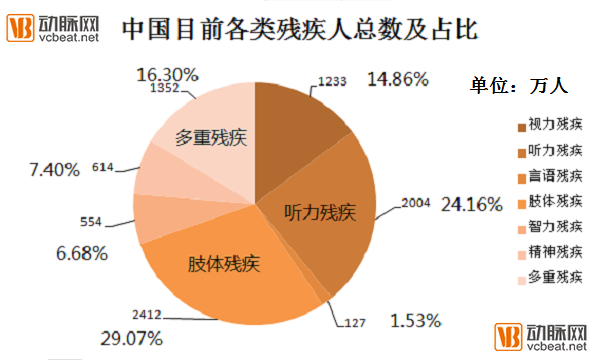
Indeed, we tend to pay insufficient attention to ear care in our daily lives. We are accustomed to brushing our teeth for oral hygiene, performing eye exercises to protect our vision, and wearing masks to reduce the inhalation of harmful substances, thereby safeguarding our nose and throat. However, our protection of the ears seems limited to covering them during firecracker displays at the Lunar New Year. Few realize that hearing impairment is the second most common cause of disability after physical impairment. According to the latest data released by the China Disabled Persons’ Federation and reported by VCBeat, the total number of people with disabilities in China currently stands at 82.96 million, among which 20.04 million have hearing disabilities, accounting for 24.16% of the total disabled population.
Data source: China Disabled Persons' Federation
China has such a large population of individuals with hearing disabilities, yet what we see in our daily lives are vision care centers and optical shops on nearly every street, while hearing care centers are rarely encountered. Let us examine another set of data.
Data Source: Douting Technology
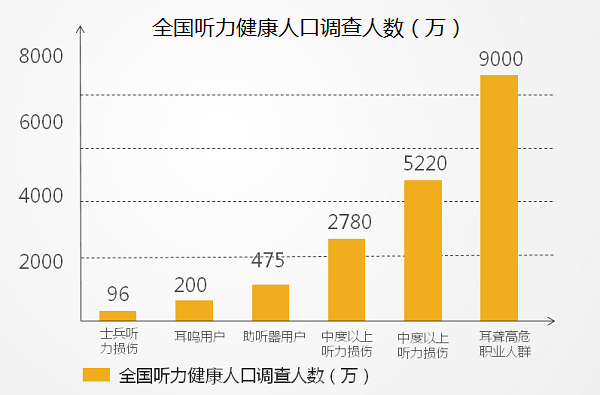
Approximately 10% of China’s population, totaling 90 million people, are at high risk for occupational noise exposure. Among them, 52.2 million individuals suffer from mild hearing impairment, while 27.8 million have moderate or more severe hearing loss. This figure continues to rise amid an aging population. The World Health Organization (WHO) once conducted a survey at a Chinese university involving 3,846 college students, of whom 1,121 were found to have varying degrees of moderate hearing loss.
Against this backdrop, some have spotted business opportunities. VCBeat recently learned about Wuhan Douting Technology Co., Ltd., a mobile health company that primarily provides integrated solutions for hearing prevention, protection, and treatment, and conducted an interview and report on the company.
One in Six Naval Personnel Suffer from Hearing Problems
Hu Yongjun, founder of Douting Technology, graduated from the University of Science and Technology of China with a master’s degree in electronic engineering. He previously worked at Siemens Communications Group, and the interstellar browser he operated amassed over 10 million users. There were multiple reasons behind his original intention to establish Douting Technology.
His partner, Yu Ning, holds a Ph.D. in Audiology and serves as a researcher at the Institute of Otolaryngology of the Chinese PLA General Hospital (301 Hospital). On one occasion, while conducting hearing tests for officers and soldiers aboard a naval vessel, he discovered that one-sixth of the crew suffered from varying degrees of hearing impairment. Given the stringent nature of military medical examinations, it was surprising that so many cases had gone undetected. The reason lies in the standard enlistment examination protocol, which typically employs tuning forks for hearing assessment. However, tuning fork tests do not provide quantitative data. Quantifiable diagnostic equipment is prohibitively expensive and available only at Grade IIIA hospitals. Consequently, enlistment candidates were passed as long as their hearing loss did not impede normal communication.
If military personnel were like this, one can only imagine the situation among the general public, who lacked even greater awareness of hearing health. Although Hu Yongjun had already recognized this as a significant business opportunity at the time, he had not yet made up his mind to start a venture. It was a subsequent incident that finally solidified his resolve. One day, his father experienced sudden sensorineural hearing loss in one ear. After spending over 1,300 yuan on hospital examinations, they learned from the doctor that sudden deafness could be treated similarly to pseudomyopia. As a result, his father refrained from playing cards and watching television for one to two weeks, and his hearing eventually recovered.
During this process, Hu Yongjun recognized the critical importance of hearing screening and prevention. Drawing on his partner Yu Ning’s experiences, he decided to establish a company dedicated to serving individuals with hearing disabilities, thereby filling the gap in China’s market for home-use hearing testing devices.
Hearing Testers, Like Snellen Charts, Have Entered Households Everywhere
Hearing problems caused by noise in living and working environments due to urbanization are becoming increasingly common, with typical sources including square dancing, open-air food stalls, and vehicle engine roar. Prolonged exposure to such noisy environments can lead to hearing loss. Audiologists state that hearing can recover if detected and treated within the first two weeks; however, if detection and treatment are delayed for a month, recovery becomes difficult. Therefore, early detection is crucial.
The Hearing Treasure Audiometer, developed by Douting Technology, is a professional home-use hearing testing device designed to work with the Hearing Treasure APP. Based on electroacoustic principles, the Hearing Treasure simulates a pure-tone audiometer by adjusting pure-tone files and the mobile phone’s system volume to generate pure tones of various frequencies and intensities. These tones are delivered to the subject via headphones to measure hearing thresholds at each frequency, thereby providing a basis for qualitative, quantitative, and localized diagnosis of hearing loss.
To enhance product precision, after the initial development of the hearing tester, DouTing Technology conducted sampling on 800 individuals at the Hearing Test Center of PLA General Hospital (301 Hospital). The DouTing Bao hearing tester was compared against professional audiometers, and the app’s data was calibrated accordingly. Subsequent comparison between the calibrated data and the results from professional audiometers demonstrated an error margin of no more than 5 dB, confirming the accuracy of the test results.
Currently, the Tinglibao hearing tester is a highly effective tool for promoting hearing health in China. On this year’s International Ear Care Day (March 3), CCTV-10’s “Approaching Science” program featured a special report on this technology in its episode titled “What’s Wrong with Your Hearing?”
Hu Yongjun told VCBeat that the product is expected to receive CFDA certification by the end of this year.
Big Data Platform for Hearing Health
DouTing Technology’s core business is a big data platform for hearing health, primarily under the brand “Tingli Bao.” Let us further discuss this hearing health big data platform. VCBeat has learned that the platform mainly provides various hearing tests, noise testing, tinnitus treatment, related software, management of user information and hearing test records, physician backend support, user guidance for medical consultation and product purchase, big data analysis and processing, and operational staff support. Meanwhile, it integrates with external systems to enable sharing of user information and hearing records.
After users undergo hearing tests with the Hearing Aid Device, they can review their data on the app. If abnormalities are detected, they can consult experts through the platform; some severe cases may require hospital treatment. However, much like vision, hearing health hinges on prevention and ongoing rehabilitation. Just as we use eye charts to test visual acuity and wear glasses for myopia, we can use the Hearing Aid Device to assess hearing and restore function through hearing aids when hearing loss occurs.
In addition to the Tingli Bao audiometer and the Tingli Bao app, Douting Technology has also developed devices such as smart hearing aids and tinnitus treatment instruments. As an internet healthcare company, Hu Yongjun told VCBeat that the advantages of their products lie in their high cost-performance ratio and ease of use, which are exactly what products should offer in the internet era.
Currently, Douting Technology has over 200,000 registered users and has sold 12,000 devices. This year, in addition to direct-to-consumer (C-end) sales, Douting Technology has developed several business-to-business (B-end) channels, with projected device sales reaching 200,000 units. Revenue streams will extend beyond hardware sales to include services such as comprehensive noise-control solutions.
Hu Yongjun told VCBeat that Douting Technology secured RMB 2 million in angel funding from the Optics Valley Talent Fund in August 2015 and is currently raising Series A financing...