

The Golden Era of Pharmaceutical Retail Has Arrived, But Four Key Challenges Must Be Addressed First
Recently, the 5th West Lake Forum was held in Hangzhou, where several leading figures in the pharmaceutical industry delivered presentations and shared insights. VCBeat (WeChat ID: vcbeat) has compiled the remarks made by Hu Jiqiang, Chairman of Conba Group, on pharmaceutical retail. The full text is as follows:
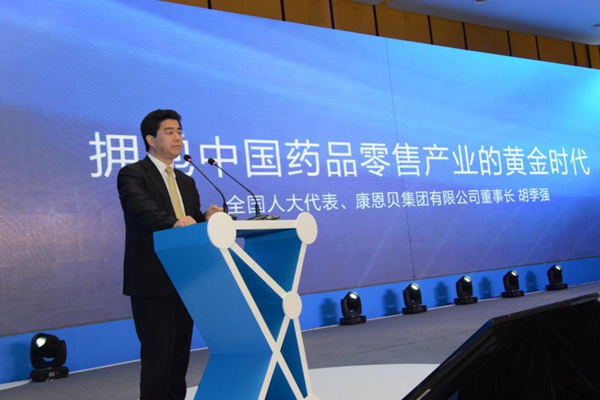
Hu Jiqiang, Chairman of the Board of Conba Group
Distinguished leaders in pharmaceutical retail, and colleagues across the pharmaceutical industry, good afternoon!
I wonder if you have noticed that in China’s pharmaceutical market in 2016, among the three sectors of manufacturing, distribution, and retail, there was a significant turning point from the broader perspective of the health industry when “hospitals” were also included: in 2016, the growth rate of the “pharmaceutical retail” sector surpassed that of the healthcare industry for the first time.
The total pharmaceutical market reached RMB 148.75 billion, of which the retail segment accounted for RMB 337.5 billion, with a growth rate of 8.5%, exceeding the overall market growth rate of 8.3%. While the national market grew by 8.3%, retail sales grew by 8.5%. The share of pharmaceuticals in public medical institutions declined from a peak of 28%–26% to 7.6%.
Meanwhile, the proportion of prescription drugs in retail pharmacies exceeded 30% for the first time in 2015, with a growth rate of 15%, which is twice that of hospitals. This rise and fall signifies the dawn of a new era: retail pharmacies are becoming the mainstream market for pharmaceuticals. Starting this year, the next 10 to 30 years will mark the golden age of China’s pharmaceutical retail industry.
China’s economic development will propel it to become the world’s largest pharmaceutical market. As the second-largest economy globally, China is expected to maintain a medium-to-high growth rate of 6%–7% over the next 10–15 years. In 2016, its GDP stood at $11.2 trillion; assuming an annual growth rate of 6.5%, it would reach $21 trillion in ten years. With a subsequent five-year growth rate of 5%, China’s GDP is projected to hit $27.8 trillion by 2031. For comparison, the United States’ GDP last year was $18.03 trillion. Taking exchange rate factors into account, it is estimated thatIn another 11 to 13 years, China will surpass the United States to become the world’s largest economy.
Likewise, China’s pharmaceutical market will unquestionably become the world’s largest within 10 to 15 years. Assuming an annual growth rate of 8%,In 10 years, our pharmaceutical market will grow to RMB 3.2 trillion, or $505 billion. In 15 years, it will reach RMB 4.3 trillion, or $670 billion. Therefore, between the 11th and 15th year, China is likely to surpass the United States to become the world’s largest pharmaceutical market—a certainty. Such a vast market will generate enormous opportunities. We should remain confident across all sectors, whether in manufacturing, distribution, or retail.
The “crowding-out” effect resulting from healthcare reform has driven the shift of hospital drug sales to retail pharmacies, a fact that has been unfolding in recent years. Under Fujian’s medical insurance payment price policy, the price for a drug from a foreign pharmaceutical company is only one-fourth or one-fifth of its original listing price, making it impossible for the company to sell the product at such a price in hospitals, soRetail Pharmacies Receiving DTP Flow。
Mandatory cost containment under the national medical insurance scheme has led to restrictions on the use of reimbursable drugs. Have you noticed the numerous triangles added to this year’s National Reimbursement Drug List (NRDL)? As cost-containment measures intensify, the triangle symbol indicates that reimbursement is limited to inpatient settings; for outpatient prescriptions, medications marked with a triangle must be paid for out-of-pocket or through the individual’s personal medical insurance account. If these cost-containment goals are truly achieved, there will be little difference between drug prescribing practices in hospitals and those in retail pharmacies.Drug Use Restrictions in Hospitals by Disease Type and Bed Count, leading to a significant influx of pharmaceuticals into the retail sector. In the absence of separation between prescribing and dispensing, prescription drugs are, in fact, increasingly flowing into retail channels.
Following price deregulation, branded pharmaceutical companies have begun to rise. This resurgence marks a shift from the past few years, when many of our branded drugs were constrained by rigid pricing, preventing them from offering sufficient profit margins to retail outlets through price adjustments. Consequently, retail terminals struggled for survival—a predicament described by Mr. Xu as the so-called “2.0 era,” which left them with no alternative.
At the retail terminal, who would be willing to sell Qianliekang with a gross margin of only 10%-15%? Qianliekang is a strong brand, yet it is being gradually abandoned by our own company and our retail terminals. This is not your fault. The current situation is set to change, because we canReposition users to clarify the relationships among end users, consumers, retail, distribution, and manufacturing.
After repositioning, I would argue that being user-centric and customer-centric are essentially aligned. A user-centric approach demands products that are safe, reliable, and genuinely effective in treating diseases. However, such products do not naturally reach consumers on their own. Nor can pharmaceuticals be sold entirely through online channels where consumers independently make purchases. Instead, they still need to rely on our distribution chain.
If you fail to build a strong brand, develop a flagship product, establish a leading brand identity, or grow into a major enterprise, and if you cannot effectively manage the relationships among the product, the brand, and all stakeholders in the value chain to foster enduring, positive, and market-responsive partnerships, it is only natural for your product to be abandoned by the market. Even with an excellent product, consumers will be unable to purchase it, and its health value for consumers will remain unrealized.
Therefore, while adhering to a user-centric approach and delivering the best possible products, manufacturing enterprises and factories must recognize the necessity of rationally configuring their value chains.Motivate the entire channel to generate enthusiasm for your product.. At the same time, such a drive will increase the average transaction value and generate incremental sales for the entire retail sector.
Market-driven competition, intensive operations, and the “Internet Plus” model will rapidly enhance the integrated health service capabilities of the pharmaceutical retail industry and improve user experience. This is precisely an area where another competitor to pharmaceutical retail—the healthcare industry—has yet to succeed today. Ninety percent of China’s healthcare sector consists of public medical institutions, while slightly more than ten percent is dominated by providers associated with the Putian network.
Therefore, public medical institutions are unable to provide high-quality patient services. In contrast, retail pharmacies operate in a highly competitive market environment, which enables us to deliver more systematic and effective services to patients and users through market competition. This type of service will also drive patients to seek care at pharmacies in the future. Particularly for minor ailments and chronic diseases, patients will increasingly present prescriptions directly or visit pharmacies without prior hospital visits—a trend I believe will define the future.
In the United States, 60% of all pharmaceuticals and nearly 80% of oral medications are dispensed through retail pharmacies, reflecting the implementation of a separation between prescribing and dispensing. Prescription drugs account for 70% of total pharmaceutical sales in retail pharmacies, with CVS deriving 76% of its sales from prescription medications. In contrast, 80% of pharmaceuticals in China are currently sold through hospitals. Hospital sales include a significant volume of injections, many of which are inappropriate or unnecessary. This trend is expected to change in the future.
What is the underlying cause? It stems from the fact that China’s healthcare reforms have not addressed the root issues. The system has failed to enable physicians to earn legitimate income through their professional skills and services. Instead, pharmaceuticals have become a source of physician income, a phenomenon known as “funding healthcare with drug profits” or “drug kickbacks.” This has led to the widespread use of unnecessary medications, so-called “miracle drugs,” where efficacy is disregarded in favor of maximizing personal financial gain. Such products and such a situation are unsustainable in the long term.
The separation of pharmaceutical prescribing and dispensing in China’s pharmaceutical industry is a certainty within the next six years., and this certain event will upend the entire current market. Therefore, the retail industry will witness an explosive opportunity, which will emerge at that very juncture.
The concept of “preventive healthcare” has taken deep root in public consciousness, driving rapid growth in the health-related product market and thereby boosting overall pharmacy revenues. Considering these factors, I believe that starting from 2017, the retail sector’s share of the pharmaceutical market will increase substantially. If we assume the separation of prescribing and dispensing is implemented by 2022, retail sales are projected to surpass RMB 1 trillion by 2023. A twofold increase over six years is unprecedented across industries. Isn’t this evidence that a true “golden age” has arrived? However, I would caution everyone against premature celebration. Does this golden age truly represent your opportunity? The Chinese pharmaceutical retail industry still faces critical challenges that must be fundamentally resolved before it can achieve significant scale and strength.
1. Highly fragmented.
The operational scale of individual stores is quite small. Compared with the United States, we have eight times as many pharmacies, yet our average sales per store are below RMB 1 million, whereas in the U.S. they exceed USD 3 million. We serve more than 3,000 people per pharmacy, while they serve 5,000. As urbanization advances, the total number of pharmacies will decline, but quality and sales per store will improve, with new store openings and closures occurring simultaneously.
2. Chain-based intensive development drives industry consolidation.
The Pharmacy Industry Enters an Era of Mergers and Acquisitions. Last year, among the top 50 companies on the Fortune Global 500 list, two were pharmaceutical retail enterprises: CVS and WBA. One ranked 18th globally with annual revenue of $153.3 billion; the other ranked 47th with revenue of $103.3 billion.
What does this indicate? It suggests that Chinese retail enterprises also have the opportunity to build world-class companies capable of ranking among the top 100 or even the top 50 globally. However, last year, Sinopharm Group Holdings—the leading player in China’s retail sector—reported sales of RMB 10.5 billion, with only four or five other companies exceeding RMB 5 billion. Therefore, it is entirely plausible that the industry will see the emergence of companies with revenues reaching hundreds of billions of RMB, or even hundreds of billions of US dollars, in the coming years. Given our currently low baseline, I believe everyone present has a chance to succeed. Whether starting from a base of USD 1 billion or USD 200–300 million and aiming for USD 100 billion, we are all essentially at the same starting line. Everyone has an opportunity; the key lies in whether you truly have the belief to achieve it.
3. Adhere to prioritizing users' health interests rather than focusing on our own profits.
4. Must embrace the Internet.
Although online sales of prescription drugs are restricted, e-commerce is not yet the mainstream channel. Nevertheless, the internet cannot be ignored. If your pharmacy, even a single store, fails to integrate with the internet, it has no future, as only through the internet can we better connect with our customers. The profound transformation of China’s pharmaceutical market has just begun, and the golden age of the drug retail industry has arrived. Both pharmacies and pharmaceutical manufacturers must embrace this change.