

Shanghai's Family Doctor Model Gains National Recognition as NHC Promotes Nationwide Rollout
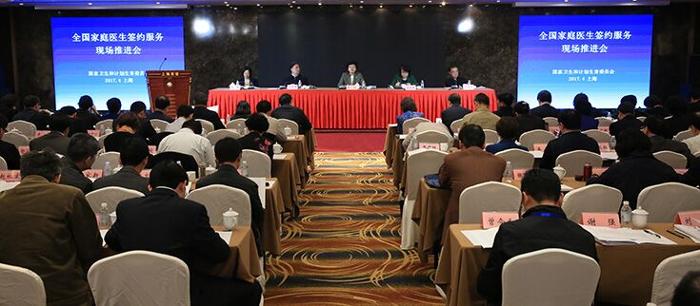
VCBeat News: On April 13, the National Health and Family Planning Commission convened an on-site promotional meeting for family doctor contract services in Shanghai. The primary objective of the meeting was to implement the "Guiding Opinions on Promoting Family Doctor Contract Services" and the spirit of the State Council’s teleconference on deepening healthcare reform, to study and promote the experiences of Shanghai and other regions, and to further solidify and improve the delivery of family doctor contract services. Li Bin, Deputy Head of the State Council Leading Group for Healthcare Reform and Director of the National Health and Family Planning Commission, attended and delivered a speech. Vice Director Ma Xiaowei presided over the meeting, and Weng Tiehui, Vice Mayor of the Shanghai Municipal People’s Government, delivered opening remarks.
Li Bin pointed out that promoting family doctor contract services is of great significance for transforming the model of medical and health services, establishing a tiered diagnosis and treatment system, building harmonious doctor-patient relationships, and strengthening the close ties between the Party and the people. The National Health and Family Planning Commission fully affirmed the experience of Shanghai and other regions in implementing family doctor contract services at the conference, and required all localities to effectively carry out family doctor contract services from six aspects.
First, enhance the substance of contract-based services by formulating appropriate service content and reasonably defining both basic and personalized service packages.
Second, strengthen the service capacity and quality at the primary care level, advance the “Year of Primary Healthcare Service Improvement” initiative, enhance the training and education of general practitioners, and promote the downward flow of high-quality medical resources.
Third, fully mobilize enthusiasm for family doctor contract services, improve performance-based salary policies, strengthen assessment and incentives, and broaden career development pathways for family doctors.
Fourth, enhance the appeal of contracted services to the public by improving residents’ recognition of such services in areas including medical consultation, referral, medication, and technical support, thereby encouraging voluntary enrollment through high-quality service delivery and differentiated policies.
Fifth, strengthen policy support for contracted services, reasonably determine service fees, fully leverage the supporting role of medical insurance, and broaden financing channels for contracted services.
Sixth, strengthen the information technology support for contracted services by building an interactive platform among family doctors, contracted residents, and upper-level hospitals to achieve interconnectivity of information.
At the conference, representatives from entities including Shanghai Municipality, Hangzhou City in Zhejiang Province, Chengdu City in Sichuan Province, Dafeng District of Yancheng City in Jiangsu Province, and the Yuetan Community Health Service Center in Beijing exchanged best practices. In the afternoon, attendees conducted on-site observations and inspections of community health service centers in Shanghai. The conference mandated that all provinces and municipalities across China promote the experiences of Shanghai and other regions this year, and effectively implement family doctor contract services. Key measures include formulating appropriate contract service content, reasonably defining basic and personalized service packages; strengthening primary care capacity and standards, enhancing the training of general practitioners, and facilitating the downward flow of high-quality medical resources; improving performance-based compensation policies, strengthening assessment and incentives, and broadening career development pathways for family doctors; reasonably determining contract service fees and expanding funding channels; and building interactive platforms among family doctors, contracted residents, and higher-level hospitals to achieve information interoperability.
Meanwhile, the National Health and Family Planning Commission has mandated that blind pursuit of contract signing rates be avoided, campaign-style approaches be eschewed, and coercive measures be prohibited. At the current stage, resources should be concentrated to prioritize contracted services for key populations, starting with major conditions such as hypertension, diabetes, tuberculosis, and severe mental disorders, and giving priority coverage to elderly individuals, pregnant and postpartum women, children, persons with disabilities, and impoverished populations.
Analysis of the Shanghai Model
Shanghai began piloting the family doctor contract system in 2011. Currently, more than 10 million permanent residents have signed up, with a coverage rate exceeding 45%. In November 2015, Shanghai issued the “Guiding Opinions on the Comprehensive Promotion of the Family Doctor System in This City,” launching a new round of comprehensive reforms in community health services. Through the “1+1+1” medical institution combination contracting model, residents can select one family doctor from a community health center, one district-level medical institution, and one municipal-level medical institution within the city, thereby forming a “1+1+1” contracted medical institution group. After signing up, patients are free to seek medical care within this designated group. The family doctor team charges an annual contract service fee to residents, which is jointly covered by three sources: the basic medical insurance fund, funding for basic public health services, and out-of-pocket payments by the contracted residents.
Residents who sign contracts with family doctors receive several tangible benefits. In addition to basic medical services, the family doctor team has access to a certain proportion of hospital specialist appointments, appointment registration slots, and reserved beds for referrals. Regarding medication, family doctors may appropriately extend the quantity of drugs dispensed per prescription for patients with chronic conditions. For patients referred down from higher-level institutions, medications can be prescribed in accordance with their condition and the medical orders from the referring healthcare facility. In terms of health insurance, differentiated payment policies are implemented for contracted residents; for example, the deductible is calculated continuously for hospitalized patients who undergo compliant referrals, and contracted residents receive a higher reimbursement rate when seeking care at primary healthcare facilities.
Compensation distribution should be prioritized toward family physicians, and the proportion of senior professional titles in community health settings should be increased (from 3%–5% to 5%–10%). During title evaluation, requirements for academic qualifications and research projects should be appropriately relaxed, while assessment should place greater emphasis on skills and performance metrics that reflect the distinctive characteristics of community healthcare.
As of March 2017, more than 1.6 million residents had signed up for the “1+1+1” family doctor service model at 218 pilot community health centers in Shanghai, with a signing rate exceeding 37% among residents aged 60 and above. As contracted residents enjoy preferential policies in areas such as consultation processes, appointment waiting times, variety of prescribed medications, and prescription quantities, there has been a significant shift of patient visits to the community level.
Field Visit to Shanghai’s Grassroots Communities by the National Health and Family Planning Commission
At around 3:00 p.m., a delegation led by Li Tao, Director of the Department of Primary Health Care under the National Health and Family Planning Commission, visited the Weifang Community Health Service Center in Pudong, Shanghai, for observation and inspection. Du Zhaohui, Director of the Weifang Community Health Center, personally introduced the delegation to a range of primary care facilities, including standardized general practice consultation rooms and a training base for general practitioners. He also provided a detailed explanation of the implementation progress of the center’s “1+1+1” family doctor contract service model.
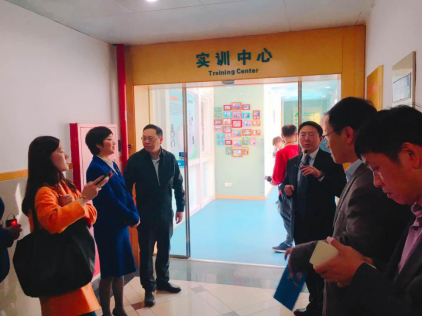
Li Tao, Director of the Department of Primary Health Care under the National Health and Family Planning Commission, and His Delegation Visit Weifang Community Health Service Center for Observation and Inspection
The National Health and Family Planning Commission required that by 2017, family doctor contract services be expanded to more than 85% of cities, with a contract service coverage rate exceeding 30%, and coverage of key populations reaching over 60%. The pilot program for contract services in Weifang Community achieved phased results after more than one year: 9,200 residents were enrolled, 41% of whom were aged 60 or above, and the consultation rate within the contracted care groups reached 84%. Meanwhile, the Weifang Community Health Center took the lead in leveraging mobile internet technologies from third-party service platforms to support Shanghai’s “1+1+1” contracted care model, accelerating enrollment and increasing coverage rates.
Community residents can apply online to sign up with a family doctor by downloading the "Yi+" app. Upon approval, they can visit the hospital to complete the "1+1+1" contract procedures. This approach not only brings convenience to community residents seeking medical care but also significantly improves the work efficiency of hospital physicians. Tasks that previously required substantial manpower can now be conveniently accomplished through mobile technology.
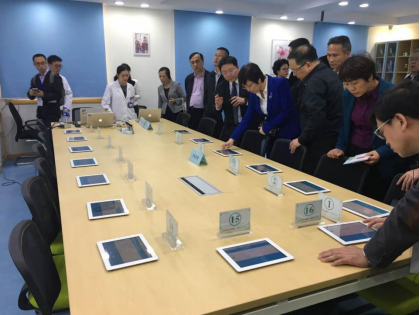
Director Du Zhaohui of the Weifang Community Health Center Explains the General Practitioner Examination System to the Delegation
"Yi+" APPThe following features have been customized for family doctor services: community physician schedule inquiry and outpatient appointment booking, extended prescription and long-term prescription inquiry, hospital referral slot availability inquiry, historical health data inquiry, and family member management functions, thereby maximizing the work efficiency of family doctors. Compared with the previous system, a single family doctor can now serve more community residents, expanding the coverage of primary healthcare.
Meanwhile, community residents are more willing to seek initial diagnosis at primary care facilities and participate in tiered referral systems through the use of mobile apps. The development and design of mobile internet-based products have addressed practical challenges in primary healthcare reform.Accelerated the Pace of National Healthcare Reform。