

WeDoctor Builds Internet Healthcare Ecosystem with Smart Pharmacies and AI-Powered Medical Consortia
During the nearly hour-long interview, aside from five minutes of pleasantries, reporters—including those from VCBeat (WeChat: vcbeat)—managed to ask only two questions, at the 32nd and 45th minutes respectively. For the remainder of the time, surrounded by nearly ten journalists, Liao Jieyuan, Founder and CEO of WeDoctor Group, spoke eloquently, with rigorous and fluent logic that remained consistent throughout.
WeDoctor is now seven years old, has undergone three rounds of financing, and is valued at nearly RMB 20 billion. With over 150 million registered users, it facilitates more than 200 million medical consultations annually, making it one of the most important entry points for internet healthcare. In 2017, WeDoctor’s strategy revealed signs of a willingness to embrace change.
How WeDoctor Serves the Smart Pharmacy Alliance
Micro Medical Group is set to venture into the pharmaceutical business, which was the first piece of information Liao Jieyuan conveyed to reporters.
His primary purpose in appearing at the Hangzhou West Lake Forum that day was to endorse the newly established “Smart Pharmacy Alliance.” Initiated by the China Medical Pharmaceutical Materials Association, with WeDoctor as the lead organizer, the project will provide pharmacies with medical services based on the Wuzhen Internet Hospital.
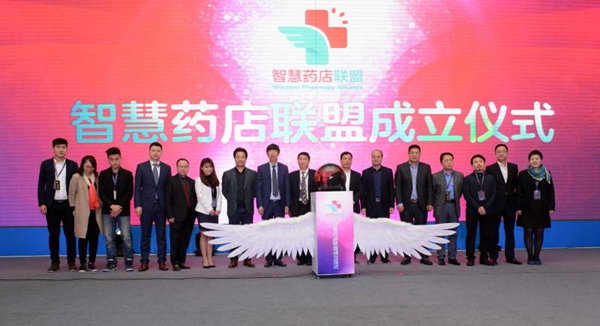
Smart Pharmacy Alliance Inauguration Ceremony
According to Liao Jieyuan, the primary objective of smart pharmacies is to assist pharmaceutical manufacturers and retail enterprises in transitioning from traditional models to innovative business models. At the operational level, the front end leverages WeDoctor to provide pharmacies with services such as remote consultations, electronic prescriptions, appointment scheduling, and patient triage and referral. On the back end, pharmacy ERP systems are directly integrated with manufacturers for drug procurement, supplemented by chronic disease management and membership management services. This transformation enables retail outlets to function as medical service centers and health management hubs, effectively supporting the separation of prescribing from dispensing and the implementation of tiered diagnosis and treatment.
Liao Jieyuan stated that the primary function of pharmacies in the past was drug sales, with limitations on product categories, mainly restricted to over-the-counter (OTC) medications and health supplements. There were numerous bottlenecks in prescription drug sales, including issues related to prescription sources and the volume of drugs listed for sale. Additionally, the overall chain rate of pharmacies was not high; two-thirds were independent pharmacies, while only one-third were (large) chain pharmacies. This resulted in weak bargaining power and a lack of influence when dealing with pharmaceutical manufacturers.
For this reason, the Smart Pharmacy Alliance will gradually address the issues plaguing the pharmaceutical retail sector. The initial step involves integrating pharmacies with the Wuzhen Internet Hospital. Through this platform, pharmacies can provide basic diagnostic and treatment services to consumers and, where appropriate, issue electronic prescriptions under the credentials of the internet hospital, thereby resolving the challenge of prescription sourcing for pharmacies.
Secondly, the Smart Pharmacy Alliance will form a procurement consortium to engage in centralized price negotiations with pharmaceutical manufacturers, ensuring direct distribution from manufacturers to pharmacies and thereby reducing intermediary costs and price distortions. Meanwhile, direct integration of pharmacy ERP systems with pharmaceutical manufacturers enables streamlined drug procurement.
“The more members this alliance has, the greater its influence and bargaining power with industrial enterprises, thereby creating more value for participants through cost savings during the process,” Liao Jieyuan told reporters, including those from VCBeat.
Liao Jieyuan also recounted a minor episode surrounding the establishment of the Smart Pharmacy Alliance. “At the conference, I noticed that pharmaceutical manufacturers were seated on one side of the audience, while retail enterprises occupied the other. It would have been inappropriate for either party to take the lead. Therefore, I stepped forward to spearhead the initiative, as I maintain friendly relationships with both sides and have no conflicting commercial interests.”
In fact, there have been prior attempts at smart pharmacy operations; however, WeDoctor and Liao Jieyuan had not previously made public statements to the outside world as they have done this time. VCBeat has previously reported on WeDoctor’s “Medical Consultation Pharmacy” project, which can be regarded as the prototype of the Smart Pharmacy Alliance.
The project was launched last March. As of March 2017, it had connected more than 12,000 pharmacies, with an average daily consultation volume exceeding 26,000, driving increases in both foot traffic and revenue for partner pharmacies.
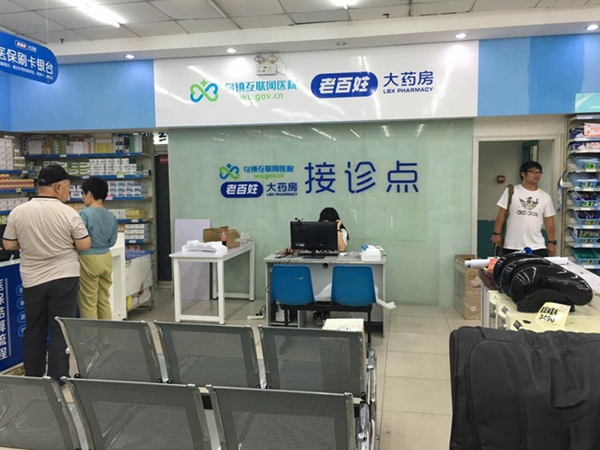
Pharmacy-Clinic
Liao Jieyuan drew an analogy, stating that the U.S. equivalent is CVS MinuteClinic, and that “Yaozhen Dian” is the Chinese version of MinuteClinic.
This time, the Smart Pharmacy Alliance has introduced the concept of “centralized procurement” in addition to its pharmacy-clinic model, achieving deeper penetration into retail formats and industrial marketing, which may offer greater potential for future growth. Liao Jieyuan also stated, “The Smart Pharmacy Alliance can help pharmacies, especially independent ones, grow faster. Combined with the centralized procurement model, it will provide partners with greater room for profit growth.”
Moreover, during the interview, Liao Jieyuan revealed additional strategic priorities for the Smart Pharmacy Alliance. He noted that, as the separation of prescribing from dispensing has become an inevitable trend, WeDoctor (which has already partnered with more than 2,400 hospitals) will assist its partner hospitals in further exploring prescription outflow and the separation of prescribing from dispensing, with the Smart Pharmacy Alliance serving as the implementing entity.
Internet Healthcare Cannot Remain Groundless
Integration into medical processes is the key point that Liao Jieyuan believes is essential for the healthy development of internet healthcare. He stated that the original internet hospital had a Medical Affairs Center and a Pharmaceutical Affairs Center. This time, the Pharmaceutical Affairs Center has been implemented as the Smart Pharmacy Alliance, while the Medical Affairs Center has been implemented as the Medical Consortium Platform.
He elaborated that the top priority among the ten key tasks outlined at the healthcare reform meeting chaired by Vice Premier Liu Yandong was the establishment of medical consortia. All tertiary hospitals across China are required to form such consortia, with specific implementation plans to be finalized by June this year.
From day one, the internet hospitals under construction by WeDoctor have been built in accordance with the standards of medical consortia. The first such hospital was established in Wuzhen, followed by expansion into various provinces. Specifically, WeDoctor establishes an internet hospital in each province and collaborates with local central hospitals at the provincial, municipal, and county levels to help form local medical consortia. The internet hospitals deployed by WeDoctor in various regions become an integral part of these consortia, enabling bidirectional referrals, remote diagnosis and treatment, and multi-party consultations.
Micro Medical Group has an internal “311” initiative. The “3” refers to implementing three core capabilities—medical services, pharmaceuticals, and insurance—in offline hospitals. The first “1” signifies Micro Medical Group’s support for 1,000 central hospitals (at provincial, municipal, and county levels) in establishing medical consortia. Within one year, the Wuzhen Internet Hospital model was rolled out nationwide, with internet hospitals established in 19 provinces, enabling Micro Medical Group to build China’s largest online-offline integrated medical consortium based on internet technology. The second “1” involves leveraging the Wuzhen Internet Hospital platform to connect 100,000 primary healthcare institutions (similar to pharmacy-based consultation points), ultimately linking all these components together to form a multi-directional, interactive ecosystem.
The underlying logic is that, by implementing the “311” initiative, healthcare resources are shared among hospitals, while synergies are established with smart pharmacies. These smart pharmacies facilitate prescription outflow from hospitals within medical consortia, inter-hospital prescription transfers, cloud pharmacies for medical consortia, and hospital pharmacy management services, thereby enabling coordinated operations across multi-tiered healthcare institutions and ensuring effective medication supply.
WeDoctor’s practical approach to implementing internet-based healthcare has also dispelled previous claims that such services were detached from reality and offered no tangible benefits to physical medical institutions. First, all of WeDoctor’s internet hospitals established across various provinces are built upon the foundation of existing physical hospitals. Furthermore, WeDoctor opened its first general practice clinic in Hangzhou, thereby validating the model of extending internet hospital services through physical entities. Second, the Smart Pharmacy Alliance helps establish more primary care access points, effectively expanding the service radius of partner hospitals and improving the utilization efficiency of physician resources. At the same time, it achieves a seamless connection between medical consultation and medication purchase, saving time and enhancing healthcare efficiency for patients, particularly those with mild symptoms or chronic conditions.
From Tools to Ecosystem
If WeDoctor was previously more of a tool for medical consultation and triage, its future focus may shift toward building an ecosystem.
Liao Jieyuan also mentioned in the interview that by concentrating both the supply and demand sides of healthcare (and pharmaceuticals) on the WeDoctor platform, WeDoctor can explore greater commercial possibilities through value-added services. “Regarding how much profit should be retained for the Smart Pharmacy Alliance, as mentioned earlier, I believe it is optional to retain any, as profits can ultimately be realized through mechanisms such as insurance,” Liao explained, commenting on the profit margins of the Smart Pharmacy project.
He drew an analogy with Tencent, which amassed a vast user base through a permanently free model before introducing value-added and paid services, ultimately growing into one of China’s greatest internet companies. Tencent’s logic centers on “platform plus ecosystem,” and WeDoctor may benefit from this approach as it explores a unique model for internet healthcare.
What is the foundational premise of the platform? It aims to provide participants with a diverse array of tools to facilitate their own growth and expansion. Based on this logic, WeDoctor’s strategic focus is on the Internet-based Medical Consortium + AI.
On March 25 this year, WeDoctor donated RMB 100 million to Zhejiang University to support the development of the Ruiyi Artificial Intelligence Research Center. Led by Wu Zhaohui, President of Zhejiang University, the center was simultaneously unveiled at Zhejiang University and the Hangzhou Bay Information Harbor. Participating entities include the College of Computer Science and Technology, the College of Information Science and Electronic Engineering, and the School of Medicine of Zhejiang University, among others. It is China’s first open medical artificial intelligence platform.
In an interview, Liao Jieyuan elaborated on the reasons for his involvement in medical AI projects, stating that it fundamentally stems from his understanding of the progression of internet-based healthcare. The most basic function of the internet is “connectivity,” which was the original intent behind initiatives such as medical consortia and smart pharmacies. The second stage focuses on enhancement, with AI serving as a critical means to bolster China’s healthcare capabilities.
“We are also collaborating with Professor Jia Weiping on an AI-driven ‘diabetes doctor.’ His goal is to equip every primary care physician with this AI system, enabling them to achieve 80% of the diagnostic and treatment proficiency of specialist endocrinologists, while the remaining 20% can be addressed through internet-based healthcare services.” Enhancing the capabilities of primary care physicians is the primary driver behind Liao Jieyuan’s push into medical artificial intelligence, which also takes into account the role of internet-based healthcare in this ecosystem.
In terms of specific applications, Liao Jieyuan envisions leveraging AI to codify existing clinical experience into algorithms, thereby replacing manual labor and enabling assisted diagnosis. This approach aims to both support primary-care physicians and alleviate the workload burden on specialists.
“The ultimate breakthrough for internet healthcare will undoubtedly lie in AI, which is where the entire industry’s value enhancement resides. The practical implementation of internet healthcare is found in medical consortia and smart pharmacies; the integration of these two represents the core value of internet healthcare,” stated Liao Jieyuan.
Smart pharmacies, medical consortiums, and Internet healthcare + AI: WeDoctor provides platforms and tools for both the demand and supply sides of medical services, connecting the entire business chain as its ecosystem gradually takes shape.