

Abbott Revises Alere Acquisition to $5.3 Billion After 14-Month Drama
Abbott and Alere Announce Agreement to Amend Terms of Abbott’s Acquisition of AlereAbbott and Alere have announced that they have agreed to amend the existing terms of Abbott’s acquisition of Alere. Under the revised terms, Abbott will acquire Alere at a price of $51 per share, for a total transaction value of approximately $5.3 billion. The original acquisition amount, first announced in February 2016, was $5.8 billion. Over the ensuing 14 months, Alere delayed the release of its annual report twice due to various issues, and the two parties became involved in legal disputes. In December 2016, Abbott even declared the termination of the transaction.
After all the turmoil, Abbott still managed to save $500 million and acquire Alere, the global leader in point-of-care testing (POCT) with a 20% share of the worldwide market. How many untold stories lie behind this latest acquisition?
VCBeat has learned from public sources that although both parties have disclosed the transaction amount, Meridian Bioscience’s shareholders have not yet approved the deal, and other closing conditions, including regulatory approvals, remain unfulfilled. According to available information, assuming these conditions are met, the transaction is expected to be completed by the end of the third quarter of 2017. Under the amended terms, the deadline for obtaining regulatory approval for the acquisition has been extended from April 30, 2017, to September 30, 2017. In addition, both parties have agreed to dismiss the prior litigation.
Let’s first introduce the two “protagonists” of today’s story and their roles in the POCT field.
POCT is a niche segment of in vitro diagnostics (IVD), leveraging its convenience and speed to deliver rapid diagnostic results at the point of care. Currently, POCT is widely used in hospitals, clinics, and patients’ homes, enabling testing for the vast majority of routine clinical indicators. The global POCT market is valued at $40 billion, with key players including Roche, Abbott, and Alere, whose respective areas of strength are blood glucose monitoring, blood gas/electrolyte analysis, and cardiac markers.
In recent years, VCBeat has noted that while the blood glucose meter market in developed Western countries accounts for 60% of the total but exhibits slower growth due to high penetration rates, niche segments such as nucleic acid testing, cardiac markers, tumor markers, and infectious disease diagnostics have achieved an overall growth rate exceeding 15%.
Abbott: The Undisputed Global Leader in POCT
Alere is a global leader in the POCT diagnostics industry. The global professional POCT market size is approximately $12 billion (excluding blood glucose testing). Alere’s sales in 2015 were about $2.5 billion, accounting for roughly 20% of the total POCT market share.
Alere was originally founded by Ron Zwanziger in 1991 under the name SelfCare, which was renamed Inverness in 2000. In 2001, it spun off from Inverness Medical Technologies to become Inverness Medical Innovations.
The company achieved leapfrog growth through aggressive acquisitions. In 2010, Inverness Medical Innovations consolidated the brands of its more than 60 subsidiaries under a unified name, Alere, establishing it as a more prominent POCT brand.
Ron Zwanziger is a shrewd Jewish businessman who started with just a few thousand dollars. His company grew rapidly, selling part of its blood glucose business, Medisense, to Abbott for $880 million in 1996, and another portion of its blood glucose business to Johnson & Johnson for $1.3 billion in 2001. Through these two transactions, Alere accumulated its first pot of gold.
VCBeat: Alere is a globally recognized leader in POCT, a pure-play POCT supplier that achieved its top global position through mergers and acquisitions.
Meril is a typical company that drives growth through inorganic acquisitions, having acquired more than 100 companies to date. Below are only some of its major acquisitions:
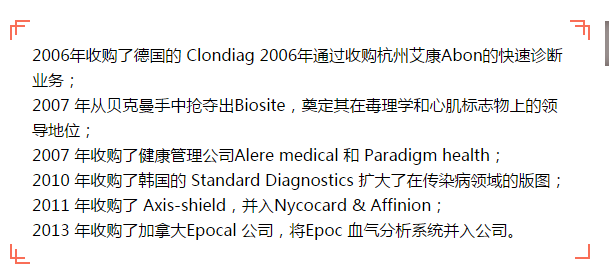
Although Alere is on the verge of being acquired, its founder Ron’s logic regarding mergers and acquisitions was remarkably clear at the time. While its layout in mobile health and telemedicine was overly ahead of its time, its strategic positioning in the three traditional business sectors—infectious diseases, cardiac markers, and toxicology—was highly comprehensive.
Abbott: Aiming to Become the Industry Leader
Abbott Laboratories is a publicly traded company on the New York Stock Exchange. Founded in 1888 and headquartered in Abbott Park, Illinois, Abbott Diagnostics focuses on the entire continuum of early disease detection, diagnosis, and therapeutic monitoring. It provides laboratories with comprehensive solutions encompassing pre-analytical processing, automation, clinical chemistry, immunoassay, hematology, and informatics products. In fiscal year 2016, Abbott Diagnostics reported sales of approximately $4.65 billion, ranking third globally in the in vitro diagnostics (IVD) market.
Company History
In 1888, Dr. Wallace C. Abbott opened his own pharmacy and began meticulously compounding and manufacturing medications, with the aim of providing more effective treatments for patients and physicians.
In 1972, Abbott launched the ABA-100 blood chemistry analyzer and Ausria II, a radioimmunoassay product for detecting hepatitis B surface antigen in serum. This marked the beginning of Abbott’s modern diagnostics instrumentation business, which quickly became a global leader in the field.
In 1985, Abbott launched the first FDA-approved certified blood test for HIV.
In 1995, acquired the Medisense blood glucose business (the predecessor of Alere), entering the blood glucose monitoring field
In 2002, acquired Vysis to enter the field of molecular diagnostics
In 2003, Abbott acquired TheraSense, a glucose monitoring products company, further strengthening its technological leadership in blood glucose monitoring systems.
In 2011, Abbott announced its split into two separate companies: one focused on branded pharmaceuticals (named AbbVie, which had its independent listing on the New York Stock Exchange in 2013), and the other dedicated to medical devices, consumer health products, and established generic pharmaceuticals (retaining the name Abbott).
In 2013, Abbott restructured its business into Nutrition, In Vitro Diagnostics (IVD), Established Pharmaceutical Products, and Medical Devices to strengthen its IVD operations.
As a long-established diagnostics company, Abbott Laboratories has not been a frequent participant in the M&A market since its inception, largely due to its robust in-house R&D capabilities. However, whenever Abbott does engage in capital mergers and acquisitions, it demonstrates keen strategic insight and maximizes its own benefits.
1996: Acquired Medisense's blood glucose business (a predecessor business of Abbott) for $880 million.
2002: Acquired Vysis to enter the molecular diagnostics field (FISH fluorescence in situ hybridization instruments)
2003: Acquired TheraSense, a blood glucose monitoring products company
In 2005, Inverness Medical Innovations (the predecessor of Alere) acquired Abbott Japan’s Determine/DynaScreen rapid diagnostic business for $56.5 million. This rapid diagnostic portfolio primarily provided qualitative results for the detection of diseases such as hepatitis, HIV, and syphilis.
In 2007, GE announced its acquisition of all of Abbott’s diagnostics businesses except molecular diagnostics for $8.13 billion (the deal ultimately failed due to FDA issues).
While maintaining its strengths in traditional diagnostics, Abbott’s acquisition did not target the currently hyped genomics sector to develop new markets; instead, it chose to enter the point-of-care testing (POCT) field, which is also a major growth hotspot but faces relatively less competition.
On one hand, Abbott has already secured a strong position in the POCT sector, whereas companies such as Roche and Illumina have long held a commanding lead in molecular diagnostics and sequencing. On the other hand, Alere accounts for approximately 20% of the global POCT market share; once the merger is successfully completed, Abbott’s dominance in the POCT field will become unparalleled.
VCBeat has learned that Abbott has long been strategically positioned in the point-of-care diagnostics sector. Abbott’s proprietary i-STAT handheld system already holds a significant share of the global market. Currently, Alere and Abbott are world leaders in blood gas analysis and cardiac biomarkers, among other areas. Should these two industry giants join forces, they would likely become an unrivaled dominant player in the point-of-care diagnostics field.
A Turbulent Acquisition
Given the convoluted nature of these events, let us review the key developments between the two parties from the initial acquisition announcement in February 2016 to the present.
In February 2016, Abbott announced its acquisition of Alere for $5.8 billion. Shortly after the announcement, Alere declared a delay in releasing its 2015 annual report data;
In March, Meril received a subpoena from a U.S. court, launching an investigation into its marketing activities in Africa, Asia, and Latin America;
In April, Abbott announced its acquisition of St. Jude Medical for $25 billion;
In April, Abbott offered to pay Alere $50 million to terminate the acquisition, but Alere’s board of directors promptly rejected the proposal;
In July, Alere recalled the INRatio coagulation analyzer again in accordance with FDA requirements;
On August 8, Allergan finally released its 2015 financial data; meanwhile, Abbott publicly stated that its merger transaction with Allergan would not be completed on schedule, or might not be completed at all.
On August 26, Allergan, having reached the end of its tether, filed a lawsuit against Abbott, demanding that Abbott fulfill its obligations under the Merger Agreement;
In December, Abbott officially announced the cancellation of its plan to acquire Alere;
On March 1, 2017, Alere announced that the company needed to re-audit its financial data in South Korea and Japan for the past three years and would be unable to release its 2016 financial report on schedule;
On April 14, 2017, Abbott announced that it would acquire Alere at a price of $51 per common share, for a total transaction value of approximately $5.3 billion.
The Four Major Questions of MedAllies
In this acquisition, Abbot's valuation decreased by $500 million, which also has its own four major issues,Weak Performance, Financial Oversights, Court Investigations, Multiple Recalls。
Performance Decline
Although Allergan’s revenue grew rapidly from 2007 to 2012,
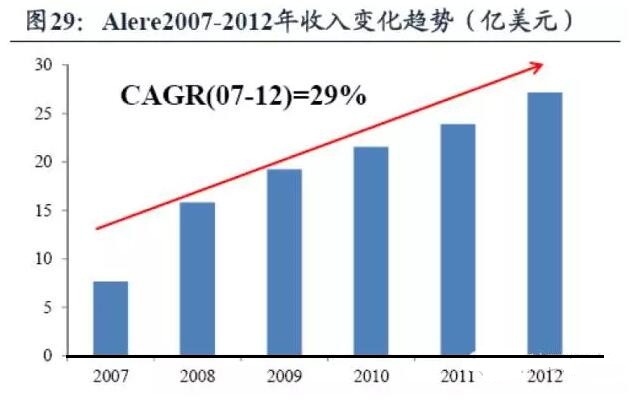
However, let us take another look at the 2015 sales data by product line released by Alere in 2014–2015:
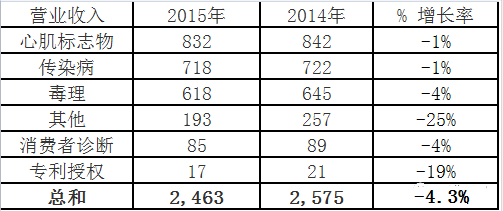
(Unit: Million USD)
Revenue in 2015 was $2.46 billion, a 4.3% decrease from $2.57 billion in 2014.
On the other hand, sales of Meridian Bioscience’s three traditional product lines—cardiac markers, infectious diseases, and toxicology—did not experience a precipitous decline, reflecting that the company’s competitiveness in these segments remains significant.
Financial Oversight
According to the revenue data disclosed by Alere in August 2016:
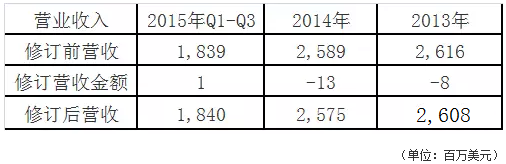
From 2013 to the third quarter of 2015, Allergan prematurely recognized sales revenue from certain contracts for goods not yet shipped, primarily involving its Africa and China regions. As shown in the table, this practice increased sales revenue by only $8 million and $13 million in 2013 and 2014, respectively, accounting for less than 1% of total operating revenue for those years.
After Allergan announced the matter in 2016, it was assumed that the issue had been resolved. However, on March 1, 2017, Allergan issued another announcement stating that it would be unable to release its 2016 financial report on schedule, as the company was re-examining its financial data in South Korea and Japan, requiring adjustments to its financial figures from 2013 through the first three quarters of 2016.
Court Conducts Two Investigations
In late February 2016, Alere acknowledged receipt of a subpoena from a U.S. court, initiating an investigation into its marketing activities in Africa, Asia, and Latin America. The court suspected Alere of engaging in illicit conduct in its dealings with distributors and healthcare system officials in these regions.
In July 2016, a U.S. court again summoned Allergan, primarily targeting its laboratory in Austin, Texas, to investigate the laboratory’s billing for public healthcare services for patients since 2010, as well as potential commercial bribery.
Four Class I Product Recalls
In July 2016, at the FDA’s request, Alere recalled the INRatio coagulation analyzer again.
In May 2012, Alere issued a global urgent recall of its Triage products (Class I recall, the most severe type) due to accuracy levels significantly lower than those stated in the product labeling.
In April 2014, after receiving reports of three patient deaths associated with the INRatio2 PT/INR Coagulation Test Strip, Alere initiated an urgent recall of the INRatio2 PT/INR Coagulation Test Strip (Class I Recall).
In December 2014, Alere issued another recall for the INRatio PT/INR Hemostasis Testing System (Class I Recall).
Abbott's Inadequate Preparation
It is undeniable that Abbott aims to become the industry leader through this acquisition. However, VCBeat has learned that although Abbott conducted due diligence before signing the Merger Agreement with Alere, it only began to express significant concern about government investigations into Alere after the agreement was signed, as Alere made further disclosures regarding such probes by relevant government authorities.
Additionally, Merit Medical also threatened to withdraw. During the litigation, it was revealed that Abbott’s CEO had threatened, in a meeting with Merit Medical executives, that if Merit Medical did not agree to terminate the merger agreement, Abbott would spare no expense in deploying its lawyers to create a “living hell” for Merit Medical, subjecting it to endless information demands akin to those in a criminal investigation.
Abbott made good on its words by continually imposing unreasonable demands on MedAlliance for the production of documents and the availability of personnel for interviews. In response, MedAlliance produced nearly one million pages of documents to Abbott, and more than thirty MedAlliance representatives were subjected to questioning by Abbott’s outside counsel.
A commercial acquisition can be as thrilling as a blockbuster movie, and it must be said that Abbott has done an impressive job. VCBeat has learned that certain regions, such as the European Union, have already approved the acquisition, suggesting that regulatory or antitrust issues are unlikely to arise. Furthermore, two weeks prior to this announcement, Abbot's stock price surged, indirectly corroborating the accuracy of the acquisition news.
Sources of information in this article include MedTrend, the official Abbott website, and the official Abbot website, compiled and organized by VCBeat.