

Wuhan Landing AI Medical Unveils Multi-Certified Cervical Cancer Screening Robot 'Landing' Backed by Millions of Clinical Data
AI Achieves New Breakthrough! At the 2017 UN Seminar on Procurement of Health Products, an AI-powered cervical cancer diagnostic robot developed by Sun Xiaorong’s team from Wuhan Landing Medical High-Tech Co., Ltd. made its debut. “Landing” has learned from millions of clinical data points and can rapidly and accurately identify cancer cells. This research achievement is primarily used for the identification of early cervical precancerous lesions and early screening of cervical cancer.
A head-to-head validation pitting experts against a robot was conducted at the conference site. A panel of five pathology experts—Professor Wu Guangping from the Department of Pathology, The First Hospital of China Medical University; Director and Professor Ren Li from the Department of Pathology, Beijing Air Force General Hospital; Director and Professor Tian Lixiang from the Department of Pathology, Changchun Maternity Hospital; Professor Li Jianmin from the Department of Pathology, Shanxi Provincial Cancer Hospital; and Professor Wang Xubo from the Department of Pathology, Xuzhou Hospital Affiliated to Nanjing University of Chinese Medicine—conducted an on-site validation of the “Landing” robot.
Within 20 minutes, five cytopathology experts and the robot “Landing” simultaneously performed on-site diagnostic readings of cervical cytology slides. Under the supervision and witness of the Jiangxia Notary Public Office in Wuhan City and hundreds of on-site spectators, the final diagnostic results submitted by the robot “Landing” were completely consistent with those of the five experts.
VCBeat believes that although the data volume in this instance is somewhat limited, the completely consistent diagnostic results demonstrate the genuine capabilities of "Landing." However, we hope that Dr. Sun Xiaorong’s team will release more experimental data to ensure their findings are beyond reproach.
Broad Application Prospects
Traditional cytological screening for cervical cancer relies on medical technologists performing microscopic examinations and making diagnoses based on their experience. According to international standards, the daily slide review volume for each cytology screener should be kept below 100 cases. As humans are not machines, it is impossible to entirely eliminate diagnostic errors caused by fatigue or variations in professional experience. The introduction of “Landing,” an AI-powered robotic system for cervical cancer diagnosis, can assist physicians in accurately detecting early precancerous lesions of the cervix, making cervical cancer highly likely to become the first malignant tumor eradicated through preventive screening.
China faces a shortage of pathologists, while approximately 300 million women across the country require regular, repeated cervical cancer screening.Currently, the 20% coverage rate has not been achieved, falling far short of the 80% population coverage target required for cervical cancer prevention and control. This clearly reflects the contradiction between people’s growing needs and underdeveloped social production.The widespread adoption of “Landing” has addressed the shortfall in China’s grassroots healthcare system, where a lack of cytopathology technicians has hindered the ability to meet government cervical cancer screening targets with both quality and quantity assured.
Overseas-Earned PhD’s 10+ Year Journey in Tech Entrepreneurship
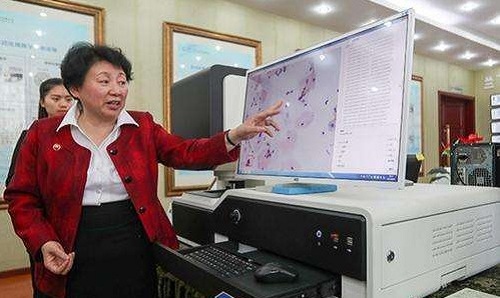
Sun Xiaorong
Sun Xiaorong, the founder of Wuhan Landing Medical, is a native of Wuhan. In 1977, she was admitted to the Department of Medicine at Tongji Medical College in Wuhan, completing her bachelor’s and master’s degrees in eight years. After earning her Ph.D. from Monash University in Australia, she conducted postdoctoral research at the Sloan Kettering Institute for Cancer Research in New York, USA, for another eight years.
In 1996, she was appointed as a researcher at the BC Cancer Research Institute in Canada. By all accounts, she could have enjoyed a comfortable and leisurely life in Canada; however, 14 years ago, she returned to China, introducing early cancer detection technologies and equipment. A few years later, she founded the “Landing Cell Detection Laboratory” and replicated its model across China. This year, the first overseas “Landing Laboratory” will be established in Hawaii, marking its entry into the international market.
VCBeat has learned that the technology brought back by Sun Xiaorong can analyze individual human cell specimens using quantitative DNA analysis during the asymptomatic stage, determining the presence of cancer cells and assessing their developmental trends. The principle involves connecting a microscope to a computer; cells are placed under the microscope, and the computer automatically generates a report. “Previously, we relied on traditional detection methods, observing tumor cells with the naked eye through a microscope, which was far less accurate than automated computer detection.”
Although the technology was advanced, around the year 2000, domestic attention to health in China remained focused on treating existing diseases. The progressive health concept of “spending money to detect potential illnesses” was difficult for people to accept. Furthermore, cancer is a condition to which people are particularly sensitive; once diagnosed, it is often hard for patients to come to terms with it. On one occasion, a woman underwent screening and was found to have possible early-stage cervical cancer. Upon learning this, she became emotionally agitated and pointed at Sun Xiaorong, shouting angrily, “I am perfectly healthy! What right do you have to curse me like this?”
Later, Sun Xiaorong proactively collaborated with the Wuhan Municipal Family Planning Commission, leveraging its well-established network to launch free early cervical cancer screening. Among the first batch of over 200 women of childbearing age screened in Hannan District, four cases of early-stage cervical cancer were identified. Thanks to the timely intervention, all four patients were successfully cured. Since then, early tumor diagnostic testing has gradually gained public acceptance, and to date, nearly one million people across China have undergone such diagnostics.
VCBeat has learned that Wuhan Landing now operates hundreds of cell laboratories across China. In recent years, the company has adopted a “McDonald’s”-style franchise model to promote its “Landing Standard Cell Laboratories” at grassroots family planning stations in rural areas, Grade II Class A hospitals in small and medium-sized cities, and Grade III Class A hospitals in provincial capitals.
In addition, Wuhan Landing has established a big data cloud diagnostic platform for cervical cancer screening to serve pathologists across China. The aim is to have 85% of cases processed by Landing’s AI robots, with the remaining 15% reviewed by physicians. Diagnostic results can be downloaded according to varying requirements, and reports are delivered to patients or attending physicians.
Millions of databases
VCBeat has learned that “Landing” owes its current performance to a large database of millions of cervical cancer screening cases accumulated over more than a decade. Since returning to China in 2001, Sun Xiaorong has been dedicated to research on cervical cancer screening, employing artificial intelligence to enable machines to learn from millions of provided samples to identify cancer cells, precancerous lesion cells, and normal cells. This approach ultimately allows for accurate differentiation between normal cervical cells and cancer cells, while also endowing the system with continuous learning capabilities.
It is particularly worth noting that the robot “Landing” has currently obtained clinical certification and approval in China, the European Union, and the United States (Class I), and its early products have been deployed in hundreds of medical institutions across China.
Currently, the R&D team led by Sun Xiaorong continues to conduct research on enhancing the capabilities of the “Landing” robot. Sun Xiaorong believes that China boasts a large pool of top-tier mathematical talent, extensive accumulation of clinical sample data, and exceptionally high internet penetration. Furthermore, the Chinese government has implemented numerous supportive policies to encourage artificial intelligence development. Therefore, there is ample reason to believe that China’s AI-driven healthcare sector will remain at the forefront globally.