

Teladoc's Widening Losses Raise Questions on the Future Path for Telehealth Companies

Founded in 2002, Teladoc is the first and largest telemedicine platform in the United States. It went public on the New York Stock Exchange in 2015 under the ticker symbol TDOC. As a benchmark for internet healthcare in the U.S., Teladoc serves as a key reference for many domestic internet healthcare companies. The platform enables users to consult with physicians anytime (24/7) and from anywhere via mobile devices, the internet, video calls, and telephone.
In March 2017, Teladoc released its 2016 annual report. Nearly two years after its initial public offering, Teladoc’s total revenue for 2016 reached $123 million, representing a significant 59.15% increase compared to 2015; however, the company also reported a net loss of $74.216 million.
Currently, domestic internet healthcare companies specializing in lightweight consultations are also transitioning toward online diagnosis and treatment, establishing internet hospitals to enable online diagnoses and prescription issuance. Although there are significant differences between China and the United States in terms of policies and market conditions for mobile health, Teladoc’s operational data still warrants careful study. What has driven the substantial growth in its operating revenue? What are the reasons behind its massive losses? VCBeat has collected Teladoc’s prospectus prior to its IPO and its annual reports from the past two years for analysis, aiming to examine the changes in Teladoc’s business model, user base, operational model, and development trajectory over recent years.
>>>>
Understanding the History of Teladoc
In 2002, Teladoc was founded in Texas as the first telemedicine company in the United States. It was established by Dr. Byron Brooks, a former NASA flight surgeon, and serial entrepreneur Michael Gorton. After more than a decade of challenges and growth, it has evolved into the largest telemedicine service provider in the U.S. Notably, it became the world’s first publicly traded online medical consultation company. Teladoc delivers remote healthcare services to users anytime and anywhere via telephone, internet, video, and mobile devices.
In 2005, Teladoc CEO Michael Gorton launched “TelaDoc Medical Services,” a telephonic consultation program, at the Consumer-Directed Healthcare Conference in Chicago, Illinois. Patients could seek medical advice by calling a 1-800 number, with physicians returning calls within three hours; the average response time was 30–40 minutes. The fee for each telephone consultation was $35, although some consultations were offered free of charge. In addition to providing medical advice, physicians would occasionally prescribe medications directly. Upon the patient’s request, Teladoc would contact the designated pharmacy to submit the prescription.
Why did Teladoc launch such a program? Surveys indicate that 70–75% of non-urgent medical issues can be resolved via telephone. Moreover, telemedicine is sometimes the only option available to patients—for instance, when their primary care physician is unavailable, when family members are away from home, during sudden nighttime health emergencies, or when illness strikes on weekends. In these scenarios, Teladoc’s remote services prove invaluable. Additionally, Teladoc’s pricing structure makes individual consultations affordable for the more than 45 million Americans who lacked health insurance at the time. Therefore, Teladoc offers an effective solution to the rising cost of healthcare in the United States, saving both time and money. Patients can register online at any time, seek consultations via phone or email, and have their consultation services activated on the same day they register.
Teladoc primarily operates under two pricing models: a membership-based model, which charges a fixed monthly fee for unlimited consultations and is mainly targeted at enterprises purchasing coverage for employees, their families, or other beneficiaries; and a fee-for-service model, which charges per consultation and is designed for individual members or customers.
In 2015, after more than a decade of development, Teladoc finally went public in the United States. At the time of its IPO, Teladoc already had over 1,100 board-certified physicians and healthcare experts, handling a large volume of medical cases daily. According to statistics, nearly 300,000 members received telemedicine services from Teladoc within one hour in 2014 alone, representing a year-over-year growth of 135%, with a total of 500,000 telemedicine consultations completed that year.
Judging from Teladoc’s financial data, telemedicine has indeed experienced rapid growth in recent years, with consistent increases in the number of registered physicians, members, served populations, service models, and revenue. However, Teladoc has yet to shake off its loss-making status; on the contrary, its deficits have worsened. Next, VCBeat will extract four years of data from Teladoc’s S-1 IPO prospectus (covering 2013 and 2014) and its annual reports for 2015 and 2016 to analyze Teladoc’s current development status and the challenges it faces.
>>>>
Interpretation of Teladoc’s 2016 Performance Report
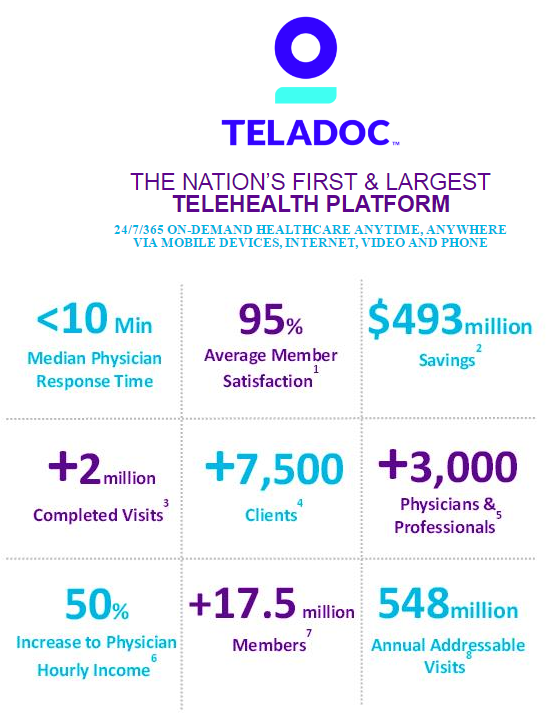
After 15 years of development, Teladoc’s telemedicine service response time has been reduced to under 10 minutes, with 95% of members expressing satisfaction with its services. To date, it has completed over 2 million consultations, cumulatively saving users $493 million (according to an independent survey by Veracity Analytics, the average savings per consultation is $472). As of the end of December 2016, the platform served 7,500 clients, with a total membership of 17.5 million. More than 3,000 board-certified physicians are affiliated with the platform, earning $150 per hour, which represents a 50% increase over the average hourly wage of full-time physicians.
The most notable achievements for Teladoc in 2016 were the growth in membership, increased revenue, and higher visit volume.
“In this year, many milestone events occurred. For instance, the company completed its two-millionth telemedicine visit, indicating that, through our partners, we have saved the U.S. healthcare system more than $900 million in total costs,” said Gorevic. “It took us approximately 12 years to reach the first million visits, but only 14 months to go from one million to two million. Clearly, this demonstrates that telemedicine has reached a tipping point and critical mass.”
>>>>
Teladoc's Rapid Growth Opportunities
Most outpatient consultations can be resolved remotely.
According to data from the U.S. Centers for Disease Control and Prevention (CDC), there are 1.25 billion outpatient visits annually in the United States, including primary care, hospital emergency departments, and other outpatient services. It is estimated that approximately one-third of these visits, or 417 million, could be addressed through telemedicine. Furthermore, data from the Agency for Healthcare Research and Quality (AHRQ) indicates that there are approximately 168 million outpatient behavioral health visits in the United States each year, of which 131 million (approximately 78%) could be managed via telehealth services. In total, the combined market potential for telemedicine across these two categories amounts to approximately 585 million virtual consultations.
Doctor Shortages: Telemedicine Can Save Costs
A 2016 study prepared for IHS Markit by the Association of American Medical Colleges found that the growth rate of physician demand continues to outpace supply, leading to a total shortage of up to 94,700 doctors by 2025, including a shortfall of approximately 36,000 primary care physicians. According to data from the National Association of Community Health Centers, 62 million people annually fail to receive adequate primary care due to physician shortages. Meanwhile, within the U.S. healthcare system, outpatient efficiency is extremely low, posing significant challenges in terms of cost and quality of care.
In such cases, many patients may not seek medical care at all, or they may go directly to emergency rooms or urgent care clinics, resulting in costly expenses and inefficient treatment. The heavy reliance of U.S. patients on emergency services has further burdened emergency departments. These situations not only affect patients’ health but also impact health insurers and employers, who ultimately bear part or all of the costs.
Can increase physicians' income
In the United States, physicians’ incomes and service capacity are declining due to reimbursement cuts and increasing administrative burdens. These factors have led to physician dissatisfaction and adversely affected their willingness to deliver medical services. According to Medscape’s 2014 Physician Compensation Report, 50% of physicians feel they are not fairly compensated, and 42% would not choose medicine as a career again. Consequently, dissatisfied with declining incomes, 44% of physicians have decided to gradually reduce their patient load, transition to part-time work, seek non-clinical roles, or retire early.
The emergence of Teladoc has the potential to change this situation. For physicians, joining Teladoc provides strong financial incentives. According to a 2013 report by Becker’s Healthcare, physicians registered on the Teladoc platform earned an average of $150 per hour, which is 50% higher than the average hourly income of $99 for other full-time physicians. As a result, Teladoc-affiliated physicians can earn an additional $100,000 annually.
Therefore, telemedicine not only has significant room for growth in terms of visit volume but also enables patients to receive more timely treatment, reduces diagnosis and treatment costs, and increases physicians’ income. These factors constitute the current opportunities driving Teladoc’s sustained forward development.
>>>>
Pre-IPO Financing History

Although Teladoc was established early on, its initial fundraising path was not smooth; it did not secure an angel round of investment of an undisclosed amount until 2008. The significant funding round occurred on December 3, 2009, when HLM Venture Partners led a $9 million investment.
When asked about the reasons for the investment, Martin R. Felsenthal, a partner at HLM Venture Partners at the time, stated, “It is truly exciting to collaborate with Teladoc. Twenty percent of Americans do not have a primary care physician, and one-third are unable to secure timely appointments for routine visits. Therefore, any healthcare initiative that benefits the 50 million uninsured Americans deserves recognition and support. We believe this investment will accelerate Teladoc’s leading market position. We are highly satisfied with the company’s current scale and market share, and we are deeply gratified by Teladoc’s commitment to delivering high-quality medical care, which has resulted in strong patient satisfaction.”
Subsequently, with the rapid development of the mobile market, the mobile health sector has garnered significant attention, and Teladoc has attracted increasing investment. The substantial influx of capital not only ensured the company’s operational stability but also enabled it to acquire numerous peer telemedicine firms, rapidly expand its market share, boost revenue, accelerate corporate growth, and ultimately achieve a public listing.
>>>>
Teladoc's Acquisition History

Since its inception, Teladoc has completed multiple acquisitions during its growth trajectory, leveraging these strategic purchases to expand its platform, service offerings, and sales capabilities.
Pre-market
In August 2013, Teladoc acquired Consult A Doctor for $16.6 million in cash.
In May 2014, Teladoc acquired AmeriDoc for $17.2 million. Both Consult A Doctor and AmeriDoc specialized in providing telehealth solutions to small and medium-sized enterprises (SMEs) through distributor channels. This acquisition created new distribution opportunities and expanded Teladoc’s sales.
In January 2015, Teladoc completed its acquisition of BetterHelp, a consumer-facing health services provider, for $3.5 million in cash and a $1 million promissory note. Teladoc committed to paying BetterHelp an annual fee each year for the following four years. This acquisition helped Teladoc expand its direct-to-consumer and behavioral health services.
On June 17, 2015, Teladoc completed the acquisition of Stat Health Services Inc. (StatDoc) for a total consideration of $30.1 million, comprising $13.3 million in cash and $16.8 million in common stock. StatDoc is a telehealth provider specializing in managed care systems and self-insured clients.
Post-marketing
On July 31, 2015, Teladoc acquired certain assets from Gateway, enabling the sale of Teladoc’s services through other third parties.
On July 1, 2016, Teladoc acquired HealthiestYou for a total consideration of $151.5 million, comprising $43.2 million in cash and $103.8 million in common stock. HealthiestYou is a leading telehealth technology platform for the small and mid-sized employer market, delivering web- and mobile-based telehealth services to end users. Its solutions include 24/7 access to physicians via phone, email, and video consultations; a location-based provider directory; and the ability to view provider ratings, reviews, and background information. HealthiestYou can compare prices for more than 5,000 medications across over 100,000 pharmacies, and offers customizable personalized reminders to help users obtain optimal care.
>>>>
Four-Year Operational Data Analysis
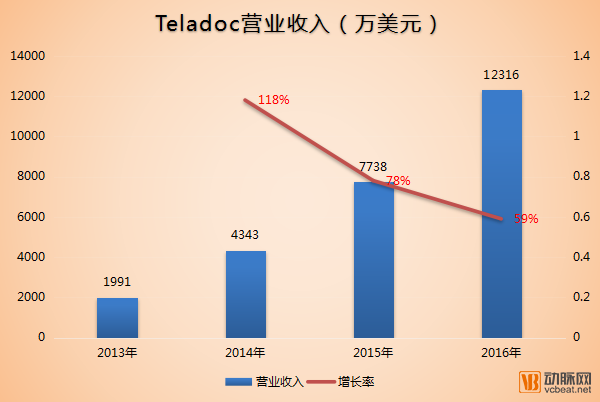
Based on Teladoc’s sales data from 2013 to 2016, revenue grew rapidly, reaching $19.91 million, $43.43 million, $77.38 million, and $123 million, respectively. Year-over-year growth was 118% in 2014 compared to 2013, 78% in 2015 compared to 2014, and 59% in 2016 compared to 2015. Although the annual growth rates remained substantial, they declined year by year. In other words, the growth rate of telemedicine revenue slowed over time. Even so, the 59% growth rate in the final year exceeded that of most industries.
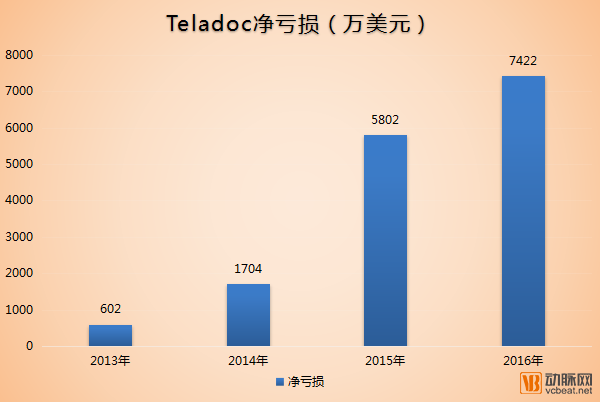
Based on current data, losses are widening alongside performance improvements. Since 2013, Teladoc has reported annual net losses of $6.02 million, $17.04 million, $58.02 million, and $74.22 million, respectively, with the deficit increasing year over year.
The increase in revenue is primarily driven by the growth in new customers, which generates income from subscription fees and visit-based charges. Teladoc has two main revenue streams: membership fees from subscribers and per-visit fees from non-subscribed users. Subscribers pay a fixed monthly fee for unlimited consultations, with services typically purchased by corporate clients on behalf of their employees, family members, and beneficiaries. Non-subscribed users are charged on a per-visit basis, with these access fees paid directly by the individual members or customers.
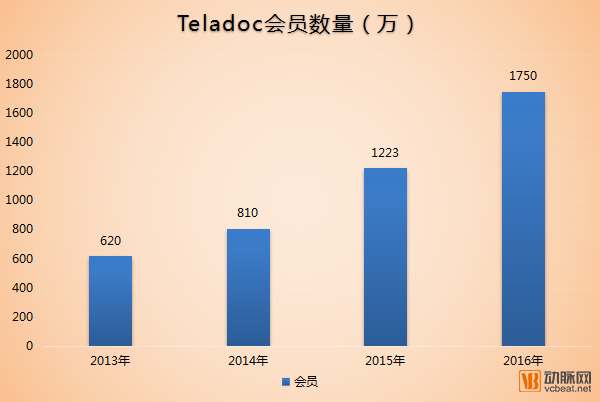
In the two years following its IPO, Teladoc’s customer and member base more than doubled. By the end of 2016, the Teladoc platform had over 17.5 million members.Subscription fees constitute Teladoc’s primary revenue source, accounting for more than 80% of total revenue. In 2016 and 2015, 82% and 18% of Teladoc’s revenue came from subscription fees and visit fees, respectively. In 2014, subscription fees and visit fees accounted for 85% and 15% of revenue, respectively. Therefore, Teladoc’s main customers are from the business-to-business (B2B) sector, a result of the company’s repeated business model adjustments and operational upgrades, which facilitated its transition from a pure B2C model to an integrated B2B2C approach.
Teladoc believes that a B2B2C distribution strategy is the optimal approach for delivering telehealth services to consumers or members. On the business side, Teladoc serves more than 7,500 corporate employers, health plans, health systems, and other entities. Its employer clients include over 220 Fortune 1000 companies and industry leaders such as Accenture, Bank of America, PepsiCo, and T-Mobile. Health system clients include Einstein Healthcare Network, Silver Cross Hospital, and Craig Hospital, among others. These clients have purchased Teladoc’s telehealth services for more than 17.5 million members. In 2016, 2015, and 2014, revenue from Teladoc’s top ten customers accounted for 23.9%, 22.9%, and 28.1% of its total revenue, respectively.
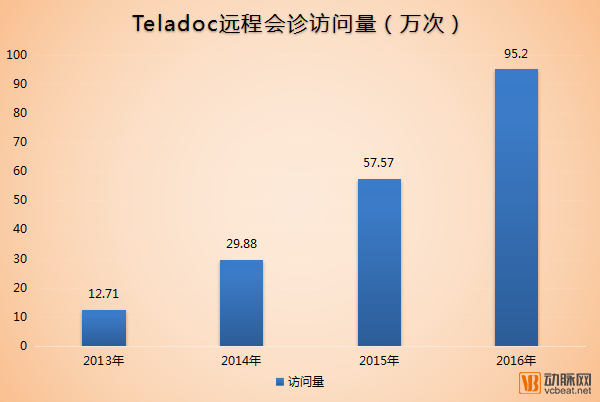
Following a significant increase in membership, the number of certified physicians also doubled, withOver 3,000 board-certified physicians and healthcare expertsTeladoc’s physicians reduced their telemedicine response time to under 10 minutes. In 2016, Teladoc completed 952,000 telemedicine visits. These are several key metrics from Teladoc’s 2016 operational performance.
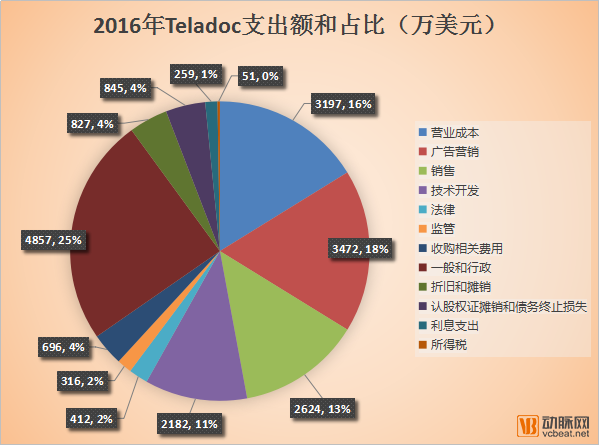
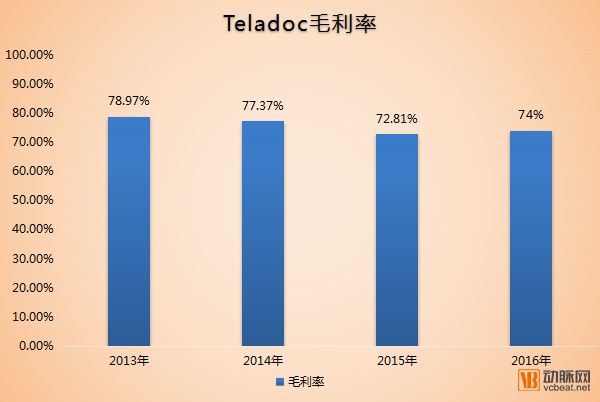
Revenue is growing, scale is expanding, and losses are widening. VCBeat examined Teladoc’s 2016 operating expenses to analyze its major expenditures. In 2016, Teladoc reported total operating revenue of $123 million, operating costs of $31.97 million, gross profit of $91.2 million, and a gross margin of 74%, which was already quite strong. However, other top expenses included $48.57 million in general and administrative expenses, $34.72 million in advertising expenses, $26.24 million in sales expenses, and $21.82 million in technology expenses. When combined with legal, regulatory, income tax, and other expenses, the total net loss amounted to $74.21 million.
Advertising, sales, and technology expenses have risen rapidly, increasing proportionally with revenue growth. This indicates that as the market expands, costs inevitably rise accordingly. Advertising and sales investments may decrease once the market reaches a certain scale, but that time has not yet come.
Many companies face no significant issues in their operations or technology, yet they often fail due to cash flow shortages. Currently, although Teladoc has reported substantial losses for several consecutive years, its cash flow remains relatively stable. Following its initial public offering (IPO) in 2015, Teladoc raised $163 million in cash after deducting issuance expenses. However, its operating expenditures in 2015 and 2016 reached $47.18 million and $51.80 million, respectively. When combined with the cash required to acquire BetterHelp, StatDoc, Gateway, and HealthiestYou during those two years, these funds were long insufficient.
Subsequently, in January of this year, Teladoc raised an additional $124 million in cash through a secondary offering, sufficient to meet its working capital and capital expenditure needs for the next year. However, Teladoc’s plans for this year include continuing mergers and acquisitions; if it fails to raise adequate funds in a timely manner when needed, its financial position could face a crisis.
>>>>
Future Growth Strategy
Focus on large enterprises to attract subscription members.
Teladoc aims to increase its number of subscription members from both existing and new customers, as growth in subscriber base is essential for generating stable revenue. Teladoc projects that it may attract 50 million members in the future. The company plans to achieve this goal by strengthening existing customer relationships and expanding its distribution channels and sales team.
Currently, Teladoc has 220 clients that are Fortune 1000 companies. If large enterprises can be acquired as new customers, they will enable deeper penetration into a broader pool of potential clients, driving significant revenue growth. Therefore, Teladoc is prioritizing its efforts on targeting large enterprises. However, with more than 20% of Fortune 1000 companies already being its clients, acquiring new customers in the future will be increasingly challenging.
Meanwhile, as a market leader in the telehealth industry, Teladoc boasts a strong and well-established brand that it will leverage to attract individual consumers through its B2C channels in the future. Attracting individual users to the platform will inevitably lead to increased advertising expenditures.
Expansion to New Clinical Specialties
Teladoc has currently onboarded more than 3,000 certified physicians and healthcare professionals who can diagnose and treat a variety of conditions, such as upper respiratory infections, urinary tract infections, sinusitis, and skin disorders. Additionally, healthcare professionals on the platform provide treatment for anxiety and depression. Teladoc plans to leverage its highly scalable platform to expand into new clinical specialties, including chronic disease management (e.g., diabetes), with a particular focus on dermatology, smoking cessation, sexual health, and psychiatry. According to a 2012 white paper from the U.S. Department of Health and Human Services, approximately 46 million adults in the United States suffer from mental illness, and over 11 million adults report unmet needs for mental health care. The shortage of psychiatrists is becoming increasingly severe across the United States.
In fact, domestic telemedicine companies primarily target patients with chronic conditions such as diabetes, respiratory diseases, and hypertension, as these patient groups present lower diagnostic and treatment risks and require continuous care.
Leverage Existing Sales Channels to Penetrate New Markets
As previously analyzed by VCBeat, B-end users are crucial to expanding Teladoc’s future revenue, and the company has already developed an efficient distribution network targeting large enterprises. In 2017, it also allocated additional marketing resources to sales channels for small and medium-sized enterprises (SMEs) to increase its penetration in the SME market. Furthermore, Teladoc intends to further penetrate the provider market, particularly hospitals and physician groups.
Continue to Expand Acquisitions
Teladoc plans to continue leveraging its expertise and the scale of its platform to pursue selective acquisitions. To date, it has completed five acquisitions, expanding its distribution capabilities and broadening its service offerings. Teladoc’s acquisition strategy focuses primarily on highly scalable and rapidly growing technologies, products, capabilities, clinical specialties, and distribution channels. In 2017, the company will continue to evaluate and pursue acquisition opportunities that complement its business.
“We have undertaken extensive product development, guided by the principle of ensuring that our products are both attractive and profitable. Of course, a slowdown in the pace of product development does not mean we will halt new product initiatives,” said Gorevic. “The expansion of our clinical area products and services will continue, albeit at a more moderate pace in 2017. Over the coming years, we will conduct research and assessments to determine which new services to add, such as currently popular near-patient testing/clinical services. In addition to selecting partners, we are also open to building our own systems.”
References:
Teladoc S-1 IPO Prospectus
Teladoc 2015 Form 10-K Annual Report
Teladoc 2016 Form 10-K Annual Report
Crunchbase.com