

IBM Research and Anhui Medical Join Forces to Advance AI-Powered Early Gastrointestinal Disease Screening
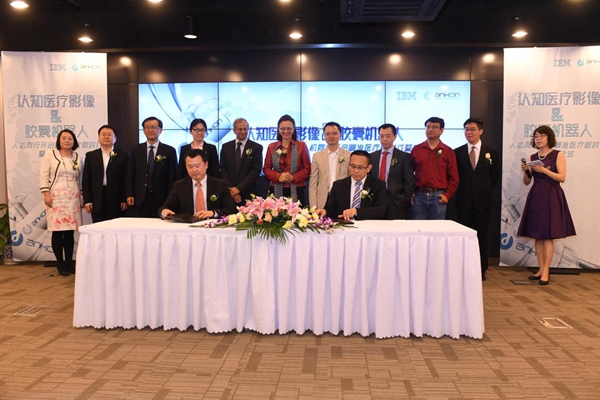
The signing ceremony between IBM and Shanghai Anhan Medical Technology Co., Ltd. was held at the IBM China Research Lab in Beijing on April 20, 2017. VCBeat was invited to attend and reported on the event immediately.
The two parties jointly announced an exploratory collaboration in the field of capsule endoscopy medical imaging, aiming to explore the feasibility of leveraging IBM’s cognitive imaging technologies to enhance early and precise screening for gastrointestinal diseases.
According to the 2015 cancer statistics published online in CA: A Cancer Journal for Clinicians (CA Cancer J Clin), China recorded 679,100 new cases of gastric cancer annually, accounting for 17.7% of total cancer deaths.
Early screening for gastric cancer is crucial. According to research by Cancer Research UK, the five-year survival rate for stage IV gastric cancer is only 5%, whereas for stage I gastric cancer it exceeds 80% (based on data from studies up to 2011).
Analysis suggests that one of the reasons for the low cure rate of gastric cancer in China is that traditional gastroscopy is not suitable for large-scale screening, resulting in a failure to provide timely treatment at an early stage.
Anhan Medical Technology Co., Ltd. has successfully developed and commercialized the world’s first magnetically controlled capsule endoscopy system. Its precise control and positioning capabilities enable comprehensive gastric examination, providing an early screening tool for gastric and digestive diseases.
This time, Anhan Medical has introduced its cutting-edge precisely controlled capsule gastroscopy system, which utilizes a capsule endoscopy robot to acquire medical imaging data, thereby enabling more efficient and less invasive collection of gastric examination information. Precise magnetic control over the robot’s position and orientation ensures a more comprehensive examination of the digestive tract. However, the approximately 20,000 images generated per examination pose new challenges for physicians in terms of data processing and achieving precise analysis.
In clinical practice, it is difficult to rapidly diagnose conditions by manually reviewing such vast amounts of imaging data. IBM’s cognitive imaging technology may hold the key to solving this challenge. This early-stage research collaboration between IBM Research China and AnHan aims to demonstrate how intelligent lesion detection technology can help AnHan process the billions of images generated annually, thereby enhancing the accuracy and feasibility of disease screening.
This research project will also explore the feasibility of IBM leveraging multimodal learning and model fusion to extract valuable insights from endoscopic images and electronic health records, thereby providing diagnostic and treatment recommendations to physicians.
Bai Shuzhong, Chairman of the China Health Promotion Foundation, a prestigious medical association, stated, “According to data from the World Health Organization, China has a high burden of gastric cancer, with 680,000 new cases and 500,000 deaths annually. The key to improving the early detection rate of gastric cancer is large-scale screening. Once this technology matures, it will help people realize their health aspiration of undergoing gastroscopy ‘without intubation’ as soon as possible, encouraging patients to feel confident and willing to undergo gastric examinations and to cooperate more actively.”
Professor Liao Zhuan, a physician at Changhai Hospital and Deputy Chairman of the Youth Committee of the Digestive Endoscopy Branch of the Chinese Medical Association, commented: “This represents a beneficial exploration of collaboration between ‘artificial intelligence’ and ‘intelligent manufacturing in China.’ By leveraging IBM’s cognitive imaging technology to enhance precision-controlled capsule robot technology, this partnership can help physicians achieve more precise insights and improve efficiency. If this model proves successful and is widely adopted, it will help optimize the allocation of medical resources and address the shortage of specialist resources for early screening of gastrointestinal diseases.”
The “Healthy China 2030” Planning Outline states that by 2030, chronic disease health management should cover the entire population across the full life cycle, and the overall five-year cancer survival rate should increase by 15%. Against this backdrop, IBM and AnHan Medical aim to leverage their respective technological strengths to integrate advanced cognitive computing technologies with capsule robot technology, thereby advancing the development of intelligent diagnostic techniques for gastrointestinal imaging.
As artificial intelligence technology continues to advance and demand for medical services keeps growing, the “AI + Healthcare” model is expected to gradually become a key driver in enhancing healthcare capabilities and efficiency, as well as promoting inclusive healthcare.
Mr. Ji Pengsong, Chairman of Anhan Medical, stated, “The collaborative exploration into integrating IBM’s image cognitive analysis technology with Anhan’s intelligent capsule endoscopy robot imaging diagnostic platform aims to assist physicians in making faster and more accurate diagnoses in the field of gastrointestinal diseases.”Anhan Medical andIBMJointly promote the exploration and application of AI-assisted diagnostic techniques for gastrointestinal imaging. This represents a new model that can optimize the tiered diagnosis and treatment system for gastrointestinal disorders. If successful, it could provide support to primary care hospitals, community hospitals, and other medical institutions facing shortages of healthcare resources.‘Medical Professional Expertise+Intelligent Assisted Diagnosis in Information Technology’, ushering in a new era of precision medicine.”
Dr. Shen Xiaowei, Chief Technology Officer of IBM Greater China and Director of IBM Research – China, stated, “IBM is committed to deepening its engagement in this field to help address the ‘information explosion’ in medical imaging that physicians are facing in the era of big data, and to strengthen the application of artificial intelligence technologies across the healthcare decision-making chain. IBM aims to provide researchers and clinicians with more efficient and precise clinical decision support through cognitive computing technologies, while offering the general public more scientific and effective personalized health management solutions. We will also actively collaborate with partners to drive innovation and explore new possibilities for precision medicine enabled by advanced AI technologies.”