

Tencent's Chen Guangyu: In Healthcare, Tencent Aims to Be a 'Component Supplier'
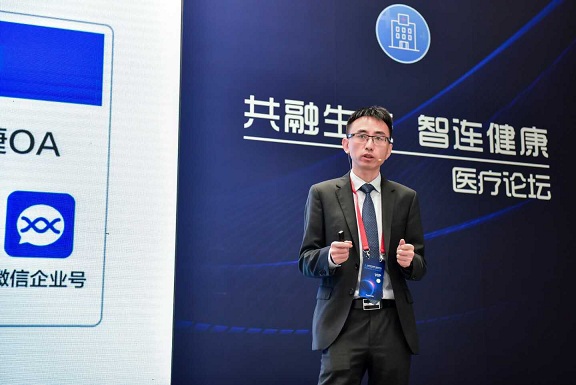
Chen Guangyu, Vice President of Tencent's Mobile Internet Business Group
WeChat,More Than Just an Information Publishing Platform
Appointment scheduling and consultation have become standard offerings at mainstream hospitals, with online appointment bookings accounting for 50% of total registrations at many institutions.
Since the launch of Ningxia’s Internet Hospital, more than a dozen internet hospitals have been established in the region within just six months. This sector is poised to become a new blue ocean market in the future.
Both policy and market depend jointly on advances in foundational technologies.Mr. Ma (Ma Huateng) once said that TencentCapable of expanding into a broader range of fields,In the final analysisIt is due to technological advancements.With cloud computing, big data,NetworkSafety,OnlinePayment.
Currently, a large number of people who previously did not use mobile payments have become proficient users.
More than 38,000 medical institutions operate their own WeChat Official Accounts, with over 110 million users searching for and utilizing these accounts. Eighty percent of medical WeChat Official Accounts have enabled Tencent’s online services. Among them, 60% of Service Accounts provide online consultation and appointment registration services.
At present, more than 2,000 hospitals have enabled WeChat Pay. In some of these hospitals, mobile payments account for as much as 60% of all transactions. At certain hospitals, over half of the total payment volume is processed through third-party payment platforms.
Additionally, on WeChat, appointment registration is available in 189 cities. A total of 1,500 hospitals have implemented online appointment registration through WeChat’s City Services.
WeChat,Not just an information publishing platform.
Tencent's Three Core Capabilities in the Healthcare Sector
First, user service capabilities.This includes capabilities for online appointment registration, online consultations, and medical insurance payments. It even encompasses the circulation of electronic prescriptions via WeChat. Regarding medical insurance payments, coverage extends beyond out-of-pocket expenses to include cross-regional healthcare services under the New Rural Cooperative Medical Scheme. In the future, Tencent will also integrate commercial health insurance, establishing a one-click and hybrid payment model that enables users to complete all transactions involving diverse payment structures through a single operation on WeChat.
Second, in addition to user services, Tencent also provides services aimed at enhancing hospitals’ internal management capabilities, such as medical cloud and big data solutions.
Over the years, hospitals have accumulated vast amounts of user information and data. However, these data have remained largely inaccessible for many years while stored on servers. Due to significant variations in data formats and storage methods, hospitals lack a unified toolset to manage such complex, multi-dimensional data.
In response, Tencent provides a suite of tools that offer both storage and data processing capabilities. Additionally, to ensure information security, Tencent has incorporated isolation features. The office platform designed for internal hospital management integrates communication and administrative functions, with underlying capabilities such as image recognition and AI-assisted decision-making.
WeChat’s Official Accounts, Mini Programs, and City Services, as well as the City Services offered by Mobile QQ and Tencent Browser, are all user-facing capabilities.
WeChat’s user base has surpassed 800 million, while Mobile QQ and QQ Browser are also platforms with hundreds of millions of users. On these platforms, Tencent possesses more precise user outreach capabilities and more comprehensive user profiling capabilities. This enables Tencent to deliver precise, personalized services in specialized fields such as healthcare.
Taking Peking University Shenzhen Hospital’s scan-to-pay service as an example, Tencent has already enabled WeChat medical insurance payments in many hospitals across Shenzhen. Although embedding a QR code on printed prescriptions may seem like a minor innovation, it allows users who do not follow the hospital’s WeChat Official Account to make payments directly by scanning the code, thereby lowering the barrier to entry. Moreover, it empowers many users who are unfamiliar with or have not followed WeChat Official Accounts to access this payment capability as well.
Another example is Liuzhou Workers' Hospital, the first hospital to issue WeChat electronic prescriptions through Tencent.
In the future, Tencent hopes to facilitate reasonable sharing and interoperability between user profiles and hospital information.Release functions such as e-prescriptions, medication circulation, and online consultations to more medical institutions.Help hospitals better leverage data to enhance patient services, hospital management, and disease analysis.
Third, Artificial Intelligence.Tencent’s artificial intelligence (AI) has not only claimed the world championship title in Go AI but is also engaging in practical applications involving the processing of massive volumes of images and information.
Whether in artificial intelligence or virtual reality, the most critical element is data. Only with sufficient data processing capabilities can an intelligent robot be trained.. Big data is a prerequisite for artificial intelligence, and Tencent happens to possess sufficient data volume with highly rich data dimensions.
In response, Tencent partnered with Sun Yat-sen University Cancer Center Nanshan Hospital to pilot an early esophageal cancer screening system in the Shantou region of Guangdong Province.
Certain towns and county-level cities in the Shantou region are among the areas with the highest incidence of esophageal cancer in China. Tencent leverages AI-based image processing to help hospitals that need to conduct large-scale preliminary screenings but lack sufficient medical capacity improve efficiency and reduce labor costs.
In the future,Tencent will also collaborate with Zhuojian and Medlinker to develop a future-oriented follow-up consultation system, providing primary care physicians with tools for the follow-up management of common diseases.。
In the healthcare industry, Tencent is a manufacturer of spare parts.
Tencent values ecological win-win cooperation; in the healthcare sector, Tencent is likewise an open enterprise.In every direction, Tencent will open up its APIs to partners, enabling them to leverage these capabilities to serve more medical institutions and patients.
As Mr. Ma stated, Tencent positions itself at the foundational layer, aiming to provide a wide range of basic components and connectivity capabilities to support traditional industries across all sectors.
In the field of “Internet + Healthcare,” Tencent is likewise a component company, an accessories company, and a company that exports capabilities and tools.。We will focus solely on excelling in areas within our capabilities, such as cloud technology, big data, and artificial intelligence. We are committed to building robust tools and strengthening foundational capabilities.