

Tencent Qintan Mini Program Expands Healthcare Applications Ahead of IPO
VCBeat (WeChat ID: vcbeat) reported that on April 20, Tencent hosted the 2017 China “Internet Plus” Digital Economy Summit, featuring a dedicated healthcare sub-forum. Stakeholders from across the healthcare industry gathered to discuss the sector’s trajectory in the context of emerging technologies. Centered on the healthcare field, the sub-forum adopted the theme “Integrated Ecosystem, Smartly Connected Health” and reviewed the achievements made in the “Internet Plus” healthcare sector to date.
As the organizer, Tencent also highlighted the services it provides to the healthcare industry through the WeChat platform, including Official Accounts, payment systems, and Mini Programs. The company stated that it will continue to explore additional application scenarios for WeChat in the medical field.
VCBeat has compiled the remarks of keynote speaker Gu Haijun from WeChat’s Open Infrastructure Department for industry professionals’ reference.
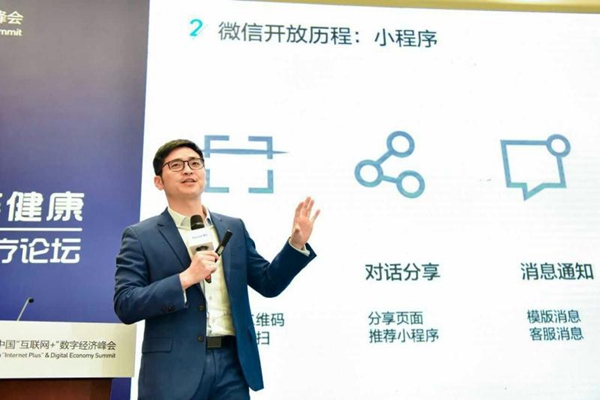
Gu Haijun: I am from the Basic Department of WeChat Open Platform. My primary responsibility is to drive WeChat’s expansion across various industries, with a particular focus on the public services sector. Healthcare is our most critical area of focus. This presentation will mainly cover two aspects:
First, WeChat has recently opened up capabilities for Mini Programs; what new changes does it feature?
Second, what specific applications can these capabilities have within mobile health and the broader healthcare ecosystem, as well as the progress we have observed on the platform.
Yesterday, April 19, marked the fifth anniversary of the launch of WeChat Moments. The Official Accounts Platform was launched later, in August.The WeChat Official Accounts Platform is approaching its fifth anniversary., Throughout this process, we have undertaken numerous initiatives. When the WeChat Official Accounts Platform was first launched, it featured a very simple architecture that allowed users to send messages, which could then be received by other users. It was essentially such a platform. Later, we discovered that it actually serves as an excellent service platform.
ActuallyThe healthcare ecosystem on WeChat got an early start.After the public platform was launched, it took only two or three months for a hospital in Wuhan to establish an official account on the platform, offering basic appointment registration services. Subsequently, Yuebei People’s Hospital became the first to implement a full-process digital healthcare model by migrating the entire patient journey onto WeChat. Following the launch of WeChat Pay, a hospital in Foshan integrated WeChat Pay capabilities, enabling patients to complete both appointment registration and payment for consultation fees.
Following this, after the mini program went live, we observedNearly 10 hospitalsWithin this framework, the entire patient journey and scenario-based capabilities throughout the medical consultation process are delivered via mini-programs. It is evident that the healthcare ecosystem is highly active on public platforms. Furthermore, numerous mobile health companies and third-party tools, such as Teng Ai, have facilitated the effective engagement of various stakeholders in the healthcare sector.
First, WeChat Mini Programs are web-based solutions built on the WeChat platform, offering an industry-grade solution that rivals native apps.
Secondly, I would like to point out that mini-program development is not difficult; in fact, it is even simpler than the H5 pages we previously developed. Our engineers can handle this task with ease, as the underlying language architectures are highly similar, delivering performance comparable to native apps.
After integrating the Mini Program with the Official Account, the Official Account’s own messaging channel can also be leveraged. It can be embedded in the Official Account’s menu, as the Mini Program’s user acquisition scenarios primarily stem from offline discovery. Meanwhile, the Official Account already has a large base of followers, all of whom represent...Can be seamlessly converted into your own Mini Program users.
One thing we are about to do,Official Accounts can embed Mini Programs, and Mini Programs can be linked within Official Accounts., but this involves the issue of legal entities. Today, we are launching a new capability that reduces tight coupling between entities, allowing them to be linked seamlessly. For instance, if our hospital has implemented this system while our internet hospital operates under a different licensed entity, previously these could not be integrated; now, they can be fully connected.
We have just discussed many aspects of the healthcare ecosystem. Let me supplement this with a few figures. The first figure relates to Service Accounts. Initially, there were two separate systems: Subscription Accounts and Service Accounts, with Service Accounts primarily delivering services. Within this category (healthcare-related Service Accounts),The proportion exceeded39%, ranking among the top across all industries, indicating that the healthcare sector has integrated a wide range of services.
At the same time, the effects it brings, focusing on users, so-calledThe monthly active rate of fans is 16.5%.,This figure is also notably high, exceeding that of other industries.
Let me add another figure: in addition to the more than 40,000 medical institutions, we also observed 140,000 accounts providing pharmaceutical and healthcare services. Within this groupThe covered fan base is 250 million., which is a remarkably high figure for our entire industry. Therefore, these are resources that we can currently leverage in delivering medical services.
The following section outlines the initiatives we are currently implementing on the WeChat platform. Over the past two years, we have gradually optimized this workflow, starting from patient entry—as previously mentioned, with appointment registration accounting for 60%, or even35% of payments were made via WeChat Pay., it's all on here. However, he still experienced slight difficulty when going out.
Users may need to print invoices for reimbursement purposes. While some hospitals handle this process efficiently, in most hospitals, the invoice-printing queue is combined with the payment and settlement queue, meaning patients still cannot avoid waiting in line at the end.
However, to keep it simple, I could develop an automatic invoice printer or create a window interface, incorporating this as a specific step in the process. If executed more effectively,It can even be integrated with commercial health insurance., which can enhance the efficiency of claims processing, to the extent that even submitting invoices may become unnecessary. These are areas we plan to explore in the future.
One of the most significant initiatives we undertook in the healthcare industry in 2016 wasMedical Insurance PaymentIn this context, we have integrated the entire system through a tripartite collaboration. I believe that such capabilities, particularly those at the foundational level, will exert a positive impact on the industry. This represents one of the few instances where WeChat has delved so deeply into a specific domain, which is also attributable to the company’s substantial investment in this area. I hope that these capabilities can be opened up more rapidly to the broader healthcare industry in the future, enabling wider adoption by medical institutions.
There are also some minor aspects in the healthcare industry where we have implemented innovations, namelyMedical CardThis issue with medical cards still persists in some hospitals. By digitizing these offline processes, we can ensure a smooth transition. On the left is our public account ecosystem, and on the right are the medical treatment cards; the two are interconnected through lightweight data integration, ensuring seamless interoperability among all parties. Users can choose their preferred access path based on their habits—whether entering via the official WeChat account or directly through the medical treatment card.The final services are hosted on the Mini Program or within the Official Account.
We would also like to discuss one of the most popular concepts at present, which isInternet Hospital. So, what can be done within the mini-program of an internet hospital? In addition to the aforementioned capabilities, a new feature is being incubated for the mini-program, calledTwo-Way Videothe ability to.
This capability is within aTesting Phase, which is in a very early testing phase. The capability we aim to develop includes a mini-program endpoint for patients.
The other end could be the PC side. As we know, WeChat has a web version for PCs, which can be integrated as an API directly into our current so-called doctor workstation software or web services. Once integrated in this way, patients can interact via mini-programs while doctors use the web service, thereby establishing a robustTeleconsultation Services。
In fact, in the healthcare sector, particularly within hospital settings, our practical experience has shown that mini-programs have significant growth potential. What is our strongest takeaway? Much like in other industries, the longer an individual remains engaged within a specific ecosystem, the more services become accessible. Consequently, we are seeing an increasing number of services that can be integrated and supported through these platforms.
For example, in a hospital setting, particularly during inpatient stays, since hospitalization is not just for a day or two but may last three days, or even several weeks to a month. In such cases, for instance,Supplementary Payment of Deposit and Hospitalization Reminder, even during hospitalizationOrder FoodWait, there are a bunch of services available.Connection and Support.
Moreover, it does not have strong integration with our current core information systems, such as the Hospital Information System (HIS) and other highly complex enterprise systems. We canRapid Iteration and Development, and integrate them. We have also observed that many hospitals are developing in this direction to improve patient satisfaction during hospitalization. Therefore, I believe this is an area we can expand and extend in the future.
That concludes my sharing. I hope the mini-program will continue to rapidly iterate and enhance its capabilities in the coming period, thereby providing greater support in the future of mobile healthcare.