

Huashan Hospital and Wuzhen Internet Hospital Launch Cross-Regional Internet-Based Medical Consortium to Enhance Remote Care for Underserved Areas
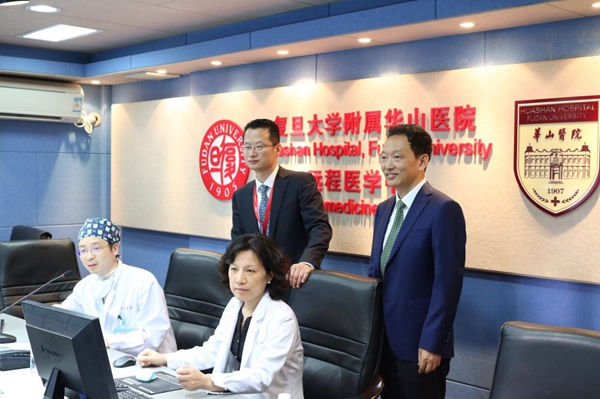
At 3:00 PM on April 20, a remote consultation spanning five provinces and autonomous regions and involving six internet-based medical consortium platforms was conducted at Huashan Hospital Affiliated to Fudan University, a top-tier tertiary hospital in China.
Huashan Hospital successfully achieved system interconnectivity with four major internet medical consortium members—Gansu Internet Hospital, Guangxi Internet Hospital, Yunnan Internet Hospital, and Haikou Internet Hospital—via the Wuzhen Internet Hospital. Experts from Huashan Hospital conducted remote consultations for four patients with complex and refractory conditions.
The joint multi-provincial remote consultation marks the launch of the Internet Medical Consortium established through the collaboration between Huashan Hospital and Wuzhen Internet Hospital.
Huashan Hospital’s “Cloud Hospital” provides users with services such as precise appointment scheduling, report inquiry, patient follow-up, and remote consultations through online collaboration and training models. In the future, hospitals in central and western China will be able to initiate convenient remote collaborations with Huashan Hospital’s Cloud Hospital.
This marks a large-scale remote consultation conducted between hospitals directly affiliated with the National Health Commission and China’s largest internet-based medical consortium platform, following the State Council’s executive meeting on April 12 that deployed the nationwide promotion of medical consortium development. Both parties will leverage their respective advantages in resources and technology to implement the new model of internet-based medical consortia, promote vertical integration of high-quality medical resources, expand the reach of premium healthcare services, enhance primary healthcare capabilities in central and western regions, and support the national tiered diagnosis and treatment system as well as health-focused poverty alleviation efforts.
Yang Dazhi, a 50-year-old employee of the Longchuan County Sugar Factory in the Dehong Dai and Jingpo Autonomous Prefecture of Yunnan Province, was recently diagnosed with a cavernous hemangioma at the First People's Hospital of Yunnan Province. At the patient’s request and due to clinical necessity, local physicians initiated a remote consultation with Huashan Hospital’s Cloud Hospital via the Yunnan Internet Hospital on the afternoon of April 20.
Leveraging systems such as remote video consultations via internet hospitals, along with the sharing of electronic medical records and imaging reports, Dr. Chen Liang, Chief Physician of the Department of Neurosurgery at Huashan Hospital, collaborated with local physicians to clarify the patient’s condition and formulate a detailed treatment plan in under half an hour.
On that day, alongside Yang Dazhi, patients with complex and refractory diseases from three western provinces and regions—Gansu, Guangxi, and Hainan—were able to consult with leading specialists from Shanghai Huashan Hospital locally via a remote consultation platform. In the future, patients across China with complex conditions will be able to initiate remote consultations with Huashan Air Hospital through the WeDoctor platform, with assistance from their local attending physicians. Prescriptions, payments, follow-up visits, and other processes can also be completed on the WeDoctor App.
“Huashan Hospital has established 10 national key disciplines under the Ministry of Education and 20 national clinical key specialties, with more than 400 professors and associate professors,” Ma Xin, Vice President of Huashan Hospital, told reporters at the consultation site. He stated that Huashan Hospital aims to leverage the internet to extend its advantages in disciplines, talent, technology, and brand to primary healthcare institutions across China. “We hope that this new model of an internet-based medical consortium, developed in collaboration with WeDoctor and the Wuzhen Internet Hospital Platform, will benefit more primary hospitals, physicians, and patients.”
Ma Xin further stated that Huashan Hospital has conducted extensive explorations in the development of medical consortiums and established the “Huashan Air Hospital,” aiming to leverage the internet to upgrade these consortiums. The collaboration between Huashan Hospital and Wuzhen Internet Hospital responds to the latest national guidelines on medical consortium construction. Adhering to the principles of resource integration, unified efficiency, interconnectivity, and information sharing, this partnership represents an innovative attempt within various medical consortium models, such as specialized alliances and remote medical collaboration networks.
“The Internet holds great promise for advancing tiered diagnosis and treatment systems and the development of medical consortiums,” stated Zhang Qunhua, Chief Operating Officer of WeDoctor and Director of Wuzhen Internet Hospital. Huashan Hospital maintains a significant lead in disciplines, technology, and talent. WeDoctor has invested RMB 280 million to build a systematic, open-platform medical consortium. By providing an integrated solution encompassing hardware, software, platforms, services, and internet-based medical applications, this platform enables Huashan Hospital specialists to remotely access patients’ electronic medical records and laboratory/test reports from various regions, as well as conduct video consultations. This model will substantially enhance the clinical capabilities of primary care physicians, bringing “medical oases” to underdeveloped provinces in central and western China.
On April 20, Wuzhen Internet Hospital marked its 500th day of operation. According to VCBeat, WeDoctor plans to spend three years connecting 1,000 provincial, municipal, and county-level central hospitals and 100,000 primary healthcare facilities across China in the future, forming a service matrix centered around three organizational models: “medical consortia,” “medical communities,” and “specialty alliances.” The collaboration between Huashan Hospital and Wuzhen Internet Hospital has strengthened the service capacity of WeDoctor’s medical consortium matrix, enabling more residents in remote provinces and primary care settings to access appropriate specialists nationwide via the internet when needed, thereby advancing the goal of tiered diagnosis and treatment.