

Integrated Medical and Elderly Care Industry: A Trillion-Yuan Blue Ocean with Hidden Challenges – Where Are the Opportunities?
“Those who need elderly care lack the funds, while those with means are not yet old.” This statement once succinctly captured the profitability dilemma currently facing the elderly care market. However, as policies gradually loosen, initiatives such as integrated medical and elderly care and smart elderly care continue to evolve. Meanwhile, several generations with shifting consumption habits are progressively reaching retirement age. Driven by various stakeholders, the elderly care market is expanding, and this trillion-yuan “blue ocean” is poised to reveal greater opportunities.
According to China Investment Advisor’s forecast for the market size of China’s integrated medical and elderly care industry from 2017 to 2021, the compound annual growth rate (CAGR) during this period is approximately 17.92%, with the market size reaching RMB 1.1603 trillion in 2021, truly becoming a mega-market exceeding the trillion-yuan mark.
Market Size Forecast for the Integrated Medical and Elderly Care Sector (2017–2021)
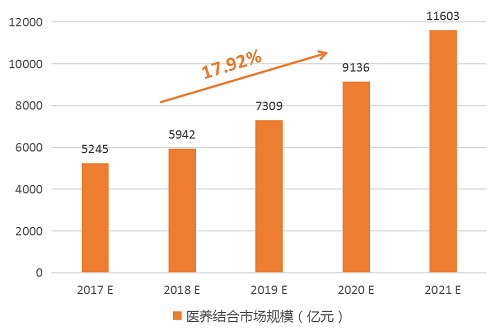
Data Source: China Investment Consultants Industry Research Center
China became an aging society in 2000. According to data from China.org.cn, the proportion of the population aged 65 and above is projected to exceed 20% by 2040. However, significant challenges remain in ensuring adequate care for the elderly, particularly regarding the most thorny issue of medical nursing. The burden is so severe that some seniors engage in “social hospitalization,” occupying hospital beds to meet their long-term care needs, thereby straining medical resources. Although the concept of integrating medical care with elderly care has been proposed for many years, its implementation faces numerous obstacles, with more观望 (wait-and-see) attitudes than practical action.
Driven by the ethos of “caring for others’ elders as one would care for their own” and attracted by a lucrative market, practitioners in the healthcare and elderly care sectors find that while the integrated healthcare and eldercare industry appears to be brimming with opportunities, capitalizing on them is exceedingly difficult. Amid this surge in integrated healthcare and eldercare, what are the potential breakthrough areas for the industry? VCBeat (WeChat ID: vcbeat) analyzes the opportunities in the integrated healthcare and eldercare sector through the lens of three major elderly care models: home-based care, community-based care, and institutional care.
Home Care: In-Home Medical Services and Smart Products
Influenced by traditional culture, aging in place remains the choice for the majority of elderly people in China and will continue to be a long-term preference for the new generation of seniors with relatively longer life expectancies. According to data from the National Working Commission on Aging, the population aged 60 and above is projected to reach 400 million by around 2033. Under the “9073” elderly care model, 90% of this group—approximately 360 million seniors—will age in place, thereby accelerating the development of home-based medical nursing systems and related facilities and equipment.
Family Physicians, Home-Visit Nurses and Caregivers
Some elderly individuals with chronic diseases or disabilities require long-term medical care. However, due to the scarcity of medical resources, which leads to difficulties and high costs in accessing healthcare, many choose to age and receive treatment at home. Without professional nursing care, these patients face increased risks of delayed treatment, complications, and readmission. In this context, home-based medical and nursing services are becoming a growing trend.
As a country with severe population aging, Japan’s home-based elderly care and medical support model offers valuable lessons for China. Since the 1970s, Japan has developed various forms of home care services, integrating medical treatment with long-term care. Each individual requiring medical and nursing care at home is supported by a comprehensive care team, including physicians, nurses, dentists, pharmacists, physical therapists, speech-language pathologists, and care workers.
Case: Shanghai’s “Home-Based Medical and Elderly Care” Pilot
Shanghai conducted a study to determine whether family doctors could reduce complications among homebound disabled elderly patients. Home hospital beds were established, and a family doctor service team was formed, consisting of one Western medicine general practitioner, one community nurse, and one traditional Chinese medicine physician. The implementation methods were as follows:
General practitioners conduct home visits once a week to monitor patients’ vital signs, perform physical examinations, change catheters and dressings, and provide rehabilitation training; they also issue medical orders and prescriptions, and deliver health education to patients, family members, and caregivers.
Community nurses make weekly home visits to execute medical orders, provide nursing care, conduct nursing assessments for the elderly, and teach caregiving techniques.
TCM physicians provide treatments using appropriate TCM techniques, such as tuina and acupuncture.
The aforementioned experimental case study was conducted over a period of nearly one year. The research conclusions drawn are as follows: the incidence of complications among elderly participants decreased, and the rate of hospital readmission was reduced. This demonstrates that, compared with traditional community medical services, family physician team services not only improve the health status of community patients but also reduce the waste of medical resources.
In China, Shanghai’s practice of family doctor services has become a national model for promotion. Features such as free optional health screening items for seniors aged 65 and above, higher medical insurance reimbursement rates for primary care visits, and the flexibility to seek care within a “1+1+1” consortium of medical institutions have facilitated access to medical services and reduced costs for elderly individuals aging in place. In mid-April, during an on-site promotional meeting on national family doctor contract services held in Shanghai by the National Health and Family Planning Commission, it was announced that the experiences of Shanghai and other regions in implementing family doctor services should be extensively studied and promoted nationwide.Currently, 26 provinces, autonomous regions, and municipalities in China have promoted family doctor services. It is believed that as the national family doctor network is gradually established, home-based elderly care will feature more diverse medical service models, giving rise to more new investment opportunities in healthcare entrepreneurship.
In our previously published article on VCBeat (WeChat ID: vcbeat), titled “Home Visit Nursing Industry Report: Global Market Value to Reach $349.8 Billion, While the Chinese Market Remains Untapped,” we noted that the global market for home visit nursing services was projected to reach $349.8 billion by 2020, while regulatory frameworks in China were being liberalized, standards were taking shape, and exploratory models were becoming increasingly diversified. The term “nurses” referred to herein includes both licensed registered nurses and trained health caregivers.
Wang Liyi, Chairman of Shandong Nightingale Nursing Service Co., Ltd. and President of Shandong Liming Vocational College of Science and Technology (formerly Shandong University of Traditional Chinese and Western Medicine), the first private medical university in China, stated in an exclusive interview with VCBeat that long-term care personnel have become a necessity for some families in China. However, pain points such as shortages of caregiving staff, insufficient professionalism in elderly care nursing, and high turnover rates are becoming increasingly prominent. In response, the government and various elderly care enterprises are adopting diverse measures to improve compensation, enhance professional competencies, and raise the social status of nursing talent. This trend signals market opportunities for specialized elderly care training institutions and home-based nursing service providers.
Smart Home Elderly Care Products
In addition to staffing healthcare professionals, “smart elderly care,” with a focus on preventive health services, will serve as a supplement to home-based elderly care. This approach leverages next-generation information technology products—such as the Internet of Things (IoT), cloud computing, big data, and smart hardware—to provide services for older adults, particularly those who are unattended, including empty-nesters and seniors living alone. The Action Plan for the Development of the Smart Elderly Care Industry (2017–2020) explicitly states thatBy 2020, cultivate more than 100 leading enterprises in the smart elderly care industry that serve as demonstration and benchmark models.。
Policy: The "Action Plan for the Development of the Smart Elderly Care Industry (2017–2020)" outlines the smart development of home-based elderly healthcare services.
· Chronic Disease Management: condition monitoring, medical record management, personalized assessment, trend analysis, diagnostic and treatment recommendations, abnormality alerts, emergency assistance, rehabilitation services, etc.
· Home Health Tools: health check-ups, home environment monitoring, remote caregiving, health interventions, and health assessment feedback.
· Personalized Health Management: Information Collection, Health Planning, Health Education, Health Tracking, Disease Diagnosis, Risk Screening, Health Information Inquiry, etc.
· Internet Health Consultation: Leveraging internet platforms to develop online consultations, appointment scheduling, pre-consultation guidance, and post-consultation follow-up.
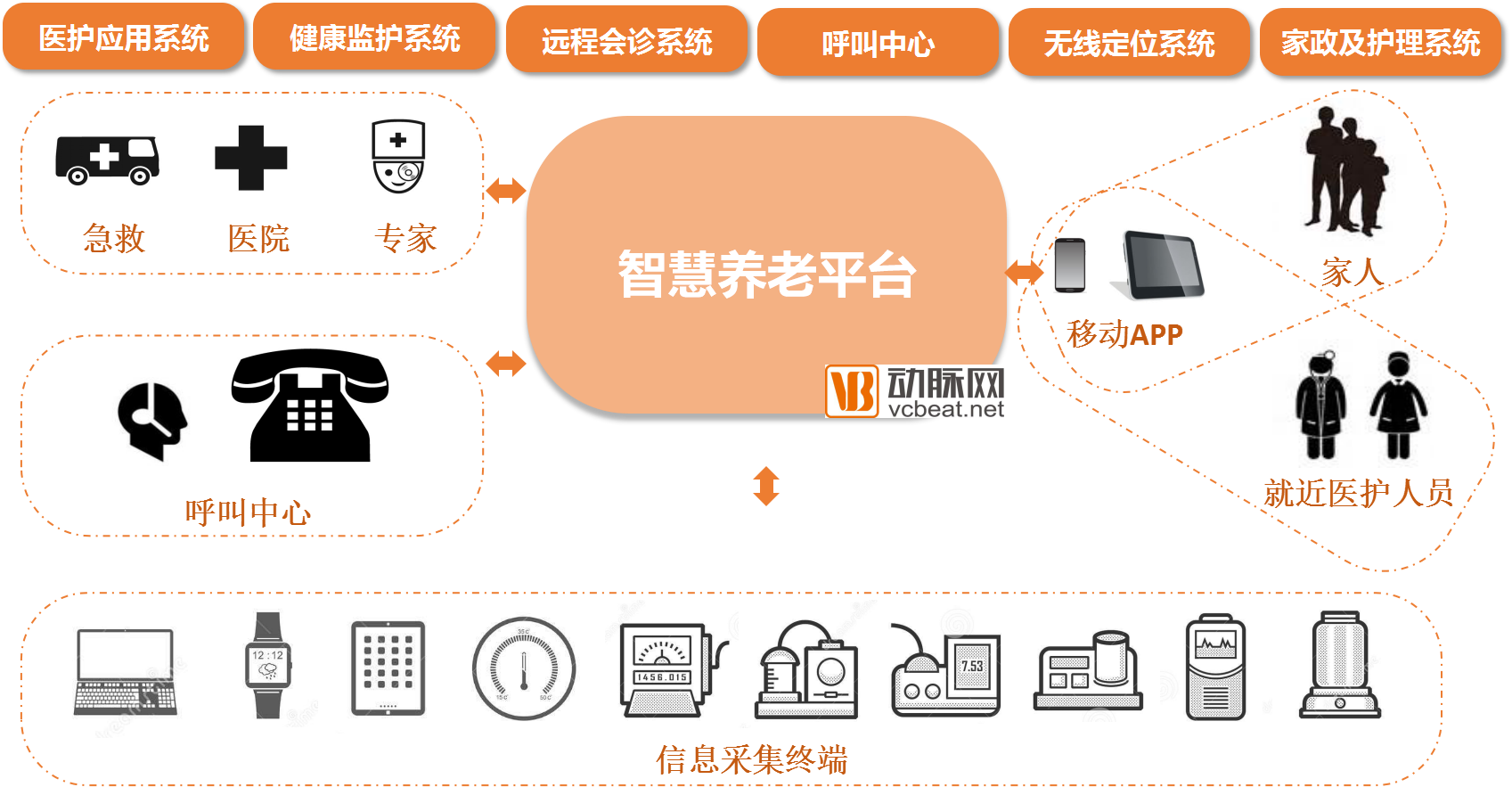
The Basic Ecosystem of Smart Elderly Care
In fact, prior to the implementation of policies encouraging comprehensive development and the strategic deployment of smart elderly care, Wuzhen in Zhejiang Province had already taken the lead in exploring home-based smart elderly care systems. A typical case is as follows: An elderly individual suddenly felt unwell and used a smart home health monitoring device to measure blood pressure, blood glucose, and body temperature. The data were shared in real time with the elderly care service center. Upon detecting abnormalities, staff promptly arranged a remote medical consultation, resolving the issue with rapid response. In addition, the Nanshan District Government in Qingdao City distributed smart bracelets to seniors, while Gusu District in Suzhou City has also piloted smart elderly care initiatives through its “Virtual Nursing Home.”
At the recent “Internet of Things+” Summit and Cyborg Capital Group Annual Conference, Zhang Jingbo, General Manager of Qingmeng Elderly Care, told VCBeat: “Establishing a comprehensive personalized assessment system is the foundation of smart elderly care.” It is reported that Qingmeng Elderly Care is developing a home nursing consultation robot based on its proprietary set of 1,500 elderly profiling criteria, which provides assessments and recommendations by leveraging in-depth insights into seniors’ health conditions.
Potential Opportunities in Home-Based Medical and Elderly Care
Leverage family physician and home-care nursing resources to provide medical and healthcare services to elderly individuals at home;
Medical devices and instruments specifically designed for home-based elderly care scenarios;
An information technology tool customized for family doctors and home care providers;
Professional Training Institution for Home-Based Elderly Caregivers;
Wearable devices with functions such as caregiving companionship, health management, and remote monitoring; portable health monitoring devices; self-service health screening devices; smart elderly care monitoring devices; AI-powered home service robots; etc.
Various platforms offering services such as remote consultations, health advice, guidance on appointment registration and medical care, and elderly care convenience.
Community: Care and Rehabilitation Therapy at Your Doorstep
Given that older adults require medical support, are prone to neglect, and have social and recreational needs, traditional home-based elderly care is unlikely to effectively meet these needs without community-based elderly care serving as its foundation and supplementary service.
Currently, community-based elderly care in China is primarily divided into two models: ordinary residential communities and senior apartment complexes. The former serves mainly as a supplement to home-based care, while the latter represents a specialized form of elderly care community, primarily targeting healthy seniors capable of self-care or mutual assistance. In well-established age-friendly communities, comprehensive facilities for elderly care, medical and healthcare services, recreation, and daily living convenience are required to be fully available.
Community-Based Care by Joint Medical and Nursing Institutions
Community-based care models, such as day care centers and elderly care homes located “at the doorstep,” provide seniors with essential services including daily living assistance, rehabilitation therapy, emotional support, and emergency aid, as well as supplementary services like entertainment, education, and social engagement. As elderly care gradually shifts toward marketization, various model explorations have emerged, including public-private partnerships (PPP), government-funded leasing, and private construction with community operation. Government operational subsidies or the provision of venues at low or no cost help operators maintain a “lighter” asset structure. Through continuous exploration of seniors’ needs and by leveraging resources such as in-home services, mutual aid among the elderly, and platform-based operations of multiple service providers, community-based care is gradually moving away from the traditional mindset that it is “unprofitable.”
Not only is it necessary to equip facilities with health preservation and rehabilitation amenities, but there is also a deepening integration of medical care and elderly care. As the peripheral nerves of the healthcare system, street-level community health service centers, township health centers, and community clinics can form natural alliances with nearby community-based elderly care institutions. These partnerships facilitate various forms of collaboration, such as dispatching specialists to communities and establishing green channels for expedited medical consultations for the elderly. From a different perspective, primary healthcare institutions can also establish community-based elderly care units. Through such cooperation, community elderly care services gain access to professional medical support, while simultaneously helping to integrate and optimize the resources of community medical institutions, thereby improving bed turnover rates.
Traditional Chinese Medicine for Healthy Aging and Elderly Care
Such services are widely applicable to various types of communities, where the elderly population has certain demands for rehabilitation physiotherapy and traditional Chinese medicine (TCM) healthcare available within their local communities. By establishing TCM Rehabilitation and Physiotherapy Departments, community health service centers provide treatments such as acupuncture, cupping, herbal fumigation, moxibustion, acupotomy, traction, tuina massage, and gua sha, along with TCM decoctions and proprietary Chinese medicines. This approach aligns with the concept of tiered diagnosis and treatment to serve the elderly, thereby supporting and promoting integrated medical and elderly care services that prioritize wellness and maintenance.
The government has recently introduced policies to encourage social forces to establish TCM wellness and healthcare institutions and brands primarily serving the elderly. In recent years, with the introduction of the concept of integrating TCM with elderly care, a regulatory indicator system and supervision rating mechanism for the TCM health and elderly care service market are being established. These measures aim to promote the emergence of new, compliant TCM physiotherapy clinics and service points, while cracking down on illegal marketers targeting the elderly population.
Policy: National Administration of Traditional Chinese Medicine's "Implementation Opinions on Promoting the Development of Health and Elderly Care Services in Traditional Chinese Medicine"; TCM healthcare plays a significant role in community-based elderly care
To bring traditional Chinese medicine (TCM) services into communities, over 85% of community health service centers and more than 70% of township health centers shall establish integrated TCM service zones (such as TCM clinics or Guoyitang halls) to provide TCM-based health and elderly care services;
Encourage non-governmental entities to establish health and wellness institutions primarily serving the elderly, providing services such as TCM-based identification and assessment of health status, consultation and guidance, and health management; utilize TCM techniques—including massage, gua sha, cupping, moxibustion, and fumigation and washing—as well as other health-promoting methods and products guided by TCM theories for health interventions.
Promote the development of TCM wellness and healthcare institutions that adhere to standardized operations, provide high-quality services, and possess distinct characteristics, and cultivate a group of well-known TCM wellness and healthcare groups or chain organizations with mature technologies and good reputations.
Community-Based Medical and Elderly Care: Potential Opportunities
Multi-Modal Elderly Care Communities;
Community clinics specializing in elderly care and rehabilitation;
Community-based elderly care and rehabilitation institutions;
Rehabilitation equipment and training for rehabilitation professionals addressing elderly care issues such as falls, bedridden status, frailty syndrome, severe osteoporosis, and dysphagia;
TCM Physiotherapy and Wellness Centers, etc.
Institutions: Diverse Collaboration in Medical and Elderly Care, Full Industry Chain Data Tracking
The growing pressure on the one-child generation to support their parents means that home- and community-based elderly care alone will struggle to meet demand. The market for elderly care institutions is rapidly emerging, but it is understood that the operational performance of these facilities is generally unsatisfactory, requiring further exploration of service delivery and profitability models.
In recent years, the widely discussed model of integrating medical care with elderly care has largely focused on institutional eldercare. Proposals include enabling elderly care institutions to obtain qualifications for providing medical services, transforming hospitals into integrated medical and elderly care service providers, and establishing contractual collaborations between medical institutions and elderly care facilities. While these measures aim to provide more convenient medical services for the elderly, they also substantially enhance opportunities for interoperability of information and data, as well as for delivering multidimensional medical services.
Policy: Support for Integrated Medical and Elderly Care Institutions in the 13th Five-Year Plan
Further relax market access requirements for private capital and social forces applying to establish elderly care institutions. Effectively implement support policies for privately run elderly care institutions in areas such as investment and financing, taxes and fees, land use, and talent development. Support elderly care institutions in establishing rehabilitation hospitals, nursing homes, hospice care facilities, medical clinics, and nursing stations in accordance with relevant regulations. Medical institutions established within elderly care facilities that meet the eligibility criteria shall be included in the designated network of basic medical insurance coverage in accordance with applicable rules.
But then again, it is insufficient to merely have nursing homes sign contracts with hospitals, establish hospitals within nursing homes, or convert hospitals into nursing homes. If medical services do not truly integrate into elderly care and the management of long-term care facilities, “medical-nursing integration” will remain nothing more than a concept.
Case: Hospital Transformation Toward Integrated Medical and Elderly Care
In late 2014, Beijing Longfu Hospital opened its Beiyuan Campus, housing both the Huichen Senior Apartment and medical staff within the same building. If elderly residents require hospital treatment, they can be transferred from an apartment bed to a hospital bed simply by moving to another room within the building.
Beijing Coking Chemical Plant Hospital, a state-owned enterprise hospital established in 2010 with 80 inpatient beds, incurred sustained losses in the subsequent years. In response, the hospital implemented a reform adopting a new integrated medical and elderly care model: it retained its outpatient services while converting half of its 80 beds for use as an elderly care facility.
Case: Collaboration Between Medical Institutions, Healthcare Brands, and Elderly Care Facilities
Beijing Longfu Hospital’s Tiantongyuan Campus is located adjacent to the Dongli Nursing Home. The two institutions formally signed a cooperation agreement in late 2014. Physicians from Longfu Hospital conduct weekly rounds at Dongli Nursing Home, providing elderly residents with rehabilitation therapy and other medical services. This partnership marks Beijing’s first integrated “medical-care” facility.
Lepu Medical’s accompanying medical consultation service brand, “Suixinzhen,” signed an agreement with Puleyuan Nursing Home in January 2016, announcing a joint effort to explore a new model of integrated medical and elderly care that combines “professional medical services with social eldercare institutions.”
Li Huaizeng, Chairman of Yanda Group and a deputy to the National People’s Congress, stated that to truly address the integration of medical care and elderly care, nursing homes must establish dedicated medical teams integrated into daily caregiving operations to meet the basic needs of residents. In cases of serious illness, these facilities should ensure seamless coordination with hospitals, providing comprehensive, end-to-end responsibility for patient care. Medical care and elderly care are complementary; robust development in the hospital sector can drive advancements in elderly care, and vice versa.
Shandong Nightingale Company states that one of its core businesses is to affiliate hospitals with chain-franchised, managed elderly care institutions, supplemented by management services and cloud platform solutions. The data generated through this integrated medical-elderly care platform helps optimize the managed elderly care facilities, manage nursing talent, and supports the development of elderly care finance and medical-elderly care products.
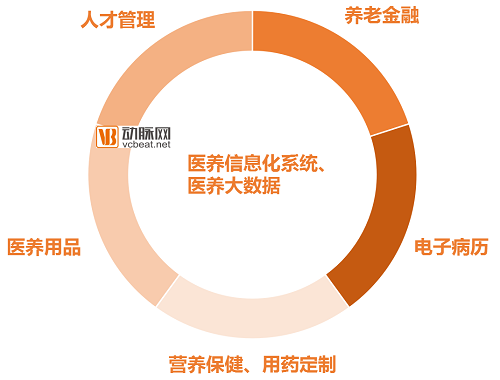
Potential Applications of IT-Enabled Integrated Medical and Elderly Care in Institutions
Opportunities for Medical-Nursing Integration Potential in Institutions
An information system that enables data interoperability between elderly care institutions and hospitals, covering health records, medical visit logs, disease management, and medication needs.
Medical and elderly care-related insurance;
Big data on the physical condition of the elderly, providing research information for pharmaceutical companies and medical-care-related insurance;
Track member needs to provide value-added services, such as customized nutritional meals, health supplements, medications, and elderly care products.
Unavoidable Challenges: Personnel, Costs, and Technology
The elderly care market has never been an easy pie to slice. First,Shortage of High-Quality Elderly Care Medical StaffThis is a reality that families, communities, and institutions must all confront. According to data from Huicheng Elderly Care, there are over 100 million “empty-nest” elderly individuals, with those living alone and the very elderly each numbering more than 20 million. Among them, 40.63 million (18.3%) are partially or fully disabled. Based on a caregiver-to-elderly ratio of 1:4, the shortfall in caregivers amounts to tens of millions, creating a severe mismatch with the demand for elderly care services.
Many elderly care service companies that conduct in-house training for caregivers emphasize that increasing income levels within the industry is the primary step toward cultivating more elderly care personnel. According to reports, the average monthly salary of ordinary elderly care assistants ranges from 3,000 to 4,000 RMB, whereas trained postpartum care specialists (yuesao) earn approximately 8,000 to 13,000 RMB. Coupled with the demanding, exhausting, and unsanitary nature of elderly care work, as well as inadequate social security benefits and low social status, these factors have significantly constrained the development of talent in the elderly care sector. VCBeat (WeChat ID: vcbeat) has learned that, to address staffing challenges, some elderly care enterprises have entered into strategic poverty-alleviation cooperation agreements with local governments to recruit and train caregivers, while others have established targeted talent pipelines through university-enterprise partnerships, offering subsidies and other incentives.
In the future, addressing the shortage of elderly care personnel will rely on two approaches: improving subsidy systems for nursing professionals and allowing marketization of elderly care services to naturally regulate service prices. Essential services such as care for the disabled will gradually see price increases.
The second factor that directly impacts the development opportunities of integrated medical and elderly care isMedical and Elderly Care ServicesReimbursement Issues. Currently, some integrated medical and elderly care institutions have been connected to the national health insurance system; however, coverage is limited to medical services, excluding custodial care. Since the reimbursement rate for medical expenses is lower than that for rehabilitation and nursing services, the challenge of reducing costs through bed-based elderly care remains difficult to address. In response, the Ministry of Human Resources and Social Security has developed a top-level design for the long-term care insurance system. Meanwhile, Qingdao in Shandong Province, Changchun in Jilin Province, and Shanghai have proactively launched pilot programs tailored to local conditions. These initiatives will further strengthen the social elderly care support system.
Finally,Elderly Care Service Network InfrastructureThe construction of such systems presents a significant challenge. In North America, where healthcare informatization is more advanced, SecurityScorecard surveyed over 700 healthcare organizations and released the “2016 Cybersecurity Report for the North American Healthcare Industry,” revealing that the current state of information security in the healthcare sector is dire. Between August 2015 and August 2016, there were 22 major data breach incidents in the North American healthcare industry, resulting in the exposure of millions of patients’ records. In China, where privacy protection is still in its early stages, similar issues are expected to occur more frequently as medical and elderly care services become increasingly digitalized. It is therefore imperative to implement proactive security controls for sensitive personal information, including health status and insurance details.