

Dr. Yu Gang Launches Meihe Medical Group, Filing IPO Prospectus for Pediatric Ophthalmology Chain
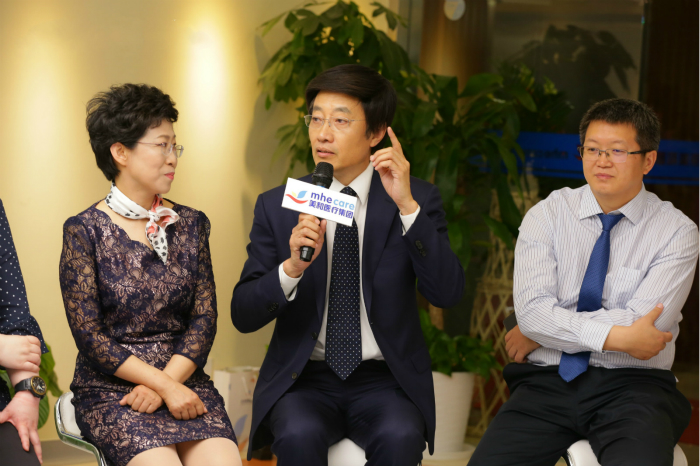
Pediatric Ophthalmology Expert Yu Gang (Center) Founded Meihe Medical, Sharing His Entrepreneurial Journey
On April 25, a new member was added to the roster of physician groups. Meihe Medical, founded by 60-year-old pediatric ophthalmology expert Yu Gang, officially made its public debut today, announcing the establishment of its own hospitals and clinics, optometry centers, and the formation of the Baobao Yan Physician Group.
Yu Gang is among the first renowned physicians in China to pioneer online medical consultations via the internet and build his personal brand. With 510,000 followers on Weibo, he ranks first among doctors nationwide in patient visits on “Haodaifu Online,” exceeding 74 million visits. Children affectionately call him “Grandpa Yu Gang.” After experiencing the surge of Weibo and WeChat during the era of internet celebrities, he enthusiastically led a team of more than 70 members to launch ophthalmology-focused live streaming and short-video content.
Amid growing calls for physicians to practice independently, Yu Gang is preparing to establish Meihe Medical Group. The group aims to create hospitals, clinics, and optometry centers owned and operated by physicians, while also providing an incubation platform for physician groups.As planned, the group will establish one flagship hospital, several ambulatory surgery centers, a chain of clinics, and dozens of optometry outpatient departments.
The Meihe Eye Clinic visited by the reporter is located in the CapitaMall office building at Xizhimen, adjacent to Subway Lines 13, 4, and 2, offering an excellent geographical location. “During its two-month trial operation, patient numbers at Meihe Clinic have gradually increased. On one afternoon in mid-April, I saw 37 patients consecutively, and surgical appointments are now scheduled two months in advance. The clinic, spanning over 500 square meters, has already proven insufficient, so we plan to expand into the neighboring office space,” said Yu Gang, describing the clinic’s operational status.
Meihe Hospital has commenced construction in Chaoyang District, Beijing, with a floor area of over 32,000 square meters.The hospital is positioned as a specialized institution with comprehensive support, featuring pediatric ophthalmology as its flagship specialty. Notably, it will serve as an incubator for multi-disciplinary physician groups and become a hub for physicians’ independent practice.。
Yu Gang’s Secret to Entrepreneurship: Always Keep Your Competitors Guessing, and Never Stop Innovating
Meihe Eye Clinic is positioned in the mid-to-high-end healthcare sector. “I aim to provide mid-to-high-end services, but high-end does not equate to high prices,” Yu Gang has emphasized repeatedly. “It refers more to tasteful and humanized services.”
The clinic currently has 10 doctors. Regarding ophthalmology services:Cataract surgery and myopia correction procedures are highly profitable services.. From a purely surgical perspective, the clinic has no difficulty performing these highly complex procedures. However, Yu Gang’s philosophy is, “We start by doing what others are unwilling to do.”
"He identified gaps in the pediatric ophthalmology market, such as children's eye care. 'This is an area that top specialists are reluctant to engage with, and patients lack trust in junior doctors. We will enter this niche by doing what others are unwilling to do.'"Our specialties also include ptosis, strabismus, and amblyopia in children.“Yu Gang said.”
It is reported that Meihe is also preparing to establish new projects, including a Prosthetic Eye Center, Lacrimal Duct Center, Genetic Eye Disease Center, Congenital Cataract Center, and Orthokeratology Center. These initiatives address critical gaps in China’s pediatric ophthalmology services.
In terms of differentiated services, Meihe has also developed service packages targeting a specific pediatric disease.For example, ptosis is a condition that in public hospitals is often reduced to a mere three-minute outpatient consultation and a single surgical procedure, yet it causes significant distress and burden for patients.“Ptosis can lead to amblyopia. Patients need to undergo numerous examinations and make multiple hospital visits. It is crucial to promptly determine the underlying cause. If a child is older than three years, the optimal treatment window will have passed, making surgery too late and severely affecting vision. To address this condition, we have developed a service package that streamlines the diagnosis and treatment process, providing an end-to-end solution covering consultation, screening, and surgery. Our advantage lies in optimizing preoperative care to maximize convenience for pediatric ophthalmology patients,” introduced Yu Gang.
“We start by tackling the small tasks others are unwilling to do, then venture into uncharted territory no one has explored before, subsequently take on major initiatives, and ultimately reach a point where competitors find it impossible to catch up even if they wish to.” Yu Gang smiled as he summarized his secret to innovation and market breakthroughs, which also outlines the direction for his future endeavors.
As planned, he hopesThe clinic has a capacity of 200–250 outpatient visits per day. While consultation times are highly flexible, they typically last around 10 minutes. The consultation fee is approximately RMB 400, which is considered mid-to-high range. Surgical fees are priced in line with those of the International Department of Beijing Children’s Hospital, while services such as eyeglass dispensing and amblyopia treatment are offered at affordable, competitive rates.。
“"Consultations and surgeries best demonstrate a doctor's value; we do not intend to profit from dispensing eyeglasses.".” Yu Gang said, “Meihe Clinic aims to maximize outpatient volume in its plans while providing high-quality medical services, which means striking a reasonable balance between pricing and the number of outpatient visits. Their future plan is to invite China’s top pediatric ophthalmology experts to conduct consultations and perform surgeries at Meihe.”
The Path of Serial Entrepreneurship: From Doctor to Manager to Entrepreneur
This marks Yu Gang’s third entrepreneurial venture and a pivotal phase in his transformation from a physician and public-sector administrator to an entrepreneur. In contrast to his previous two startups, his mindset this time is remarkably composed. “My first two ventures unfolded naturally, whereas this one fills me with awe and apprehension.”
Having lived through the era when public hospitals were strapped for cash, and having experienced the coldness and impetuousness of private hospitals, he is a cross-generational entrepreneurial physician. His medical career has been filled with adventure, innovation, and achievement, underpinned by both technical expertise and managerial acumen.
“I am someone who is inherently restless,” Yu Gang summarized his personality.
In 1991, 34-year-old Yu Gang became the youngest director of the Zhangjiakou Eye Hospital. “This was my first entrepreneurial venture and my first foray into management, even though it was at a public hospital,” he said.
In the early days of his tenure as hospital director, this young leader demonstrated a strong curiosity for new developments. In the late 1990s, public hospitals were required to be financially self-sufficient. To raise funds and retain key medical staff, he turned his attention to the emerging market for computers and internet cafes. He leased a row of 20 ground-floor commercial units adjacent to the hospital’s rodent control facility and purchased 50 brand-new computers and 50 used ones for RMB 1.5 million. Given the economic conditions at the time, this represented a substantial investment.
Shortly after investing in an internet café, Yu Gang leveraged its advantages to provide network skills training for the hospital’s key personnel and physicians. The café operated commercially during the day, while the two hours after work were dedicated to serving as a space for hospital staff to learn about the internet. At that time, the hospital’s main campus had only three computers, and its application systems were still running on Windows 97.
The internet café helped Dr. Yu Gang’s expert team complete their digital literacy training. As a result, the hospital became one of the earliest medical institutions to go online, with many experts later becoming proficient in using the internet. Subsequently, as internet cafés became widespread, Dr. Yu decided to close the hospital’s internet café and relocate all computers back to the hospital. This move made the hospital the first institution in Hebei Province to implement informatization and the earliest to achieve paperless operations.
In 2004, Yu Gang resigned at all costs from his position as President of the Fourth Hospital of Zhangjiakou, Hebei Province (Zhangjiakou Eye Hospital), and also gave up his roles as Vice Chairman of the Zhangjiakou Municipal Committee of the Chinese People's Political Consultative Conference and Chairperson of the Zhangjiakou Municipal Committee of the Jiusan Society. He joined Beijing Children's Hospital as an introduced talent. The following year, his colleagues also resigned without alternative employment lined up to join him in Beijing, embarking on their "Beijing drifter" life and launching their second entrepreneurial venture.
"If one were to weigh gains and losses, his tenure in Zhangjiakou represented the most illustrious chapter of his life; yet he chose to resign without securing another position."
When he arrived at Beijing Children’s Hospital, the department started with virtually no resources. At that time, pediatric ophthalmology was not an independent department but was affiliated with the Department of Otorhinolaryngology–Head and Neck Surgery. It had no outpatient clinics, no inpatient wards, no surgical services, no performance bonuses, and no research projects. The entire staff consisted of only three physicians and one retired expert, generating an annual revenue of just RMB 500,000. By 2014, the annual outpatient volume of the hospital’s ophthalmology department had reached 220,000 visits, with a comprehensive annual revenue of RMB 124 million. The department had grown into a team of 96 medical, nursing, and technical professionals, becoming the largest pediatric ophthalmology team in China.
Yu Gang established a high-end pediatric ophthalmology program within the International Department of Beijing Children’s Hospital. At the time, no one was optimistic about this venture. Nine years ago, Yu Gang set the price for a single specialist consultation in the International Department at 700 yuan, sparking widespread controversy across China. Within the specialized field of ophthalmology,Apart from Beijing Tongren Hospital, the institution with the strongest comprehensive pediatric ophthalmology capabilities is Beijing Children's Hospital..” he introduced.
He and his entire team ventured into online consultations and healthcare. Shortly after joining the hospital, he co-founded a website with Zhang Feng.www.baobaoeye.com, this was a website built entirely by ophthalmologists, with its own domain name and server. At that time, Zhang Feng, another co-founder, would take an overnight train from Zhangjiakou to Beijing every Friday after work. He and Yu Gang would hole up in a “small dark room” working on the website, and Zhang Feng would take the overnight train back to Zhangjiakou on Sunday night. Back then, the monthly bonus for each staff member in the Ophthalmology Department of the Children’s Hospital was only 500 yuan, yet their annual out-of-pocket expenses for maintaining baobaoeye.com exceeded 50,000 yuan. Recalling the hardships and difficulties of those days, Yu Gang choked up.
Later, at Wang Hang’s sincere invitation, Yu Gang became one of the first physicians to register on the Haodf Online platform. He also required all members of his team to register on Haodf. One day, a staff member from Haodf called him in urgency: “Is there something wrong with Director Yu? Why did you suddenly register more than 30 doctors? Is this a malicious attack?” He replied cheerfully, “No, I simply set a requirement for them: only by registering on the Haodf website can they receive their online work bonuses and support.”
Over the twelve years since Dr. Yu Gang’s team embarked on their entrepreneurial journey at the Children’s Hospital, they leveraged twelve different platforms for online doctor–patient communication: Tianya Forum, Mop, QQ, Blog China, and even Sina’s Song Request Room all served as tools for facilitating interactions between doctors and patients.
As early as 2005, while working at the Children’s Hospital, Yu Gang began establishing a team-based clinical care model. The expert team led by Yu Gang and Wu Qian includes associate chief physicians, optometrists, and nurses.Dr. Yu Gang led a team of associate chief physicians in patient consultations and established a policy whereby half of his consultation fees were shared with the specialists who saw the patients. As a result, pediatric face-to-face consultations, optometry, and surgical scheduling were all completed in a single outpatient visit. In 2015, the Beijing Municipal Health and Family Planning Commission issued guidelines on specialist team-based clinics; Dr. Yu’s “team-based clinic” model predated these regulations by a full decade. Dr. Yu stated, “This model of specialist team-based clinics is essentially the prototype of a physician group.”
Addressing the Pain Points of Our Time: Building a Platform for Physicians’ Independent Practice
Having spent 32 years in management at a Grade A tertiary hospital, Yu Gang has an intimate understanding of its internal ecosystem. He candidly acknowledges that such hospitals are constrained by numerous policy bottlenecks. Today, leveraging the dividends of national policies, he has established his medical team, transcending institutional barriers to once again set sail on the journey of physician entrepreneurship.
Since 2014, prominent physicians such as Zhang Qiang, Yu Ying, and Gong Xiaoming have successively resigned from public hospitals, sparking a wave of independent medical practice. Yu Gang also took note of this trend but has been searching for a niche that suits him—specifically, one tailored to pediatric ophthalmology.
In Yu Gang’s view,Physician independent practice and multi-site practice are the key pulse of healthcare reform in this era, but the implementation process is fraught with unknown difficulties and challenges.. As we entered 2017, a growing number of physicians realized that independent practice was merely the first step in a long and arduous journey, with the challenges they individually faced becoming increasingly evident.
First, China lacks platforms for physicians to practice independently. Public hospitals, constrained by the institutional framework and health insurance payment methods, are largely unable to accommodate physician groups. Although some physician groups can enter the special-needs departments of public hospitals, extensive time is required to align on service standards, processes, and philosophies.Secondly, although China already has 12,000 private hospitals, few truly meet international medical service standards or are equipped to accommodate physician groups. Moreover, most hospitals still employ physicians on a full-time basis. Finally, physician group members will increasingly require a mature training and education platform in the future.
In this era of transformation, Yu Gang hopes to play his part. Should he first establish a physician group, or should he first build a brick-and-mortar medical institution?
Yu Gang has decided to pursue a distinctive path by simultaneously advancing hospitals, clinics, optometry centers, and physician groups. They plan to establish a practice platform for physician groups in the field of pediatric ophthalmology, including setting up two to three mid-to-high-end pediatric ophthalmology clinics, two ambulatory surgery centers, and one mid-to-high-end general hospital in Beijing.。
During the preparatory phase, Yu Gang meticulously studied healthcare policies and tax laws, leading his team to visit more than 30 domestic and international hospitals. According to Yu Gang, mid-to-high-end clinics in Beijing, Shanghai, and Shenzhen each possess distinct characteristics and unique strengths, but they have yet to achieve significant scale.
During his investigation, he did not anticipate that some private hospitals had already achieved remarkable success, such as Shanghai United Family Hospital. What surprised him even more was the strong interest and demand among Chinese people for mid-to-high-end medical services. In addition, there is a shortage of private mid-to-high-end pediatric healthcare institutions, let alone specialized pediatric ophthalmology clinics. This niche market is full of opportunities.
Yu Gang plans to establish a medical group using a partnership model, bringing together a large number of experts to provide their own brand of medical services, without initially introducing venture capital.In fact, many well-known domestic investment institutions have visited Yu Gang to discuss financing. He has found that introducing venture capital at this stage would affect his say in hospital operations, more specifically by increasing “communication costs.”
After three long years of eager anticipation, Meihe Eye Clinic obtained its license from the Xicheng District Health and Family Planning Commission in February 2017. Following six months of intensive preparation, the clinic officially opened its doors.
The Most Beautiful Wish: Infusing Healthcare with Warmth and Human Touch
Yu Gang prefers to provide more humanized medical services. He believes that what is truly lacking in China's healthcare system is the humanistic spirit.
Many children are afraid of doctors in white coats, so Yu Gang removes his white coat upon starting consultations and meets patients in the leisure area, conducting on-site evaluations while they play, seizing every opportunity to complete the assessments.
To alleviate children’s psychological stress, Meihe Clinic has also established the “Meihe Mini Classroom” in its waiting area. Led by volunteer teachers holding teaching certifications, the program engages young patients in activities such as drawing, origami, and block-building, thereby transforming the medical visit into a joyful experience.
Staff at Meihe Clinic voluntarily purchased small toys and hand-sewn colorful flower pots, on which Yu Gang and Wu Qian wrote messages of encouragement to give to the children. “I plan to transform the clinic’s lounge into a paradise for children, and we may even keep some small pets in the future—though they will, of course, need to be vaccinated,” said Yu Gang, outlining his vision. “I am even considering organizing an outing for celebrity mothers and their babies. These mothers have great potential to serve as volunteer patient coordinators for other patients.”
In mid-April, they collaborated with anesthesiology experts to conduct a preoperative anesthesia and analgesia experience program. By allowing children to enter the operating room in advance while wearing isolation gowns, the initiative aimed to alleviate their pre-surgical psychological fear. The “Treasure Hunt Adventure” activity received unexpectedly high praise from parents.
Currently, Yu Gang’s medical team also responds to patient inquiries on approximately seven online platforms, handling more than 100 queries daily. Some patients are already very knowledgeable about their conditions and visit the clinic simply to meet the doctor in person. “Many parents don’t even have questions; they just keep smiling at me,” Yu Gang said. “They say, ‘After so long with online consultations, I just wanted to come and see you in person.’”
To enhance communication with patients, Yu Gang developed standardized services and procedures, providing staff training on communication scripts, online response protocols, and outpatient service practices. The training even covers details such as how to stand, sit, and smile. “Many of our communication techniques are not merely about teaching you how to speak to patients; they focus more on emotional connection and humanistic care. During each consultation, I always hold the child’s hand—this is a form of interaction. By holding the child’s hand, you are also winning the mother’s heart!”
Furthermore, the basic consultation time allocated to each patient at the clinic is 7–11 minutes. Pre- and post-consultation communications, each lasting approximately half an hour, are conducted online. Patients engage in thorough communication with the physician via the internet before visiting the clinic, so the time spent describing their condition in person is reduced to about one minute. Subsequently, Gang’s assistant, who has received specialized training, spends five minutes explaining relevant information to the patient. The physician’s examination time has been extended from three minutes to five minutes, a change highly valued by many parents. After leaving the clinic, patients have unlimited access to further online communication with the healthcare team.
He also schedules patients with similar conditions to see him during the same time slots for group consultations. “These patients are already very knowledgeable about their conditions. By bringing together patients with similar diagnoses for group consultations, parents can ask questions and support one another, maximizing efficiency and allowing them to learn from each other’s strengths,” said Yu Gang. He noted that what is currently most lacking in China is access to diagnosis, treatment, and guidance from renowned experts.
Finally, Yu Gang summarized his experience in establishing medical practices: “Opportunities are always reserved for physicians who are well-prepared. Having served as a manager does not necessarily mean you are ready to launch a startup; successful entrepreneurship requires management experience, prior entrepreneurial exposure, and practical hands-on expertise. Entrepreneurs must be willing to embrace failure. Physician-entrepreneurs must also broaden their knowledge base, gaining proficiency in marketing, digital platforms, tax laws, policies, clinical medicine, innovation, interpersonal dynamics, and the art of humility and compromise.”
In the future, he will focus on exploring and developing new projects in the healthcare periphery. “I want to let go of many familiar, well-trodden paths and attempt projects that are unfamiliar both to others and to us.”