

Zhongke Tianqi Launches Hospital Risk Monitoring Management System to Empower Healthcare Administrators with Real-Time Public Opinion Surveillance
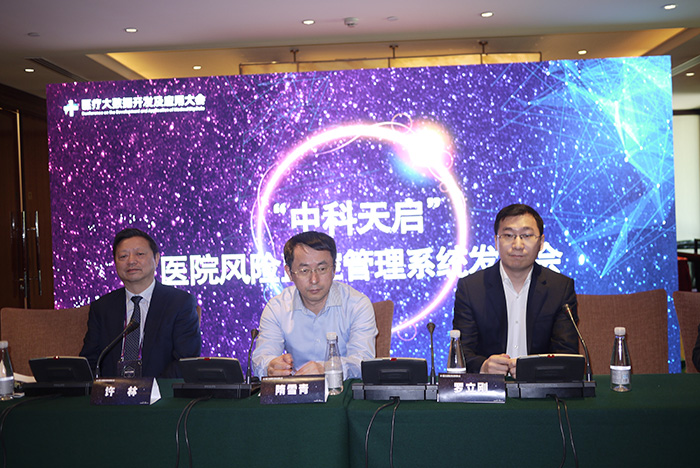
From left to right: Professor Lin Xu of Jiangsu Cancer Hospital, Professor Xueqing Sui, Director of the Intellectual Property Operation and Management Center of the Chinese Academy of Sciences, and Ligang Luo, Chief Technology Officer of LinkDoc Technology Co., Ltd.
On April 27, VCBeat attended the “Medical Big Data Development and Application Conference,” held in the Binhai New Area of Tianjin under the theme “Sharing, Interconnectivity, and Building a Community for Health and Medical Big Data.” At the event, Zhang Tianze, President of LinkDoc Technology; Liu Wei, Director of the Yantai Institute of Network Technology, Chinese Academy of Sciences (CAS), and Director of the Yantai Branch of the Institute of Computing Technology, CAS; She Lisha, Director of the Party Committee Publicity Office of Xiangya Hospital, Central South University; and Han Bingyue, Deputy Secretary of the Party Committee of Tianjin Medical University General Hospital, jointly launched the “Zhongke Tianqi” Hospital Risk Monitoring and Management System.
With the rapid development of the Internet, the landscape of public opinion has undergone constant and profound changes, enabling the public to express their views more freely through various channels. Under the new circumstances,Hospitals must also establish a sensitive, comprehensive system for collecting and responding to public opinion data. This system should timely and accurately gather useful information from various high-volume channels to monitor online public sentiment trends and assess the hospital’s standing within that discourse. Such capabilities enable early warning of potential issues, allowing for prompt corrective actions to mitigate negative online publicity, thereby providing data-driven support for departmental crisis communication and brand image marketing.To this end, LinkDoc Technology and the Yantai Branch of the Institute of Computing Technology, Chinese Academy of Sciences, have jointly developed the world’s first risk monitoring and management system for big data public opinion in healthcare institutions, following years of research and exploration.
“Zhongke Tianqi” Hospital Risk Monitoring and Management System, jointly developed by LinkDoc Technology and the Yantai Branch of the Institute of Computing Technology, Chinese Academy of Sciences, is the world’s first big data public opinion risk monitoring and management system tailored for healthcare institutions. It features multiple modules, including intelligent data collection, real-time monitoring, intelligent analysis, public opinion tracking, rapid early warning, and industry reporting. The system supports both PC and APP login modes, enabling continuous monitoring of big data public opinion risks in healthcare institutions anytime, anywhere.
Online public sentiment serves as the "skin" of a hospital, reflecting multiple dimensions of information such as hospital management, operational processes, and public satisfaction. Managing public sentiment has become a pain point for 74% of healthcare institutions. Leveraging advanced technologies from the Chinese Academy of Sciences and Zero Krueger Technology’s decade of experience in public sentiment management and brand communication, the "Zhongke Tianqi" system provides healthcare institutions with comprehensive and timely external big data. By deeply mining the value of public sentiment data, the system offers supportive insights for hospital management, enhancement of public satisfaction, and brand communication.
Following the conference, VCBeat interviewed Professor Xueqing Sui, Director of the Intellectual Property Operation and Management Center at the Chinese Academy of Sciences (and former Director of the Yantai Branch of the Institute of Computing Technology, CAS); Professor Lin Xu from Jiangsu Cancer Hospital; Lisha She, Director of the Publicity Office of the Party Committee at Xiangya Hospital of Central South University; and Ligang Luo, Chief Technology Officer of LinkDoc Technology Co., Ltd.
Luo Ligang, Chief Technology Officer of LinkDoc Technology, stated, “The public opinion monitoring system is part of LinkDoc’s big data strategy, leveraging big data and artificial intelligence technologies to serve physicians and benefit patients. LinkDoc’s big data strategy offers three core services: supporting management decision-making, facilitating scientific research, and assisting clinical practice. The ‘Zhongke Tianqi’ public opinion monitoring system falls under the category of supporting management decision-making.”
The “Zhongke Tianqi” system was jointly developed by LinkDoc Technology and the Chinese Academy of Sciences (CAS). It integrates external public opinion data into hospital management. CAS leverages its advantages in data crawling technologies and resources related to public sentiment, while LinkDoc, drawing on its deep understanding of medical data, embeds these insights into the overall healthcare information system to provide decision-support guidance for hospital administration. When making managerial decisions, hospital presidents and department directors require data support, including internal clinical and diagnostic data, patient satisfaction ratings for physicians, public evaluations of the hospital, and analytical data on the impact of specific events on the hospital.
Administrators from two hospitals already using the system have evaluated the “Zhongke Tianqi” Public Opinion Management System. Professor Xu Lin of Jiangsu Cancer Hospital stated, “LinkDoc’s products provide comprehensive support to hospitals in three areas: management systems, research systems, and clinical decision support for physicians.” The “Zhongke Tianqi” public opinion system serves as an auxiliary platform for hospital management. It generates weekly reports that monitor online public sentiment, including evaluations and reputational feedback on both the hospital and its physicians, while also enabling real-time tracking of any adverse information posted online. The management team at Jiangsu Cancer Hospital uses this system to objectively evaluate physicians and take necessary measures to address negative issues affecting the hospital.
She Lisha, Director of the Publicity Office of the Party Committee at Xiangya Hospital of Central South University, stated, “The public opinion management system enables hospitals to monitor online sentiment in real time, conduct scientific assessments on the same day, and respond promptly and proactively, thereby achieving ‘acute awareness’ and effectively promoting modern hospital management.”
About Zero Ke
LinkDoc is a global leader in artificial intelligence and medical big data platforms, dedicated to providing leading clinical data services and hospital brand management solutions to oncology specialty hospitals and comprehensive Grade 3A hospitals in China. Leveraging the power of medical big data, LinkDoc assists hospitals in addressing research and clinical challenges, empowering Chinese healthcare institutions and clinical experts to utilize advanced technologies such as big data analytics, machine learning, and artificial intelligence to mine and activate medical data. This enables smarter medical decision-making, ensuring that everyone has access to inclusive and precise healthcare services. For nearly a decade, LinkDoc Technology has been conducting big data-driven public opinion risk monitoring for healthcare institutions, accumulating thousands of cases and serving dozens of large Grade 3A hospitals across China, including West China Hospital of Sichuan University, Xiangya Hospital of Central South University, Jiangsu Province People’s Hospital, and Tianjin Medical University General Hospital, thereby establishing an authoritative position in the healthcare public opinion industry.
About the Institute of Computing Technology, Chinese Academy of Sciences
Institute of Computing Technology, Chinese Academy of Sciences, established in 1956, is China’s first academic institution dedicated to comprehensive research in computer science and technology. Network big data is one of its three flagship domains, undertaking critical missions such as national security and supporting the development of core national departments and major internet enterprises.