

Qingdao's Two Leading Hospitals Launch Watson-Powered Intelligent Oncology Centers
On April 27, two public Grade-A tertiary hospitals in Qingdao simultaneously introduced the Watson for Oncology artificial intelligence solution from Baiyang Smart Technology.Qingdao Municipal Hospital and the Affiliated Hospital of Qingdao University have respectively established the “Watson Intelligent Oncology Consultation Center” and the “Watson International Oncology Diagnosis and Treatment Center”, becoming one of the first hospitals in Qingdao and a leader in China to adopt this world’s most mature oncology solution, providing patients with optimal diagnostic and treatment plans.
VCBeat has learned that this marks Baiyang Intelligent Technology’s first major implementation in Chinese hospitals, following its signing of an exclusive three-year distribution agreement with IBM on March 28, 2017, for Watson for Oncology in the Chinese market. It is reported that Baiyang Intelligent Technology will soon announce a nationwide launch plan targeting all hospitals across China, with Watson for Oncology consultation centers expected to proliferate throughout the country by the end of the year.
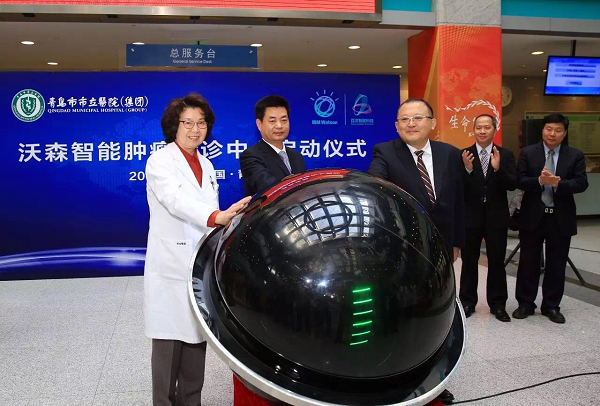
Launch Ceremony of the Watson Intelligent Oncology Consultation Center at Qingdao Municipal Hospital
Practice Verification: Watson for Oncology Is a “Capable Assistant to Physicians”
Watson for Oncology, leveraging its robust database and accumulated expertise, rapidly formulates leading, personalized, evidence-based cancer treatment plans. Its recommendations demonstrate over 90% concordance with those of world-renowned oncology experts, gradually establishing it as an essential intelligent assistant for oncologists.
Currently, Watson for Oncology has learned from a vast number of cancer cases from MSKCC and dozens of medical institutions in the United States, over 300 medical professional journals, more than 200 oncology monographs, over 15 million research papers, as well as cancer treatment guidelines based on NCCN and MSKCC’s clinical experience in cancer treatment in the United States over the past century.
“Watson” not only possesses the capability to access knowledge bases at high speed,the ability to rapidly and accurately extract key information, analyze large volumes of data, and distill them into critical “decision points”, to assist treating physicians in establishing evidence-based, patient-centered, individualized treatment plans.
First, “Watson” extracts keywords from the patient’s medical records and rapidly filters key data from vast datasets. It then generates multiple “personalized” treatment recommendations tailored to the patient. For each recommendation, it cites sources and supporting evidence, ranked by level of credibility, for the treating physician’s reference. Once a treatment plan is selected, Watson provides relevant information such as the number of cases using this regimen, survival rates, and incidence of adverse reactions, thereby assisting physicians in comprehensively evaluating the efficacy and risks of the chosen approach.
Currently, the diagnostic and therapeutic scope of “Watson” covers the treatment of lung cancer, breast cancer, rectal cancer, colon cancer, gastric cancer, and cervical cancer.
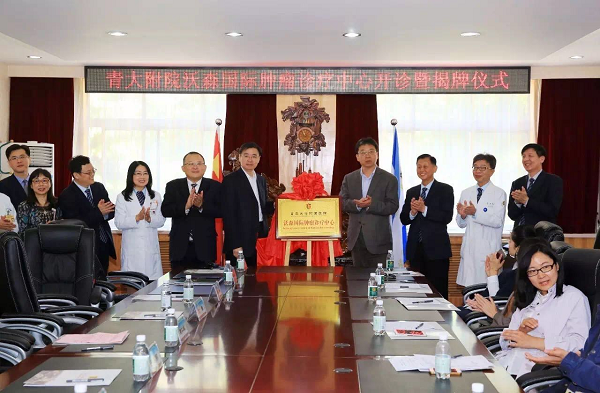
Unveiling Ceremony of the Watson International Oncology Diagnosis and Treatment Center, Affiliated Hospital of Qingdao University
VCBeat has learned that, at the launch ceremony, two hospitals each held an unveiling ceremony for their Tumor Consultation Centers. After undergoing preliminary training, medical staff at Qingdao Municipal Hospital tested the Watson system on dozens of tumor cases; meanwhile, a panel of experts discussed these cases and developed treatment plans. The hospital believes that by comparing and validating the treatment plans formulated by the expert panel against those recommended by the Watson system, it has been confirmed that the Watson system can provide reasonable treatment options and serve as a valuable supplement, thereby becoming a capable tool and assistant for medical specialists.
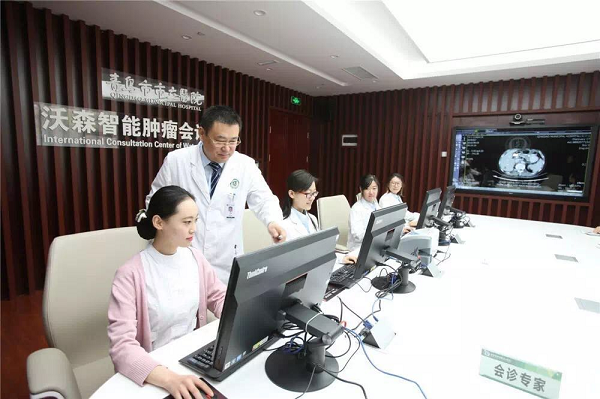
At the Affiliated Hospital of Qingdao University, the Watson International Oncology Diagnosis and Treatment Center, led by Professor Zhang Xiaochun—Vice President of the Qingdao University Medical Group, a Taishan Scholar Distinguished Overseas Expert, and a Senior Scientist at the University of Texas MD Anderson Cancer Center—admitted its first two oncology patients. After reviewing the patients’ medical histories, Professor Zhang transmitted key clinical data to “Watson.” Following a brief search, “Watson” presented preliminary diagnostic and treatment plans for the patients.From the doctor’s input to Watson’s output, it took only a few seconds.. Although Watson is highly intelligent, it serves merely as a capable assistant to physicians, with the final decision resting solely with the doctor.
Fu Gang, Chairman of Baiyang Pharmaceutical Group, stated, “Watson for Oncology serves as an assistant to physicians in treatment and is currently the only artificial intelligence tool worldwide that has reached application-level maturity. By inputting more than 20 test results from a patient, the system generates recommended treatment plans, lists contraindicated options, and provides recommendations from top global oncology teams along with evidence-based medical data. This will be highly beneficial to clinical decision-making. The Watson for Oncology solution will significantly enhance physicians’ professional standards and capabilities.”
The Gap in Oncology Treatment Between China and the United States Is Continuously Narrowing
According to data from the National Cancer Center of China and the U.S. National Cancer Institute, significant disparities remain in cancer diagnosis and treatment between China and the United States.In 2015, the 5-year survival rate for cancer patients in the United States was as high as 67%, whereas in China it was only 37%.Moreover, 38% of cancer patients in the United States are diagnosed at an early stage, whereas only 10% of patients in China are diagnosed at an early stage.
The United States boasts top-tier medical resources, expert oncology teams, and a wealth of accumulated cancer treatment cases, from which Watson for Oncology has emerged. The maturation and widespread adoption of the Watson for Oncology solution have undoubtedly narrowed the gap in cancer care across countries.
Xuan Shiying, President of the Municipal Hospital, also believes that the hospital’s efforts in recent years to establish internationalized clinical standards and medical culture, along with its internet-based information platform, have provided a mature foundation for the deployment of “Watson.”The Municipal Hospital Will Play a Leading Role in the Localization and Popularization of Medical Artificial Intelligence"The introduction of Watson for Oncology enables patients to access optimal diagnostic and treatment recommendations for cancer based on global big data, thereby receiving internationally benchmarked, precise, and personalized oncology treatment plans. 'Stay at home while staying in sync with the world.'"
Zhang Xiaochun, Vice President of the Affiliated Hospital of Qingdao University, stated, “Through the Watson International Oncology Diagnosis and Treatment Center, the hospital can integrate authoritative international multidisciplinary consultations and provide intelligent medical support for oncology diagnosis and treatment decision-making services;Provide patients with standardized, precise, and personalized treatment plans to avoid misdiagnosis and overtreatment, significantly improving outcomes."The introduction of Watson for Oncology will bring the world’s most advanced cancer treatment cases, enabling hospitals to utilize these cases for teaching and research, significantly enhancing physicians’ knowledge and clinical capabilities, and aligning with international best practices."
Fu Gang believes that, based on current clinical data from China and the United States, cancer is a major disease threatening human life. Many patients in second- and third-tier cities in China, upon diagnosis, lack confidence in the diagnostic and treatment capabilities of local hospitals and often choose to seek care in first-tier cities or even abroad.
The introduction of Watson for Oncology is equivalent to adding top-tier U.S. physicians to the consultation centers of local hospitals., providing evidence-based, personalized, and accurate treatment plans tailored to patients' conditions can reduce redundant examinations, overtreatment, and mismanagement, enabling more patients to receive precise and timely care close to home.。
Globally, many medical institutions have adopted the Watson for Oncology solution. In addition to Memorial Sloan Kettering Cancer Center, adopters include Bumrungrad International Hospital, Gachon University Gil Medical Center and Pusan National University Hospital in South Korea, and 16 Manipal Hospitals in India. As the management capabilities of Chinese hospital administrators continue to improve, the Watson for Oncology solution is expected to be deployed in more hospitals across China, significantly enhancing the standard of oncology care in the country and narrowing the gap between China and the United States.
Meanwhile, Watson for Oncology covers an increasingly broad range of cancers, currently encompassing the treatment of lung cancer, breast cancer, rectal cancer, colon cancer, gastric cancer, and cervical cancer.It is expected that the service will expand to cover 8–12 cancer types in 2017, enabling more patients to benefit from it in the future.