

Putian Pharmaceutical & Medical Device Network Files IPO Prospectus, Targeting $1.4B+ B2B Market for Private Hospitals
When it comes to pharmaceutical e-commerce, many people immediately think of online pharmacies catering to individual consumers, such as Tmall Health, 111.com.cn, and Jianke.com. In contrast, B2B pharmaceutical e-commerce receives less exposure and rarely appears in the public eye. However, in terms of transaction volume, market potential, and impact on pharmaceutical distribution channels, B2B pharmaceutical e-commerce may be even more significant.
VCBeat (WeChat ID: vcbeat) has previously published a series of reports on B2B pharmaceutical e-commerce platforms, including Yaodou.com, Yaoyaohao, Drug Terminal Network, and My Medicine. These platforms primarily target retail pharmacies and clinics. In this article, we interviewed Putian Pharmaceutical & Medical Device Network, a company specializing in online procurement of pharmaceuticals and medical devices for private hospitals, to discuss the intricacies of procurement in the private hospital sector.
Private Hospitals and Public Hospitals Have Significant Differences in Procurement
“There are significant differences in procurement practices between private and public hospitals. The most apparent distinction is that procurement in public hospitals is led by regulatory authorities, such as health regulators, medical insurance payment departments, and drug bidding agencies; this can be summarized as a separation between the purchasers and the end users. In contrast, private hospitals have unified payers and users, with the hospital serving as both the entity responsible for procurement payments and the end user.”
Wu Xidong, President of Putian Pharmaceutical and Medical Device Network, believes that while the procurement processes of public hospitals are highly standardized, they lack sufficient competition. Centralized tendering and procurement involve price negotiations conducted on an annual or multi-year basis, resulting in insufficient flexibility. In contrast, private hospitals enjoy greater autonomy in procurement, adopt more market-oriented purchasing methods, and can adjust procurement cycles according to demand.

Wu Xidong, President of Putian Pharmaceutical and Medical Device Network
He elaborated that the operating costs of private healthcare institutions encompass various aspects, including procurement, human resources, and investment costs. Procurement costs constitute a significant proportion of these expenses. As other costs continue to rise without any decrease, controlling procurement costs has become a critical lever for managing overall operating expenses in the private healthcare sector, reflecting an urgent need.
Furthermore, Wu Xidong highlighted another phenomenon. During the use of pharmaceuticals and medical devices in public hospitals, there is a misalignment of interests among various stakeholders. After drugs are included in the centralized procurement catalog, physicians determine prescriptions, hospital pharmacies aggregate prescription data, and nursing staff provide ancillary support. Pharmaceutical companies, driven by sales targets, often manipulate these processes. Consequently, what ultimately prevails is not the clinical value of the medications, but rather the vested interests of the personnel involved.
Private hospitals do not face the misalignment of interests among these parties; the interests of the hospital and its physicians are aligned. It is precisely for this reason that private hospitals have a stronger expectation for transparent and open procurement processes.
“Sunshine procurement—a concept we proposed six years ago and which has gained recognition within the public healthcare system—has been implemented in the recent comprehensive reforms of urban public hospitals in Beijing, Shanghai, Guangdong, and Shenzhen.”
According to Wu Xidong, transparent procurement of pharmaceuticals and medical devices leverages market-based mechanisms to address information asymmetry, lack of process transparency, and insufficient competition inherent in traditional hospital procurement practices.
“We have established a procurement platform for private healthcare, providing one-stop transaction services, financial services, and big data services to suppliers, purchasers, logistics and distribution companies, financial institutions, and other stakeholders. The platform comprises a transparent procurement module, a tendering and negotiation module, a government regulatory module, a pharmaceutical big data module, and a financial services module. We are currently the only comprehensive public service platform capable of delivering 24/7 operations.”
Wu Xidong positions Putian Pharmaceutical and Medical Device Network as a public service platform for the health industry, initiating services with procurement for private hospitals while also facilitating online procurement for public hospitals. Through its framework design and process control, the platform helps hospitals reduce costs and improve efficiency in their procurement operations.
In-Depth Analysis of Putian Pharmaceutical and Medical Device Network
Putian Pharmaceutical and Medical Device Network was established in late 2014 and has deep ties with the Putian (China) General Association of Health Industry. Wu Xidong himself serves as the Executive Vice Chairman of the association. Other senior leaders of the association, including Executive Vice Chairmen Su Qingcan, Chen Guoxing, and Lin Yuming; Executive Deputy Supervisors Liu Yayong and Lin Changqing; and Vice Chairman Ke Xiangqian, all appear on the shareholder list of the company registered under Putian Pharmaceutical and Medical Device Network. Zhan Yangbin, the Executive President of the association, serves as the Chairman of Putian Pharmaceutical and Medical Device Network.
The Putian (China) Health Industry Association was officially established in June 2014, with its headquarters located in Beijing. It has set up branches in 31 provinces and municipalities across China, categorized by region and specialty. Its purpose is to “integrate and optimize resources, curb vicious competition, advocate standardized operations, and enhance professional management and operational standards.” At the time of its establishment, the Health Industry Association claimed it would be the world’s largest alliance organization in the health industry, boasting over 8,600 private hospital members nationwide, an annual turnover reaching RMB 260 billion, and providing more than one million jobs for medical personnel.
Putian Pharmaceutical and Medical Device Network’s push into the B2B e-commerce sector for pharmaceuticals and medical devices in private hospitals is not unrelated to this background.
In February 2015, Putian Pharmaceutical and Medical Device Network was officially launched. In August of the same year, the website officially obtained the “Certificate for Internet Drug Transaction Services,” becoming the first such Class A national certificate issued in Fujian Province and the 17th in China.
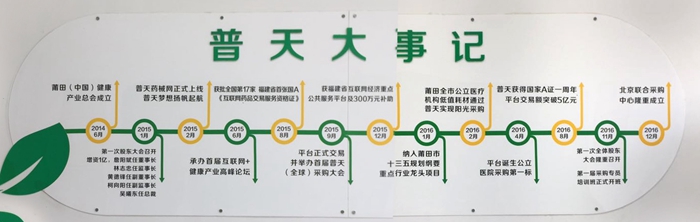
Putian Pharmaceutical and Medical Device Network: Key Development Milestones
Wu Xidong introduced to VCBeat that Putian Pharmaceutical and Medical Device Network is committed to building a public service platform for the pharmaceutical and medical device supply chain and industrial informatization, aiming to integrate the information flow, capital flow, document flow, logistics, and commercial flow of the pharmaceutical supply chain to achieve the integration of these five flows.
The platform provides access via both PC and mobile app interfaces, is designed on a SaaS model, supports enterprise-level customization, enables comprehensive site-wide data auditing, and facilitates high-volume data interactions along with real-time big data analytics. Based on this architecture, its core features are as follows:
(1) Functions of Pharmaceutical Bidding and Transparent Procurement Services
The platform provides government agencies with a one-stop, secure, and convenient bidding service that integrates project posting, product registration, automated scoring, expert review, online bidding, bid award announcement, delivery application, and procurement organization. Built on supply chain management principles, the Sunshine Procurement Platform effectively integrates information flow, logistics, documentation flow, commercial flow, and capital flow to achieve a rapid, transparent, and end-to-end pharmaceutical supply chain system, facilitating resource sharing and mutual benefit among upstream and downstream enterprises. It supports multi-dimensional statistical analysis for hospitals and ensures the security and legality of transactions through technologies such as electronic digital signatures on transaction contracts and electronic data preservation.
(II) Financial Settlement and Service Functions
The platform provides comprehensive solutions for procurement fund settlement, order financing, credit-based procurement, installment payments, automatic deductions from medical insurance accounts, and equipment financial leasing. Additionally, through integration with bank-enterprise connectivity, it enables functionalities such as automatic reconciliation, gateway payments, secured transactions, and automated disbursements.
(3) Big Data Services in the Pharmaceutical Industry
By selecting and organizing pharmaceutical product order data, the platform establishes a public product repository, greatly facilitating enterprises’ online listing and distribution applications. A big data warehouse is built based on platform-wide product and order data. Through scientific big data analytics, the platform guides product manufacturing, clinical utilization, and market pricing, while disclosing suppliers’ service quality, thereby effectively enhancing the efficiency of enterprise product promotion and hospital operational performance.
(4) Industry Supervision and Government Regulatory Functions
The platform establishes pharmaceutical distribution regulatory accounts for various government departments, enabling the supervision and dynamic analysis of healthcare industry data to provide data-driven support for governmental decision-making. All processes—including procurement entities, sales enterprises, product quality, order data, and bidding—are retained on the platform in digital form, allowing regulatory authorities to access and review them at any time.
1 Billion in Transaction Volume Marks a New Starting Point
According to Wu Xidong, during its two years of operation, Putian Pharmaceutical and Medical Device Network has communicated with more than 30,000 suppliers, participated in 18 major domestic pharmaceutical and medical device expos, and received nearly 2,500 visits from manufacturers. The platform has onboarded 3,245 purchasers (including medical group companies, hospitals, pharmacies, and clinics) and 3,809 suppliers, with 160,000 products listed. As of January 2017, the platform’s total transaction volume exceeded RMB 1 billion.
In addition to providing comprehensive coverage of the private healthcare sector, Putian Pharmaceutical and Medical Device Network has also actively participated in centralized procurement for public hospitals, earning recognition from the Putian Municipal Government and the health and family planning authorities. Over the past year, the platform completed, in phases, the centralized procurement of low-value medical consumables for three batches of public medical institutions in Putian City.
The first batch of centralized procurement of medical disinfectants for public hospitals saw 24 companies shortlisted, with 191 valid product specifications and 24 winning specifications; the overall prices decreased by 19% compared to the provincial tender prices in 2008. The second batch of centralized procurement of hemodialysis consumables for public hospitals had 42 companies shortlisted, with overall prices decreasing by 21.7% compared to the provincial tender prices in 2008, among which the highest price reduction for a single variety reached 51.1%. The third batch of low-value medical consumables (precision infusion sets, indwelling needles, hemostatic gauze, anesthesia kits, and infusion pumps) included 116 winning products, with an average price decrease of 18.46% compared to the procurement prices of similar manufacturers and specifications currently in use.
“Practice from three rounds of centralized procurement and sunshine online listing procurement of medical consumables has demonstrated that the Putian Pharmaceutical and Medical Device Network Platform has initially acquired the capability to provide centralized procurement services for public hospitals, and is able to enhance procurement efficiency and reduce procurement costs for public medical institutions across the province.”
Wu Xidong stated to VCBeat that there are still many aspects of the distribution of pharmaceuticals, medical devices, and consumables that can be transformed through internet-based approaches. Eliminating distribution costs reduces end-user expenditures, which holds significant value for both public and private hospitals.
Where Are the Opportunities in B2B E-commerce for Pharmaceuticals and Medical Devices?
From the perspective of the entire pharmaceutical industry chain, pharmaceutical e-commerce has entered a period of explosive growth this year. Favorable factors, including policy support, strong industry enthusiasm, and strengthened end-user demand, have ushered in the optimal window for development in pharmaceutical e-commerce.
From a policy perspective, the State Council recently abolished the review process for Class B and Class C licenses in pharmaceutical e-commerce, lowering entry barriers and further liberalizing the sector. From an industry standpoint, under the influence of policies such as the replacement of business tax with value-added tax (VAT) and the Two-Invoice System, pharmaceutical and medical device companies need to restructure their distribution channels, making pharmaceutical e-commerce their primary choice. From the demand side, retail pharmacies, primary care clinics, private hospitals, and other entities have directly experienced the benefits of information symmetry and pricing negotiation power through procurement via these platforms, thereby enhancing their willingness to purchase online.
It is precisely for this reason that pharmaceutical e-commerce startups have emerged in abundance. These include online trading platforms for traditional Chinese medicinal materials, self-built websites by pharmaceutical and medical device manufacturers or distributors, third-party platforms for pharmaceutical and medical device distribution, online pharmacies targeting end-users, and O2O medicine delivery services. Furthermore, with mobile health and internet healthcare ventures entering the pharmaceutical and medical device distribution sector, the pharmaceutical e-commerce landscape has temporarily taken on a vibrant character of “a hundred flowers blooming and a hundred schools of thought contending.”
Prior to the abolition of the Class B and Class C licenses for pharmaceutical e-commerce, data from the China Food and Drug Administration (CFDA) showed that there were 40 companies with Class A licenses, 195 with Class B licenses, and 598 with Class C licenses, a distribution that essentially encapsulates the full competitive landscape of the industry.
According to market statistics from the Ministry of Commerce, the overall market size of pharmaceutical e-commerce in China reached approximately RMB 120 billion in 2016, with B2B transactions accounting for more than 90%. The conventional pharmaceutical e-commerce sector (B2C) had a market size of less than RMB 20 billion.
From the perspective of industry development, it is widely believed that the persistent challenge constraining the growth of pharmaceutical e-commerce is profitability. The B2B model facilitates volume scaling but yields lower profit margins; meanwhile, the B2C market is relatively smaller in scale and faces challenges such as price competition and low consumer trust. (In fact, the primary source of profitability for most B2C pharmaceutical e-commerce platforms comes from non-pharmaceutical products, including medical devices, health supplements, and adult products.)
For any industry, there is a set of key competitive factors. Specifically, in the pharmaceutical and medical device distribution sector, these include supply chain, pricing, technology, warehousing and distribution, logistics, channels, end-user demand, and services. Companies that better align with these competitive factors are more likely to gain market recognition and emerge as “unicorns” within the industry.
For pharmaceutical e-commerce enterprises such as Putian Pharmaceutical and Medical Device Network, which primarily serve private healthcare institutions, it is particularly crucial to accurately identify and address their pain points. VCBeat’s analysis suggests that the procurement pain points of private healthcare institutions are mainly concentrated in two aspects: First, because their procurement activities do not directly interface with pharmaceutical and medical device manufacturers but instead go through multiple tiers of distributors, they lack visibility into supply information, leading to passivity in procurement decision-making. Second, due to fragmented procurement units and small order volumes, these institutions lack bargaining power in procurement, resulting in high procurement costs.
These issues can be largely addressed through third-party procurement platforms for pharmaceutical e-commerce. First, pharmaceutical and medical device companies can directly publish product information on the website, thereby avoiding distortion caused by multi-tiered dissemination. Second, decentralized procurement activities can be centralized via the platform, which inherently leverages volume to negotiate lower prices.
Of course, serving only the purchasers would certainly be biased. However, from a different perspective, the above two points also represent optimal solutions to the pain points faced by industrial enterprises. Under the influence of policies such as the replacement of business tax with value-added tax (VAT) and the “two-invoice system,” traditional channels used by pharmaceutical and medical device companies, such as individual agent representations, have collapsed. There is an urgent need to extend product distribution through new channels reaching private medical institutions. Third-party pharmaceutical e-commerce platforms can fill this channel gap, while ensuring compliance in cost structures through consulting fees, service fees, and other legitimate means. On the other hand, terminal sales data, which is highly valued by pharmaceutical and medical device companies, was difficult to obtain or incomplete under the previous multi-tiered distribution systems. With digitalization, the process of collecting and processing such data has become simpler, thereby supporting decision-making in pharmaceutical and medical device production.
In summary, third-party e-commerce platforms for pharmaceuticals and medical devices have vast market potential. By effectively bridging the supply and demand sides and empowering stakeholders, these platforms could become a significant distribution channel parallel to offline channels.