

Miao Health: Building an Intelligent Hardware and Health Big Data Ecosystem through Retail 4.0
Miao Health and Hongtu Brookstone’s first health zone officially opened for business in the early winter of 2016 at the Nanjing Qingliangmen Store. This was China’s first scenario-based experience store dedicated to smart hardware for health management.Novel and Distinct from Conventional Electronics Malls, which forms people's first impression, has attracted numerous individuals to try out various health device products.
Since the inaugural year of the smart hardware boom in 2014, the market has gradually cooled and matured. VCBeat (WeChat: vcbeat) has observed that after repeatedly driving smart hardware to peak popularity, people have begun to express pessimism once again. Take the United States as an example: many stock analysts alternately disparage Fitbit, predicting that sales of its fitness and health devices will continue to decline and that it will soon become a junk stock; at other times, they speak favorably of its increasingly fashionable and functional products, arguing that Fitbit is merely experiencing a temporary downturn.
In China, the smart health hardware industry is still in its infancy, yet its emerging potential cannot be underestimated. Withings, a French boutique smart health hardware company (now part of Nokia), has stated that China represents a major market for them, accounting for double-digit sales percentages. However, at present,In China’s health-focused smart hardware market, brands, distribution channels, and the entire health data ecosystem have yet to establish long-term feedback loops, while trends in fitness and nutritional supplements are still in their early stages of emergence.。
Transformation: Retail 4.0, Building an "Experience-First" Approach for Smart Hardware
As the era of Retail 4.0 dawns, industries across the board are joining this major trend. For smart health hardware, such changes can represent either a forced adaptation to keep pace with the times or a proactive embrace of emerging challenges and opportunities.
Currently, internet marketing costs are gradually rising, making online sales of smart hardware increasingly difficult. Furthermore, a fundamental drawback of online sales is the inability to generate purchase impulse through first-hand experience. For health-related smart hardware products, which heavily rely on user experience,Creating “immersive experiences” and winning over consumers through in-person, tangible interactions is gaining widespread acclaim.。
Therefore, the O+O model of “online traffic acquisition and offline marketing” has become a better choice. However, the challenge lies in the fact that some smart hardware manufacturers lack the resources and capacity to establish offline distribution channels. In this regard, we learned from More Health that they are working to break through this bottleneck. Smart hardware manufacturers integrated into its ecosystem will be able to leverage More Health’s robust offline channel resources.
In collaboration with Sanpower Group’s retail resources, including Leye Communications and Hiteker 3C, Miao Health will gradually establish “Miao Health Offline Health Experience Zones” in more than 3,000 offline stores across China. Currently, hundreds of smart hardware devices are available for experience and purchase, along with services such as rapid health check-ups. The company is also expanding its presence beyond Sanpower Group’s retail network; telecommunications operators like China Telecom and China Unicom have expressed interest in cooperation, aiming to introduce health zones into their offline business halls.
It is reported that on April 11, when Miao Health was invited to exhibit at China Telecom Jiangsu Company’s 2017 All-Netcom Partner Summit and Spring Ordering Fair, its booth received a steady stream of cooperation inquiries, with frequent questions regarding franchise agency opportunities and the integration of hardware products.
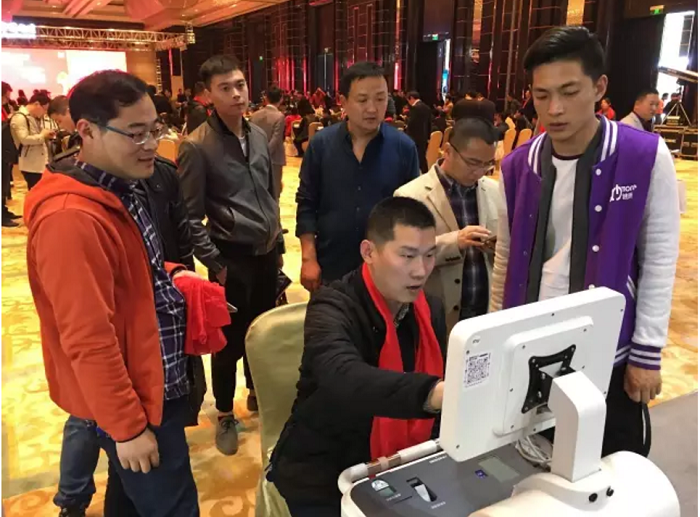
At the 2017 China Telecom Jiangsu Company All-Netcom Partner Summit, Miao Health Products Were Highly Acclaimed
Connectivity: Health Data Transforms “Hardware Clusters” into an “Ecosystem”
If the collaboration between smart device manufacturers and Miao Health is merely characterized as a relationship where one party provides products while the other offers platforms and retail outlets, then it falls far short of constituting a true “ecosystem” for smart health. An analysis of its business model reveals thatAt its core lies the underlying data integration platform—Miao+.“The platform is specifically designed to integrate various smart devices. By leveraging multi-channel data sources, it aims to build a big health data ecosystem, enabling users to establish more comprehensive health records through a variety of smart hardware products from different brands and categories,” said a representative from Miao Health in an interview.
After using Miao Health’s smart hardware to measure various indicators, users can instantly view the test results upon opening the app. For instance, in the Miao Health Zone, individuals can use large-scale all-in-one health screening kiosks to simultaneously measure dozens of health-related metrics, including height, weight, body temperature, body fat percentage, blood pressure, blood glucose, heart rate, blood oxygen saturation, uric acid, and cholesterol. These data points are instantly synchronized and displayed on the Miao Health app.
By integrating with the Miao+ platform, independent health-focused smart hardware from various manufacturers is truly “brought into” a unified ecosystem, rather than remaining perpetually isolated in a “one device, one app” paradigm. The vast amounts of health big data generated by these numerous smart devices will unlock greater possibilities for future health management, which constitutes the true value of intelligent health hardware.
The model of leveraging data interoperability to build “app ecosystems,” “smart hardware ecosystems,” and even “smart voice ecosystems” is gaining significant momentum. Apple’s HealthKit, ResearchKit, and CareKit aim to encourage the development of more healthcare and medical applications within its ecosystem by opening up data access. Meanwhile, Amazon’s Alexa AI voice assistant is opening its platform to various types of smart home devices, integrating them into its voice-interaction ecosystem. Moreover, Alexa has now “ventured into healthcare,” with health- and medical-related smart voice features already embedded in certain devices.
The aforementioned enterprises have gained access to more population health information during data flows, thereby enabling real-time feedback.On the one hand, it enables the identification of areas for improvement from population health data; on the other hand, it helps enterprises uncover opportunities and issues.
As for Miao Health, it is also exploring how to more effectively leverage health data from its rapidly expanding ecosystem to uncover deeper value. Currently, Miao Health is engaged in the following initiatives:Leveraging Artificial Intelligence for More Efficient Data Mining, enabling users of smart devices to gain a more data-driven and visualized understanding of their health status, and facilitating health behavior management through personalized behavioral guidance. This opens up a new “AI+” pathway for mobile health management.
Development: All for Better Health Management
On the consumer side, integrating health management into people’s daily habits is an even greater challenge.Adopting gamified, reward-based approaches to enhance user stickiness has become a more accessible and effective strategy.
Miao Health’s approach involves delivering health interventions to users through a gamified points system within its app, while further promoting its concept of entertainment-based health management through offline experience stores. Users satisfy their curiosity about their own health status using engaging devices and then leverage game-like mobile applications to help achieve their health goals.
Just in mid-April, the company completedRMB 250 Million Series B Financing, jointly invested by Citic Capital and Abc Wuxi Equity Investment Fund. This financing will help More Health expand the number of smart hardware devices integrated into Miao+, enhance the output capabilities of the Miao+ SDK, and optimize its proprietary Health Behavior Index (M-Value) algorithm.

From scenario-based marketing in Retail 4.0 to gamified operations, the ultimate goal is to enhance user health management through superior experiences. Within the ecosystem being built by Miao Health, a mutually beneficial and win-win relationship is taking shape among users, smart hardware manufacturers, and big data stakeholders.The journey to explore smart health hardware remains long and arduous. This company has already developed its own unique approach to forging a path for industrial upgrading, while continuing to strive tirelessly for further breakthroughs.