

How Artificial Intelligence Creates Value Across Healthcare, Insurance, and Investment Sectors
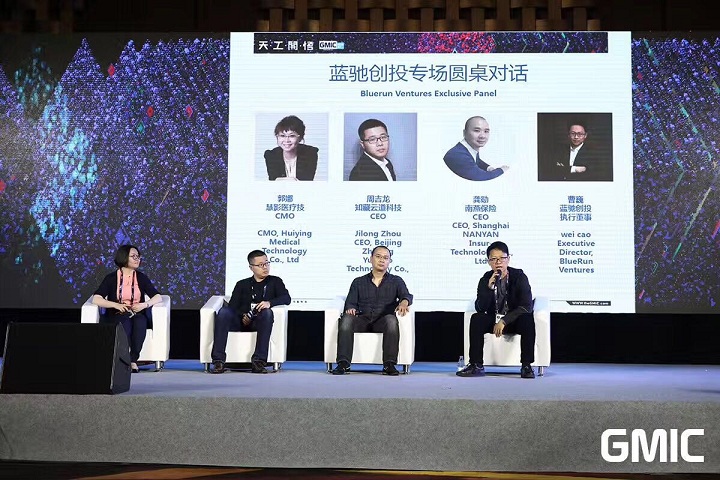
The GMIC 2017 Beijing Conference kicked off from April 27 to May 1. Compared with previous editions, the GMIC 2017 Beijing Conference saw participation from numerous top scientists worldwide. As an invited media outlet, VCBeat had the honor of attending the GMIC Global Investment Ecosystem Summit.
Despite the AI hype, capital markets have remained hesitant to make bold moves. In response, BlueRun Ventures has kicked off its major AI investment initiative. VCBeat provided comprehensive coverage of the Global Investment Ecosystem Summit – BlueRun Ventures Special Session. Below is a curated summary of key insights from the onsite roundtable discussion.
Moderator: Cao Wei (Executive Director, BlueRun Ventures);
Guest:
Zhou Jilong (Chief Executive Officer, Beijing Zhicang Yundao Technology Co., Ltd.);
Gong Xun (CEO, Shanghai Nanyan Information Technology Co., Ltd.);
Guo Na (CMO, Huiying Medical Technology (Beijing) Co., Ltd.).
Cao Wei:BlueRun Ventures believes that AI is merely a label and a means to an end. The ultimate goal remains centered on cloud computing, in-depth data analysis, and AI-driven business models to address commercial scenarios and solve problems within the smallest viable loop that delivers commercial value. Indeed, defining and solving problems is the essence of our overall strategic direction. This process may involve numerous iterations in models and algorithms, as well as the unleashing of new innovative capabilities by various stakeholders and research institutions.
Gong Xun:Nanyan Insurance operates on a cloud-based PaaS platform, driving the industry-wide adoption of SaaS and leveraging big data technologies to design insurance products.
From the very beginning, we built our strategy around the concept of big data. This is because insurance is inherently a big-data-driven industry; areas such as underwriting, actuarial science, claims processing, and product design are all closely integrated with big data.
From the perspective of big data and AI, product design revolves around how to assign tags and deliver a superior customer experience.What are the corresponding claims costs generated by high-risk projects? Nan Yan has conducted countless estimates on this matter.
Zhou Jilong:Zhizang specializes in enterprise intelligent decision-making. By leveraging models and algorithms, it enables computers to more intelligently assist businesses in making commercial decisions. Efforts in this area began quite early, when such approaches were referred to as intelligent models.
Solving problems through models encompasses concepts from machine learning, reinforcement learning, and deep learning. We undertake this initiative because we observe that throughout the developmental stages spanning cloud computing to big data and then to artificial intelligence, data continues to grow in abundance while computational power keeps strengthening.
It is precisely due to the significant breakthroughs in algorithms that we have witnessed a wide array of application scenarios across various enterprises, where efficiency can be enhanced through algorithmic support.
For the enterprise service side, what artificial intelligence needs is AI scientists combined with strong sales capabilities.From our perspective, there is a missing link in the scenario of serving enterprises: the consultant. It requires someone who can deeply understand business models, extract solutions from these models, comprehend algorithms, and interface with them, ultimately enabling the creation of high-quality AI products.
Guo Na:Medical imaging inherently possesses internet-ready characteristics, lends itself to SaaS-based applications, and its data holds immense mineable value that can be unlocked through artificial intelligence to create new value.
Over the past two years, Huiyi Huiying has completed a comprehensive closed-loop ecosystem, spanning from underlying SaaS infrastructure to medical services, and ultimately to value generation through medical data modeling.
Currently, there are more than 400 intelligent networks spanning from Grade IIIA hospitals to Grade IIA hospitals and primary care institutions across China. Within this network, we aim to empower healthcare through data-driven approaches.
Over the next 5 to 10 years, the path of development will need to address challenges on two dimensions:First, dual innovation in both technology and business models is required, necessitating a transformation of the entire business environment. Second, entrepreneurs must repeatedly reflect on and refine their strategies to determine in which scenarios commercial value can be generated and the value of technology effectively amplified, rather than relying solely on an algorithm.。
Guo Na:The healthcare industry is transitioning from the IT era to the DT (Data Technology) era. In this process, all systems are being restructured. During the IT era, the value of IT in healthcare was very limited. Oracle could sell a software suite for hundreds of millions of dollars, whereas a healthcare system costing several hundred thousand to even one million yuan would be considered a significant investment. This indicates that IT systems did not become part of the core KPIs in healthcare. The two most critical aspects of healthcare are diagnosis and treatment. IT systems, at best, addressed issues related to informatization.
The primary capability of a hospital lies in providing medical care to patients. However, hospitals have limited means to unlock the value of their data. Therefore, there is a need for companies to offer comprehensive solutions. Professionals with a medical background far outnumber those with an internet background or expertise in algorithms. Hence,We can engage in logical communication with doctors, rather than simply selling products.。
Zhou Jilong:The biggest challenge for enterprises is that stakeholders are increasingly immune to hype and demand tangible value. However, enterprise clients often lack clarity regarding their own needs.Moreover, customer needs are often quite basic.. For instance, in the marketing domain, the goal is to improve conversion rates by achieving higher returns with lower investment. In logistics, the aim is to increase gross profit margins while reducing costs. This necessitates consultants to help clients propose solutions.
Gong Xun:Insurance companies are often subject to stringent regulation, yet their core systems may have been established 15–20 years ago and are significantly outdated. Consequently, there are abundant opportunities for startups.
Insurance companies seek quality premiums, yet most insurers in the market are blindly pursuing volume. Nanyan’s entrepreneurial approach enters this market through a SaaS model, establishing a distribution system that rapidly delivers volume to the market. As an information platform, Nanyan can seamlessly integrate the separate regulatory frameworks for property and casualty insurance and life insurance at the back-end with minimal investment.
Zhou Jilong:In China, apart from the internet and TMT sectors, IT systems and the underlying data infrastructure are extremely weak. In the most challenging scenarios, even basic data platforms are absent.
Overall,I believe that the establishment of an enterprise data platform and the application of models are two parallel tracks advancing simultaneously; building the necessary infrastructure still requires a certain amount of time.。
It is advisable to start by experimenting with specialized vertical domains that offer relatively high data richness, where models and algorithms can be deployed on existing data infrastructure. This encompasses two scenarios: one where external data is comprehensive, and another where the reliance on external data is minimal, allowing internal data to suffice.
Guo Na:Big data does not necessarily imply a large volume of data. Medical patient data is time-series in nature, spanning the entire timeline from disease onset through ongoing treatment and medication, to eventual recovery after one year; it is fundamentally a temporal concept.
Data across the time dimension is also valuable.
For entrepreneurs, certain types of data are relatively easy to collect. For instance, Huiyi Huiying has accumulated medical imaging data from over one million patients and more than four million cases over the past two years.
Thanks to the standardization of medical imaging formats and interfaces, data from all hospitals and devices are relatively uniform. This is one dimension where we focus on improving efficiency. For instance, X-rays and CT scans can both be interpreted by computers.
Second, the truly significant transformation that this wave of big data brings to healthcare is that when a person falls ill, it is not merely manifested as a tumor; rather, there are underlying genetic mutations and additional pathological data involved. The true direction of big data’s transformative impact on healthcare lies in whether multi-dimensional data—including genetic mutations and pathological findings—can be integrated into comprehensive modeling to generate robust predictive models through computational analysis. This process requires the integration of various hospital information systems, which presents considerable challenges.
Gong Xun:In the health insurance sector, certain front-end data are simply unobtainable. What is the solution? Our profound insight is that we should leverage mature or readily available market information sources across the extensive transaction chain, utilizing them to deepen our understanding and extract valuable insights.
Cao Wei:From BlueRun’s perspective, we firmly believe that the transformation of traditional industries by AI is only just beginning to enter its initial phase of change. While capital markets are inevitably subject to fluctuations in sentiment, we are currently witnessing a significant influx of investment and a surge of new startups entering the space.
However, we firmly believe that the true path to success lies in addressing a highly specific, acute need and then continuously expanding your customer base by iterating through the smallest viable business loop. After all, the AI solutions developed by the three of us here are centered on enterprises—specifically, enhancing efficiency within vertical industries and serving both businesses and their end customers. By clearly defining problems, delivering effective solutions, validating the business model, and sustaining iterative growth, we consider this approach to be the most solid and sustainable strategy for long-term success.