

National Medical Consortium Alliance — China's 'National Team' for Healthcare Integration — Files IPO Prospectus
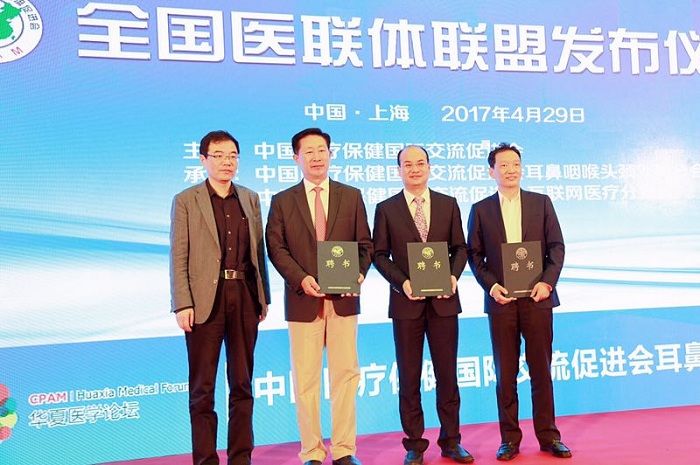
On April 29, the National Medical Consortium Alliance was established in Shanghai, initiated by the China International Exchange and Promotive Association for Medical and Health Care and jointly participated in by one hundred hospitals and industrial institutions across China. This marks the first open medical consortium platform in China established by an industry association in collaboration with medical and industrial institutions, under the guidance of the National Health and Family Planning Commission, just two days after the General Office of the State Council issued the “Guiding Opinions on Advancing the Construction and Development of Medical Consortia.”
With Support from 100 Hospitals, the “National Team” of Medical Consortiums Is Born
As the “main force” and “national team” of medical consortia, the China Medical Consortium Alliance will promote the development of specialty alliances within medical consortia, thereby driving a fundamental enhancement of primary healthcare capabilities in China.
At the inaugural ceremony of the National Medical Consortium Alliance, Zhang Zongjiu, Director of the Bureau of Medical Administration and Hospital Management under the National Health and Family Planning Commission, presented the appointment letter for Chairman of the Alliance to Han Demin, an academician of the Chinese Academy of Engineering and President of the Chinese Medical Promotion Association (CMPA); appointed Liao Jieyuan, Chairman and CEO of WeDoctor, as Executive Vice Chairman; and appointed Zhang Qun, Dean of Wuzhen Internet Hospital, as Secretary-General. Over one hundred renowned hospitals, including Huashan Hospital Affiliated to Fudan University, Guangdong Provincial Hospital of Traditional Chinese Medicine, and the First Affiliated Hospital of Xi’an Jiaotong University, had their deans serve as Vice Chairmen, Executive Directors, and Directors of the Alliance. The permanent secretariat of the Alliance is the Medical Consortium Branch of the CMPA, which is the first medical consortium branch established by a national-level industry association, with Academician Han Demin serving as its Chairman.
A Relatively Comprehensive Policy System for Medical Consortiums Was Established in 2020
Recently, the General Office of the State Council issued the Guiding Opinions on Comprehensively Promoting the Construction of Medical Consortia, requiring the full launch this year of pilot programs in various forms, including medical consortia, medical communities, and specialized alliances. The directive calls for the implementation of unified management and benefit-distribution mechanisms within medical consortia, to enable physicians’ free practice and promote the establishment of a tiered diagnosis and treatment system, with the goal of forming a relatively comprehensive policy framework for medical consortia by 2020.
“Shanghai is the birthplace of medical consortia. The Hua Tuo Project has actively united peers to launch the Medical Consortium Alliance, supporting the national promotion of homogenized and grid-based medical services, with the aim of better serving the public’s health,” stated Director Zhang Zongjiu. He pointed out that advances in the internet and new medical technologies are gradually shifting medical services toward healthcare and wellness services.
According to Han Demin, Chairman of the Alliance, as a special medical technology assistance project under the Chinese Medical Promotion Association, the core objective of the Hua Tuo Project is to promote the decentralization of appropriate diagnostic and therapeutic technologies, establish functional universal health records, and leverage the advantages of Traditional Chinese Medicine (TCM) to provide comprehensive, real-time health management services for the entire population.
“1+X”: A Specialty-Linked Product System
The National Medical Consortium Alliance has established a “1+X” product system linked by specialties, where “1” refers to the Otorhinolaryngology Medical Consortium and “X” represents medical consortium products across various other specialties.
Specialty Medical Alliances will establish specialty headquarters at top-tier hospitals, specialty assistance centers at county-level central hospitals, and patient intake points at the grassroots level. By integrating specialized brand, technology, data, service, and operational resources, and on the basis of establishing a standardized system for grassroots specialties, these alliances will provide support to primary healthcare institutions in areas such as information sharing, joint specialty development, personnel training, and academic exchange.
It is reported that the National Medical Consortium Alliance will establish five specialty-based medical consortia and implement them in 100 cities across China in 2017. “The real challenge in building medical consortia lies in achieving vertical integration between primary, secondary, and tertiary care institutions, with medical specialties serving as the linking纽带,” revealed Academician Han Demin.
Witnessed by nearly 1,000 otolaryngology experts across China, the alliance’s first disciplinary medical consortium project—the National Otolaryngology Medical Consortium—was officially launched. Han Demin was appointed as Chief Scientist, and Professor Zhou Bing, Director of the Department of Otolaryngology–Head and Neck Surgery at Beijing Tongren Hospital, was appointed as President. Seven regional discipline leaders from institutions including Xijing Hospital, the First Affiliated Hospital of Zhengzhou University, and the Second Affiliated Hospital of Harbin Medical University were appointed as Presidents of branch hospitals.
“Over the past seven years since its establishment, WeDoctor has connected high-quality resources, including more than 2,400 key hospitals and 7,300 expert teams. It has invested nearly RMB 300 million to build a medical consortium platform covering six major systems, accumulating extensive online and offline operational capabilities,” said Liao Jieyuan. He stated that through close integration with the Huatuo Project, WeDoctor will fully open up its resources, systems, and operational advantages to provide an open support platform for the development of specialized medical consortia, facilitating the downward flow of high-quality medical resources to primary care levels and achieving the goal of “managing serious illnesses within the county.”