

Breaking Through Tiered Diagnosis and Treatment: Multi-Pronged Approaches Including 'Triple-Doctor Collaborative Management' and Medical Consortium Development for Equitable Healthcare Resource Allocation
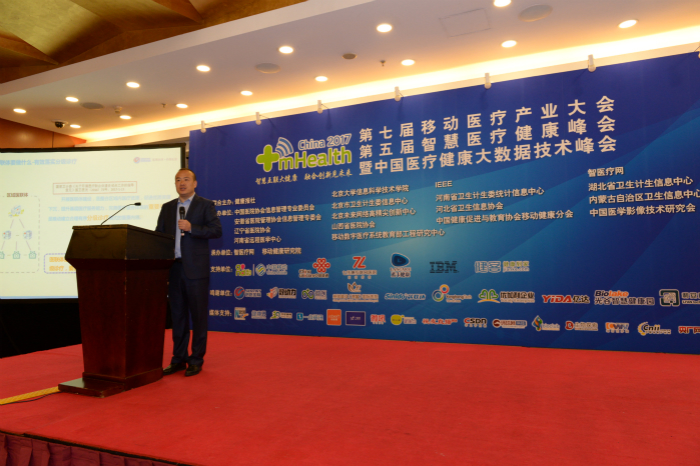
Vice President of Winhealth International, Liu Peng, Shared the Company’s Service System in His Speech
Tiered diagnosis and treatment is a national policy that is being vigorously promoted. From a policy perspective, the document having the greatest impact on tiered diagnosis and treatment is “Document No. 70,” which has caused significant repercussions in the healthcare sector.
On April 28, VCBeat attended the “7th Mobile Health Industry Conference and the 5th Smart Healthcare Summit,” where it joined industry leaders in discussing how to effectively promote the development of a tiered diagnosis and treatment system. Key topics included family doctor contract services under the “three-professional collaborative management” model, chronic disease management within the tiered diagnosis and treatment framework, the separation of prescribing from dispensing, and the establishment of urban medical consortia. Given the intensity of China’s healthcare reforms this year, accelerating the development of primary healthcare and balancing the distribution of high-quality medical resources are imperative.
Document No. 45 Establishes the Six Key Tasks for Pilot Programs on Tiered Diagnosis and Treatment
On September 8, 2015, the General Office of the State Council officially issued the “Guiding Opinions on Advancing the Development of a Tiered Diagnosis and Treatment System” (Guo Ban Fa [2015] No. 70), emphasizing that the tiered diagnosis and treatment model should establish four key mechanisms: initial consultation at primary care institutions, two-way referrals, separate management of acute and chronic conditions, and coordination between upper- and lower-level medical institutions. The core objective is to improve the tiered diagnosis and treatment service system with a focus on strengthening primary care.
On May 12, 2016, the National Health and Family Planning Commission announced that the “Basic Standards for Medical Service Capabilities of County Hospitals” and the “Recommended Standards for Medical Service Capabilities of County Hospitals” (selected excerpts appended below), designed to facilitate tiered diagnosis and treatment, had been finalized. The documents provide detailed specifications regarding departmental structure, required competencies, and equipment configurations for county hospitals. In essence, they formally establish the basic and recommended standards for medical service capabilities at county hospitals.
In June 2016, seven departments, including the State Council’s Office of Healthcare Reform, jointly issued the “Guiding Opinions on Advancing Family Doctor Contract Services,” requiring the implementation of family doctor contract services in 200 pilot cities for comprehensive public hospital reform in 2016. Priority coverage was to be extended to the elderly, pregnant and postpartum women, children, persons with disabilities, as well as patients with chronic diseases such as hypertension, diabetes, and tuberculosis, and those with severe mental disorders.
Until the highly significant Document No. 45. In August 2016, the National Health and Family Planning Commission and the State Administration of Traditional Chinese Medicine issued the “Notice on Promoting Pilot Programs for Tiered Diagnosis and Treatment” (Guo Wei Yi Fa [2016] No. 45), designating four municipalities directly under the central government, including Beijing, and 266 prefecture-level cities, including Shijiazhuang in Hebei Province, as pilot cities to carry out tiered diagnosis and treatment pilot programs. The notice also outlined six key tasks for advancing the pilot implementation of tiered diagnosis and treatment.
The six key tasks are to further enhance primary care service capacity, promote family doctor contract services, explore the establishment of medical consortia, scientifically implement differentiated treatment for acute and chronic conditions, accelerate the informatization of healthcare, promote regional sharing of medical resources, strengthen inter-departmental coordination, and improve supporting policies. With this, tiered diagnosis and treatment has become the top priority of healthcare reform. Specific strategies have been outlined for its implementation, making the pathway clearer and outcomes more promising.
Xiamen Launches “Three-Professional Joint Management” Tiered Diagnosis and Treatment Model, with Family Doctors Beginning Home Visits
As one of the first pilot cities for public hospital reform in China, Xiamen pioneered a “three-provider co-management” service model involving specialist physicians from large hospitals, primary care general practitioners (family doctors), and health managers, thereby guiding high-quality medical resources to flow down to the grassroots level.
Simply put, the "Three-Provider Team" consists of one specialist from a tertiary hospital, one general practitioner from a community health service center, and one health manager. The specialist is responsible for diagnosis and formulating individualized treatment plans; the general practitioner is responsible for implementing and monitoring the patient’s treatment plan and referring patients with unstable conditions or poor control to the specialist; the health manager is responsible for daily management and follow-up, as well as providing behavioral interventions and health education.
“Three-Physician Co-Management” is a typical team-based service model. This team represents a “human resource combination” of medical professionals, distinct from the inter-institutional alliances seen in Medical Consortiums. It aligns more closely with core management elements, fostering greater trust among enrolled patients and enhancing the operational feasibility of fulfilling contractual agreements.
Through daily interactions and regular follow-ups, general practitioners and health managers have established accountable and continuous trust-based relationships with patients. Coupled with meticulous community referral arrangements, this has significantly improved the effectiveness of chronic disease management. This precise, continuous, and accountable management model has effectively alleviated the pressure on tertiary hospitals regarding follow-up visits for chronic diseases.
Zhang Junfeng, Deputy Director of the Tiered Diagnosis and Treatment Office of the Xiamen Municipal Health and Family Planning Commission, revealed to reporters that, in order to incentivize proactive participation, the government has prioritized key performance indicators—such as extended-hour services, the “three-specialist co-management” tiered diagnosis and treatment model, and family doctor contract signings—in its financial subsidies, assessments, and performance-based incentive mechanisms for primary care institutions, providing additional rewards based on improved performance.
For healthcare providers, who previously received fixed salaries, income has become more substantial due to performance-based incentives: signing up more patients and delivering high-quality care, combined with bi-monthly performance bonuses. For patients, enrolling with a family doctor enables them to obtain prescriptions at their doorstep, eliminating the need for frequent visits to large hospitals. Basic health services, such as blood pressure and blood glucose monitoring, can be conducted at home by visiting health managers. When referrals are necessary, patients can schedule appointments three days in advance for both general and specialist outpatient clinics at major hospitals in Xiamen through their family doctors.
It has been reported that since 2014, Xiamen City has adopted chronic diseases (hypertension and diabetes) as a starting point to implement contracted services under the “three-provider co-management” model. This initiative has redirected a total of 1.92 million patient visits for other common and frequently occurring conditions to primary care settings, effectively diverting patients from general outpatient departments in tertiary hospitals while simultaneously enhancing the diagnostic and treatment capabilities at the grassroots level. Although residents are free to seek care directly at Grade A tertiary hospitals, an increasing number are being drawn to the refined services offered by community health centers, voluntarily choosing to receive treatment at the primary care level.
Xinyi International Deepens Medical Consortium Development and Strengthens Primary Healthcare Infrastructure
The fundamental issue addressed by tiered diagnosis and treatment is the orderly distribution of medical resources. As a leading domestic builder, operator, and service provider of telemedicine solutions, XinYi International’s Vice President, Liu Peng, shared the company’s service system in his speech. He highlighted how establishing medical consortia facilitates coordinated planning and collaborative division of labor among healthcare institutions at all levels, thereby enhancing the diagnostic and therapeutic capabilities and operational efficiency of primary care facilities and ensuring rational patient triage.
The government’s initial intent in launching pilot programs for tiered diagnosis and treatment, as well as establishing “medical consortia,” was to link primary care hospitals with tertiary Grade A hospitals, thereby extending the latter’s medical expertise to primary healthcare institutions, facilitating the downward flow of high-quality resources, and ultimately enhancing the quality of care at the primary level.
In 2017, Heart Doctor International focused on the joint development of seven major specialties: stroke, cardiovascular, respiratory, oncology, ophthalmology, orthopedics, and rehabilitation, leveraging its resource advantages to promote in-depth specialty development. It provides a range of services including technical guidance, research collaboration, two-way referrals, personnel training, discipline construction, and resource sharing, thereby achieving multi-level support for grassroots institutions and helping to improve the diagnostic and treatment capabilities of clinical departments in primary healthcare facilities.
It is reported that Xinyi International has supported the establishment of more than 50 national-level teleconsultation centers. Its medical consortium remote collaboration system now covers over 4,000 hospitals across 31 provinces in China. The company has assisted Guizhou, Qinghai, and Henan provinces in building inter-provincial remote healthcare platforms. Leveraging its competitive advantages, Xinyi International pioneered the exploration of medical consortium development ahead of the market, contributing to the construction of more than 90 medical consortium projects in various forms.
It is evident that the Xinyi International service system facilitates four-party collaboration among tertiary hospitals, primary care institutions, physicians, and patients. This approach not only addresses the difficulty faced by grassroots populations in accessing medical resources but also provides support to primary care hospitals, thereby enhancing their overall medical capabilities and promoting the equitable distribution of healthcare resources.
Tailored to regional needs, Winning Health has successfully helped hospitals establish regional medical consortia, specialty/clinical specialty medical consortia, and integrated medical-educational-research consortia. These initiatives aim to integrate business operations, data, and information channels among tertiary Grade A hospitals, secondary hospitals, and primary community health service centers within the region. By effectively connecting hospitals at different levels, the system enables the goals of “managing minor illnesses within the community” and “treating major illnesses within the local district,” allowing patients to quickly access homogeneous, high-quality medical services from large hospitals without the need for long-distance travel.
Additionally, to effectively retain patients for initial consultations at primary care facilities and address longstanding challenges such as difficulty in securing appointments, brief consultation times, and the need to seek medical care across multiple institutions, Xinyi has launched a remote outpatient service featuring a “specialist from higher-level hospitals + primary care physician + patient” model. Whether for complex and refractory conditions or chronic disease management, primary care hospitals can quickly schedule remote consultations with specialists through the platform, thereby sparing patients the burden of long-distance travel for medical care.
Regarding the more challenging issues in current telemedicine, Liu Peng pointed out that remote training for primary care physicians is a key concern. Xinyi International has already begun leveraging its platform’s technological advantages to conduct multi-dimensional remote education and training, providing professional development opportunities for primary care physicians. Furthermore, the implementation of remote consultations will effectively connect primary care physicians with top-tier experts in first-tier cities, enabling them to receive professional guidance and thereby continuously improving the diagnostic and treatment capabilities of primary healthcare institutions.