

Frequency Therapeutics Files for IPO with Breakthrough Non-Surgical, Non-Device Therapy for Hearing Loss
Hearing loss is not uncommon in daily life; you may need to speak close to your grandparents’ ears and raise your voice to communicate with them. In older adults, aside from factors related to chronic diseases, hearing loss is more likely due to aging, which damages approximately 15,000 hair cells in each ear—a process akin to the aging of other cells in the body.
Hearing loss is not merely a consequence of aging; it is increasingly prevalent among young people. Individuals who are chronically exposed to high-decibel noise due to occupational requirements, such as those working in heavy construction sites or undergoing military training, are highly susceptible to hearing decline. Whether on the subway or in the library, young people frequently use headphones to listen to music or make phone calls. Excessive headphone use or excessively high volume can lead to the death of sensory hair cells in the inner ear. Unfortunately, these cells do not regenerate naturally, and their loss is considered an irreversible process.
According to the latest data from the U.S. Centers for Disease Control and Prevention (CDC), approximately one-quarter of adults in the United States have varying degrees of hearing loss, mostly mild, resulting in an average annual productivity loss of $56 billion. The World Health Organization (WHO) also reports that 1.1 billion people worldwide are at risk of hearing damage due to recreational noise exposure.
Hidden Dangers of Hearing Loss Are Everywhere
Faced with such irreversible cellular loss, people were once helpless and could only rely on external devices such as hearing aids for assistance. However, small-molecule drug technology developed by the U.S. medical startup Frequency Therapeutics now offers a solution to this challenge.
According to VCBeat, Frequency Therapeutics was founded in 2015 and is currently headquartered in Woburn, Massachusetts. The company’s current President and CEO is David Lucchino, one of its co-founders.
Frequency Therapeutics is dedicated to developing small-molecule drugs that activate progenitor cells in the body to restore tissue health. By transiently activating progenitor cells with its drug candidates, Frequency avoids the complexities associated with genetic engineering.
Their lead program currently focuses on the regeneration of inner ear sensory hair cells for the treatment of chronic noise-induced hearing loss. Frequency Therapeutics has built its technology platform based on the breakthrough Progenitor Cell Activation (PCA™) technology developed by Dr. Jeff Karp of Harvard University and Bob Langer of MIT.
Through this technology platform, its patented small-molecule drug combination can induce quiescent inner ear progenitor cells to re-enter the cell cycle and proliferate, thereby generating new inner ear hair cells. This approach of localized drug delivery to facilitate tissue regeneration holds profound therapeutic potential. The company’s underlying scientific rationale has been extensively published, and it was recently featured on the cover of the February 2017 issue of Cell Reports. Furthermore, the company has secured exclusive intellectual property licenses from MIT and Partners Healthcare.
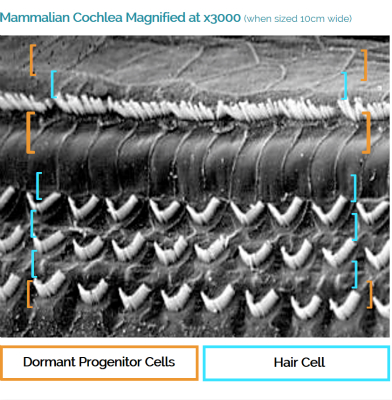
3000x Micrograph of Quiescent Progenitor Cells and Sensory Hair Cells
Over 48 million Americans face hearing impairment yet lack access to medical care, creating a massive potential market worth $20 billion.
Collaborative Efforts by Industry Leaders
In addition to President David, the other three co-founders are Dr. Jeff Karp, Dr. Chris Loose, and Dr. Will Mclean. All four co-founders are seasoned veterans in the healthcare industry, underscoring the formidable pedigree of Frequency Therapeutics.
David Lucchino, the current President, holds an MBA from the MIT Sloan School of Management. As an entrepreneur with over 20 years of experience, he has achieved significant success in launching ventures within life sciences and other innovative sectors. Frequency Therapeutics is not his first MIT-affiliated startup; previously, he founded Semprus BioSciences, which successfully obtained FDA approval and was acquired at a substantial valuation just five years after its inception.
Semprus aims to develop an innovative platform technology to reduce complications associated with artificial implants, a business plan that won the $100,000 prize at the MIT Entrepreneurship Competition. Before being acquired by Teleflex in 2012, Semprus had completed several rounds of substantial financing. Additionally, LaunchCyte, an investment firm focused on the commercialization of intellectual property in the biomedical sector, is another entrepreneurial venture founded by David.
In addition to his extensive entrepreneurial experience, David is also a leading figure in corporate management. He previously served as President and CEO of Entrega Bio, a company dedicated to developing innovative capsule technologies designed to enable the oral administration of injectable drugs. Currently, he serves as Vice Chair of the Board of Directors at MassBio, Chair of the Audit Committee at Mt. Auburn Hospital (affiliated with Harvard Medical School), and a Director of the Multiple Myeloma Research Foundation.
Dr. Chris Loose, the current Chief Technology Officer of Frequency Therapeutics, and David are long-time partners; together, they co-founded Semprus BioSciences. A graduate of MIT’s Department of Chemical Engineering, Dr. Loose is a quintessential technical expert. Prior to co-founding Semprus with David, he served as a chemical engineer at Merck Research Laboratories. In 2011, he was awarded the inaugural Peter Strauss Prize for Entrepreneurship by the Deshpande Center for Technological Innovation at MIT. Additionally, he was named one of the “40 Under 40” technology leaders by Boston Business Journal.
As the current Vice President, Dr. Will McLean has established a significant strategic position at Frequency Therapeutics and substantially supported the company’s technological development, leveraging his expertise in stem cell biology, audition, and neuroscience. During his doctoral studies at MIT, Dr. McLean elucidated the distinct types of stem cells present in the inner ear. His research on hearing has been published in numerous prestigious journals.
Dr. Jeff Karp, a current member of the Scientific Advisory Committee, serves as the company’s technological cornerstone. He concurrently holds the positions of Associate Professor at Brigham and Women’s Hospital, Harvard Medical School, and Principal Faculty Member at the Harvard Stem Cell Institute. Several of his technologies have already formed the foundation for commercialized products. As a world-leading expert in drug delivery and stem cell therapy, he has enabled Frequency Therapeutics to fully leverage its potential through the Progenitor Cell Activation (PCA™) technology platform.
Inspired by Nature
“Can we achieve a cure for diseases through small-molecule drugs?” This question, once raised by Robert Langer of MIT and Dr. Jeff Karp of Harvard University, serves as the foundational premise behind Frequency Therapeutics’ technology. In addressing this challenge, they have focused on regenerative biology, meticulously screening small-molecule drugs and leveraging targeted pathways to enable cells and tissues to heal directly within the body.
In nature, researchers have discovered that certain species, such as birds and reptiles, can regenerate specific cells and tissues on their own. Some amphibians can regenerate limbs, and birds can spontaneously recover from damage to sensory hair cells in the inner ear—regenerative capacities that are rarely observed in humans and other mammals.
However, God has not completely closed the door to regeneration in mammals. Progenitor cells with the potential to differentiate into hair cells exist in the mammalian inner ear, but their regenerative capacity is typically dormant.
Given the known potential for cellular regeneration, company co-founders such as Dr. Jeff Karp embarked on research into regenerative regions of the human body to identify similar molecular pathways. For instance, the epithelial cells in our gastrointestinal tract regenerate every five days, and a subset of epithelial stem cells is marked by a specific receptor called Lgr5. Lgr5 is part of the Wnt signaling pathway and plays a critical role in the differentiation process of certain stem cells.
It has been demonstrated that these special progenitor cells marked by Lgr5 are actually present in the human inner ear, eyes, skin, and pancreas. However, due to certain specific reasons, these progenitor cells only play a regenerative role in the gastrointestinal tract and do not differentiate in other regions. Through the relentless efforts of Langer, Karp, and other team members, they finally succeeded in activating Lgr5+ progenitor cells in a laboratory setting, achieving their division and differentiation using a combination of small-molecule drugs. This significant discovery laid the foundation for the establishment of Frequency Therapeutics.
Technical Core: Progenitor Cell Activation (PCA™)
Progenitor cells can differentiate into various types of tissue cells; however, unlike typical stem cells, progenitor cells are more mature and specialized. As mentioned above, whether progenitor cells can differentiate into specific target cells depends on their location within the body. Most progenitor cells spontaneously divide and differentiate only under specific conditions or during certain stages of human development, such as embryonic development.
Unlike some methods that forcibly convert Lgr5+ progenitor cells into specific cell types, Frequency Therapeutics applies naturally existing pathways to the human body. By using small-molecule drugs to mimic signals from cells adjacent to the progenitor cell niche, this approach activates progenitor cells. This precise and controllable method closely resembles the natural regeneration processes of human skin and intestinal tissues. This proprietary approach is known as the Progenitor Cell Activation (PCA™) platform.
Dr. Jeff Karp stated, “All we need to do is promote the proliferation of these cells, and the endogenous signaling cascades already present in the human body will drive a subset of progenitor cells to differentiate into hair cells.”
Frequency stated that PCA technology holds significant potential to pioneer a novel approach to disease treatment, particularly in the context of widespread degeneration of human progenitor cells. To accelerate drug development, Frequency is currently leveraging its PCA screening platform, utilizing primary human cell samples—including cochlear progenitor cells and adult gastrointestinal progenitor cells. The company has now achieved the ability to generate unlimited quantities of progenitor cells in vitro, enabling the screening of more than 10 distinct targets throughout the body.
Treating hearing impairment is merely Frequency’s starting point. The company believes that PCA technology has vast potential for application, with therapeutic promise in areas such as dermatology, muscle repair, and gastrointestinal disorders. They are now actively working to translate this potential into real-world technologies, by intensifying internal R&D efforts while also pursuing strategic alliances.
Advantages: Simple and direct, addressing both symptoms and root causes
Frequency Therapeutics’ treatment for hearing impairment requires only the topical application of a small-molecule drug combination, thereby avoiding the invasiveness of surgery and the complexities associated with gene therapy or CRISPR.
The Frequency treatment process takes approximately three minutes. It employs a clinically validated injection method to deliver small-molecule drugs encapsulated in a sustained-release hydrogel into the inner ear. This intratympanic injection technique has been widely used in otolaryngology surgeries for high-dose steroid administration.
Unlike many external assistive devices such as hearing aids, PCA technology directly stimulates the division and differentiation of progenitor cells to generate new inner ear sensory hair cells, fundamentally improving patients’ hearing. Enabling the regeneration of human hearing is undoubtedly a major breakthrough in medical history.
Series A Funding Completed
VCBeat learned that on April 11, Frequency Therapeutics announced the completion of its Series A financing round, raising a total of $32 million. The round was led by CoBro Ventures, with participation from other U.S. and international investors, including Morningside Ventures, Immersion Capital, Korea Investment Partners, and Alexandria Real Estate Equities, Inc.
Marc Cohen, co-founder of CoBro Ventures, stated in January: “The vision of Dr. Bob Langer and Dr. Jeff Karp is to repair tissues using small-molecule drugs, achieving effects comparable to gene therapy and CRISPR. We believe this approach is more straightforward and better suited for widespread adoption.” Marc Cohen, who also serves as Chairman of the Board at Frequency Therapeutics, expressed strong confidence in their technology: “Our data are highly compelling, and we look forward to advancing them into clinical applications within the next 12–18 months.” The latest round of financing will help Frequency Therapeutics further develop and launch novel regenerative medicine therapies.