

Liuzhou Launches China's First Hospital-to-Retail E-Prescription Service Powered by Tencent's WeChat
Prescriptions Issued by Hospitals, Medications Purchased Outside: This Patient-Friendly Medical Service Has Been Implemented in Liuzhou!
Recently, with the support of Tencent’s “Internet Plus” technology, Liuzhou Workers’ Hospital became the first in China to launch an “Outpatient Prescription Circulation” service, covering eight pharmacies under the Liuzhou Pharmaceutical Group. Henceforth, patients can freely choose to pick up their medications either within the hospital or at designated off-site pharmacies after consultation. This initiative not only facilitates medical consultations and medication purchases for residents of Liuzhou but also accelerates the rapid development of Liuzhou Workers’ Hospital’s Internet Hospital.

Signing Ceremony of the “Strategic Cooperation Framework Agreement for the Internet Medical Service Platform Project of Liuzhou Workers’ Hospital”
This is the first implemented project following the signing of the Strategic Cooperation Framework Agreement on the Liuzhou Workers’ Hospital Internet Medical Service Platform Project by Liuzhou Workers’ Hospital, Liuzhou Pharmaceutical Co., Ltd., and Tencent at the 2017 China “Internet+” Digital Economy Summit. It also represents the first benchmark case of “out-of-hospital prescription circulation” services in China, holding significant importance for the rapid development of “Internet Hospitals.”
Long waiting times for registration, payment, and medication pickup have long been a major pain point for patients. With the launch of the “Out-of-Hospital Prescription Circulation” service, which leverages “Internet+” technology and is integrated into the WeChat official account of Liuzhou Workers’ Hospital, patients in Liuzhou can now receive electronic prescriptions issued by their physicians directly through the account after their consultations. They can then proceed to designated retail pharmacies to scan the code and purchase their medications. This initiative provides patients with more options and further reduces the time spent waiting in line within the hospital.
It is worth noting that the “out-of-hospital prescription circulation” service has been designed with comprehensive safety considerations.On one hand, the "out-of-hospital prescription circulation" service directly connects to hospital and pharmacy systems, enabling comprehensive traceability of all valid prescription information and preventing the use of counterfeit paper prescriptions. On the other hand, in terms of timeliness, electronic prescriptions issued by Workers' Hospital are valid for only 24 hours, with the prescribing time visible and immutable, thereby preventing unauthorized medication dispensing through the misuse of expired or fraudulently used prescriptions.
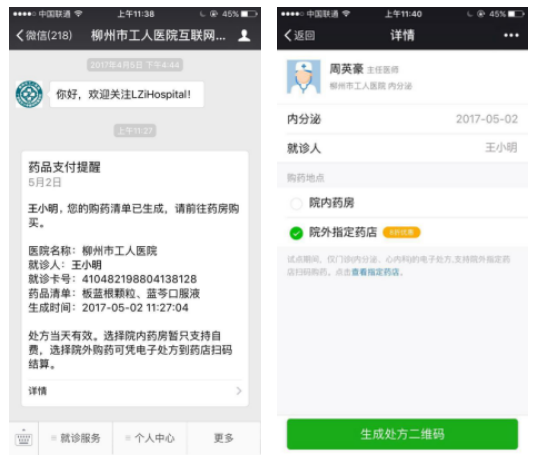
Liuzhou Patients Can Receive Electronic Prescriptions Issued by Doctors via the Official WeChat Account After Consultation
The implementation of the “out-of-hospital prescription circulation” service not only facilitates patients in obtaining medications and seeking medical care, but also further advances the national policy of “separating pharmaceuticals from medical services.” As early as 2015, the General Office of the State Council issued the Guiding Opinions of the General Office of the State Council on Pilot Comprehensive Reform of Urban Public Hospitals, requiring all public hospitals in pilot cities to promote the separation of pharmaceuticals from medical services and abolish drug markups.
Subsequently, the State Council and the National Development and Reform Commission (NDRC) successively encouraged medical institutions to extend prescriptions outside hospitals, requiring them to issue prescriptions using generic drug names and proactively provide these prescriptions to patients, thereby safeguarding patients’ right to choose where to purchase their medications. At the closing of the National Health and Family Planning Work Conference on January 6, 2017, Li Bin, Director of the National Health and Family Planning Commission, stated that reforms of public hospitals would be rolled out across all cities in China that year, with all markups on drugs eliminated to ensure a smooth transition from the old to the new operational mechanisms.
Nowadays, by leveraging “Internet+” technologies, the healthcare reform policy of “separating pharmaceuticals from medical services” is being effectively implemented, truly addressing the difficulties and high costs patients face in accessing medical care.
"Outpatient Prescription Circulation" to purchasing medications outside the hospital is merely one of the many services offered by "Internet Hospitals."Liuzhou Workers’ Hospital Internet Hospital has also launched multiple internet-based medical services, including digitization of patient cards, WeChat-based appointment registration, online scheduling for laboratory and imaging tests, and e-prescriptions.。
In addition, services such as WeChat medical insurance payment, “light consultations” (online consultations), online prescriptions, and medication delivery will be rolled out and made widely available in phases. Leveraging WeChat’s real-name authentication and payment capabilities, efforts will be made to establish a closed-loop payment system covering the entire patient journey, from appointment scheduling and registration to consultation and hospitalization.
Currently, the “outpatient prescription circulation” service at Liuzhou Workers’ Hospital in Guangxi is the first of its kind in China. With the deepening implementation of healthcare reforms and the advanced integration of “Internet + Healthcare,” this service is expected to be rolled out nationwide in the future, comprehensively addressing the challenges of difficult and costly access to medical care and enhancing patients’ healthcare experience.