

TmiRob Secures RMB 40 Million Series A Funding to Advance Clinical Research of Specialized Service Robots

TMI Robotics
Developer of Intelligent Service Robots
VCBeat learned that on May 3, TMiRob announced the completion of its RMB 40 million Series A financing round.This round of investment was led by IDG Capital, with participation from Goke Jiahe, Ecovacs, and Chuangtu Fund.
Pan Jing, founder of TMiRob, told VCBeat,Following this round of financing, TMiRob will continue to deepen the clinical research of its specialized robots. By aligning with specific healthcare needs, the company will deploy its products across a wide range of medical scenarios—from surgical procedures to rehabilitation care, and from ward services to cold-chain logistics. This expansion aims to enhance hospital service capabilities, improve management efficiency, reduce healthcare costs, and mitigate occupational hazards for medical staff., reduce redundant labor, improve patients' healthcare experience, save medical costs, and achieve precision treatment.
TMiRob is dedicated to integrating its technology with various healthcare scenarios, serving patients, physicians, hospitals, and other stakeholders in the medical industry.
In addition to its own technological advantages, which are also a key point of interest for investors, Qian Dongqi, Chairman of Ecovacs Robotics Co., Ltd., an investor in this round of financing, stated: “Identifying genuine needs within application scenarios and solving practical problems are the key directions for service robotics companies to consider and explore. TMiRob’s endeavors in the medical services sector have enabled robots to play a role in hospital service systems, gradually achieving the goals of saving labor and replacing humans in performing specific tasks unsuitable for human workers.“We also believe that founder Pan Jing and his team, with their expertise in integrated robotics technologies and ability to translate them into commercial applications, will enable TMiRob to deeply penetrate and expand within hospital service scenarios.”
Universal Robot Chassis
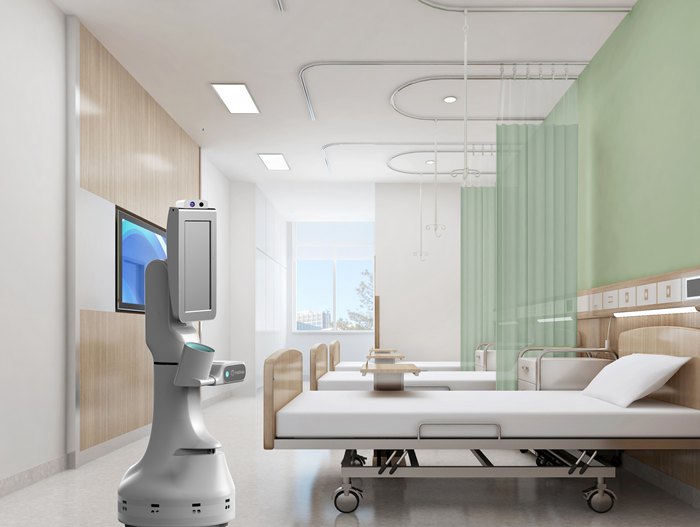
TMiRob is able to serve most healthcare scenarios thanks to its universal robotic chassis technology.
The greatest advantage of TMiRob’s specialized medical service robots lies in their universal robotic chassis technology. This universal chassis is a series of autonomous, omnidirectional mobile research platforms featuring advanced configurations, simple programming, and ease of learning and use. The platform boasts a simple and intuitive structure, is portable, adopts a modular design for easy customization and expansion, and supports the Robot Operating System (ROS), a robotic software platform that provides operating system-like functionalities for heterogeneous computer clusters.It is China's first ROS-based medical service robot platform.. Additionally, the robot is equipped with various novel sensors to assist physicians in promptly collecting patients' physiological data.
The robot can be optionally equipped with various sensors and accessories, including infrared, ultrasound, LiDAR, voice modules, Kinect, RealSense, cameras, and tablet displays, thereby facilitating functions such as autonomous navigation, autonomous obstacle avoidance, SLAM, human-computer interaction, and wireless video/image transmission.
In addition to its technological advantages, TMiRob has also achieved rapid development.TMiRob was established in 2015. In 2016, it secured tens of millions of RMB in angel funding from Guoke Jiahe and Chuangtu Fund. In October 2016, two of its robots entered clinical trials at Wuhan Union Hospital. On May 3 this year, the company raised RMB 40 million, a remarkably rapid pace for the robotics sector.。
For more information about TMiRob, please click (Shanghai TMiRob Secures Nearly RMB 10 Million in Angel Funding; Specialized Medical Service Robot Expected to Debut in Late October)